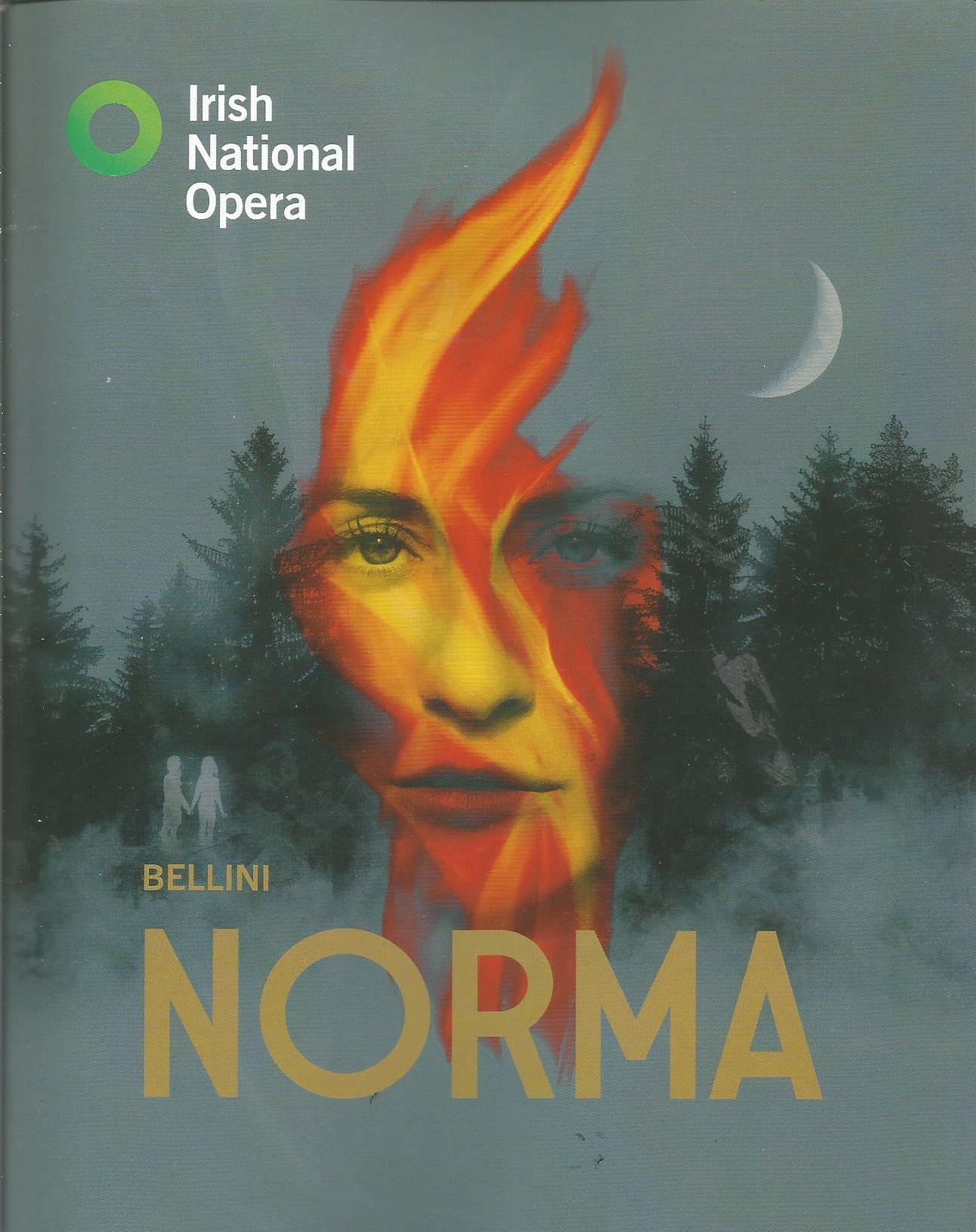
I had seen the by Vincenzo Bellini‘s opera Norma twice (before yesterday evening) but both times were before I starting blogging so I was very pleased to see that Irish National Opera were doing a new production this year. It had a run at the Gaiety Theatre in Dublin, but I took the chance to see it National Opera House in Wexford. The first time I went there was last year and was to see a very different opera, although that one and Norma are both generally categorized by the term bel canto. I was so excited by the prospect of seeing this production that I made myself a Bellini on Saturday, only to discover that the cocktail is named after a different Bellini…
Norma is not performed all that often, largely because it is difficult to find a singer capable of doing justice to the title role which is acknowledged as being one of the most vocally demanding roles in all opera. It is a role that the great Maria Callas made her own in the 1950s which places the additional burden on the the singer of stepping out of the shadow of such a legend. I was delighted that in Salome Jicia INO found an artist who could meet the challenges of the part. She was stunning.
I think the part of Norma is difficult not only because of the vocal range of the part, from the lyrical beauty of the famous aria Casta Diva to the agility needed to perform the coloratura passages, but also for the sheer stamina required. There really is a lot of singing for her to do in this opera! Jicia took it in her stride. Bellini rarely gets the orchestra to double the vocal line, so the voice of the singer is very exposed. At times it’s like watching acrobatics knowing that there’s no safety net!
Anyway, to the plot.
Norma is a tragedia lirica in two Acts, set in ancient Gaul which is under occupation by the Romans. The eponymous Norma is the high priestess of the native Druids. She is also a complex chartacter, not least because she is in a relationship with a high-ranking Roman, Pollione, with whom she has had two kids. It turns out that Pollione is tiring of Norma and has turned his attention to her friend Adalgisa, who does not know about Pollione’s involvement with Norma.
The Opera begins with the heavily armed Gauls, led by Norma’s father Oroveso, planning to rise up against the Roman occupiers. But only Norma can sanction an armed rebellion and she says no. The aria Casta Diva expresses Norma’s desire for peace, but this is not just because she feels the Romans have greater military strength and would crush the rising, but because of her thing with Pollione. Over the course of the Opera we find out about Pollione’s infatuation with Adalgisa and their planned elopement to Rome which sends Norma into such a rage she threatens to kill her own children. Eventually Norma decides to change her mind about the uprising and calls for it to go ahead. Protocol requires a human sacrifice to initiate such a move, so the question is who is for the chop? Will it be Pollione, or Adalgisa? Norma surprises the assembled Gauls by confessing her sacreligious relationship with Pollione and declaring herself to be the sacrifice. Pollione is overcome by remorse at what he has done, and decides to join Norma in death.
Well, what did you expect in an Opera, a happy ending?
This production eschews the Normal (geddit?) setting of forest groves and scared shrines and places it in a sort of modern post-apocalyptic dystopia. The stage is dominated by barricades apparently hastily constructed from broken furniture and scrap metal. Lighting is sombre and claustrophobic. This jars with Bellini’s music when it evokes pastoral beauty – the music is too light and pretty for such a gloomy setting.
Gone are the swords, spears and druidic robes and in come AK-47s, pistols and somewhat scruffy modern-looking outfits. Even Norma’s dress is nothing fancy. The Gauls look like a ramshackle but heavily armed paramilitary group and are indistinguishable in costume from the Romans, except that the latter have special haircuts – mohawks died bright red on top. I found this a bit confusing and felt that it negated the theme of “occupiers versus occupied” which runs throughout the piece. This choice is probably intended to show the struggle as one between two rival groups in a polarized community. In the hands of the chorus the guns create a very menacing backgroup to several scenes, and of course the ending ends not by ritual burning, as in the original, but by firing squad.
The musical pyrotechnics do pose challenges for the staging, however, because an opera is not just a concert. It doesn’t work as music drama if the singers are just standing there belting out tunes. They also need to employ gestures and facial expressions to match the emotions expressed by the score and it can’t be too static. In this production the set is rather simple, and when I first saw it I assumed that it would be moved around a lot to create different locations, but that was only done to a limited extent. To compensate for the inflexible scenery, the chorus often provides a moving backdrop to the action. In the hands of the chorus the proliferation of guns create a very menacing backgroup to several scenes, and of course the ending ends not by ritual burning, as in the original, but by firing squad. The chorus was used very imaginatively, I’d say, not only to make up the numbers on stage, but also in their singing. I liked the idea of the chorus being split for some passages, leading one’s attention around the stage as the different groups gave voice.
I already mentioned Salome Jicia, but the other principals were also very good. Mario Chang (tenor) was a fine Pollione, William Guanbo Su a towering Oroveso with a rich bass and Siobhan Stagge as Adalgisa sang and acted beautifully. Despite some reservations about the staging, I thought this was a hugely enjoyable performance. Bellini has his critics, but I think the last part of Act II, the principals and chorus singing their hearts out to wonderful music, as the drama moves inexorably to its tragic conclusion, is one of the most intensely moving experiences in the entire operatic repertoire.
P.S. If you have 20 minutes to spare, listen to the Act II finale as performed by Callas here.