Archive for Jean Sibelius

Shostakovich 50 at the National Concert Hall

Posted in Uncategorized with tags , , , , , , , , on May 10, 2025 by telescoper

Last night’s concert at the National Concert Hall in Dublin was billed Shostakovich 50 because 2025 marks the 50th anniversity of the death in 1975 of Dmitri Shostakovich, whose First Symphony was performed after the interval, by the National Symphony Orchestra under the direction of guest conductor John Storgårds. As you can see, though, the programme was quite varied and no fewer than three other composers were represented.

The first piece was The Oceanides, tone poem by Jean Sibelius intended to evoke the sea nymphs of Greek mythology. It’s quite a short piece – only eleven minutes in performance – but full of movement, suggesting the ebb-and-flow of the sea and its different moods, from tranquil to stormy. Its place on the programme made it a good workout for the orchestra and a wonderful starter to whet their appetite of the audience for the rest of the menu.

After that appetizer we had a performance of the Rhapsody on a Theme by Paganini by Sergei Rachmaninov with soloist Yukine Kuroki at the piano. This piece comprises a set of 24 variations on a them from one of Paganini’s caprices for solo violin. The Rhapsody on a theme of Paganini is piece full of contrasts: sometimes pyrotechnical, sometimes lyrical. My favourite section is the 18th variation, in which a lovely romantic melody emerges and is picked up by the whole orchestra in a manner that’s very characteristic of Rachmaninov. This tune is just an inversion of the theme transposed into a different  key and slowed down.

The Rachmaninov alone was worth the cost of the ticket. I was amazed how pianist Yukine Kuroki coped with the technical challenges of this work but also how she managed to generate so much power for a person of such slight build. Rachmaninov himself was quite a large man who had hands like shovels, so his work often places difficult demands on a soloist. Not last night, though, as Yukine Kuroki not only played with great accomplishment but also clearly enjoyed herself. In the passages during which the piano was not playing she was bouncing up and down and tapping her feet waiting for her cue. It was lovely to watch as well as to listen to. I’ll also mention that she was wearing a gorgeous one-shoulder dress with a vivid red colour.

After the wine break interval we returned for a piece that was new to me, the Symphony No. 3 ‘White Interment’ by Ukrainian composer Victoria Vita Polyova. This is described a symphony, but it doesn’t have the traditional structure in terms of movements. It has instead a rather static structure, consisting of thematic blocks based on a poem Now always snows. It’s a sombre and rather minimalist piece, with little of the development you would expect from a true symphony, but the sound world it creates is layered in interesting ways. I enjoyed the performance.

And finally we have the Symphony No. 1 by Dmitri Shostakovich which I don’t think I had heard in concert before. The most astonishing thing about this work was that he wrote it as a graduation piece for the St Petersburg Conservatory. Its first performance was in 1926, when the composer was only 19. It is a substanial work over four movements (the last two played without interruption) and there are passages within it in which you can see that he had already found much of the distinct voice that he used in his later compositions. This piece isn’t really reminiscent of any other composers, either.

The performance was excellent, with particularly strong work by the woodwinds and brass. It was very well received by the NCH audience which is always very generous with its applause.
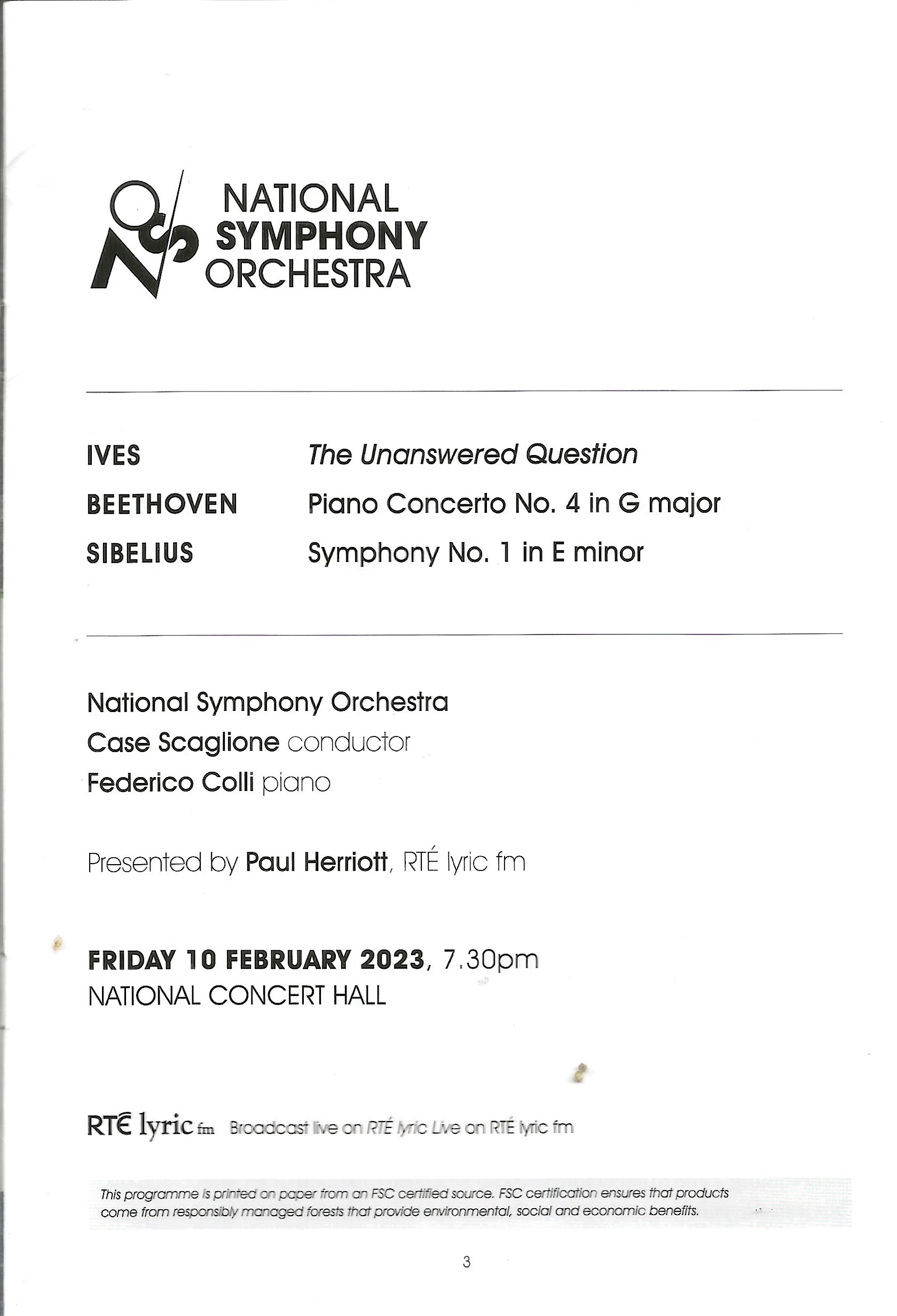

Ives, Beethoven and Sibelius at the National Concert Hall

Posted in Biographical, Music with tags , , , , , , , on February 11, 2023 by telescoper

Last night’s concert by the National Symphony Orchestra at the National Concert Hall in Dublin was one that I’d been looking forward to for a long time. It didn’t disappoint! Congratulations to the National Symphony for yet another excellent concert, this time under the direction of guest conductor Case Scaglione.

The first half of the programme consisted of The Unanswered Question by Charles Ives and Beethoven’s Piano Concerto No. 4 with soloist Federico Colli. That’s an interesting juxtaposition, made even more interesting by the Beethoven piece was played directly after the Ives without a break for applause. I wondered what was up when Case Scaglione walked on stage with Federico Colli who took his seat at the piano at the start of the concert. There is no piano part in The Unanswered Question, so Colli sat quietly until the end of that piece and then went straight into the opening piano statement of the Beethoven. I wasn’t expecting this before the performance but it worked very well. The only problem is that I didn’t get the chance to applaud at the end of The Unanswered Question.

The Unanswered Question is one of my favourite works by Charles Ives (along with Three Places in New England), a composer whom I admire greatly. I wrote a piece about him some years ago, actually.  The Unanswered Question, was completed in 1908 (although it was revised later) and is subtitled “A Cosmic Landscape”. It’s a sort of meditation on the philosophical problem of existence. It comprises three different voices: muted strings playing notes from a G-Major triad (a rather “churchy” key, giving the flavour of a simple hymn). Then, played (in this performance) from the balcony behind the conductor, a solo trumpet poses the Question: a five note figure that is repeated with almost imperceptible variations several times during the work. The reply to the Question comes from the woodwinds, whose dissonant response is at first plaintive but then increasingly agitated and frustrated. Then the Question comes again without an answer, but the strings carry on quietly in G Major until everything goes quiet.

The Piano Concerto No. 4 by Ludwig van Beethoven is in G Major, so there is a continuity between the two pieces in terms of tonality, although of course the musical language is very different. It was composed in 1805/6, a hundred years before the Ives. It’s an audacious piece right from the start as it opens with unaccompanied piano. The second movement is a kind of dialogue between the orchestra and the piano, which at times sounds more like an argument as the orchestra makes a series of rather harsh statements with somewhat conciliatory responses from the piano. The last movement is a more conventional and jovial Rondo, by which time the solo trumpeter from the Ives piece had found her way back to the stage from the balcony. I’ve heard this movement several times played on its own on the radio.

Federico Colli cut a dashing figure in a grey suit and waistcoat with a high collar and a voluminous white cravat. He was well up to the demands of the piece, playing very expressively, tenderly at times and with virtuosic brilliance when called for.

After the wine break we returned for the majestic Symphony No. 1 by Jean Sibelius. This is one of the great symphonies and another favourite of mine – I have several different recordings of it and have heard it on the radio many times – but I had never heard it performed live in person before last night. The First Movement (initially Andante) opens with a theme played by solo clarinet. It then moves into allegro energico which was played very briskly in this performance (in contrast to some famous recordings which slow it down). The motif played by the clarinet at the start permeates the whole work, returning in different guises and endowing the composition with a strong sense of unity. It’s all shot through with great romantic tunes and has wonderful dynamics. In short, it’s a masterpiece. Not bad for a First Symphony!

Finlandia!

Posted in History, Music with tags , , , , on December 6, 2017 by telescoper

Today marks the 100th anniversary of Finland’s Declaration of Independence from Russia, which took place on 6th December 1917.

To celebrate the occasion here is  Finlandia by Jean Sibelius from this year’s Proms, performed by the BBC Singers, BBC Symphony Chorus and the BBC Symphony Orchestra, under the direction of Finnish conductor Sakari Oramo.

Happy Independence Day to Finns everywhere, and especially to my friends and colleagues in the world of physics and astronomy!

Sibelius of the Rings

Posted in Film, Music with tags , , , , , on May 13, 2014 by telescoper

My frame of mind for the day is largely determined by what is playing on BBC Radio 3 when it switches on at 6am as it does every morning to wake me up. This morning it happened to be the rousing Intermezzo from the Karelia Suite by Jean Sibelius. An intermezzo is very often a piece of fairly nondescript music played while people change the sets on stage during an opera or theatre performance, but this one is actually a terrific piece in its own right.

Often when the radio switches on when I’m asleep I don’t actually wake up immediately, but somehow seem to be able to incorporate the music into a dream. As I slowly emergedfrom my slumbers this morning my half-asleep mind somehow put this music together with a sort of action replay of the Ride of the Rohirrim, as Theoden’s army arrives to relieve the siege of Minas Tirith from The Lord of the Rings; the preamble fits well with the riders and horses gathering into line and preparing for battle, and the main theme conjures up the subsequent cavalry charge in rousing fashion.

My lunchtime task today has therefore been to find a clip of the film on Youtube and see how the music works. I suggest you turn the sound off the film clip (first youtube link) and let it run until about 58s in before starting the second which has the actual music on it. That way the peak of the crescendo and loud cymbal crash in Sibelius’ score coincides with the impact of the charge upon the orc formation.