Archive for John Wiley & Sons

The Big Four and Your Work

Posted in Open Access with tags , , , , on September 10, 2024 by telescoper

In Agatha Christie’s novel The Big Four (left) the great detective Hercule Poirot tries to identify the members of sinister group of unscrupulous individuals bent on world domination.

When it comes to the world of academic publishing, the members of the The Big Four are somewhat easier to identify, though no less unscrupulous. They are Elsevier, Spring-Nature, Taylor & Francis, and John Wiley & Sons who have cornered almost 50% of the lucrative market in scholarly books and journals and the eye-watering profits that go with that territory.

Recently, however, these companies have found a new way of boosting their profits still further. This involves selling their “content” to tech companies in order to train the generative AI algorithms known as Large Language Models. The latest to do this is Wiley, which has already cashed in to the tune of $44 million. Wiley has not given its authors the right to opt out of this deal nor will authors be remunerated. Others outside the Big Four are also cashing in. Oxford University Press, for example, which publishes Monthly Notices of the Royal Astronomical Society, has done similar deals.

This sort of arrangement provides yet another reason to avoid the commercial publishing sector. Do we become academic researchers in order to be mere “content creators” for Wiley and the rest?
Academic Publishing: Never Mind the Quality…

Posted in Open Access with tags , , , , , , , , on March 16, 2024 by telescoper

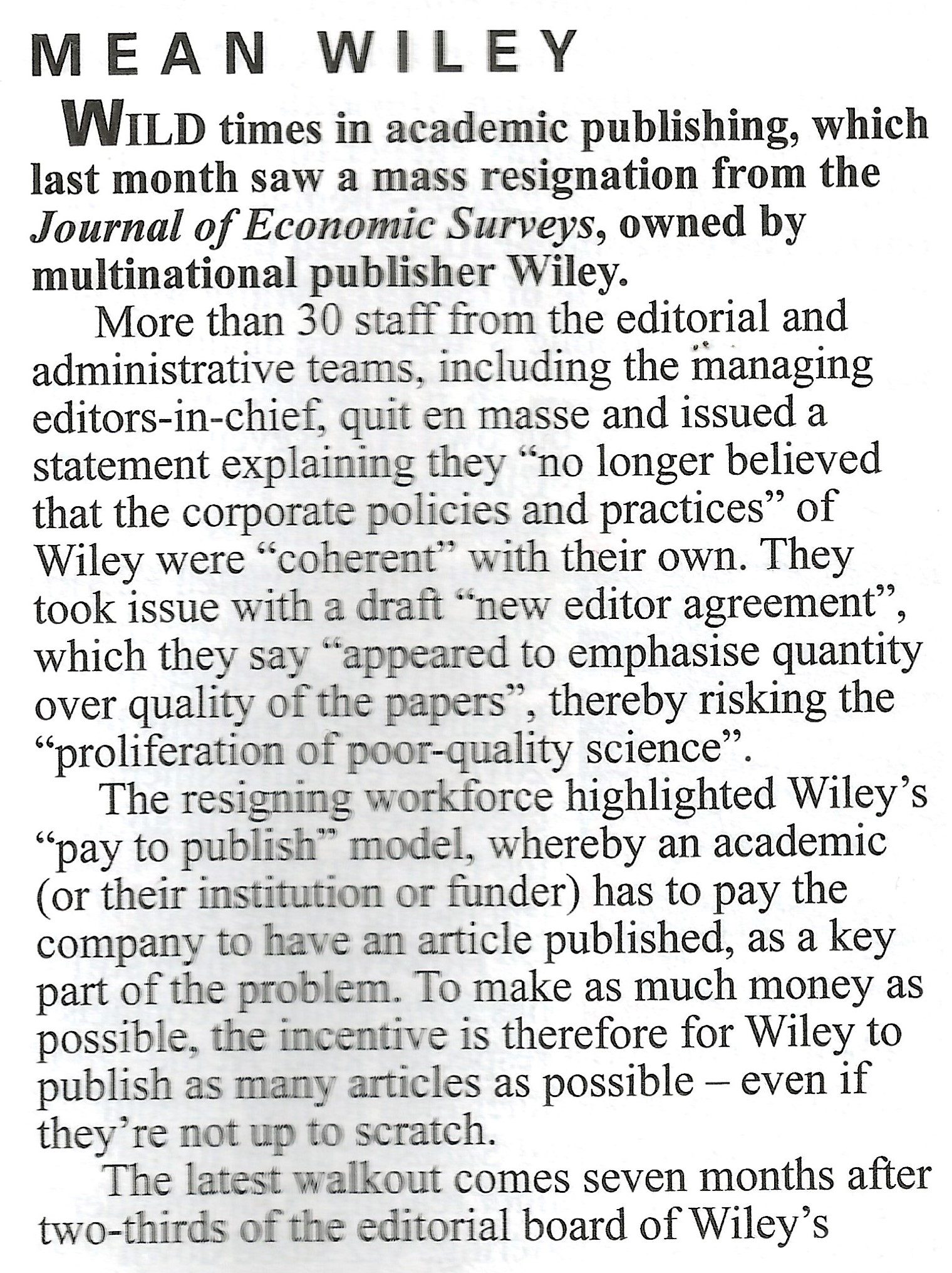
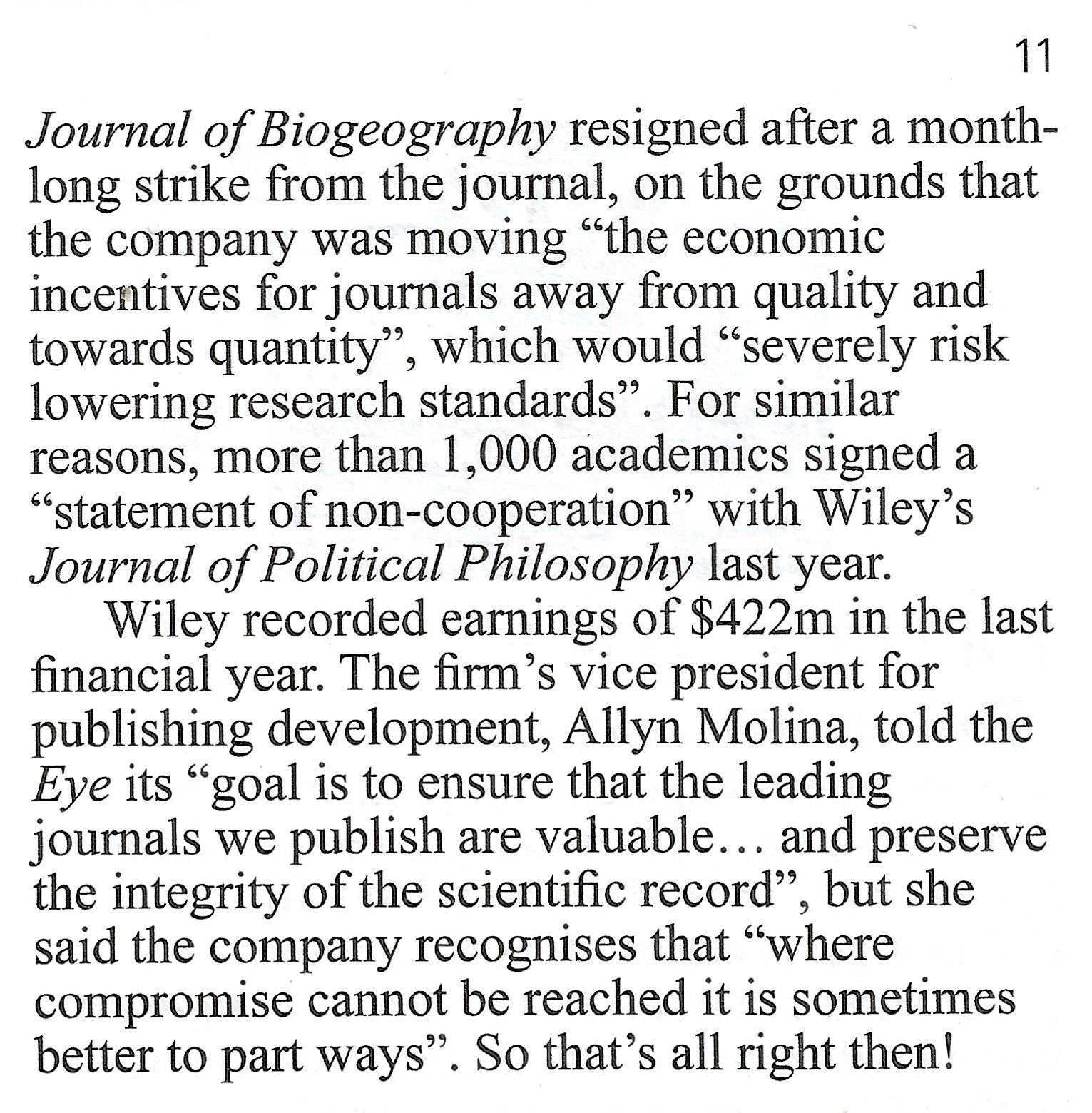
I was interested to see that the latest issue of Private Eye contains a short item about academic publishing:

I’ve heard many stories of this type, with publishers putting pressure on their Editorial Boards to allow more papers to be published. This is undoubtedly motivated by the Gold Open Access model in which authors or their institutions are forced to pay thousands of dollars upfront to publish papers. Since the publisher makes an eye-watering profit on every article, why not publish as many as possible? The recent decision by the Royal Astronomical Society adopt this model is highly likely to have a similar effect there, as its journals will be able to increase revenue at the expense of quality. Under the older subscription-based system, publishers could sell their product to libraries on the basis of quality but they no longer need to do that to make a profit.

The academic publishing industry is perverse enough without adding this obvious incentive to lower editorial standards. There are far too many low quality papers being published already, a situation driven not only by the profiteering of the publishing industry but also by the absurd policies of academia itself which require researchers to churn out huge numbers of papers to get promotion, win research grants, etc.

This part of the academic system is definitely broken. To fix it, academic publishing must be taken out of the hands of commercial publishers and put into the care of research institutions whose libraries are perfectly capable of publishing and curating articles on a non-profit basis. But that won’t be enough: we need also to overhaul how we do research assessment. The principles outlined in the San Francisco Declaration on Research Assessment would be a start.

The Price of Jackson

Posted in The Universe and Stuff with tags , , , , on May 25, 2016 by telescoper

The chance conjunction on this blog of a post about the death of Professor  J.D. Jackson with another about the greed of academic publishers caught the attention of one Ian Jackson (son of the aforementioned Professor) and prompted him to forward me some correspondence between his father and the publisher of the famous textbook, Classical Electrodynamics (published by John Wiley & Sons).

I won’t copy it all here, but here is an excerpt:

The Letter of Agreement of 1996 stipulates that Wiley should not increase the net price more than 5% in any two year period with the author’s permission. A month or so ago I found out from the physics Editor that the US net price was $87, a big jump from the last number I knew. By knowing that the list price is closely 1.3 times the net, I could look at my records of the single copy list price on Wiley’s web site to find that they had increased the price by 5% at least once and probably twice beyond what was permitted by our agreement. I wrote a strong letter, citing chapter and verse about their obvious violation.

John David Jackson was obviously a generous man: the royalties for this book were divided among his four children (including my correspondent Ian). He goes on to add in a letter to all four of them, after the publishers agreed to reduce the list price:

Sorry to be keeping your royalties in check, but I was thinking of the poor students who are paying 1.3 x $82 = $106.60.

They do keep the book for the rest of their lives, so perhaps it is an OK investment.

I don’t remember how much I paid for my copy, but I don’t begrudge the amount because it’s an excellent book. You should always remember, however, that the author of a textbook typically only gets a small percentage (usually~10% ) of the net receipts.

The correspondence sent by Ian includes this hand-drawn graph by the late Professor Jackson:

Jackson_price

It seems Professor Jackson shared my (low) opinion of academic publishers!

For the record, my textbook on Cosmology (co-authored with Francesco Lucchin) was also published by Wiley. A representative of the publisher explained to me that their pricing strategy involved trying to keep the revenue constant in time, so that as sales went down the price went up. My book is now very much out of date so I can understand why the sales have fallen off, but I find it hard to believe that the same is true of an enduring classic. Professor Jackson seems to have agreed; he described Wiley’s pricing strategy as “gouging”…