Archive for Jupiter

The Radio and Microwave Sky from Juno

Posted in The Universe and Stuff with tags , , , , , , , on May 16, 2024 by telescoper

I found out about an interesting paper by Anderson et al. at a discussion group this morning. The abstract reads:

We present six nearly full-sky maps made from data taken by radiometers on the Juno satellite during its 5-year flight to Jupiter. The maps represent integrated emission over ∼4% passbands spaced approximately in octaves between 600 MHz and 21.9 GHz. Long time-scale offset drifts are removed in all bands, and, for the two lowest frequency bands, gain drifts are also removed from the maps via a self-calibration algorithm similar to the NPIPE pipeline used by the Planck collaboration. We show that, after this solution is applied, residual noise in the maps is consistent with thermal radiometer noise. We verify our map solutions with several consistency tests and end-to-end simulations. We also estimate the level of pixelization noise and polarization leakage via simulations.

arXiv:2405.08388

For those of you unaware about Juno, it is a NASA space mission (launched in 2011) intended to study the planet Jupiter (which it is still doing). On the way there, however, this spacecraft made continuous measurements of the radiation field around it, at radio and microwave frequencies. The work described by Anderson et al. involved turning these observations into maps at a range of frequency; they also studied the polarization properties of the radiation.

The full maps and other relevant data can be downloaded here. Here are some pretty pictures (the grey bits represent the parts of the sky that were not covered; radio emission from our own Galaxy is the most obvious component at low frequencies, but it looks more complicated at higher frequencies).

It’s always fun when data sets are used for something so different from the purpose originally intended, and what has come out of this analysis are rather nice maps of the emission from the Milky Way. These might turn out to be useful for many things, such as foreground removal for extragalactic surveys or studies of our own Galaxy.
The Great Conjunction

Posted in The Universe and Stuff with tags , , on December 22, 2020 by telescoper

I thought I’d follow the precedent set by many of my fellow astrologists by posting this exciting image of the Great Conjunction of Jupiter and Saturn.

cloudy-night-sky842504659097248730.jpg

It’s hard to believe that it’s been over four hundred years since anyone has seen a sight like this: two planets so close together in the sky that they can both be completely hidden by the same piece of cloud!

Chaotic Clouds on Jupiter

Posted in The Universe and Stuff with tags , , on June 23, 2018 by telescoper

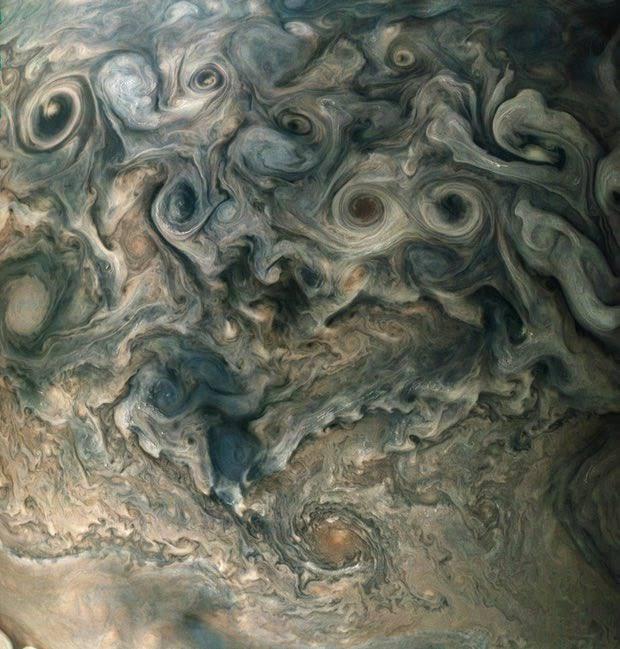
I’ve been too busy today with Open Day business to do a proper post so I thought I’d just share this marvellous image from NASA’s Juno Mission.

The picture is like an extraordinary work

of abstract art, but it’s scientifically fascinating too:

The region seen here is somewhat chaotic and turbulent, given the various swirling cloud formations. In general, the darker cloud material is deeper in Jupiter’s atmosphere, while bright cloud material is high. The bright clouds are most likely ammonia or ammonia and water, mixed with a sprinkling of unknown chemical ingredients.

The Art of Jupiter

Posted in Art, The Universe and Stuff with tags , on May 25, 2017 by telescoper

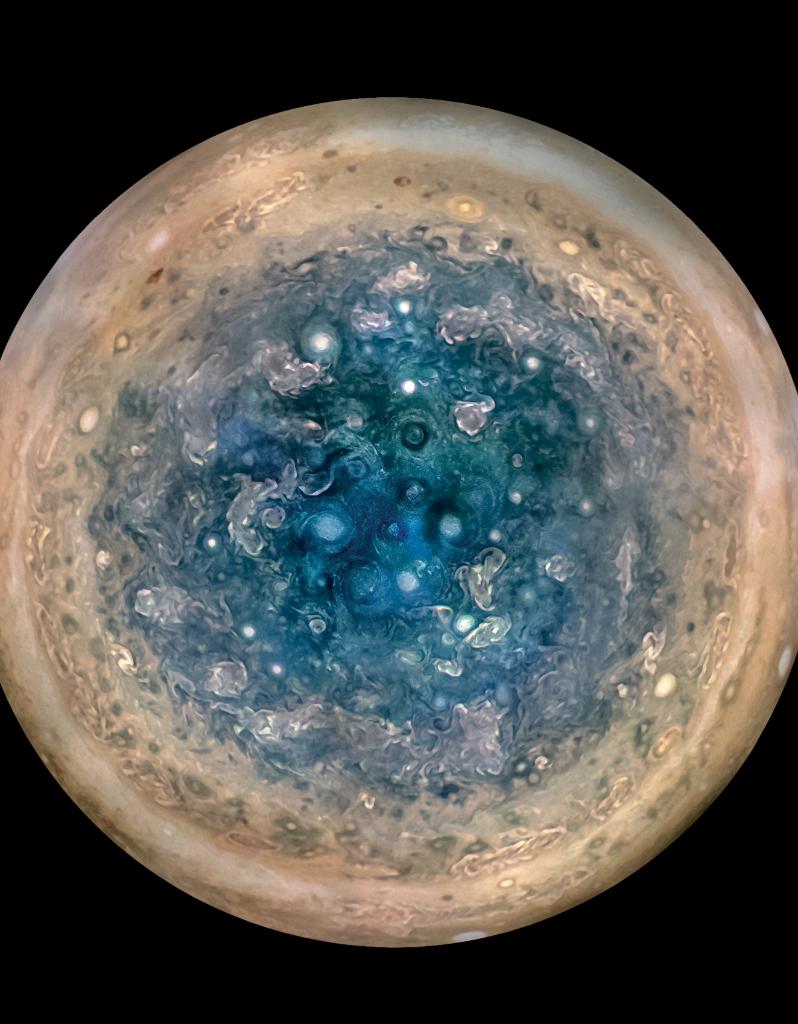
This amazing closeup image is of the North polar region of Jupiter. It was taken by NASA’s Juno spacecraft. Here’s a wider view:


I think it will take scientists quite some time to figure out what is going on in all those complex vortex structures!

In the meantime, though, I think these picture and the others that have been released can be enjoyed as a work of art! As a matter of fact reminds me of van Gogh’s Starry Night...

The Possible Plumes of Europa

Posted in The Universe and Stuff with tags , , , , , , , on September 27, 2016 by telescoper

I was too busy yesterday to write a post about the latest hot news from the NASA Hubble Space Telescope, so here’s a quick catch-up.

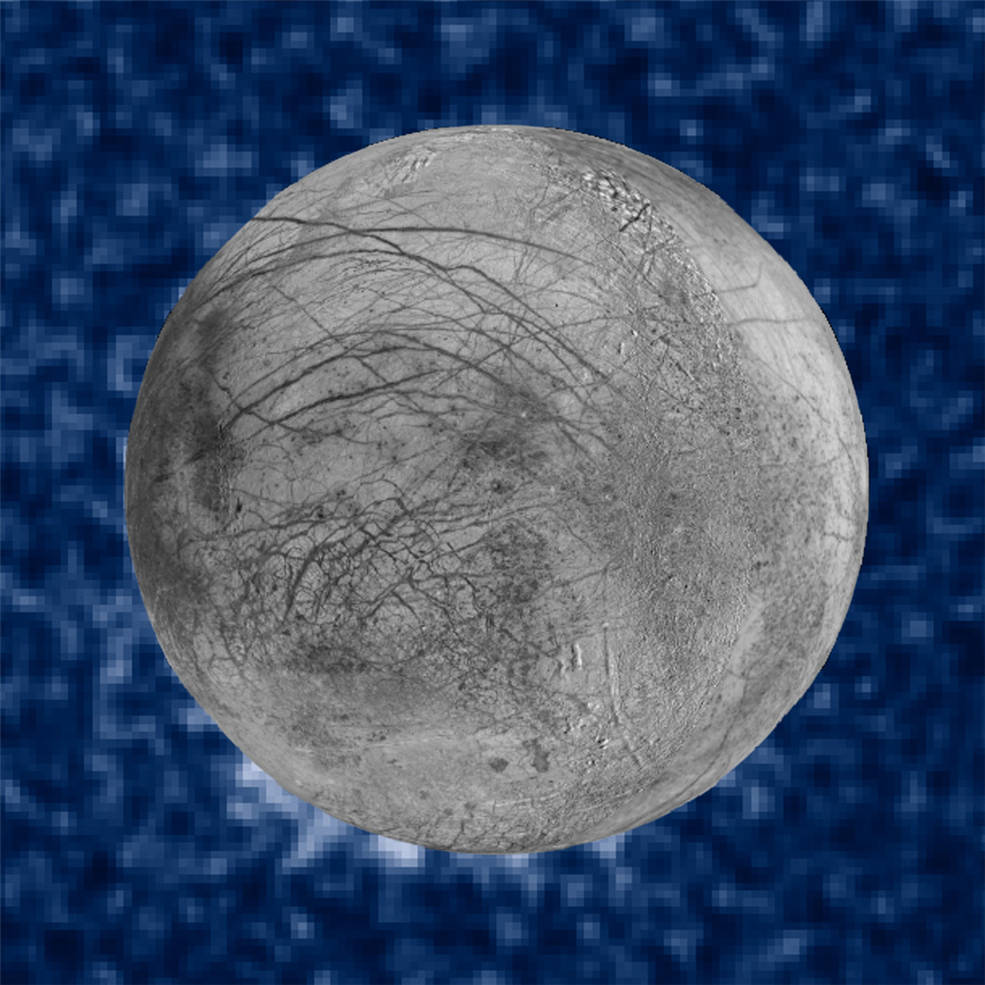
It seems that Europa, the smallest of the four Galilean moons of Jupiter, may from time to time be releasing “plumes” of water vapour. It has long been speculated that there might be large quantities of liquid water under Europa’s extremely smooth icy crust. Here’s a picture of possible plumes (to the bottom left of the image) in which a high-resolution picture of the surface of Europa has been superimposed.

europa

Picture Credits: NASA/ESA/W. Sparks (STScI)/USGS Astrogeology Science Center

There’s also short video explaining the possible discovery here.

It’s not obvious at first sight that features like that shown above are caused by water erupting through Europa’s surface. On the face of it they could, for example, be caused by the impact of a smaller body. However,  long-term observations of this phenomenon suggest out-gassing is much more likely.  The Hubble Space Telescope’s Imaging Spectrograph was used to study what are essentially Aurorae powered by Jupiter’s strong magnetic field in which the presence of excited states of hydrogen and oxygen provide evidence for the disintegration of water molecules through interaction with electrons in this highly energetic environment. The images were taken when Europa was in front of Jupiter so they are seen were seen in silhouette.

There is also evidence that these appearance of these plumes is periodic, and that they are more likely to occur when Europa is further from Jupiter than when it is closer. A plausible theory is that water is released from cracks in Europa’s surface which open and close owing to a combination of tidal gravitational and magnetic effects.

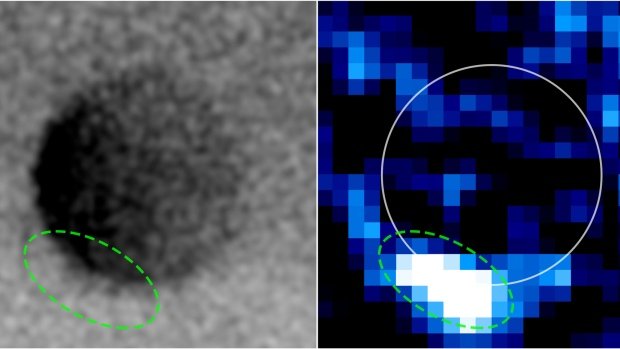
I wouldn’t say this was definite proof of the water interpretation. These observations push the capability of the Hubble Space Telescope to the limit because the features are so faint. For information here’s what the raw image looks like (left)  and with enhanced contrast (right):

raw_image


Verification of these results through independent means is clearly an important priority, though likely to prove challenging. The plume interpretation is possible, but whether it is yet probable I couldn’t say!


Bad News for Astrophysics from ESA

Posted in Science Politics, The Universe and Stuff with tags , , , , , , , , on April 18, 2012 by telescoper

Just a quick post to pass on the news (which I got from Steinn Sigurdsson’s blog) that the ESA Executive (see correction in comments below) Space Science Advisory Committee (SSAC) of the European Space Agency (ESA) has made a recommendation as to the next large mission to be flown. The short list consisted of a mission to Jupiter’s moons (JUICE), an X-ray observatory (ATHENA), and a gravitational wave observatory (NGO). The last two of these are severely de-scoped versions of missions (IXO and LISA respectively) that had to be re-designed in the aftermath of decisions made in the US decadal review not to get involved in them.

Not unexpectedly, the winner is JUICE. Barring a rejection of this recommendation by the ESA Science Programme Committee (SPC) this will be the next big thing for ESA space science.

The School of Physics and Astronomy at Cardiff University has a considerable involvement in gravitational wave physics, so the decision is disappointing for us but not entirely surprising. It’s not such a big blow either, as we are mainly involved in ground-based searches such as LIGO.

The biggest local worry will be for the sizeable community of X-ray astronomers in the UK. With no big new facilities likely for well over a decade one wonders how the expertise in this area can be sustained into the future, even if LOFT is selected as one of the next medium-sized missions. Or, given that STFC funding is already spread extremely thin, perhaps this is time for the UK to organize a strategic withdrawal from X-ray astronomy?