Archive for JWST

The Earliest Galaxy we’ve seen?

Posted in Astrohype, The Universe and Stuff with tags , , , on July 20, 2022 by telescoper

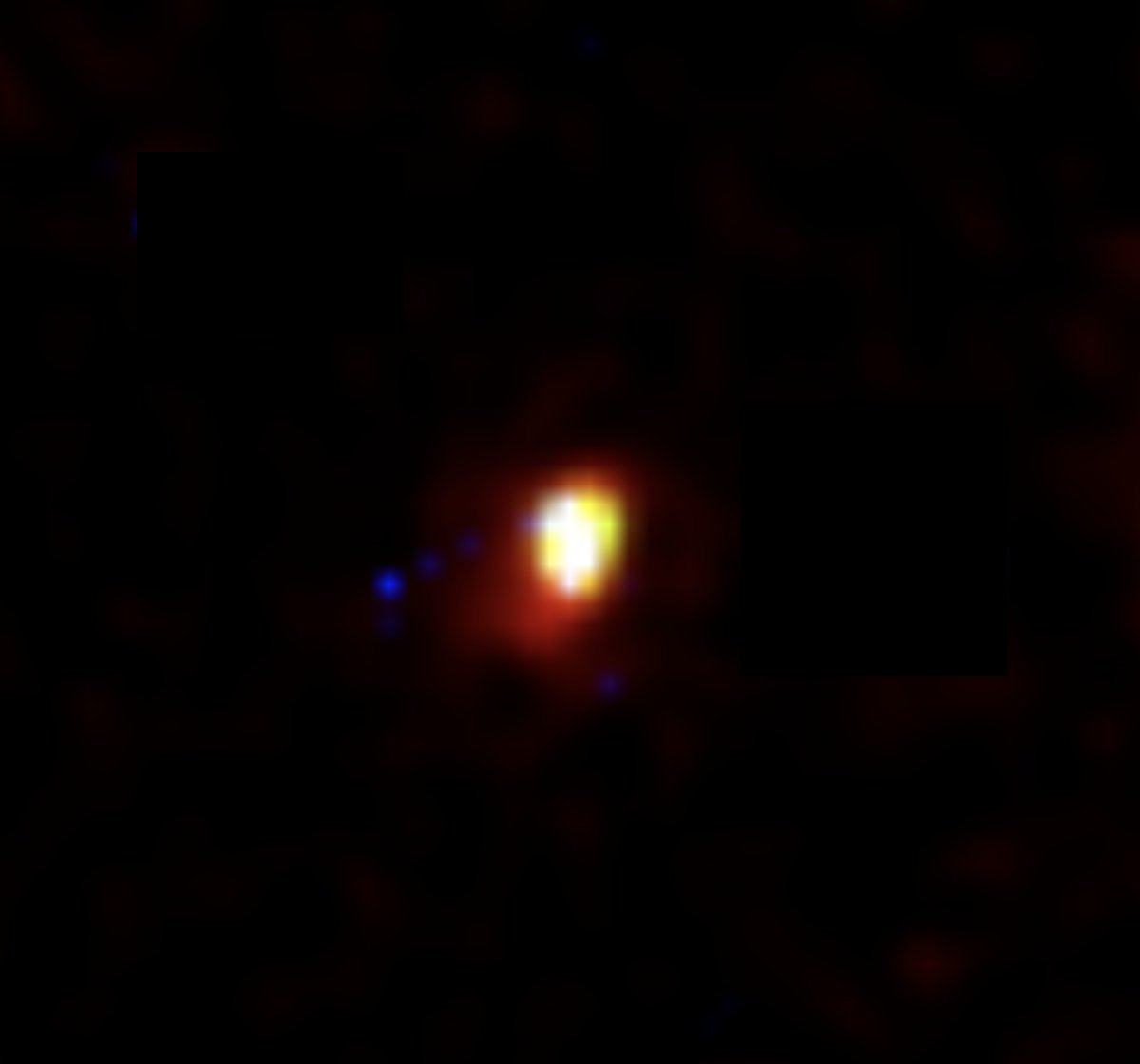
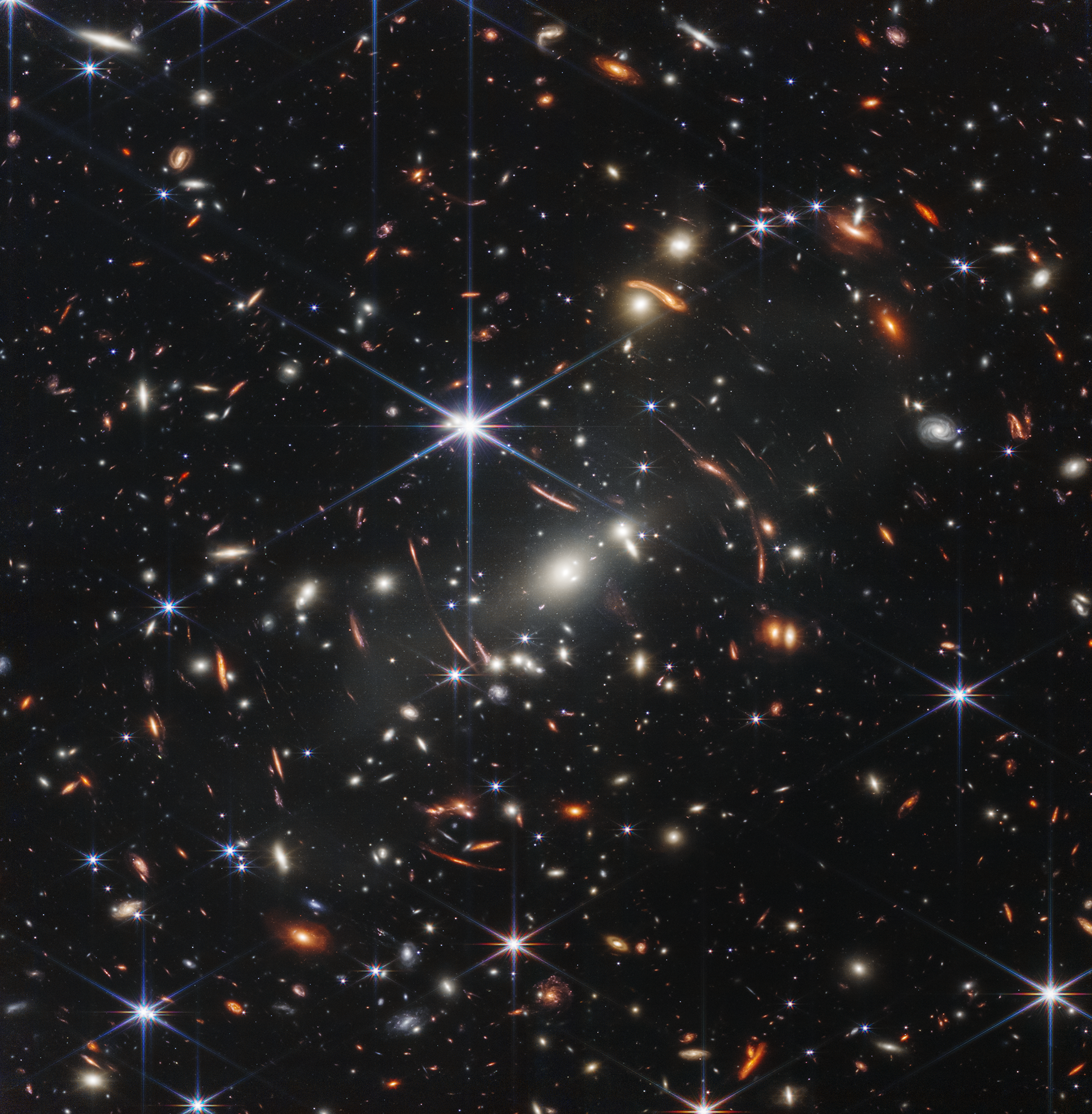
The red smudge in the centre of this image is thought to be a galaxy with a redshift of around z=13, as seen by the NIRCam instrument on the James Webb Space Telescope. This redshift estimate is based on photometry so the object remains a candidate rather than a confirmed high-redshift galaxy, but if confirmed spectroscopically this would be the highest-redshift galaxy yet observed.

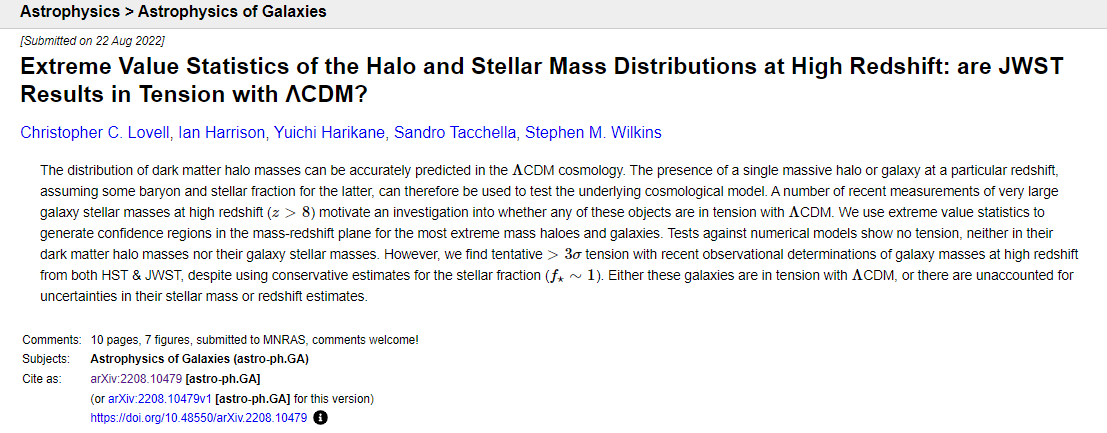
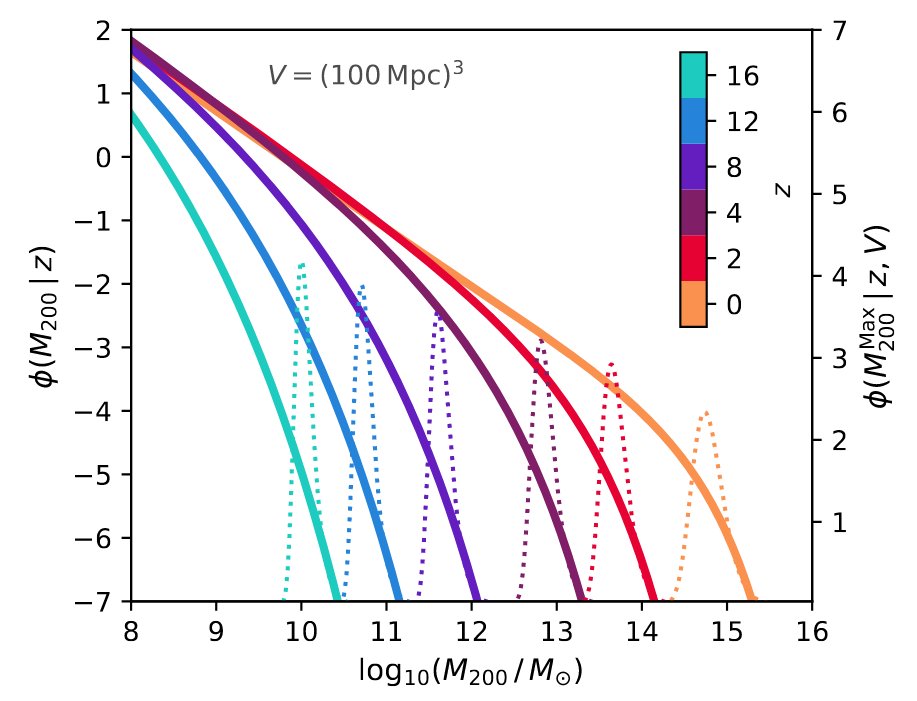
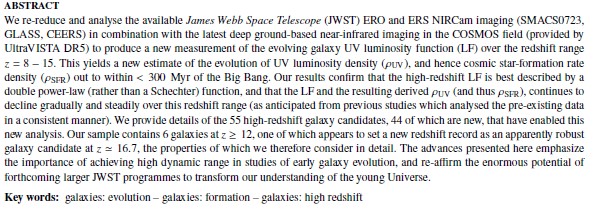
For more details on the observations and their implications see the preprint on arXiv here. It’s interesting (and challenging) that there are such bright galaxies at such an early stage of cosmic evolution, assuming of course that the redshift is correct. Photometric redshift estimates have been wrong before.

If we take the estimated redshift at face value and adopt the standard cosmological model, the lookback time to this galaxy (GLASS-z13) is about 97.6% of the current age of the Universe so we’re seeing it as it was just 330 million years after the Big Bang. It could therefore be the earliest galaxy we have seen. It isn’t very accurate to say that it is the oldest galaxy we’ve seen, as we are probably seeing it as it was when it was very young.

These observations come from JWST Early Science Release Programmes so are just a taster of what is to come. No doubt we’ll hear much more about high-redshift galaxies from JWST in future and there’s every chance that they will change our view of the high-redshift Universe in dramatic ways.

I’ll just mention here that I’m old enough to remember going to conferences where “high redshift” meant z=0.5! In those days the highest redshift objects were quasars, but they have long since been overtaken.

Characterization of JWST science performance from commissioning

Posted in The Universe and Stuff with tags , , , on July 14, 2022 by telescoper

I don’t suppose it will take very long for science papers based on the first data from JWST to start appearing on arXiv but I haven’t seen any yet. There is however a very important with an uncountable number of authors, led by Jane Rigby, that describes the commissioning process. Uncountable by me, that is.

Here is the abstract:

This document characterizes the actual science performance of the James Webb Space Telescope (JWST), as known on 12 July 2022. Following six months of commissioning to prepare JWST for science operations, the observatory is now fully capable of achieving the discoveries for which it was built. A key part of commissioning activities was characterizing the on-orbit performance of the observatory. Here we summarize how the performance of the spacecraft, telescope, science instruments, and ground system differ from pre-launch expectations. Almost across the board, the science performance of JWST is better than expected. In most cases, JWST will go deeper faster than expected. The telescope and instrument suite have demonstrated the sensitivity, stability, image quality, and spectral range that are necessary to transform our understanding of the cosmos through observations spanning from near-earth asteroids to the most distant galaxies.

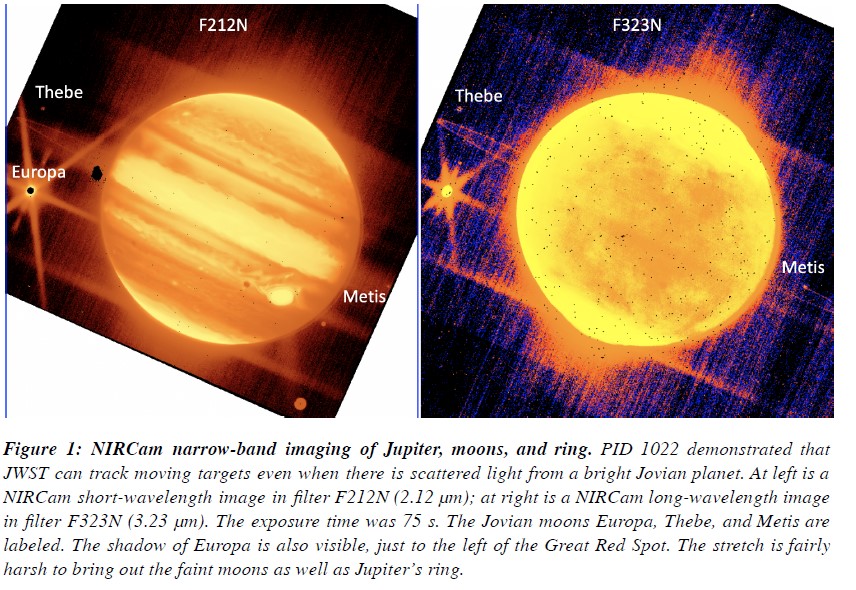
Although it’s very long (60 pages) it’s well worth reading for an account of how meticulously the various calibrations etc were done. Various objects make cameo appearances, including Jupiter:

Those First Results from JWST

Posted in The Universe and Stuff with tags , , , , , on July 12, 2022 by telescoper

As promised in my post earlier today, we gathered in a small lecture theatre in Maynooth to watch the “reveal” of various new images and other data from the James Webb Space Telescope. The images are indeed wonderful and spectacular, but the video stream was excruciatingly bad to watch, with more technical glitches than I’ve had hot dinners. It was like an astronomical version of Acorn Antiques!

Anyway, you can find them all the new results together with explanations and descriptions here so Ill just put up a gallery here:

Those are the four results released today. This image was previewed last night and appeared in my post earlier today:

I couldn’t resist, however, adding this spectrum of a faint reddish galaxy in the above image:

This spectrum is taken using the NIRSpec instrument on JWST. The observed wavelength along the horizontal axis is measured in microns. If I’ve got the line identifications correct I think this galaxy is at an amazing redshift of about z=8.5. Amazing. High redshift galaxy spectra obtained are usually a lot rattier than this. I think this demonstrates that JWST is going to revolutionize the field of galaxy formation.

Merry JWSTmas!

Posted in The Universe and Stuff with tags , , , , on December 25, 2021 by telescoper

Well it’s 10.20am on Christmas Day and I’ve got up specially early in order to be ready for the launch at 12.20pm today (Irish Time) of the James Webb Space Telescope from Kourou in French Guiana. The JWST project has been almost thirty years in the making and it is great that it is finally going to be heading into space. The launch however is just the start – JWST has a very complicated journey in front of it – as demonstrated by the following little video.

In particular, JWST should separate from the Ariane 5 launcher at about 27 minutes after takeoff so look out for that.

I have no direct personal involvement with JWST but I am still feeling a bit nervous. I can’t imagine how it must feel to have spent decades working on it. I know a great many astronomers around the world who are waiting anxiously and hoping all goes well. Fingers crossed!

If you want to watch the launch live you can do so on Youtube here:

You can find alternative viewing options here.

The launch window opens at 12.20 UTC and lasts for 31 minutes but I understand they’re going to launch as early as possible within that so it looks like we’re in for a launch before lunch rather than the other way round.

I’ll update with any news as the day goes on.

UPDATE: 12.28pm Launched right on time, everything nominal as JWST leaves Earth’s atmosphere propelled by Stage One of the Ariane 5.

UPDATE: 12.31pm Stage One jettisoned, Stage 2 ignition. All still nominal.

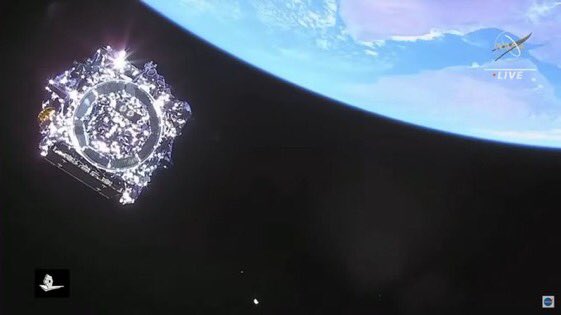
UPDATE: 12.48pm JWST has separated from the launch vehicle and is on its way. The solar panel is deployed and is working. The spectacular onboard video showing the separation of JWST from the Ariane 5 launch vehicle and the deployment of the solar panels was supplied by Irish company Réaltra.

P.S. I still think JWST should have had a different name.

Top Ten JWST Facts!

Posted in The Universe and Stuff with tags , , on December 4, 2021 by telescoper

The James Webb Space Telescope looks nothing like the Hubble Space Telescope shown here.

As excitement mounts ahead of the launch of the James Webb Space Telescope (JWST) later this month I thought I would, as a service to the community, for the edification of the public at large, and despite popular demand, present my list of Top Ten JWST Facts.

  1. The JWST spacecraft will orbit the Sun near the Second Lagrange Point, L2, because it took so long to get built that tickets were no longer available for L1.
  2. JWST cost $10bn but its telescope is so sensitive that it can see back to redshifts greater than ten, meaning that it sees light that was emitted when its budget was less than $1 bn.
  3. To provide secure backup storage of the complete JWST data set, NASA has commandeered the world’s entire stock of 3½ inch floppy disks.
  4. As well as observing the Universe’s first galaxies and revealing the birth of stars and planets, JWST will look for signs that there might be intelligent life somewhere in the Universe.
  5. JWST’s unique 6.5m deployable mirror was  especially designed by experts from the IKEA company in Sweden who are famous for making items for ‘easy self-assembly’.
  6. The angular resolution of JWST is  0.1 arc seconds, which means  it could resolve a football at a distance of 550 km (or even further if it had Sky Sports).
  7. The Near-Infrared Spectrograph on JWST will be able to make simultaneous measurements of up to 100 sources while at the same time making a cup of coffee and washing the dishes.
  8. The BBC will be shortly be broadcasting a new 26-part TV series about JWST. Entitled WOW! JWST! That’s Soo Amaazing… it will be presented by Britain’s leading expert on infra-red astronomy, Professor Brian Cox.
  9. Er…
  10. That’s it.

The Curious Incident of the JWST and the Clamp Band…

Posted in The Universe and Stuff with tags , , , on November 23, 2021 by telescoper


Just a quick newsflash to pass on the news that the launch of the James Webb Space Telescope has been pushed back until at least 22nd December 2021 owing to an “incident” that occurred during preparations for its launch.

It seems the sudden release of a “clamp band” – or is it band clamp? – caused unwanted vibrations through the observatory and it now has to be thoroughly checked before it can be declared safe for launch.

This is not the news anyone wanted to hear, but the previous launch date was 18th December, so hopefully the few days’ delay won’t cause too much difficulty.

I was going say that for JWST to work there has to be something incident on its mirror, but on reflection I decided that wasn’t a very good joke.


JWST: Nice Telescope, Shame about the Name…

Posted in LGBTQ+, Science Politics, The Universe and Stuff with tags , , , , , , , on October 17, 2021 by telescoper
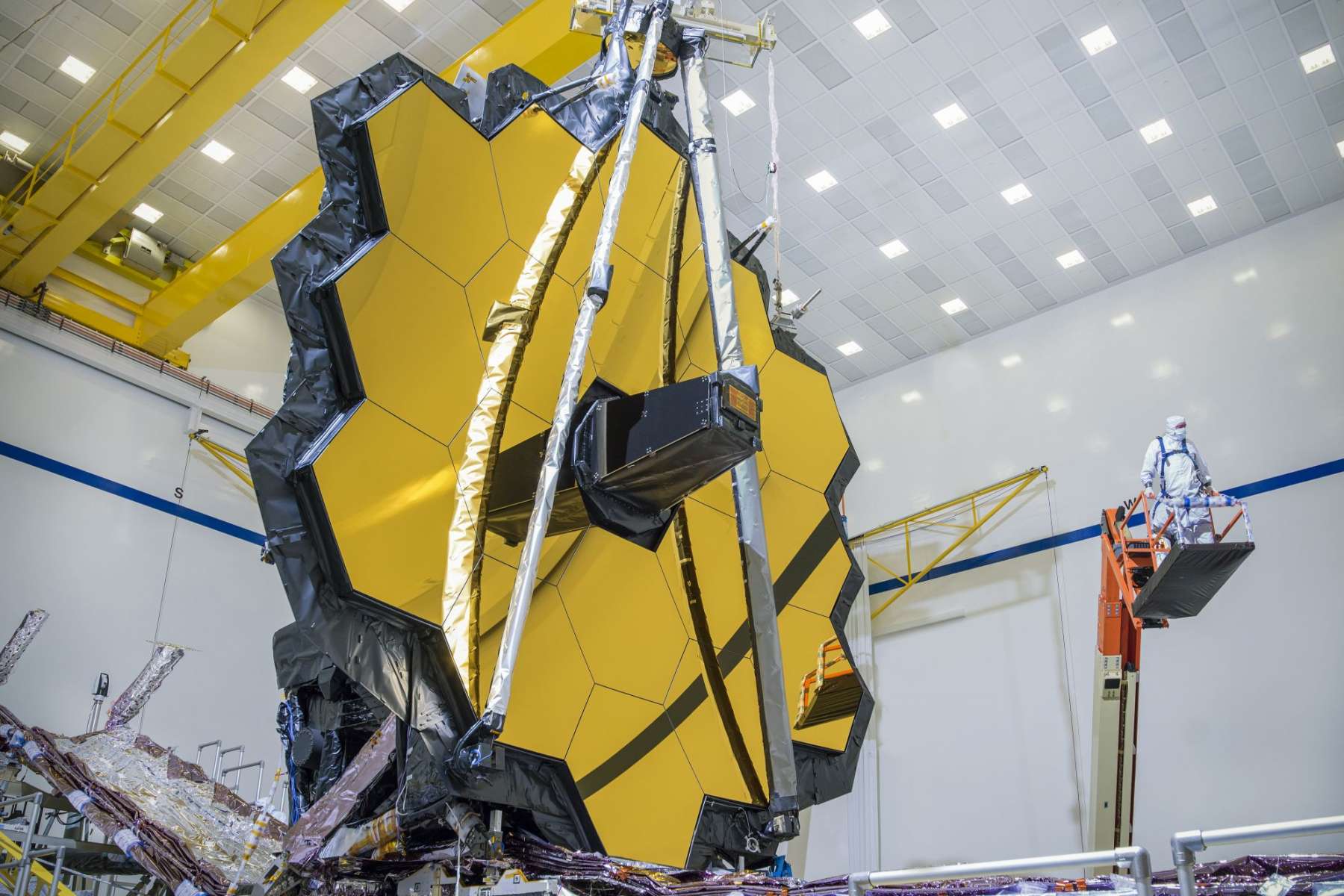
The JWST deployable mirror undergoing tests

I heard last week that the ship carrying the James Webb Space Telescope (JWST) arrived safely in French Guiana and is now being prepared for launch on an Ariane-5 rocket at the European Space Agency’s facility at Kourou. Since the telescope cost approximately $10 billion there was some nervousness it might have been hijacked by pirates on the way.

I’m old enough to remember JWST when it was called the Next Generation Space Telescope NGST); it was frequently discussed at various advisory panels I was on about 20 years ago. Although the basic concept hasn’t changed much – it was planned to be the successor to the Hubble Space Telescope working in the infrared and with a deployable mirror – at that time it was going to have an even bigger mirror than the 6.5m it ended up with, was going to be launched in or around 2010, and was to have a budget of around $600 million. About a decade ago cost overruns, NASA budget problems, and technical hitches led to suggestions that it should be cancelled. It turned out however that it was indeed too big too fail. Now it is set for launch in December total cost greater than ten times the original estimate.

I know many people involved in the JWST project itself or waiting to use it to make observations, and I’ll be crossing my fingers on launch day and for the period until its remarkable folding mirror is deployed about a fortnight later. I hope it goes well, and look forward to the celebrations when it does.

There is a big problem with JWST however and that is its name, which was changed in 2002 from the Next Generation Space Telescope to the James Webb Space Telescope after James E. Webb, a civil servant who was NASA’s chief administrator from 1961 to 1968.

It’s not uncommon for scientific space missions like this to be named after people once the proposal has moved off the drawing board and into serious planning. That happened with the European Space Agency’s Planck and Herschel to give two examples. In any case Next General Space Telescope was clearly never anything but a working title. Yet naming this important mission after a Government official always seemed a strange decision to me. Then news emerged that James Webb had enthusiastically cooperated in a McCarthyite purge of LGBT+ people working in government institutions, part of a wider moral panic referred to by historians as the Lavender Scare. There have been high-profile protests (see, e.g., here) and a petition that received over a thousand signatures, but NASA has ruled out any change of name.

The main reason NASA give is that they found no evidence that Webb himself was personally involved in discrimination or persecution. I find that very unconvincing. He was in charge, so had responsibility for what went on in his organization. If he didn’t know then why didn’t he know? Oh, and by the way, he didn’t have anything to do with infrared astronomy either…

It’s a shame that this fantastic telescope should have its image so tarnished by the adoption of an inappropriate name. The name is a symbol of a time when homophobic discrimination was even more prevalent than it is now, and as such will be a constant reminder to us that NASA seems not to care about the many LGBT+ people working for them directly or as members of the wider astronomical community.

P.S. As an alternative name I suggest the Lavender Scare Space Telescope (LSST)…

Posted in Science Politics with tags , , , on October 26, 2011 by telescoper

No time for a post of my own today – it’s our “Staff Away Day” (which owing to budget cuts is only half a day and is being held in Cardiff, at the Millennium Stadium). Anyway, I was going to pass on the same rumours that Andy Lawrence is writing about, and he knows more about this than I do, so over to him for the ongoing ramifications of JWST…

JWST: Over and Out?

Posted in Science Politics, The Universe and Stuff with tags , , , , on August 23, 2011 by telescoper

News filtered through recently that the cost of the James Webb Space Telescope, which is already  threatened with cancellation owing to cuts in NASA’s budget, is now estimated to be around $8.7 billion dollars, about $2.2 billion higher than previous figures. In fact about a decade ago, when I was a lad, and chair of the old PPARC Astronomy Advisory Panel, the price tag of  the NGST (Next Generation Space Telescope), as it was then called, was put at significantly less than one billion dollars.

The implications of cancelling JWST are profound on both sides of the Atlantic. As Mark McCaughrean explains in detail over on the e-astronomer, the European Space Agency has already made a substantial investment in JWST and planned future contributions include the launch and substantial operating costs. The instrument development is nearly finished, but whether there will actually be a telescope to put instruments on remains to be seen. It’s clear that this, together with previous unilateral decisions by NASA, is putting some strain on the relationship with ESA.

There were many who reacted to the initial suggestion that JWST should be cancelled by arguing that it was mere political posturing by Republicans in the House of Representatives and that it could and would be reversed if appropriate campaigning took place. To this end there has been, e.g.,  a letter to the White House Science Advisor (here for non-US astronomers and there for US ones). There’s also been a letter of support from the President of the Royal Astronomical Society. NASA’s administrators have also apparently come up with a plan to divert funds from other projects to support it. These efforts notwithstanding I get the distinct feeling that cancellation of JWST is a very real prospect and it goes without saying that the chances of avoiding it are not helped by  the increased estimated expense.

I’ve talked about this to a number of astronomers and cosmologists over the summer and found very mixed views not only about  (a) whether JWST will be cancelled or not but also about (b) whether it should be cancelled or not. Even astronomers have expressed exasperation with the spiralling cost of JWST and pointed out that if we had known a decade ago that it would take so long and involve such an outlay then it would never have gone ahead in the first place.

So let me try a straw poll:

JWST: Too Big to Fail?

Posted in Finance, Science Politics, The Universe and Stuff with tags , , , , , on July 7, 2011 by telescoper

News emerged last night that the US Government may be about to cancel the  James Webb Space Telescope, which is intended to be the successor to the Hubble Space Telescope. I’m slow out of the blocks on this one, as I had an early night last night, but there’s already extensive reaction to the JWST crisis around the blogosphere: see, for example, Andy Lawrence, Sarah Kendrew, and Amanda Bauer; I’m sure there are many more articles elsewhere.

The US House Appropriations Committee has released its Science Appropriations Bill for the Fiscal Year 2012, which will be voted on tomorrow. Among other announcements (of big cuts to NASA’s budget) listed in the accompanying press release we find

The bill also terminates funding for the James Webb Space Telescope, which is billions of dollars over budget and plagued by poor management.

It is undoubtedly the case that JWST is way over budget and very late. Initial estimates put the cost of the at $1.6 billion and that it would be launched this year (2011). Now it can’t launch until at least 2018,  and probably won’t fly until as late as 2020, with an estimated final price tag of $6.8 billion. I couldn’t possibly comment on whether that is due to poor management or just that it’s an incredibly challenging project.

There’s a very informative piece on the Nature News Blog that explains that this is an early stage of the passage of the bill and that there’s a long way to go before JWST is definitely axed, but it is a worrying time for all those involved in it. There are serious implications for the European Space Agency, which is also involved in JWST, to STFC, which supports UK activity in related projects, and indeed for many groups of astronomers around the world who are currently engaged in building and testing instruments.

One of the arguments against cancelling JWST now is that all the money that has been spent on it so far would have been wasted, in other words that it’s “too big to fail”, which is an argument that obviously can’t be sustained indefinitely. It may be now it’s so far over budget that it’s become a political liability to NASA, i.e. it’s too big to succeed. It’s too early to say that JWST is doomed – this draft budget is partly a political shot across the bows of the President by the Republicans in the House – but it does that the politicians are prepared to think what has previously been unthinkable.

UPDATE: A statement has been issued by the American Astronomical Association.