Archive for Kay Lehnert

A Hitchhiker’s Guide to the Swampland

Posted in Maynooth, The Universe and Stuff with tags , , , , , on September 5, 2025 by telescoper

A very comprehensive review article has appeared on arXiv with the title Hitchhiker’s Guide to the Swampland: The Cosmologist’s Handbook to the string-theoretical Swampland Programme by Kay Lehnert (who just happens to be my PhD student). The paper is 170 pages long and contains over 1,800 references, which gives some idea of what a large field this is and how much work Kay has put into writing it!

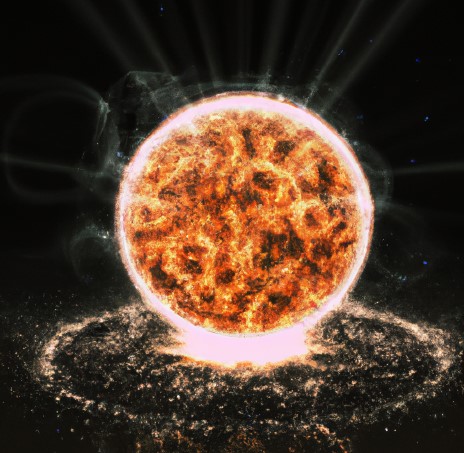
This is Figure 3 from Kays paper. If you would like to know more of what it is about, turn to page 50…

The abstract reads

String theory has strong implications for cosmology: it tells us that we cannot have a cosmological constant, that single-field slow-roll inflation is ruled out, and that black holes decay. We elucidate the origin of these statements within the string-theoretical swampland programme. The swampland programme is generating a growing body of insights that have yet to be incorporated into cosmological models. Taking a cosmologist’s perspective, we highlight the relevance of swampland conjectures to black holes, dark matter, dark energy, and inflation, including their implications for scalar fields such as quintessence and axions. Our goal is to inspire cosmological model builders to examine the compatibility of effective field theories with quantum gravitational UV completions and to address outstanding cosmological tensions such as the Hubble tension. This comprehensive literature review presents clear definitions, cosmological implications, and the current status – including evidence and counterexamples – of the following swampland conjectures: the anti-de Sitter distance conjecture (AdSDC), the completeness conjecture (CC), the cobordism conjecture, the de Sitter conjecture (dSC), the swampland distance conjecture (SDC), the emergence proposal (EP), the Festina Lente Bound (FLB), the finite number of massless fields conjecture (or finite flux vacua conjecture (FFV)), the no global symmetries conjecture, the no non-supersymmetric theories conjecture, the non-negative null energy condition conjecture, the positive Gauss-Bonnet term conjecture, the species scale conjecture, the gravitino swampland conjecture (GSC), the tadpole conjecture, the tameness conjecture, the trans-Planckian censorship conjecture (tPCC/TCC), the unique geodesic conjecture, and the weak gravity conjecture (WGC), including the repulsive force conjecture (RFC).

This is essentially the literature review part of Kay’s thesis; the aim of his research is to study the implications of the string-theoretical swampland programme for cosmology. He’s particularly interested in the predictions string theory makes regarding inflation, dark energy, and dark matter, and the impact this has on the Hubble tension. The point of writing this review was to suggest projects that might be undertaken to bring string theory into the realm of testability, thus suppling material for the rest of Kay’s thesis, but I think it is also a very good guide for cosmologists of all types to what the swampland conjectures are and what they do and do not say about the Universe we actually live in.
The Universe Keeper

Posted in Maynooth, The Universe and Stuff with tags , , , , , , on February 28, 2025 by telescoper

Interested in learning a little bit about the ideas behind string theory? Here’s a short video that tries to explain the basics in a thought-provoking way. It features three main characters: The Universe Keeper Renata, inspired by Russian-American physicist Renata Kallosh, the quizzical Wolfie, inspired by the Austrian Nobel laureate Wolfgang Pauli, and the inquisitive Albie, inspired by Albert Einstein.

See what you make of it…

(One of the creators of this video is my PhD student Kay Lehnert, who has just given a departmental seminar in which he mentioned the video.)

ChatGPT in the Swampland

Posted in Maynooth, Open Access, The Universe and Stuff with tags , , , , , on January 22, 2023 by telescoper

My inestimable PhD student Kay Lehnert has been having a look at the capabilities of the Artificial Intelligence platform ChatGPT at writing about string theoretical ideas, specifically the swampland conjectures. It’s remarkable what this does well but also notable what it doesn’t do well at all. What he found was so interesting he wrote it up as a little paper, which you can find on the arXiv here. The abstract is:

In this case study, we explore the capabilities and limitations of ChatGPT, a natural language processing model developed by OpenAI, in the field of string theoretical swampland conjectures. We find that it is effective at paraphrasing and explaining concepts in a variety of styles, but not at genuinely connecting concepts. It will provide false information with full confidence and make up statements when necessary. However, its ingenious use of language can be fruitful for identifying analogies and describing visual representations of abstract concepts.

It took arXiv a while to decide what to do with this paper as it doesn’t fit in any of the usual categories. The arXiv sections that usually cover string theory are General Relativity and Quantum Cosmology (gr-qc) and/or high-energy physics theory (hep-th), which was where it was originally submitted, but this isn’t really a string theory paper per se. After being held by the moderators for a while it eventually it appeared in Popular Physics (physics.pop-ph), cross-listed in Artificial Intelligence (cs.AI) & Computation and Language (cs.CL); the latter two are computer science categories, obviously.

Figure 2 of the paper, which you should read if you want to know what it represents!

The reclassification of this paper was perfectly reasonable. In fact with this, as with any other arXiv paper, the thing that matters most is that it it is freely available to anyone who wants to read it and is discoverable, i.e. can easily be found via search engines. In the era of Open Access, things will generate interest if they are interesting (and accessible).

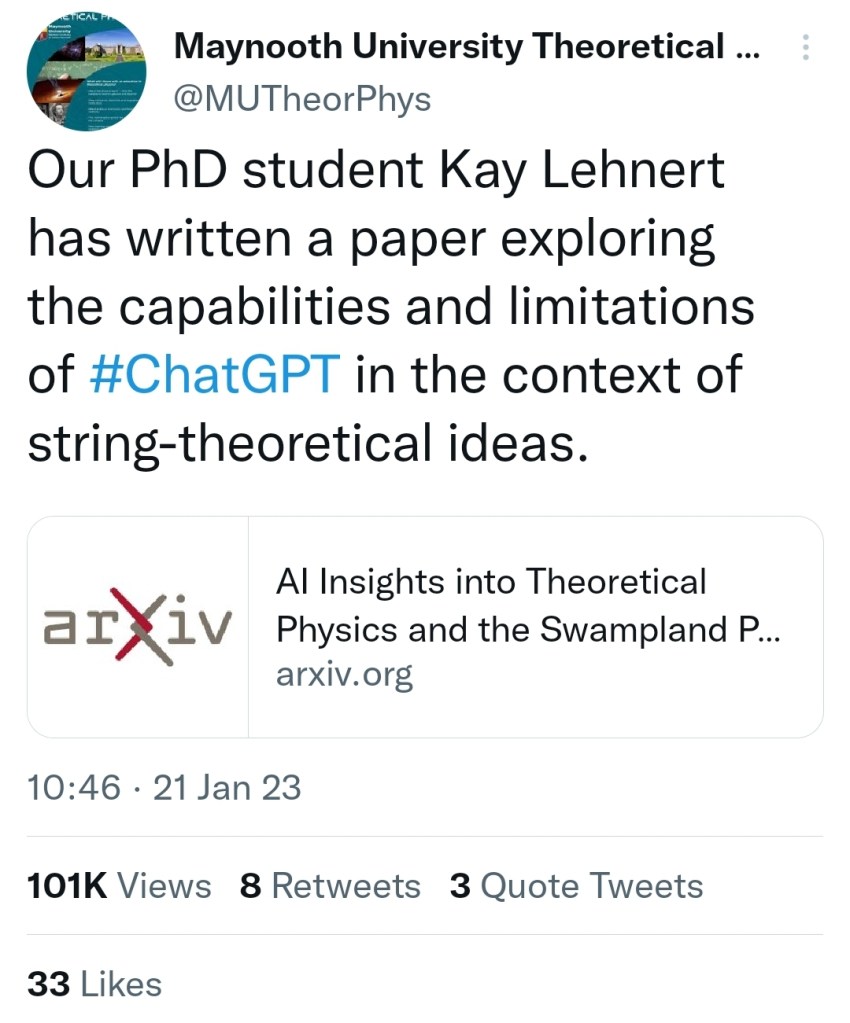
We posted the following on the Maynooth University Theoretical Physics Department Twitter account, something we do whenever a new paper by someone in the Department comes out:

Judging by the number of views (101K) by this morning, this one certainly seems to be attracting interest! Hopefully this blog post will generate even more..

Finally, there might be people reading this blog who can suggest a journal that might consider publishing an article on this sort of subject? Whatever you think about ChatGPT I think it’s generating a lot of discussion right now, so the topic is… er… topical.

Please use the box below for any suggestions.