Archive for KIDS

Weekly Update from the Open Journal of Astrophysics – 27/09/2025

Posted in OJAp Papers, Open Access, The Universe and Stuff with tags , , , , , , , , , , , , , , , , , , , , , , on September 27, 2025 by telescoper

It’s Saturday again, so it’s time for a summary of the week’s new papers at the Open Journal of Astrophysics. Since the last update we have published five new papers, which brings the number in Volume 8 (2025) up to 141, and the total so far published by OJAp up to 376.

The first paper to report this week is “The Bispectrum of Intrinsic Alignments: Theory Modelling and Forecasts for Stage IV Galaxy Surveys” by Thomas Bakx (Utrecht U., NL), Alexander Eggemeier (U. Bonn, DE), Toshiki Kurita (MPA Garching, DE), Nora Elisa Chisari (Leiden U., NL) and Zvonimir Vlah (Ruđer Bošković Institute, Croatia). This paper was published on Monday 22nd September 2025 in the folder Cosmology and NonGalactic Astrophysics. It studies the bispectrum of intrinsic galaxy alignments, a possible source of systematic errors in extracting cosmological information from the analysis of weak lensing surveys.

The overlay is here:

You can make this larger by clicking on it.  The officially accepted version of this paper can be found on the arXiv here.

The second paper this week, published on Tuesday 23rd September 2025 is “Reanalysis of Stage-III cosmic shear surveys: A comprehensive study of shear diagnostic tests” by Jazmine Jefferson (University of Chicago, USA) and 13 others for the LSST Dark Energy Science Collaboration. It is also in the folder Cosmology and NonGalactic Astrophysics; it describes diagnostic tests on three public shear catalogs (KiDS-1000, Year 3 DES-Y3 s, and Year 3 HSC-Y3); not all the surveys pass all the tests.

The corresponding overlay is here:

You can find the officially accepted version on arXiv here.

The third one this week, published on Wednesday 24th September 2025 in the folder Astrophysics of Galaxies, is “Is feedback-free star formation possible?” by Andrea Ferrara, Daniele Manzoni, and Evangelia Ntormousi (all of the Scuola Normale Superiore, Pisa, Italy). This paper presents an argument that Lyman-alpha radiation pressure strongly limits star formation efficiency, even at solar metallicities, so that a feedback-free star formation phase is not possible without feedback. The overlay is here:

You can find the officially-accepted version on arXiv here.

Next we have “Microphysical Regulation of Non-Ideal MHD in Weakly-Ionized Systems: Does the Hall Effect Matter?” by Philip F. Hopkins (Caltech, USA), Jonathan Squire (U. Otago, New Zeland), Raphael Skalidis (Caltech) and Nadine H. Soliman (Caltech). This was also published on Wednesday 24th September 2025, but in the folder Earth and Planetary Astrophysics. It presents an improved treatment of non-ideal effects in magnetohydrodynamics, particularly the Hall effect, and a discussion of the implications for weakly-ionized astrophysical systems.

The corresponding overlay is here:


You can find the officially accepted version of this one on arXiv here.

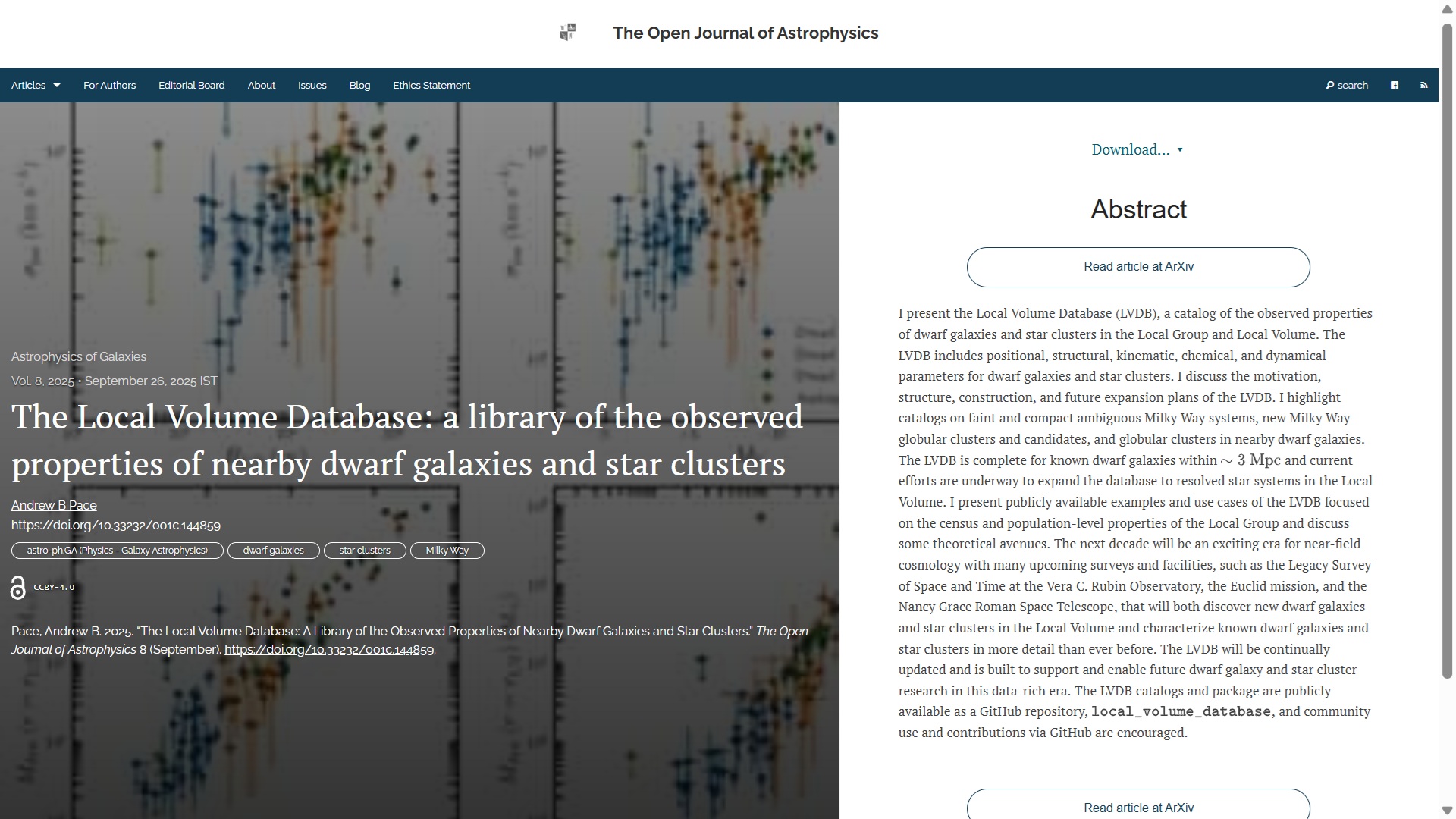
The fifth, and last, one for this week is “The Local Volume Database: a library of the observed properties of nearby dwarf galaxies and star clusters” by Andrew B. Pace (University of Virginia, USA). This one was published on Friday 26th September (i.e. yesterday) in the folder Astrophysics of Galaxies. It presents a catalogue of positional, structural, kinematic, chemical, and dynamical parameters for dwarf galaxies and star clusters in the Local Volume. The overlay is here:
You can find the officially-accepted version of this paper on arxiv here.


And that concludes the report for this week. I’ll post another update next Saturday.
The KiDS Legacy

Posted in The Universe and Stuff with tags , , , , , , , , on March 30, 2025 by telescoper

What with all the cosmological goings-on of the past couple of weeks – see here, here and here – I quite forgot to mention another important set of results. These are from the final data release Kilo-Degree Survey known as KiDS for short and represent a final analysis of the complete dataset. For those of you not in the know, KiDs is a weak lensing shear tomography survey and its core science drivers are to map the large scale matter distribution in the Universe and constrain the equation of state of Dark Energy. The results can be found in three papers on arXiv, which you can add to your reading list:

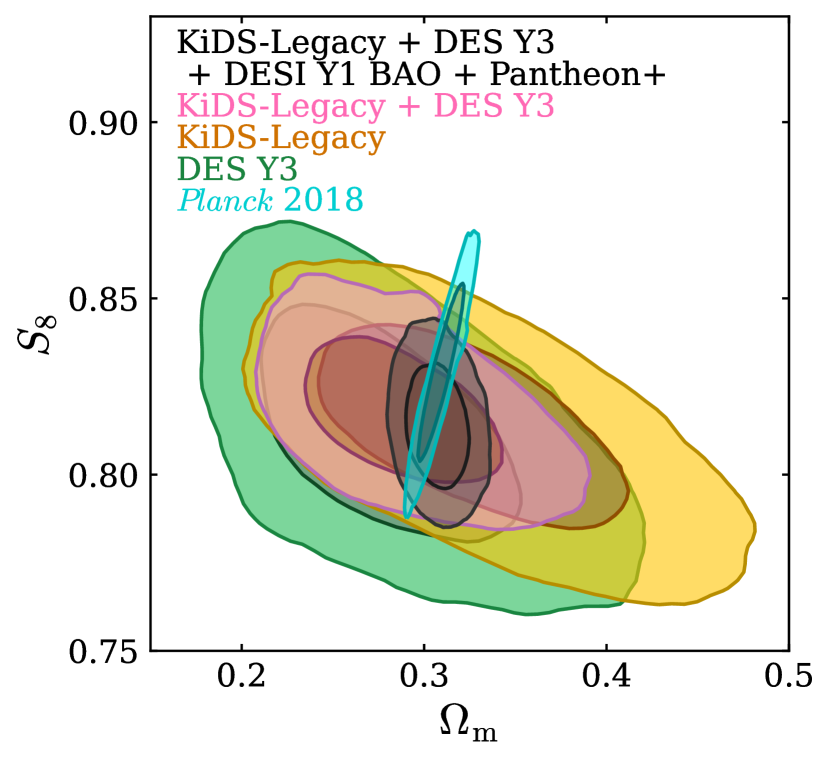
As far as I’m concerned, the main result to leap out from the cosmological analysis, which primarily constrains the clumpiness of matter in the universe, expressed by the density parameter Ωm and a fluctuation amplitude σ8 in the combined parameter “S8“, which is constrained almost independently from Ωm. The value obtained for this parameter by KiDS has previously been “in tension” with values from other experiments (notably Planck) ; see here for a discussion. The new results, however, seem consistent with the standard cosmological model. Here is a figure from the last paper in the above list that illustrates the point:

As is often the case, there’s also one of those nice Cosmology Talks videos that discusses this and other aspects of the KiDS Legacy results to which I refer you for more details!

New KiDS on the Blog!

Posted in The Universe and Stuff with tags , , , , , , , , , , on August 5, 2020 by telescoper

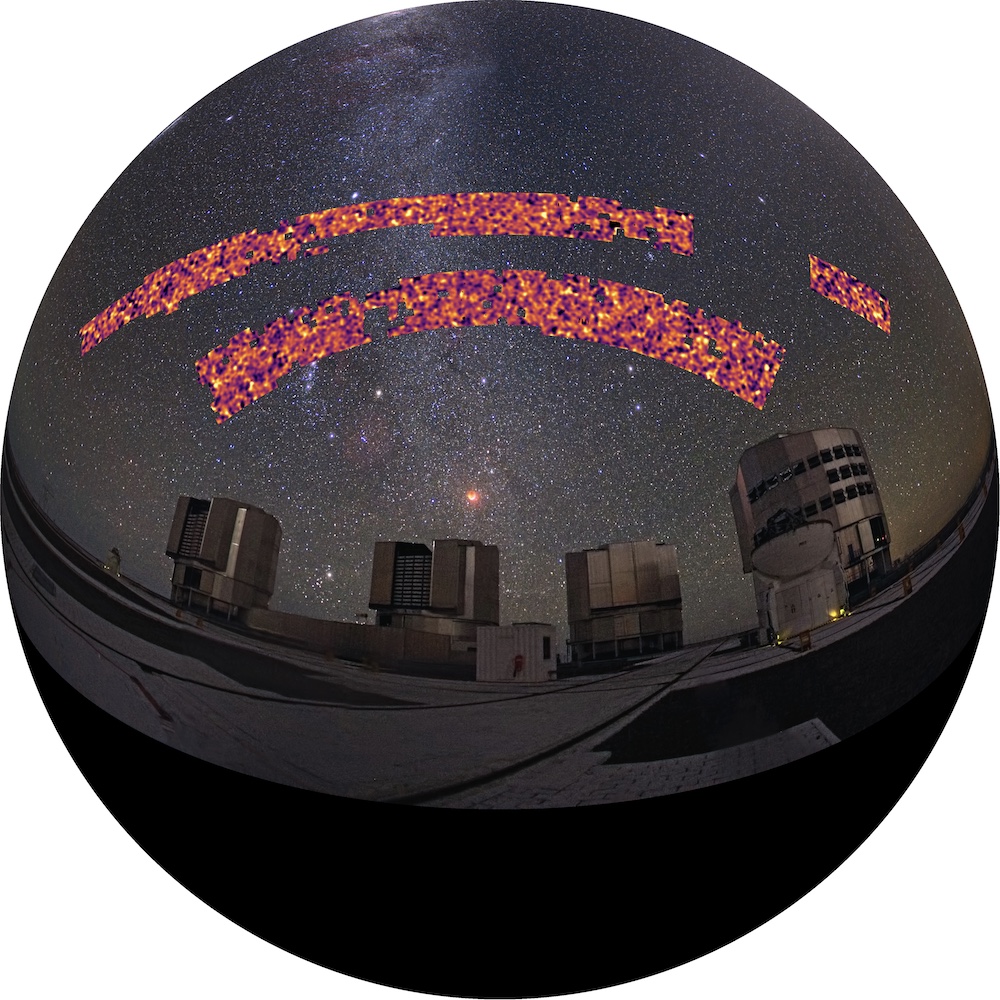
The above image is from the Kilo Degree Survey, performed using the OmegaCAM instrument on the European Southern Observatory’s VST Survey Telescope at Cerro Paranal in Northern Chile. I got it by googling `Pictures of KiDS’, which was probably unwise.

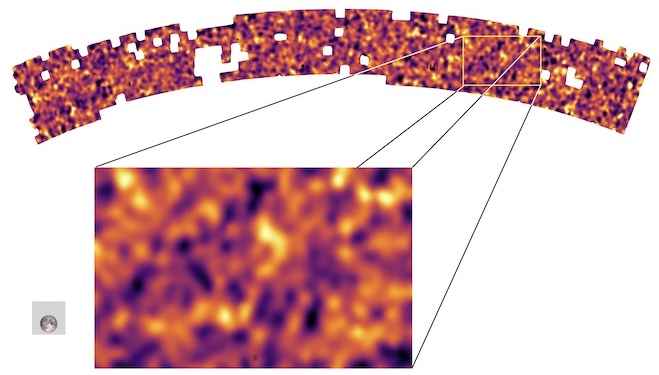
Here’s another picture, of part of the survey region.

A few people have asked me why I didn’t post about the new results from KiDs which came out last week. The answer is simply that I’ve been a bit busy, but here we go now with a post on the blog about the new KiDs papers. These appear as a bunch of five on the arXiv:

KiDS-1000 Methodology: Modelling and inference for joint weak gravitational lensing and spectroscopic galaxy clustering analysis

KiDS-1000 catalogue: weak gravitational lensing shear measurements

KiDS-1000 catalogue: Redshift distributions and their calibration

KiDS-1000 Cosmology: Cosmic shear constraints and comparison between two point statistics

KiDS-1000 Cosmology: Multi-probe weak gravitational lensing and spectroscopic galaxy clustering constraints

The result that stands out from the latest release is the suggestion that the Universe is about 8% less clumpy than the standard cosmological model suggests. The level of clumpiness is quantified by the parameter S8 which, according to Planck, has a value 0.832 ± 0.013 whereas KiDS gives 0.776 (+0.020/-0.014), a discrepancy of about 3σ. It’s not only the Hubble constant that is causing a bit of tension in cosmological circles!


KiDS-450: Testing extensions to the standard cosmological model [CEA]

Posted in The Universe and Stuff with tags , , , on October 19, 2016 by telescoper

Since I’ve just attended a seminar in Cardiff by Catherine Heymans on exactly this work, I couldn’t resist reblogging the arXiver entry for this paper which appeared on arXiv a couple of days ago.

The key finding is that the weak lensing analysis of KIDS data (which is mainly to the distribution of matter at low redshift) does seem to be discrepant with the predictions of the standard cosmological model established by Planck (which is sensitive mainly to high-redshift fluctuations).

Could this discrepancy be interpreted as evidence of something going on beyond the standard cosmology? Read the paper to explore some possibilities!

arxiver's avatararXiver

http://arxiv.org/abs/1610.04606

We test extensions to the standard cosmological model with weak gravitational lensing tomography using 450 deg$^2$ of imaging data from the Kilo Degree Survey (KiDS). In these extended cosmologies, which include massive neutrinos, nonzero curvature, evolving dark energy, modified gravity, and running of the scalar spectral index, we also examine the discordance between KiDS and cosmic microwave background measurements from Planck. The discordance between the two datasets is largely unaffected by a more conservative treatment of the lensing systematics and the removal of angular scales most sensitive to nonlinear physics. The only extended cosmology that simultaneously alleviates the discordance with Planck and is at least moderately favored by the data includes evolving dark energy with a time-dependent equation of state (in the form of the $w_0-w_a$ parameterization). In this model, the respective $S_8 = sigma_8 sqrt{Omega_{rm m}/0.3}$ constraints agree at the $1sigma$ level, and there is `substantial concordance’ between…

View original post 159 more words