Archive for King Oliver

A Jazz Centenary

Posted in History, Jazz with tags , , , , , on April 5, 2023 by telescoper
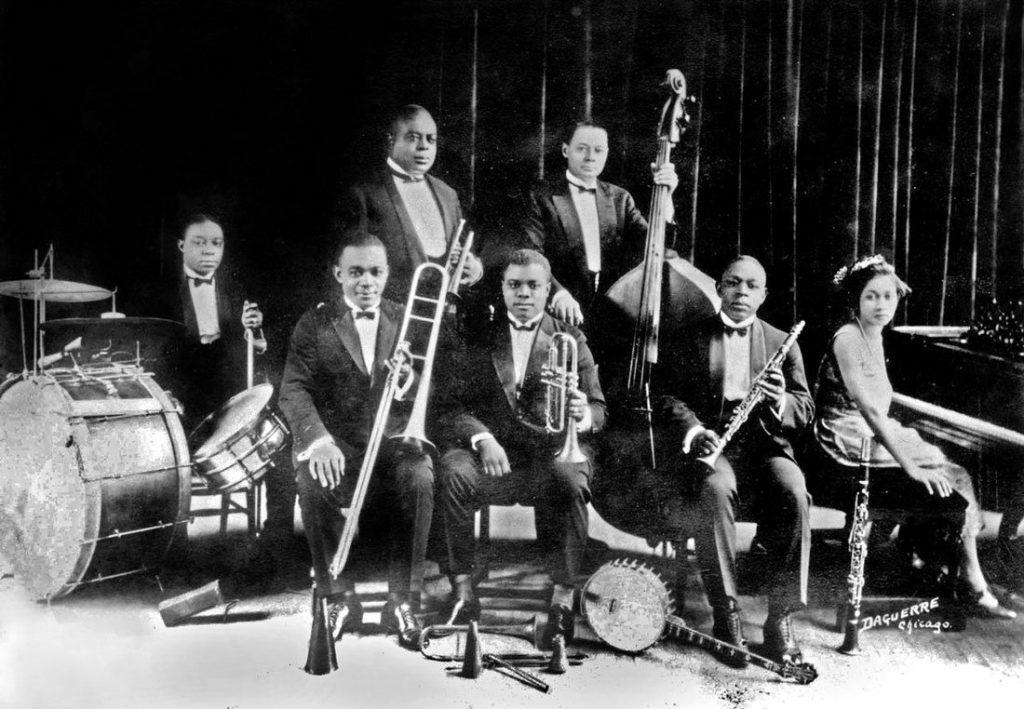
King Oliver’s Creole Jazz Band vintage 1923. From the left: Warren “Baby” Dodds (drums); Honore Dutrey (seated front, trombone); Joe “King” Oliver (standing rear, cornet); Louis Armstrong (seated front, cornet); Bill Johnson (standing rear, string bass and banjo); Johnny Dodds (seated front, clarinet); and Lil Hardin (piano)

I’ve been looking forward to this day because it marks an important jazz centenary. Or at least I think it does. There’s some contradictory evidence about whether it was April 5th 1923 or April 6th, or maybe both, when King Oliver‘s Creole Jazz Band did its first ever recording session at the Gennett studios in Richmond, Virginia. They recorded 20 sides in that session, which may well have involved two days with a break in between or working through the night.

These dates represent a remarkable occasion not only because King Oliver’s band was really the first jazz Supergroup, but also because it had been joined just a few months earlier by a young cornet player by the name of Louis Armstrong. This session therefore represent the first examples of Louis Armstrong ever heard on record.

It is somewhat surprising that this historic session happened at the Gennett studios. The band was based on Chicago, Illinois, and the studios were in Richmond, Virginia, so it required a long road trip to get there. Moreover the studio building wasn’t exactly in a prime location, as it was right next to a railroad line:

Musicians had to time their recordings so as to avoid the noise from passing trains. Still, records only lasted about 3 minutes in those days so presumably weren’t so frequent as to make it difficult to fit in a take between two of them! Recording techniques were rather primitive in those days though, and the sound quality that emerged isn’t great.

The lineup for the band is shown in the picture at the top of this page. It’s interesting to note that four of these musicians (Armstrong, Hardin, and the Dodds brothers) were to feature regularly from 1925 onwards in the classic Hot Fives and Hot Sevens. King Oliver’s band, however, had style that was very different from these later records, with a much greater emphasis on polyphony, much more complex arrangements, and much less emphasis on solos. Also, King Oliver’s band played to live audiences on a regular basis, but the Hot Fives and Hot Seven only ever performed as such in recording studios.

As far as I understand how this band worked, King Oliver made the arrangements. I don’t think they used full written scores, but tended to play from wonderfully intricate “head arrangements” worked out beforehand, with ensemble passages, gaps for breaks and solos, and King Oliver introducing the (usually very catchy themes). Armstrong and Johnny Dodds improvised a decorative counterpoint, and Honore Dutrey added harmonic breadth to the ensemble. This must have been a great learning experience for the young Louis Armstrong, has he had to develop a great ear for what was going on around him to play like this. I gather that Louis Armstrong often tended to play very loud so he was kept well in the background in these early Gennett sessions, but such a prodigious talent was never going to play second fiddle for long and in later sessions he effectively duets with King Oliver and swapped leads with him freely and completely intuitively, producing a sound that was entirely unique. I am always astonished by how much is going on in these old records, even if you can’t hear it all very well!

I’ve mentioned before that, over time, this classic type of polyphonic Jazz – derived from its New Orleans roots – gradually morphed into musical form dominated by much simpler arrangements and a succession of virtuoso solos. This change was also reflected in the differing fortunes of Louis Armstrong and King Oliver. The former went on to become an international celebrity, while the latter lost all his savings when his bank went bust during the Wall Street Crash and ended his life working as a janitor.

As well as Gennett, this band recorded with other labels in 1923 including Okeh and Columbia. Sadly however they split up at the end of 1923 over disagreements about a possible tour in 1924. Only about 40 sides were ever recorded King Oliver’s Creole Jazz Band. Many of them are absolutely marvelous.

This is the first track recorded by the band in April 1923. It’s called Just Gone. It’s a scratchy old record, with a rather compressed acoustic, so it’s like putting your next to one end of a tunnel leading back a hundred years, but it’s a good example of the Creole Jazz Band’s style. Joe Oliver’s lead cornet clearly influenced Louis Armstrong’s later style. You have to listen hard to hear Satchmo in the background on this track, but it’s worth the effort. You’re listening to a piece of music history, and a wonderful piece at that.

A Musical Memory: Mabel’s Dream

Posted in Biographical, Jazz with tags , , , , , on November 7, 2019 by telescoper

So that’s that. The funeral is over. We all said our goodbyes, and there many tears.

My Mam chose the music for her funeral a long time ago, and the piece that was playing as we arrived in the West Chapel of the West Road Crematorium was one that I wrote about about a decade ago, so I thought I’d indulge myself by posting here the version we heard today.

Years ago my Mam told me that she heard the tune Mabel’s Dream played on the piano by a friend of the family by the name of Johnny Handle. Best known as a folk musician (and founder member of a well-known band called The High Level Ranters) he is also a music teacher and musicologist with a wide range of interests in music. I read somewhere that this lovely tune was originally written by Jelly Roll Morton and performed by him on solo piano, but by far the most famous recording of Mabel’s Dream was made by King Oliver and his Creole Jazz Band in Chicago in 1923. This was the band that the young Louis Armstrong belonged to before going on to make the classic Hot Fives and Hot Sevens, one of which I posted a bit ago. It’s interesting how different the earlier band sounds: with two cornets (King Oliver and Louis Armstrong), clarinet (Johnny Dodds), and trombone (Honore Dutrey) playing together virtually all the time except for short improvised solo breaks. King Oliver usually played lead cornet, at least in their earlier recordings, with Louis Armstrong playing a decorative counterpoint around him rather like a clarinettist might. Later on, they swapped leads freely and completely intuitively producing a sound that was entirely unique.

The ensemble playing is intricate, but the band had no written music, preferring to work exclusively from “head” arrangements. Their music is consistently delightful to listen to, with a succession of marchy themes that makes it impossible not to want to tap your feet when you listen to them.

Over time, this classic type of polyphonic Jazz- derived from its New Orleans roots – gradually morphed into musical form dominated by much simpler arrangements and a succession of virtuoso solos. This change was also reflected in the differing fortunes of Louis Armstrong and King Oliver. The former went on to become an international celebrity, while the latter lost all his savings when his bank went bust during the Wall Street Crash.

Considering the relatively brief time that they played together, King Oliver and Louis Armstrong made an astonishingly large number of astonishingly beautiful records, including this one which I’m posting here to show that as well as many other things my Mam had great taste in Jazz.

My Sweet Lovin’ Man

Posted in Jazz with tags , , , , , on March 21, 2011 by telescoper

A high temperature and raging sore throat have confined me to the house today. I got up as usual at 7.30 but quickly realised I wasn’t going to be of much to anyone; trying to give a lecture when barely able to produce a whisper didn’t seem worth the effort. So off I went back to bed, after feeding the cat, and got up again about an hour ago.

I’ve been trying to cheer myself up by listening to – and transferring to digital using my USB turntable – some lovely old jazz records that I haven’t heard for ages. Not all of them came out well, but fortunately one of my all-time favourite records is actually on youtube anyway so I thought I’d put it up.

This is My Sweet Lovin’ Man recorded by King Oliver’s Creole Jazz Band on June 22nd 1923, in Chicago. It  is a purely mechanical recording, meaning that the musicians stood shoulder-to-shoulder  blowing into a horn causing a needle to cut the record directly onto a disk;   copies would be pressed using this master which could be played back for the listener by a gramophone, usually amplified by another horn. Obviously the technology was very limited, but it’s good enough to reveal the superb musicianship involved in creating this wonderful piece of music.

I love jazz from all eras of its history, but there can’t have been many  finer collections of musicians than this. It’s led by King Oliver, who plays cornet, with the young Louis Armstrong also playing cornet alongside him. Honoré Dutrey is the trombonist and the unmistakeable clarinet sound is supplied by the great Johnny Dodds. By the way, why is Johnny Dodds’ wikipedia article so brief? He was a colossal figure in the history of jazz! I must do something about that if nobody else does…

The piece was co-written by Lil Hardin, whose lovely piano playing is unusually well recorded on this track; pianos generally proved very difficult to record with the technology available in 1923.  Lil Hardin, incidentally, became Lil Armstrong when she married Louis Armstrong in February 1924. The rhythm men are Bud Scott on banjo and Warren “Baby” Dodds (Johnny’s brother) on drums, who provide an insistent yet fluid pulse underneath the rest of the band.

King Oliver’s band never used written arrangements; the musicians worked out the ensemble segments together and then played them from memory. When Louis Armstrong joined the band,  King Oliver  at first led on cornet, with  Armstrong providing decorative embellishments,  but  later on the two cornettists  developed such an understanding that they were able to swap leads almost telepathically. Their playing together on this track is sublime. The improvised counterpoint provided by Johnny Dodds and Honoré Dutrey is also breathtakingly beautiful. Although it was recorded in Chicago, this is the classic form of New Orleans polyphony sustained throughout at the very highest level.

I think this is one of the greatest jazz records of all time, but it also reminds me that there was  a move some time ago to refer to jazz as black classical music. It never caught on, but in this case the term seems to me to be perfectly apt. Anyway, I hope you enjoy it as much as I do.


Share/Bookmark

Mabel’s Dream

Posted in Biographical, Jazz with tags , , , on June 22, 2009 by telescoper

I could attempt to make a cheesy Radio 2 kind of link between my previous post and this one, along the lines of “From one dream to another..” but I don’t think I’ll bother.

Years ago my mum told me that she heard the tune Mabel’s Dream played on the piano by a friend of the family by the name of Johnny Handle. Best known as a folk musician (and founder member of a well-known band called The High Level Ranters) he is also a music teacher and musicologist with a wide range of interests in music.  I read somewhere that this lovely tune was originally written by Jelly Roll Morton and performed by him on solo piano, but I’ve never managed to locate a solo version. However, every time I try looking for it (which I did this evening) I seem to come across something really nice. Today was no exception.

By far the most famous recording of Mabel’s Dream was made by King Oliver and his Creole Jazz Band in Chicago in 1923. This was the band that the young Louis Armstrong belonged to before going on to make the classic Hot Fives and Hot Sevens, one of which I posted a bit ago. It’s interesting how different the earlier band sounds:  with two cornets (King Oliver and Louis Armstrong), clarinet (Johnny Dodds), and trombone (Honore Dutrey) playing  together virtually all the time except for short improvised solo breaks. King Oliver usually played lead cornet, at least in their earlier recordings, with Louis Armstrong playing a decorative counterpoint around him rather like a clarinettist might. Later on, they swapped leads freely and completely intuitively producing a sound that was entirely unique.

The ensemble playing is intricate, but the band had no written music preferring to work exclusively from “head” arrangements. Their music is consistently delightful to listen to, even though the recordings are very low-fi, with a succession of marchy themes that makes it impossible not to want to tap your feet when you listen to them. You can find their version of Mabel’s Dream here.

Over time, this classic type of polyphonic Jazz- derived from its New Orleans roots – gradually morphed  into musical form dominated by much simpler arrangements and a succession of virtuoso solos. This change was also reflected in the differing fortunes of Louis Armstrong and King Oliver. The former went on to become an international celebrity, while the latter lost all his savings when his bank went bust during the Wall Street Crash. He ended his days working as a janitor, and died in poverty in a dingy rooming house in Savannah, Georgia in 1938.

When the traditional Jazz revival happened after the Second Wold War, many fans turned against the Hot Sevens because they weren’t genuine “Noo Awlins” meaning that they hankered after music that was made more collectively and had less emphasis on the soloists. Across Europe in particular, many bands tried to recreate the sound of the earlier era of American Jazz, with varying degrees of success. 

Looking around for a version of Mabel’s Dream, I came across the following clip from a French band called The High Society Jazz Band which I think is just gorgeous. The recording was made at a live performance in 1960, at the height of the “trad” revival. The lineup of the band is just like King Oliver’s many years earlier, complete with the front line of two cornets, clarinet and trombone as well as piano, drums, banjo and sousaphone. Mostly it’s a deliberate note-for-note copy of the King Oliver version, but at a slightly slower tempo. Normally I don’t really go for deliberate copies like this, even if they’re meant as a tribute, but any two cornettists willing and able to copy Louis Armstrong and King Oliver deserve the greatest respect! Hats off , then, to Pierre Merlin and Claude Rabanit (two names quite new to me) for doing such a great job. In fact, I also like Pierre Atlan’s take on Johnny Dodd’s clarinet breaks, and the trombonist (Mowgli Jospin) deserves a mention for his name alone!