Archive for LambdaCDM

Everyone wants something better than ΛCDM

Posted in The Universe and Stuff with tags , , , , on October 8, 2025 by telescoper

There’s a nice short review article on arXiv today by Mike Turner. I wasn’t going to share it because it hasn’t got any pictures in it, but changed my mind.

Here is the abstract

The current cosmological paradigm, ΛCDM, is characterized (b) its expansive description of the history of the Universe, its deep connections to particle physics and the large amounts of data that support it. Nonetheless, ΛCDM’s critics argue that it has been falsified or must be discarded for various reasons. Critics and boosters alike do agree on one thing: it is the not the final cosmological theory and they are anxious to see it replaced by something better! I review the status of ΛCDM, provide my views of the path forward, and discuss the role that the “Hubble tension” might play.

arXiv:2510.05483

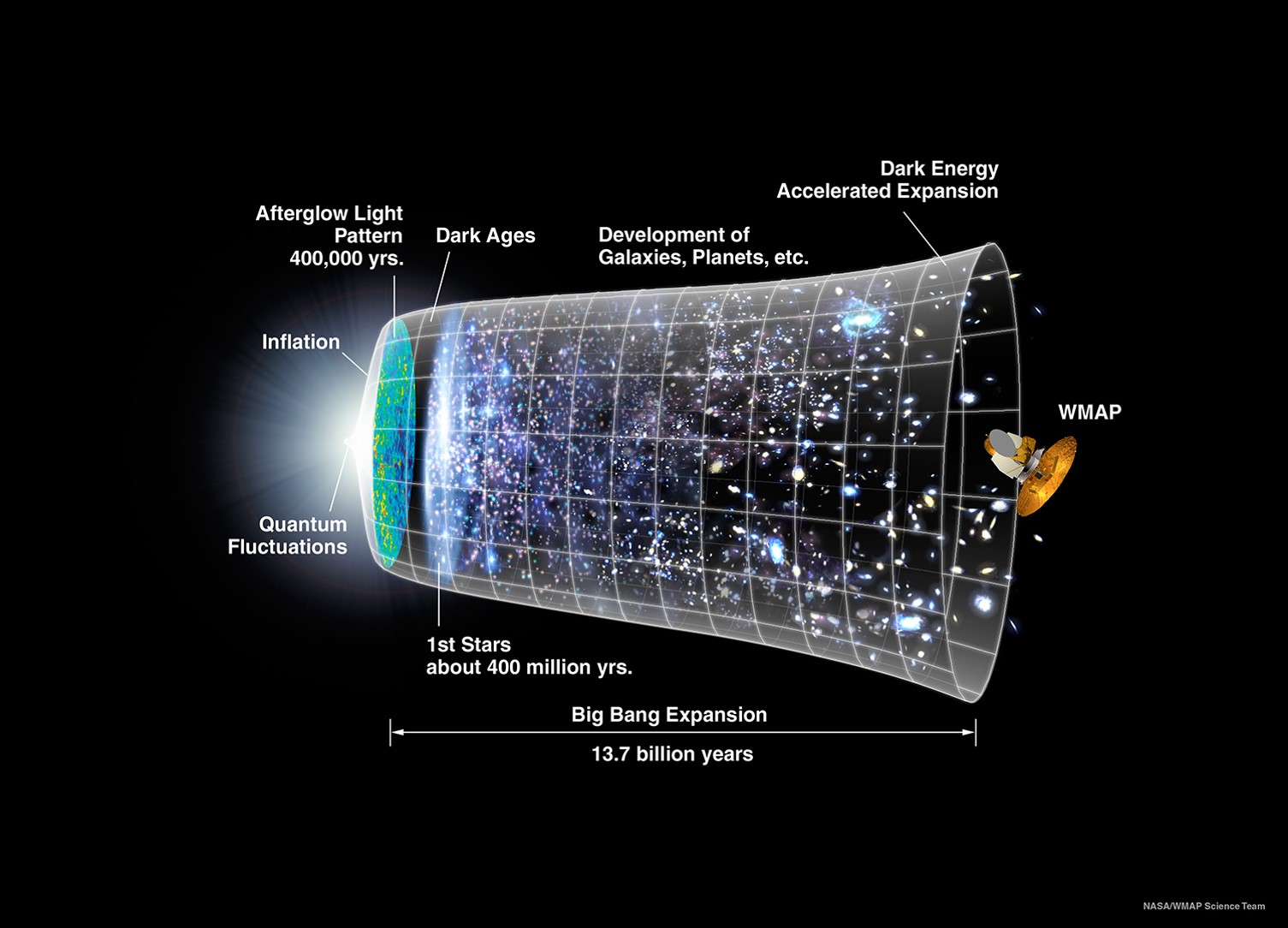
To make up for the lack of pictures in the article, here’s the first image that came up when I did a search for “ΛCDM”:

Big Things in the Universe

Posted in Bad Statistics, The Universe and Stuff with tags , , , , on February 7, 2025 by telescoper

About a year ago I wrote a couple of articles (here and here) in response to the discovery of a very large structure (“The Big Ring“) and claims that this structure and others – such as a Giant Arc – were inconsistent with the standard model of cosmology; the work concerned was later submitted as a preprint to arXiv. In my first post on the Big Ring I wrote

To assess the significance of the Big Ring or other structures in a proper scientific fashion, one has to calculate how probable that structure is given a model. We have a standard model that can be used for this purpose, but to simulate very structures is not straightforward because it requires a lot of computing power even to simulate just the mass distribution. In this case one also has to understand how to embed Magnesium absorption too, something which may turn out to trace the mass in a very biased way. Moreover, one has to simulate the observational selection process too, so one is doing a fair comparison between observations and predictions.

Well on today’s arXiv there is a preprint by Sawala et al. with the title aims to assess the significance of structures comparable to the Giant Arc. The title of the paper is The Emperor’s New Arc: gigaparsec patterns abound in a ΛCDM universe from which you can guess the conclusions. The abstract is

Recent discoveries of apparent large-scale features in the structure of the universe, extending over many hundreds of megaparsecs, have been claimed to contradict the large-scale isotropy and homogeneity foundational to the standard (ΛCDM) cosmological model. We explicitly test and refute this conjecture using FLAMINGO-10K, a new and very large cosmological simulation of the growth of structure in a ΛCDM context. Applying the same methods used in the observations, we show that patterns like the “Giant Arc”, supposedly in tension with the standard model, are, in fact, common and expected in a ΛCDM universe. We also show that their reported significant overdensities are an algorithmic artefact and unlikely to reflect any underlying structure.

arXiv:2502.03515

Here’s a picture of a large structure (a “Giant Arc”) taken from a gallery of such objects found in the simulations


I quote from the conclusions:

We hope that our results will dispel the misconception that no inhomogeneity can be found in the standard model Universe beyond some finite size. Instead, any given realisation of the isotropic universe comprises a time- and scale-dependent population of structures from which patterns can be identified on any scale.

I have nothing to add.
Is Dark Matter a Superfluid?

Posted in The Universe and Stuff with tags , , , , , , on May 22, 2018 by telescoper

In between marking exams and project reports I’ve been doing a little bit of reading in preparation for a talk that I’m due to give next week, which prompted me to share this talk by Justin Khoury of the University of Pennsylvania, which is about framework that unifies the claimed success of Modified Newtonian Dynamics (MOND) on galactic scales with the that of the standard ΛCDM model on cosmological scales. This is achieved through the physics of superfluidity. The dark matter and MOND components have a common origin, representing different phases of a single underlying substance. In galaxies, dark matter thermalizes and condenses to form a superfluid phase. The superfluid phonons couple to baryonic matter particles and mediate a MOND-like force. This framework naturally distinguishes between galaxies (where MOND is successful) and galaxy clusters (where MOND is not): dark matter has a higher temperature in clusters, and hence is in a mixture of superfluid and normal phase. The rich and well-studied physics of superfluidity leads to a number of observational signatures, discussed in the talk.

The idea that dark matter might be in the form of a superfluid is not new (see e.g. this paper) but there has been a recent surge of interest driven largely by Khoury and collaborators. If you want to find out more, can find a review paper about this model here.