Archive for large-scale structure of the Universe

An Integral Appendix

Posted in Biographical, Cute Problems, The Universe and Stuff with tags , , , , , , on August 7, 2013 by telescoper

After the conference dinner at the Ripples in the Cosmos meeting in Durham I attended recently, a group of us adjourned to the Castle bar for a drink or several. I ended up chatting to one of the locals, Richard Bower, mainly on the subject of beards. I suppose you could call it a chinwag. Only later on did  we get onto the subject of a paper we had both worked on a while ago. It was with some alarm that I later realized that the paper concerned was actually published twenty years ago. Sigh. Where did all that time go?

Anyway, Richard and I both remembered having a great time working on that paper which turned out to be a nice one, although it didn’t exactly set the world on fire in terms of citations. This paper was written before the standard “concordance” (LCDM) cosmology was firmly established and theorists were groping around for ways of reconciling observations of the CMB from the COBE satellite with large-scale structure in the galaxy distribution as well as the properties of individual galaxies. The (then) standard model (CDM with no Lambda) struggled to satisfy the observational constraints, so in typical theorists fashion we tried to think of a way to rescue it. The idea we came up with was “cooperative galaxy formation”, as explained in the abstract:

We consider a model in which galaxy formation occurs at high peaks of the mass density field, as in the standard picture for biased galaxy formation, but is further enhanced by the presence of nearby galaxies. This modification is accomplished by assuming the threshold for galaxy formation to be modulated by large-scale density fluctuations rather than to be spatially invariant. We show that even a weak modulation can produce significant large-scale clustering. In a universe dominated by cold dark matter, a 2 percent – 3 percent modulation on a scale exceeding 10/h Mpc produces enough additional clustering to fit the angular correlation function of the APM galaxy survey. We discuss several astrophysical mechanisms for which there are observational indications that cooperative effects could occur on the scale required.

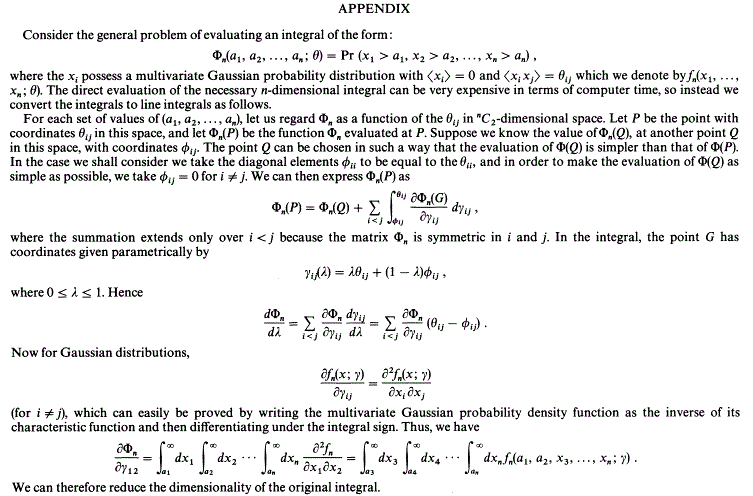
I have to say that Richard did most of the actual work on this paper, though all four authors did spend a lot of time discussing whether the idea was viable in principle and, if so, how we should implement it mathematically. In the end, my contribution was pretty much limited to the Appendix, which you can click to make it larger if you’re interested.

t2png

As is often the case in work of this kind, everything boiled down to evaluating numerically a rather nasty integral. Coincidentally, I’d come across a similar problem in a totally different context a few years previously when I was working on my thesis and therefore just happened to know the neat trick described in the paper.

Two things struck me looking back on this after being reminded of it over that beer. One is that a typical modern laptop is powerful enough to evaluate the original integral without undue difficulty, so if this paper had been written nowadays we wouldn’t have bothered trying anything clever; my Appendix would probably not have been written. The other thing is that I sometimes hear colleagues bemoaning physics students’ lack of mathematical “problem-solving” ability, claiming that if students haven’t seen the problem before they don’t know what to do. The problem with that complaint is that it ignores the fact that many problems are the same as things you’ve solved before, if only you look at them in the right way. Problem solving is never going to be entirely about “pattern-matching” – some imagination and/or initiative is going to required sometimes- but you’d be surprised how many apparently intractable problems can be teased into a form to which standard methods can be applied. Don’t take this advice too far, though. There’s an old saying that goes “To a man who’s only got a hammer, everything looks like a nail”. But the first rule for solving “unseen” problems has to be to check whether you might in fact already have seen them…

A Sense of Proportion – Postscript

Posted in The Universe and Stuff with tags , , on October 30, 2012 by telescoper

It took all day to do so, evidently because I’m old and slow, but this morning’s post eventually got round to reminding me of this cartoon, the context of which is described here. Was that really in 1992? That was twenty years ago!

Merseyside Astronomy Day

Posted in Books, Talks and Reviews, The Universe and Stuff with tags , , , , on May 11, 2012 by telescoper

I’m just about to head by train off up to Merseyside (which, for those of you unfamiliar with the facts of British geography, is in the Midlands). The reason for this trip is that I’m due to give a talk tomorrow morning (Saturday 12th May) at Merseyside Astronomy Day, the 7th such event. It promises to be a MAD occasion.

My lecture, entitled The Cosmic Web, is an updated version of a talk I’ve given a number of times now; it will focus on the large scale structure of the Universe and the ideas that physicists are weaving together to explain how it came to be the way it is. Over the last few decades astronomers have revealed that our cosmos is not only vast in scale – at least 14 billion light years in radius – but also exceedingly complex, with galaxies and clusters of galaxies linked together in immense chains and sheets, surrounding giant voids of empty space. Cosmologists have developed theoretical explanations for its origin that involve such exotic concepts as ‘dark matter’ and ‘cosmic inflation’, producing a cosmic web of ideas that is in some ways as rich and fascinating as the Universe itself.

Anyway, I’m travelling to Liverpool this afternoon so I can meet the organizers for dinner this evening and stay overnight because there won’t be time to get there by train from Cardiff tomorrow morning. It’s not all that far from Cardiff to Liverpool as the crow flies, but unfortunately I’m not going by crow by train. I am nevertheless looking forward to seeing the venue, Spaceport, which I’ve never seen before.

If perchance any readers of this blog are planning to attend MAD VII please feel free to say hello. No doubt you will also tell me off for referring to Liverpool as the Midlands…

The World as a Beach

Posted in Biographical, The Universe and Stuff with tags , , , , , , on April 10, 2012 by telescoper

Well, as some of you will have noticed, I’ve been offline over the long weekend. There’s no internet connection – not one that I could get to work, anyway – at the residence I’m staying in and I couldn’t be bothered to traipse all the way up the hill to the department in the pouring rain to connect from my office. Hence the first gap in my postings this year. I don’t suppose anyone minds that much. Anyway, here are a few pictures and random thoughts from the weekend.

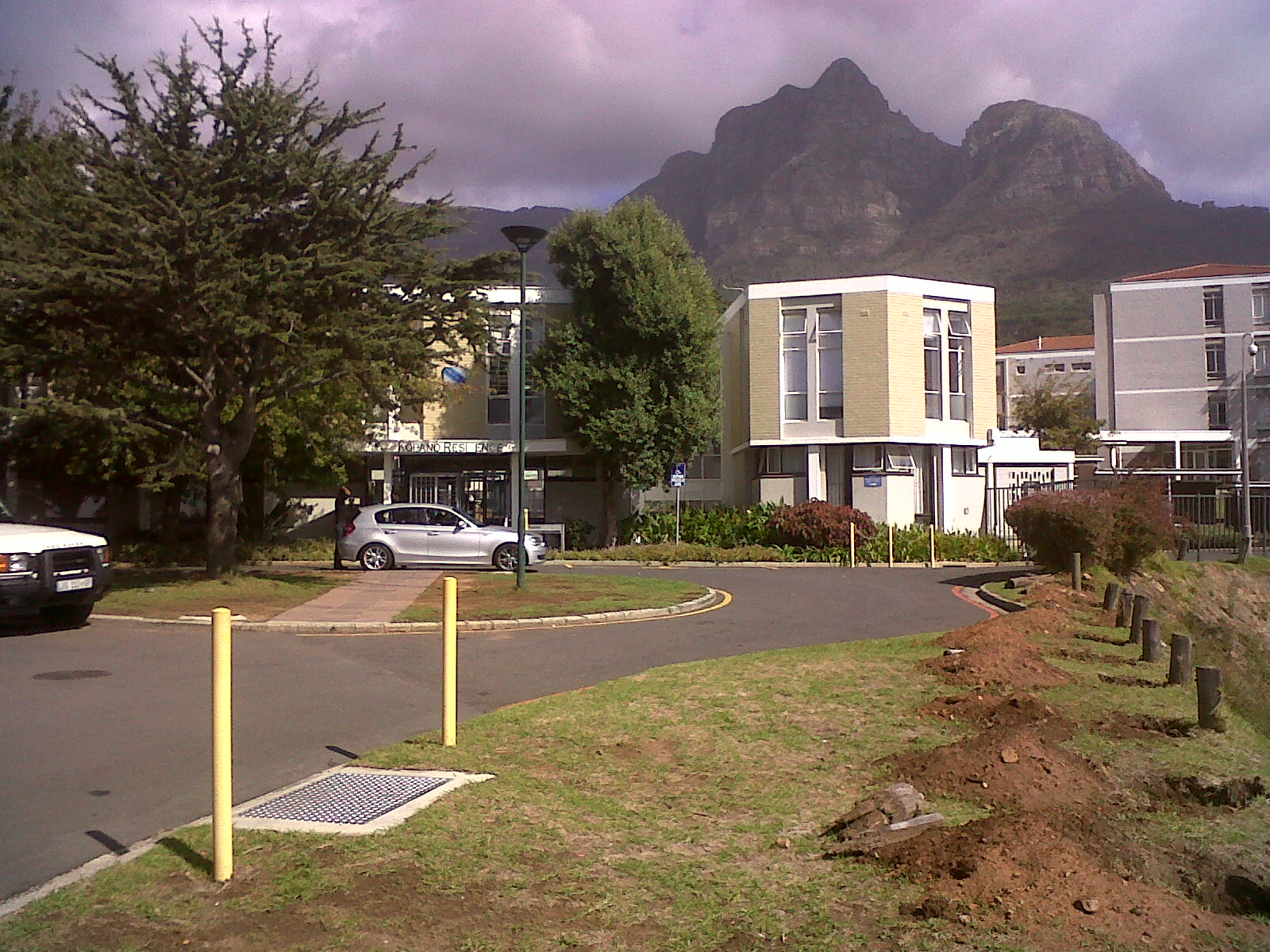
Here’s a picture of the residence, by the way. It’s called Kopano, although when I previously stayed it was called Driekoppen. The old name was a relic of the days of slavery – three slaves were tortured and executedin public  after rebelling against the terrible conditions they were held in. Their heads were displayed on pikes nearby, hence the name which means “Three Heads”. This was in 1724. I’m not surprised that the end of apartheid brought a change in the name, although keeping it as it was would have served as a reminder of South Africa’s terrible past. One shouldn’t  become obsessed by events that took place such a long time ago, but neither should one forget them.

Good Friday was a very Good Friday indeed, starting with a lovely breakfast and a walk on the beach in Muizenberg. Apparently this is something of a surfer’s paradise but, as I said, I didn’t have an internet connection so couldn’t join in. Also, they have sharks here. I mean big ones. Great White ones, as  a matter of fact. None showed up while I was there, though, and in any case I was only paddling along the shoreline. It may not be obvious from the picture, but it was pretty hot. Almost 30 degrees.

 I was watching a chap surfing while we walked along and it reminded me of the post I did a while ago about teaching analogies. Standing on a beach looking out towards the horizon is a bit like doing cosmology. Off in the far distance everything looks smooth; the waves on the surface are much lower in amplitude than the depth of the sea out there, so everything evolves linearly and is quite easy to understand. That’s like looking back in time at the early Universe imprinted on the cosmic microwave background. Nearer to the shore, however, the waves become non-linear because their height is comparable to, or larger than, the depth of the water. These waves evolve in a non-linear way producing, breaking on the beach to produce foam and spray, just as the primordial waves collapse to form galaxies and the foam of large-scale structure when their self-gravity becomes sufficiently strong.

That’s enough of that, I think.

Unfortunately, the weather changed for the worse over the rest of the Easter weekend and torrential rain kept me from doing much on Saturday or Sunday. The finishing section of the  Two Oceans Marathon, which ended on the UCT campus on Saturday, was like a quagmire. As you can see from the picture, I reached the line well in front of the pack. About two days in front, actually. I took this as they were building the stands and hospitality tents a few days before the race.

Anyway, the good side of the bad weather was that I got quite a lot of work done, catching up on things I have let slip for far too long. I also exhausted the reading material I brough with me, so will have to find a good bookshop in the next day or two. Well, that’s about enough for now. I hope to continue regular dispatches from now on until I return to Blighty  next week.

What’s the Matter?

Posted in The Universe and Stuff with tags , , , , , on September 19, 2011 by telescoper

I couldn’t resist a quick comment today on a news article to which my attention was drawn at the weekend. The piece concerns the nature of the dark matter that is thought to pervade the Universe. Most cosmologists believe that this is cold, which means that it is made of slow-moving particles (the temperature of  a gas being related to the speed of its constituent particles).  They also believe that it is not the sort of stuff that atoms are made of, i.e. protons, neutrons and electrons. In particular, it isn’t charged and therefore can’t interact with electromagnetic radiation, thus it is not only dark in the sense that it doesn’t shine but also transparent.

Cold Dark Matter (CDM) particles could be very massive, which would make them much more sluggish than lighter ones such as neutrinos (which would be hot dark matter), but there are other, more complicated, ways in which some exotic particles can end up in a slow-motion state without being massive.

So why do so many of us think the dark matter is cold? The answer to that is threefold. First, this is by far the simplest hypothesis to work on. In other words, good old Occam’s Razor. It’s simple because if the dark matter is cold there is no relevant physical scale associated with the speed of the particles. Everything is just dominated by the gravity, which means there are fewer equations to solve. Not that it’s exactly easy even in this case: huge supercomputers are needed to crunch the numbers.

The second reason is that particle physics has suggested a number of plausible candidates for non-baryonic candidates which could be cold dark matter particles. A favourite theoretical idea is supersymmetry, which predicts that standard model particles have counterparts that could be interesting from a cosmological point of view, such as the fermionic counterparts of standard model bosons. Some of these candidates could even be produced experimentally by the Large Hadron Collider.

The final reason is that CDM seems to work, at least on large scales. The pattern of galaxy clustering on large scales as measured by galaxy redshift surveys seems to fit very well with predictions of the theory, as do the observed properties of the cosmic microwave background.

However, one place where CDM is known to have a problem is on small scales. By small of course I mean in cosmological terms; we’re still talking about many thousands of light-years! There’s been a niggling worry for some time that the internal structure of galaxies, especially in their central regions,  isn’t quite what we expect on the basis of the CDM theory. Neither do the properties of the small satellite galaxies (“dwarfs”) seen orbiting the Milky Way seem to match what what we’d expect theoretically.

The above picture is taken from the BBC website. I’ve included it partly for a bit of decoration, but also to point out that the pictures are both computer simulations, not actual astronomical observations.

Anyway, the mismatch between the properties of dwarf galaxies and the predictions of CDM theory, while not being exactly new, is certainly a potential Achilles’ Heel for the otherwise successful model. Calculating the matter distribution on small scales however is a fearsome computational challenge requiring enormously high resolution. The disagreement may therefore be simply because the simulations are not good enough; “sub-grid” physics may be confusing us.

On the other hand, one should certainly not dismiss the possibility that CDM might actually be wrong. If the dark matter were not cold, but warm (or perhaps merely tepid), then it would produce less small-scale structure whilst not messing up the good fit to large-scale structure that we get with CDM.

So is the Dark Matter Cold or Warm or something else altogether? The correct answer is that we don’t know for sure, and as a matter of fact I think CDM is still favourite. But if the LHC rules out supersymmetric CDM candidates and the astronomical measurements continue to defy the theoretical predictions then the case for cold dark matter would be very much weakened. That might annoy some of its advocates in the cosmological community, such as Carlos Frenk (who is extensively quoted in the article), but it would at least mean that the hunt for the true nature of dark matter would be getting warmer.

The Bull’s-Eye Effect

Posted in The Universe and Stuff with tags , , , , on February 10, 2011 by telescoper

What a day.

For a start we had another manic UCAS admissions event. Applications to study physics here have rocketed, by more than 50% compared to last year, so it’s all hands on deck on days like this. Next weekend we have our first Saturday event of the year, and that promises to be even more popular. Still, it’s good to be busy. Without the students, we’d all be on Her Majesty’s Dole. At least some of our advertising is hitting the target.

After that it was back to the business of handing out 1st Semester examination results to my tutees – the Exam Board met yesterday but I skived off because I wasn’t involved in any exams last semester. Then a couple of undergraduate project meetings and a few matters related to postgraduate admissions that needed sorting out.

Finally, being a member of our esteemed Course Committee, I spent a little bit of time trying to assemble some new syllabuses. All our Physics (and Astrophysics) courses are changing next year, so this is a good chance to update the content and generally freshen up some of the material we teach.

In the course of thinking about this, I dug about among some of my old course notes from here there and everywhere, some of which I’ve kept on an old laptop. I chanced upon this cute little graphic, which I don’t think I’ve ever used in a lecture, but I thought I’d put it up here because it’s pretty. Sort of.

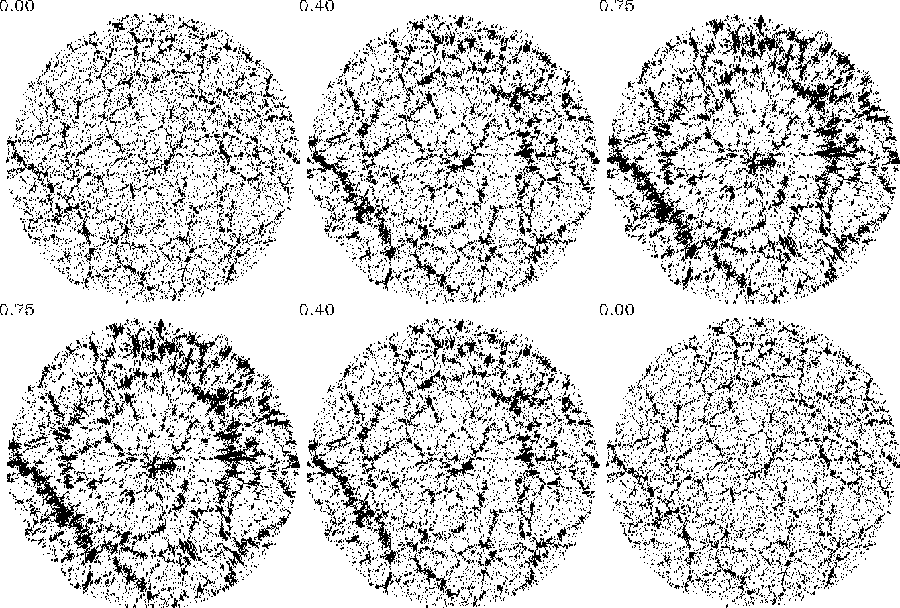
What it shows is a simulation of the large-scale structure of the Universe as might be mapped out using a galaxy redshift survey. The observer is in the centre of the picture (which a two-dimensional section through the Universe); the position of each galaxy is plotted by assuming that the apparent recession velocity (which is what a redshift survey measures) is related to the distance from the observer by Hubble’s Law:

V\simeq cz =H_0 R

where V  is the recession velocity, z  is the redshift, H_0 is Hubble’s constant  and R is the radial distance of the galaxy. However, this only applies exactly in a completely homogeneous Universe. In reality the various inhomogeneities (galaxies, clusters and superclusters) introduce distortions into the Hubble Law by generating peculiar velocities

V=H_0 R+ V_p

These distort the pattern seen in redshift space compared to real space. In real space the pattern is statistically isotropic, but in redshift space things look different along the line of sight from the observer compared to the directions at right angles as described quite nicely by this slide from a nice web page on redshift-space distortions.

There are two effects. One is that galaxies in tightly bound clusters have high-speed disordered motions. This means that each cluster is smeared out along the line of sight in redshift space, producing artefacts sometimes called “Fingers of God” – elongated structures that always point ominously at the observer. The other effect caused by large-scale coherent motions as matter flows into structures that are just forming, which squashes large-scale features in the redshift direction more-or-less opposite to the first.

These distortions don’t simply screw up our attempts to map the Universe. In fact they help us figure out how much matter might pulling the galaxies about. The number in the upper left of the first (animated) figure is the density parameter, \Omega. The higher this number is, the more matter there is to generate peculiar motions so the more pronounced the alteration; in a low density universe, real and redshift space look rather similar.

Notice that in the high-density universe the wall-like structures look thicker (owing to the large peculiar velocities within them) but that they are also larger than in the low-density universe. In a paper a while ago, together with Adrian Melott and others, we investigated  the dynamical origin of this phenomenon, which we called the Bull’s-Eye Effect because it forms prominent rings around the central point. It turns out to be Quite Interesting, because the merging of structures in redshift-space to create larger ones is entirely analogous the growth of structure by hierarchical merging in real space, and can be described by the same techniques. In effect, looking in redshift space gives you a sneak preview of how the stucture will subsequently evolve in real space…


Share/Bookmark

Astronomy Look-alikes, No. 40

Posted in Astronomy Lookalikes, The Universe and Stuff with tags , , , on September 10, 2010 by telescoper

Obviously someone else has already noticed the remarkable similarity between the structure of the human brain and that revealed by computer simulations of the large-scale structure of the Universe.

Does this mean that dark matter is really just all in the mind?


Share/Bookmark

Colour in Fourier Space

Posted in The Universe and Stuff with tags , , , , , on February 9, 2010 by telescoper

As I threatened promised after Anton’s interesting essay on the perception of colour, a couple of days ago, I thought I’d write a quick item about something vaguely relevant that relates to some of my own research. In fact, this ended up as a little paper in Nature written by myself and Lung-Yih Chiang, a former student of mine who’s now based in his homeland of Taiwan.

This is going to be a bit more technical than my usual stuff, but it also relates to a post I did some time ago concerning the cosmic microwave background and to the general idea of the cosmic web, which has also featured in a previous item. You may find it useful to read these contributions first if you’re not au fait with cosmological jargon.

Or you may want to ignore it altogether and come back when I’ve found another look-alike

The large-scale structure of the Universe – the vast chains of galaxies that spread out over hundreds of millions of light-years and interconnect in a complex network (called the cosmic web) – is thought to have its origin in small fluctuations generated in the early universe by quantum mechnical effects during a bout of cosmic inflation.

These fluctuations in the density of an otherwise homogeneous universe are usually expressed in dimensionless form via the density contrast, defined as\delta({\bf x})=(\rho({\bf x})-\bar{\rho})/\bar{\rho}, where \bar{\rho} is the mean density. Because it’s what physicists always do when they can’t think of anything better, we take the Fourier transform of this and write it as \tilde{\delta}, which is a complex function of the wavevector {\bf k}, and can therefore be written

\tilde{\delta}({\bf k})=A({\bf k}) \exp [i\Phi({\bf k})],

where A is the amplitude and \Phi is the phase belonging to the wavevector {\bf k}; the phase is an angle between zero and 2\pi radians.

This is a particularly useful thing to do because the simplest versions of inflation predict that the phases of each of the Fourier modes should be randomly distributed. Each is independent of the others and is essentially a random angle designating any point on the unit circle. What this really means is that there is no information content in their distribution, so that the harmonic components are in a state of maximum statistical disorder or entropy. This property also guarantees that fluctuations from place to place have a Gaussian distribution, because the density contrast at any point is formed from a superposition of a large number of independent plane-wave modes  to which the central limit theorem applies.

However, this just describes the initial configuration of the density contrast as laid down very early in the Big Bang. As the Universe expands, gravity acts on these fluctuations and alters their properties. Regions with above-average initial density (\delta >0) attract material from their surroundings and get denser still. They then attract more material, and get denser. This is an unstable process that eventually ends up producing enormous concentrations of matter (\delta>>1) in some locations and huge empty voids everywhere else.

This process of gravitational instability has been studied extensively in a variety of astrophysical settings. There are basically two regimes: the linear regime covering the early stages when \delta << 1 and the non-linear regime when large contrasts begin to form. The early stage is pretty well understood; the latter isn’t. Although many approximate analytical methods have been invented which capture certain aspects of the non-linear behaviour, general speaking we have to  run N-body simulations that calculate everything numerically by brute force to get anywhere.

The difference between linear and non-linear regimes is directly reflected in the Fourier-space behaviour. In the linear regime, each Fourier mode evolves independently of the others so the initial statistical form is preserved. In the non-linear regime, however, modes couple together and the initial Gaussian distribution begins to distort.

About a decade ago, Lung-Yih and I started to think about whether one might start to understand the non-linear regime a bit better by looking at the phases of the Fourier modes, an aspect of the behaviour that had been largely neglected until then. Our point was that mode-coupling effects must surely generate phase correlations that were absent in the initial random-phase configuration.

In order to explore the phase distribution we hit upon the idea of representing the phase of each Fourier mode using a  colour model. Anton’s essay discussed the  RGB (red-green-blue) parametrization of colour is used on computer screens as well as the CMY (Cyan-Magenta-Yellow) system preferred for high-quality printing.

However, there are other systems that use parameters different to those representing basic tones in these schemes. In particular, there are colour models that involve a parameter called the hue, which represents the position of a particular colour on the colour wheel shown left. In terms of the usual RGB framework you can see that red has a hue of zero, green is 120 degrees, and blue is 240. The complementary colours cyan, magenta and yellow lie 180 degrees opposite their RGB counterparts.

This representation is handy because it can be employed in a scheme that uses colour to represent Fourier phase information. Our idea was simple. The phases of the initial conditions should be random, so in this representation the Fourier transform should just look like a random jumble of colours with equal amounts of, say, red green and blue. As non-linear mode coupling takes hold of the distribution, however, a pattern should emerge in the phases in a manner which is characteristic of gravitational instability.

I won’t go too much further into the details here, but I will show a picture that proves that it works!

What you see here are four columns. The leftmost shows (from top to bottom) the evolution of a two-dimensional simulation of gravitational clustering. You can see the structure develops hierarchically, with an increasing characteristic scale of structure as time goes on.

The second column shows a time sequence of (part of) the Fourier transform of the distribution seen in the first; for the aficianados I should say that this is only one quadrant of the transform and that the rest is omitted for reasons of symmetry. Amplitude information is omitted here and the phase at each position is represented by an appropriate hue. To represent on this screen, however, we had to convert back to the RGB system.

The pattern is hard to see on this low resolution plot but two facts are noticeable. One is that a definite texture emerges, a bit like Harris Tweed, which gets stronger as the clustering develops. The other is that the relative amount of red green and blue does not change down the column.

The reason for the second property is that although clustering develops and the distribution of density fluctuations becomes non-Gaussian, the distribution of phases remains uniform in the sense that binning the phases of the entire Fourier transform would give a flat histogram. This is a consequence of the fact that the statistical properties of the fluctuations remain invariant under spatial translations even when they are non-linear.

Although the one-point distribuition of phases stays uniform even into the strongly non-linear regime, they phases do start to learn about each other, i.e. phase correlations emerge. Columns 3 and 4 illustrate this in the simplest possible way; instead of plotting the phases of each wavemode we plot the differences between the phases of neighbouring modes in the x  and y directions respectively.

If the phases are random then the phase differences are also random. In the initial state, therefore, columns 3 and 4 look just like column 2. However, as time goes on you should be able to see the emergence of a preferred colour in both columns, showing that the distribution of phase differences is no longer random.

The hard work is to describe what’s going on mathematically. I’ll spare you the details of that! But I hope I’ve at least made the point that this is a useful way of demonstrating that phase correlations exist and of visualizing some of their properties.

It’s also – I think – quite a lot of fun!

P.S. If you’re interested in the original paper, you will find it in Nature, Vol. 406 (27 July 2000), pp. 376-8.