Archive for Learning

Approaching Examinations

Posted in Education, Maynooth with tags , , , , , , , , on November 27, 2024 by telescoper

We’re in Week 9 of teaching in the Autumn Semester at Maynooth University, which means we’ve got one eye on the forthcoming Examination Period, which starts on 10th January 2025. Examination papers have already been prepared in draft form, and are now being checked ahead of printing. A draft examination timetable has also been released to staff, but not yet to students in case it has to be revised because of clashes.

I’m still on schedule with both my modules to finish the actual content in time to do use the last week for revision classes, going through past examination papers and generally helping the students prepare for the ordeals of January. There is a continuously-assessed component of both my modules, which counts 20% of the overall grade. One purpose of these assignments is to give the students some practice at the sort of problems they might encounter in the examinations: if they can do the assignments, they shouldn’t be too fazed by the examination questions. The purpose of the coursework is not just about passing examinations, however. I think the only way really to learn about mathematical physics is by doing it; the coursework is at least as important as the lectures and tutorials in terms of actually learning the subject. I think that modern higher education involves drastic over-assessment. Too much emphasis on grades and scores can be detrimental to real learning, but assessment that is formative can be extremely beneficial. Continuous assessment provides a way to give feedback to students on how they are doing, and to lecturers on how well the message is getting across; giving grades to such coursework is really just an incentive to the students to do it. It’s not primarily intended to be summative.

Anyway, back to examinations. One big difference between our examinations in Theoretical Physics in Maynooth and those at other institutions at which I’ve taught (in the UK) is that most of the papers here offer no choice of questions to be answered. Elsewhere it is quite common to find a choice of two or three questions from four or five on the paper. In my module on Differential Equations and Complex Analysis, for example, there are four questions on the examination paper and students have to do all of them for full marks.

One  advantage of our system is that it makes it much harder for students to question-spot in the hope that they can get a good grade by only revising a fraction of the syllabus. If they’re well designed, a few longish questions can cover most of the syllabus for a module, which they have to in order to test all the learning outcomes. To accomplish this, questions can be split into parts that may be linked to each other to a greater or lesser extent in order to explore the connections between different ideas, but also sufficiently separate that a student who can’t do one part can still have a go at others. With such a paper, however, it is a  dangerous strategy for a student to focus only on selected parts of the material in order to pass.

As an examiner, the Maynooth style of examination also has the advantage that you don’t have to worry too much if one question turns out to be harder than the others. That can matter if different students attempt different questions, as students might be penalized if they chose a particularly hard one, but not if everyone has to do everything.

But it’s not just the number of questions that’s important, it’s the duration. I’ve never felt that it was even remotely sensible for undergraduate physics examinations to be speed tests, which was often the case when I was a student. Why the need for time pressure? It’s better to be correct than to be fast, I think. I always try to set examination questions that could be done inside two hours by a student who knew the material, including plenty of time for checking so that even a student who made a mistake would have time to correct it and get the right answer. If a student does poorly in this style of examination it will be because they haven’t prepared well enough rather than because they weren’t fast enough.
General Science at Maynooth

Posted in Education, Maynooth with tags , , , , , , , on May 27, 2024 by telescoper

Following on – sort of – from yesterday’s post – here is a little promotional video about the ‘Omnibus’ Bachelor of Science undergraduate course (codename MH201). I have blogged about this course before (e.g. here) but this gives me an opportunity to repeat the salient points.

Currently, most students doing Science subjects here in Maynooth enter on the General Science programme a four-year Omnibus BSc course that involves doing four subjects in the first year, but becoming increasingly specialized thereafter. That’s not unlike the Natural Sciences course I did at Cambridge, except that students at Maynooth can do both Mathematical Physics and Experimental Physics in the first year as separate choices. I’d recommend anyone who wants to do Physics in the long run to do both of these, as they do complement each other. Other possibilities include Chemistry, Computer Science, Biology, etc.

In Year 1 students do four subjects (one of which has to be Mathematics). That is narrowed down to three in Year 2 and two in Year 3. In their final year, students can stick with two subjects for a Joint Honours (Double Major) degree, or specialise in one, for Single Honours.

I like this programme very much because it does not force the students to choose a specialism before they have had a taste of the subject, and that it is flexible enough to accommodate Joint Honours qualifications in, e.g., Theoretical Physics and Mathematics. It also allows us to enrol students onto Physics degrees who have not done Physics or Applied Mathematics as part of the Leaving Certificate.

Anyway, this video features Oisín Davey, who took Mathematical Physics, Experimental Physics, Chemistry and Mathematics in his first year. As a matter of fact I taught him in Year 1 (Mechanics & Special Relativity) and Year 2 (Vector Calculus and Fourier Series) but, despite that, as he explains, he has decided to persist with Mathematical Physics. He will be in the final year next academic year, after he returns from his summer in CERN, and I’ll be back from sabbatical.

Teaching + Learning ≠ Lecturing

Posted in Biographical, Education, Maynooth with tags , , , , , on January 13, 2022 by telescoper
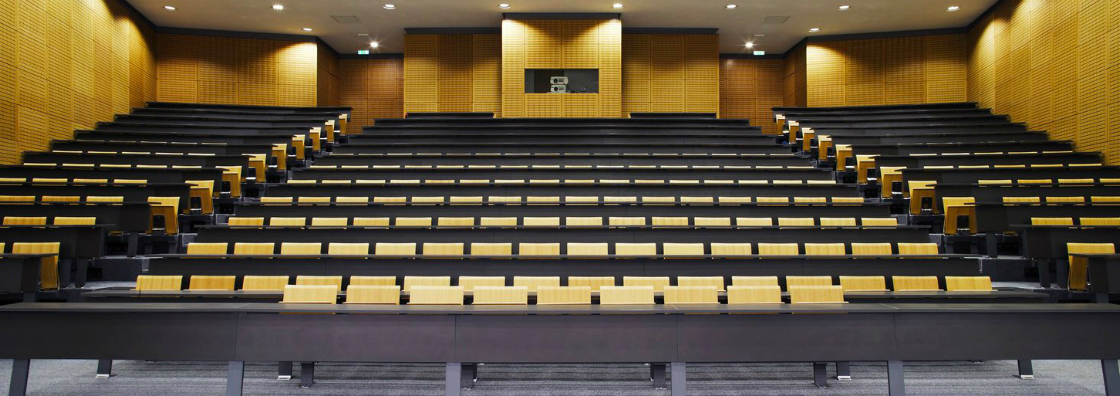
Iontas Lecture Theatre, Maynooth University

The main purpose of this post is to encourage you to read a piece written by a second-year student at the blog run by Phil Moriarty of Nottingham University entitled Death of the Lecture: Musings of a second year student as it provides at least some first-hand reflections from a current student about the difficulties being faced by a student. So, go on, or as they say round here, gwan. Read it.

I couldn’t resist making a few tangential comments of my own.

First, on my philosophy of teaching (such as it is) which is largely formed by my own experiences both as a student many years ago and as a lecturer for many years since then. When I was an undergraduate I didn’t get much out of the lectures I attended at Cambridge and my attendance dropped off a bit as my course went on (though I still attended most). This was because the majority of lectures just involved transparency after transparency being put on and taken off the overhead projector, with students frantically writing down as much as they could but with little time to think. I think that’s what people nowadays call a “traditional” lecture. I agree with Phil Moriarty that these are pedagogically useless. If there ever is a return to normality, the New Normal – to use a very hackneyed phrase – should not be based on this as the primary mode of teaching.

I think this form of non-teaching evolved because it is cost-effective, but academics have gone along with it largely because lots of them actually enjoy standing up and talking about their subject; sometimes it’s difficult to get them to stop. As a matter of fact, that applies to me too. I enjoy talking about physics and astrophysics. I like to think that I can at least communicate some enthusiasm for the subjects through lectures, but I do realize that this does not necessarily make me a very effective teacher.

But in many ways I think the “traditional lecture” described above is a straw man. Many lecturers actually use the traditional format (50 minutes with a class in a large room) to do much more than I’ve just described. When we had to switch teaching online I bought a blackboard and did my lectures from home using it. I know a lot of people found it quaint that I adopted this “traditional” approach but I think explaining mathematical concepts through examples works well via a chalkboard and by standing up I could put more energy into the session than I could if sitting at a screen.

The point is that nowadays we provide students with many more resources to back up this kind of activity – besides my sessions the students get tutorials, and besides the live sessions they get printed notes, problem sets to do on their own, various online resources and of course video recordings. Having all that allows the lecturer to free themselves from the task of delivering material and instead try to cultivate understanding. I never lecture verbatim from notes; I prefer to cover the material in a complementary fashion, expanding on the bits I think need most explanation and/or are most important.

When I was a student I found I learned best not by attending lectures but by reading textbooks and doing problems. That’s just me though. Over the years I realized that different students learn in very different ways. The most important thing for teachers to do is to provide as many ways as possible for the students to learn so they can use what works best for them. In some respects I think of higher education as being more like a smorgasbord than a set menu.

But there lies the difficulty. There is now so much extra material available that many students find it hard to know where to start, just as when you arrive at a buffet table: it might look appetizing but you might not even know what’s in many of the dishes. There needs to be some structure, especially in the early years of a degree to help students find their own way to navigate the more independent methods of study required in an undergraduate degree.

The question for me is not whether lectures have a role to play in the New Normal – I think they do – but what is the best way to incorporate them in a blend. More importantly we need to do a lot more to help students develop their study skills and structure their time so they can learn most effectively. There was no time to do this when the pandemic forced us to change and we were given few resources to assist in the task, but it’s going to be necessary in future as we move inevitably to a more flexible future. Timetabled lectures do of course provide a structure, but there’s almost certainly a better way. As one concrete proposal, I’d call for a vastly expanded induction programme for new students focussing on study skills and other aspects of learning to put in place for the benefit of future intakes.

Like most universities, Maynooth University has a “Teaching & Learning Committee”. I sometimes wonder whether there is as strong a connection between these two words as we’d like to believe. At any rate, switching teaching online does not necessarily mean that learning goes with it!

Challenges Past and Future

Posted in Covid-19, Education, Maynooth with tags , , , , , , on June 19, 2020 by telescoper

Yesterday afternoon we held our Departmental Examination Board in Theoretical Physics (via Microsoft Teams*) which all went remarkably well in the circumstances.

The most challenging thing to happen yesterday afternoon was that a bloke came to cut back the bushes outside my office with a very large and noisy hedge trimmer. I thought I was going to have to contend with that all afternoon but it seems he had done most of it the day before and only came back yesterday to finish off. He left before the Exam Board started.

The next stage of our Exams process is for all the Departmental results to be collated for those students on joint programmes before the final University Board takes place about ten days from now. After that students will get their results.

That doesn’t quite finish examination matters for 2019/20 however because some students will need to take repeat examinations in August. These will be a week later than usual as a knock-on effect of the extra week we were given to mark and correct the May exams. We anticipate that at least some of the repeats will be the traditional `in person’ on campus style, but some may be online timed assessments like the ones we held in May. That depends a bit on how the Covid-19 pandemic pans out in Ireland over the next few weeks (and of course how many students actually take repeats, as social distancing generates a capacity issue for the examination halls).

At the moment we are optimistic because the number of new cases of Covid-19 is low and stable. That coulld change, of course, if the virus starts to spread again so we have to have contingency plans.

Even more uncertain is what will happen in September, although I have been very annoyed by some reports in the media that seem to have been actively trying to put students off coming to University next academic year on the grounds that there won’t be any lectures. We certainly plan to offer as much face-to-face teaching as possible and I think other third-level institutions in Ireland will do likewise. There will of course have to be a backup if there is another lockdown, which may mean switching back to remote teaching at relatively short notice, but at least we’ve done that once already so know much better now what works and what doesn’t. Nevertheless I would encourage all potential students not to believe everything they read in the media nor be deterred from attending university by rumours from sources who don’t know what they are talking about.

Earlier this week I was starting to think about how we might build the required flexibility into our teaching for next year and two main things struck me.

The first is that while we have more-or-less been forced into making various kinds of video material available to students, this is something that I feel we should have been doing already. I’ve long felt that the more types of teaching we incorporate and the wider range of learning materials we provide the better the chance that students find something that works for them. Even if we do have a full programme of lectures next year, it is my intention to continue to provide, e.g., recorded video explainers as well because they might augment the battery of resources available to the student.

Some time ago I had to make some policies about `reasonable adjustments’ for some disabled students learning physics. In the course of providing extra resources for this small group I suddenly thought that it would be far better, and far more inclusive, simply to make these resources available to everyone. Likewise, we’ve been forced to adjust to providing material remotely but we should be thinking about how to keep the best things about what we’ve done over the last few months and embedding them in the curriculum for the (hopefully Coronavirus-free) future and not regard them all as temporary special measures.

The other thing that struck me is in the same vein, but a little more speculative. Over the last many years I have noticed that students use printed textbooks less and less for learning. Part of that may be because we in a digital age and they prefer to use online resources. The switch to remote learning has however revealed that there are some students who are disadvantaged by not having a good internet connection. I just wonder whether this might lead to a resurgence in the use of textbooks. I’ll certainly be making a strong recommendation to the new first-year students in Theoretical Physics that they should get hold of the recommended text, which I have previously regarded as an optional extra.

*At one point I got muddled up between Teams and Zoom and called it Tombs. It was a grave error, but it can only be a matter of time before Microsoft Tombs actually arrives…