Archive for Leaving Certificate 2025

Moving On

Posted in Education, Maynooth with tags , , , , , , , on August 22, 2025 by telescoper

Last week I wrote a post about the loose ends of the academic year, one of which concerned my PhD student Aoibhinn, who passed her viva voce examination way back in May, who had to submit a bound copy of the thesis to the relevant office by September 6th so that her degree could be ratified by Faculty and Academic Council. She has now done that, and in the process kindly made me an extra copy of the Authorized Version to put on my shelf:
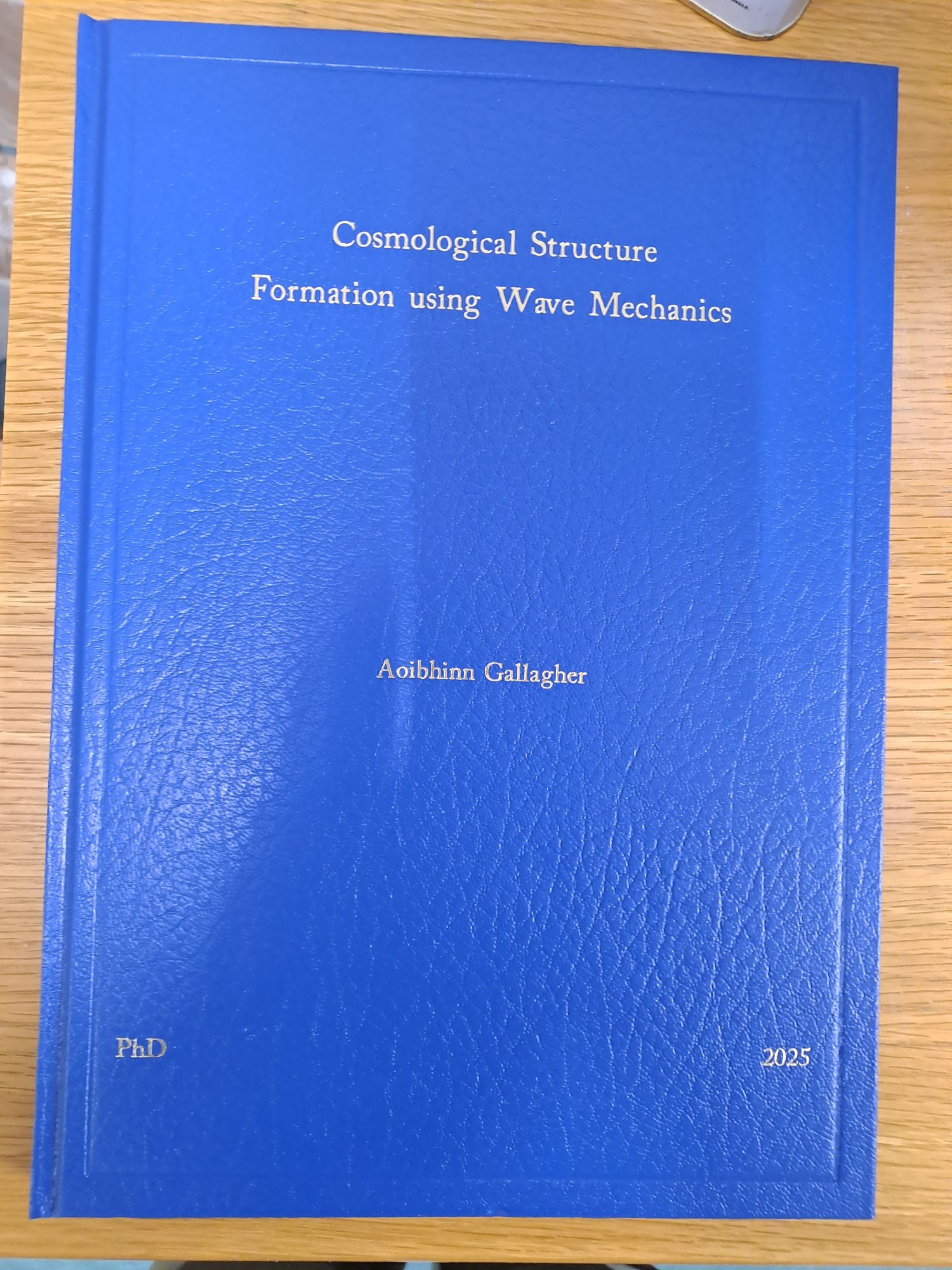
It will be easy to find on my shelf because it’s a different colour from the others. Aoibhinn will be off to Germany for a postdoctoral fellowship after her conferring ceremony in October.

In subsequent post I mentioned a plethora of meetings to take place this week, all of which went off without much incident. The various Departmental Examination Boards did their business and students will receive their results on September 5th. Students involved in these will be moving on in various ways: some will be graduating, some progressing to the next year of their course and others – though not very many at all – will be leaving without qualifying.

Meanwhile, elsewhere in Ireland, students in the Class of 25 have today been receiving their school Leaving Certificate results. As expected, the proportion at the highest grade (H1) is down significantly compared 2024. On the other hand, the total number of students taking  Leaving Certificate examinations is significantly higher  than last year. You can find all the national statistics here.

How these nationwide effects  will work their way through to undergraduate admissions at Maynooth remains to be seen. Applicants will get offers through the CAO system next week; the points required by each higher education institution should be available online on Wednesday 27th. The Irish Times traditionally publishes a pull-out supplement showing all the offers for all courses at all universities across the sector the following day, i.e. on Thursday 28th September.

By the end of next week, therefore, we’ll have some sort of an idea how many students we will have entering the University in September 2025 and can begin moving on to the next academic year. One thing I’ve already got sorted out – way ahead of previous years – is my teaching timetable for Semester 1. Usually I’ve been happy if I had this before the first week of term! My new timetable makes Tuesdays and Thursdays my heaviest teaching days, but gives me Wednesday free for research and other things that I’ve started planning already.

The 2025 Leaving Certificate Physics papers

Posted in Education, Maynooth with tags , , , on June 18, 2025 by telescoper

As I have already mentioned on this blog, examinations for the 2025 school Leaving Certificate are under way. One of the interesting things about the Irish system is that the examination papers are put up online immediately after the examinations so it’s very easy to share the content. I have already posted the two Mathematics papers for 2025. This year’s Physics examinations (at Ordinary and Higher level) took place this morning, so I thought I’d share the papers here. In particular, readers in the UK might be interested to compare the standard of these papers with that of current A-levels in Physics.

One thing I should mention is that Leaving Certificate Physics is not a prerequisite for entry into any of our Physics programmes at Maynooth University. Some do have it, but many don’t. We teach the first-year material from scratch for all students. Anyway, here are this years papers, Ordinary and Higher respectively. As usual comments are welcome, through the box below:

I think the Ordinary level paper could have done with better proof-reading. As well as Jim’s comment below, there is

Explain how your calculations can be used to verify the principle of conversation of
momentum.

The Leaving

Posted in Biographical, Education, mathematics, Maynooth with tags , , , , , on June 4, 2025 by telescoper

Today is not only a significant date for me (in more ways than one), but it’s important for many young people in Ireland because the Junior Certificate and Leaving Certificate examinations both start today, so the first thing I need to do is wish everyone starting their examinations the very best of luck!

Among other things, the results of the leaving certificate examinations are important for September’s university admissions. This year the grade inflation that occurred during the pandemic years will be reduced, though it is not yet clear how. Whatever happens is likely to have a big impact on student recruitment to third-level institutions.

In the system operating in England and Wales the standard qualification for entry is the GCE A-level. Most students take A-levels in three subjects, which gives them a relatively narrow focus although the range of subjects to choose from is rather large. In Ireland the standard qualification is the Leaving Certificate, which comprises a minimum of six subjects, with many students taking more than this. This gives students a broader range of knowledge at the sacrifice (perhaps) of a certain amount of depth; it has been decreed for entry into this system that an Irish Leaving Certificate subject counts as about 2/3 of an A-level subject for admissions purposes, so Irish students do the equivalent of at least four A-levels, and many do more than this. It’s also worth noting that all students have to take Mathematics at Leaving Certificate level.

One can choose to do Leaving Certificate subjects at Ordinary or Higher level and there’s quite a big difference between the two, especially in Mathematics (of which more below).

Overall I prefer the Leaving Certificate over the UK system of A-levels, as the former gives the students a broader range of subjects than the latter (as does the International Baccalaureate). I would have liked to have been allowed to take at least one arts subject past O-level, for example.

For University admissions points are awarded for each paper according to the marks obtained and then aggregated into a total CAO points, CAO being the Central Applications Office, the equivalent of the UK’s UCAS. This means, for example, that our main Science pathway at Maynooth allows students to study Physics without having done it at Leaving Certificate level. This obviously means that the first year has to be taught at a fairly elementary level, but it has the enormous benefit of allowing us to recruit students whose schools do not offer Physics.

There is however a big problem with Mathematics. It was decided some years ago that students would get 25 extra CAO points if they got a mark of at least 40% in Higher Mathematics. This has led to more students taking the subject, which is good, but there are signs that this may have led to a decline in standards. If, for example, the marking is such that a fixed proportion of students get the top grade but more weaker students take the examination, that means that standards fall at the top end. For more discussion, see here.

Anyway, our Theoretical Physics & Mathematics course requires a good result in Higher Mathematics for entry. Will changes to the marking of Higher Mathematics this year make it harder for students to make the grade? We’ll just have to wait and see.

Moreover, since the pandemic struck, students have been able to choose to answer questions from a limited range of sections on the mathematics examination papers. That means that students can get very high grades despite knowing nothing about a big chunk of the syllabus. That matters most for subjects that require students to have certain skills and knowledge for entry into University, such as Physics. I taught part of our first year Mathematical Physics course in Maynooth for about 5 years. It was noticeable how the fraction that were comfortable with basic differentiation and integration was falling. Will this trend accelerate? Again, we’ll just have to wait and see…