Archive for Louis Armstrong

One Hundred Years of the Hot Five

Posted in History, Jazz with tags , , , , , , , on November 12, 2025 by telescoper

Exactly one hundred years ago today, on 12th November 1925, five musicians gathered in the Okeh studios in Chicago to create musical history. The band was Louis Armstrong and his Hot Five and they were about to embark on a series of recording sessions that would result in a rich treasury of 20th century music in the form of 33 sides recorded between November 1925 and December 1927.

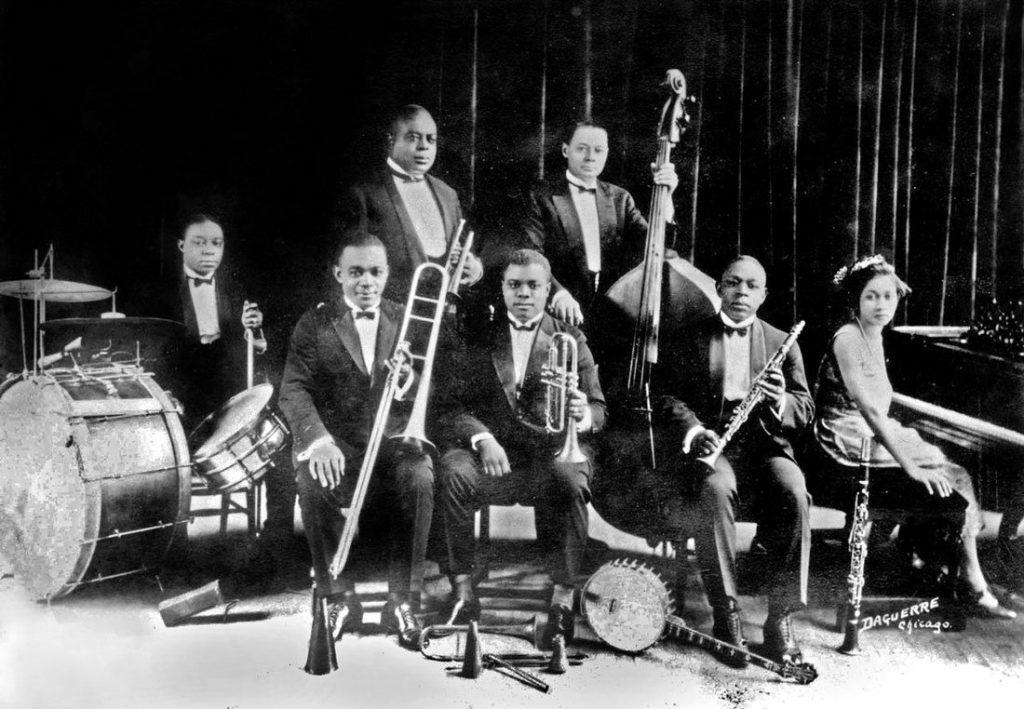
The band (pictured above) consisted of Louis Armstrong (on cornet on this track, although he switched to trumpet by the time of the later sessions). Kid Ory played trombone Johnny Dodds Clarinet. Lil Hardin (who was married to Louis Armstrong at the time and credited as Lil Armstrong) played piano and Johnny St Cyr played banjo or guitar. For many people, the collective imagination and sheer drive of Armstrong, Dodds and Ory made them just about the perfect front line. The way they take this one out at the end is a great example.

I won’t even try to write a detailed analysis of this historic record. I’ll just make a couple of points about the Hot Fives.

First, this band never played together as such in live concerts; they were strictly a studio band. In fact, they always sounded like a bunch of friends getting together to have fun making music, which is no doubt because that’s what they were. Most of the records they made were done in a single take, too.

Second, the line-up was unusual because it didn’t have a full rhythm section. At least part of the reason for this was that, at the time, drums were very difficult to record. In Louis Armstrong’s recorded reminiscences he talks about the fact that drums would often make the needle jump when cutting a record if they were were positioned close to the recording equipment. On the other hand if they were too far away to avoid that happening then they often couldn’t be heard at all. The low-frequency response of old fashioned recording systems made bass lines largely inaudible too. Anyway, it was decided that the excellent combination of Lil Hardin’s piano and Johnny St Cyr’s banjo would provide a sufficient framwork. So they were, though later on, in May 1927, a brass bass and drums were added to create the Hot Seven who made a further 11 sides, including the all-time classic Potato Head Blues.

Finally I’ll just remark that according to Satchmo’s memoirs, this track Gut Bucket Blues was the first to be recorded. It does sound like it too, as he introduces the members of the band. I wonder if they knew at this first session what a sensation these records were going to create?

P.S. I know it’s a bit scratchy, but it’s 100 years old. It’s amazing to me that you can hear anything at all.
A Century of See See Rider

Posted in Jazz with tags , , , , , , , on October 16, 2024 by telescoper

Back in 2023 I posted an item marking the first appearance of Louis Armstrong on record with King Oliver’s Creole Jazz Band back in 1923. Now it’s time to mark another jazz centenary which also involves Satchmo but in a different setting. King Oliver’s band split up at the end of 1923 over a disagreement about a planned nationwide tour and in 1924 Louis Armstrong moved to New York. He was soon snapped up by Fletcher Henderson and spent a glorious year as star trumpet soloist with Henderson’s big band. During that time he also made records with various small bands, including a number with the great vocalist and “Mother of the Blues” Gertrude “Ma” Rainey.

One of the tracks recorded by Ma Rainey in the Paramount studio in New York was called See See Rider. Although not released until 1925, the very first recording of this number was made exactly one hundred years ago today, on 16th October 1924, by “Ma Rainey and her Georgia Jazz Band”, the supporting musicians being Charlie Dixon (Banjo), Buster Bailey (Clarinet), Charlie Green (Trombone), Fletcher Henderson (Piano) and Louis Armstrong (Cornet). The origins of this blues song are lost in the mists of time but it has been recorded a huge number of times, not only by jazz and blues musicians but also by the likes of Elvis Presley; I posted a great version by Peggy Lee here.

Unusually for the time, two takes were made of which the following was the first. Notice that there is an introduction in the form of a verse, which is quite unusual: most blues performances involve only a chorus. Despite the limitations of recording technology at the time you can hear what a tremendously soulful voice Ma Rainey had, and the muted cornet work by Louis Armstrong is unmistakable.

The sound quality may not be great, but it’s a priceless piece of music history.

A Jazz Centenary

Posted in History, Jazz with tags , , , , , on April 5, 2023 by telescoper
King Oliver’s Creole Jazz Band vintage 1923. From the left: Warren “Baby” Dodds (drums); Honore Dutrey (seated front, trombone); Joe “King” Oliver (standing rear, cornet); Louis Armstrong (seated front, cornet); Bill Johnson (standing rear, string bass and banjo); Johnny Dodds (seated front, clarinet); and Lil Hardin (piano)

I’ve been looking forward to this day because it marks an important jazz centenary. Or at least I think it does. There’s some contradictory evidence about whether it was April 5th 1923 or April 6th, or maybe both, when King Oliver‘s Creole Jazz Band did its first ever recording session at the Gennett studios in Richmond, Virginia. They recorded 20 sides in that session, which may well have involved two days with a break in between or working through the night.

These dates represent a remarkable occasion not only because King Oliver’s band was really the first jazz Supergroup, but also because it had been joined just a few months earlier by a young cornet player by the name of Louis Armstrong. This session therefore represent the first examples of Louis Armstrong ever heard on record.

It is somewhat surprising that this historic session happened at the Gennett studios. The band was based on Chicago, Illinois, and the studios were in Richmond, Virginia, so it required a long road trip to get there. Moreover the studio building wasn’t exactly in a prime location, as it was right next to a railroad line:

Musicians had to time their recordings so as to avoid the noise from passing trains. Still, records only lasted about 3 minutes in those days so presumably weren’t so frequent as to make it difficult to fit in a take between two of them! Recording techniques were rather primitive in those days though, and the sound quality that emerged isn’t great.

The lineup for the band is shown in the picture at the top of this page. It’s interesting to note that four of these musicians (Armstrong, Hardin, and the Dodds brothers) were to feature regularly from 1925 onwards in the classic Hot Fives and Hot Sevens. King Oliver’s band, however, had style that was very different from these later records, with a much greater emphasis on polyphony, much more complex arrangements, and much less emphasis on solos. Also, King Oliver’s band played to live audiences on a regular basis, but the Hot Fives and Hot Seven only ever performed as such in recording studios.

As far as I understand how this band worked, King Oliver made the arrangements. I don’t think they used full written scores, but tended to play from wonderfully intricate “head arrangements” worked out beforehand, with ensemble passages, gaps for breaks and solos, and King Oliver introducing the (usually very catchy themes). Armstrong and Johnny Dodds improvised a decorative counterpoint, and Honore Dutrey added harmonic breadth to the ensemble. This must have been a great learning experience for the young Louis Armstrong, has he had to develop a great ear for what was going on around him to play like this. I gather that Louis Armstrong often tended to play very loud so he was kept well in the background in these early Gennett sessions, but such a prodigious talent was never going to play second fiddle for long and in later sessions he effectively duets with King Oliver and swapped leads with him freely and completely intuitively, producing a sound that was entirely unique. I am always astonished by how much is going on in these old records, even if you can’t hear it all very well!

I’ve mentioned before that, over time, this classic type of polyphonic Jazz – derived from its New Orleans roots – gradually morphed into musical form dominated by much simpler arrangements and a succession of virtuoso solos. This change was also reflected in the differing fortunes of Louis Armstrong and King Oliver. The former went on to become an international celebrity, while the latter lost all his savings when his bank went bust during the Wall Street Crash and ended his life working as a janitor.

As well as Gennett, this band recorded with other labels in 1923 including Okeh and Columbia. Sadly however they split up at the end of 1923 over disagreements about a possible tour in 1924. Only about 40 sides were ever recorded King Oliver’s Creole Jazz Band. Many of them are absolutely marvelous.

This is the first track recorded by the band in April 1923. It’s called Just Gone. It’s a scratchy old record, with a rather compressed acoustic, so it’s like putting your next to one end of a tunnel leading back a hundred years, but it’s a good example of the Creole Jazz Band’s style. Joe Oliver’s lead cornet clearly influenced Louis Armstrong’s later style. You have to listen hard to hear Satchmo in the background on this track, but it’s worth the effort. You’re listening to a piece of music history, and a wonderful piece at that.

Louis Armstrong and Bix Beiderbecke: Singin’ the Blues

Posted in History, Jazz with tags , , on September 4, 2022 by telescoper

 Leon “Bix” Beiderbecke became a jazz-age romantic legend not only by playing brilliant cornet but also by drinking too much bad prohibition liquor resulting his premature death in 1931, at the age of only 28. His short life was punctuated by episodes of very bad health caused by chronic alcoholism in an era when the only booze that was available was bathtub gin or rotgut whisky. Despite all his problems, Bix still gave us some of the greatest ever jazz records.

Although he was of middle-class white origins, Bix’s playing was deeply admired by leading black musicians of the day notably the great Louis Armstrong. Some years ago I listened to a radio play called Bix: Singing the Blues which is a fictional account of the only occasion in which Bix Beiderbecke and Louis Armstrong played together, in a private, after-hours session. Given the description of that as “fictional” I assumed that Bix and Satchmo didn’t know each other well. Recently, however, I came across a recording of Louis Armstrong talking about Bix Beiderbecke that shows I was wrong:

(There is one little bit of confusion in the discussion: Bix wasn’t 31 when he died: he died in 1931, at the age of 28. )

So how good was Bix? Well, make your own mind up. Here is his classic version of Singing the Blues, with Frankie Trumbauer’s Orchestra in 1927, a three minute track in which Bix’s stunning solo starts a minute in and lasts a minute.

Jazz being largely improvised music, it is often a bit rough around the edges; even the Hot Fives and Hot Sevens have their share of duff notes. Bix’s solo on this record with that beautiful ringing, bell-like tone, and effortless swing at what is quite a slow tempo, is as close to perfection as you’ll ever find.

But you don’t need to take my word for it.

During his heyday in the1920s Louis Armstrong played virtually every popular tune that was put in front of him, including many songs that seemed unpromising from a jazz perspective, and in the process turned any amount of base metal into solid gold. Singin’ the Blues was a smash hit, but Louis Armstrong refused to play it. When asked why he replied that he didn’t think he could play it as well as Bix. There is no higher praise.

See See Rider Blues

Posted in History, Jazz with tags , , on May 23, 2020 by telescoper

There have been dozens of versions of the old song See See Rider and its origins are lost in the mists of time, but I’m pretty sure that the first ever recording was this one, made in October 1924 by the fabulous Gertrude `Ma’ Rainey (vocals) together with a stellar backing group including Louis Armstrong on cornet, Buster Bailey on clarinet and Fletcher Henderson on piano.

A Musical Memory: Mabel’s Dream

Posted in Biographical, Jazz with tags , , , , , on November 7, 2019 by telescoper

So that’s that. The funeral is over. We all said our goodbyes, and there many tears.

My Mam chose the music for her funeral a long time ago, and the piece that was playing as we arrived in the West Chapel of the West Road Crematorium was one that I wrote about about a decade ago, so I thought I’d indulge myself by posting here the version we heard today.

Years ago my Mam told me that she heard the tune Mabel’s Dream played on the piano by a friend of the family by the name of Johnny Handle. Best known as a folk musician (and founder member of a well-known band called The High Level Ranters) he is also a music teacher and musicologist with a wide range of interests in music. I read somewhere that this lovely tune was originally written by Jelly Roll Morton and performed by him on solo piano, but by far the most famous recording of Mabel’s Dream was made by King Oliver and his Creole Jazz Band in Chicago in 1923. This was the band that the young Louis Armstrong belonged to before going on to make the classic Hot Fives and Hot Sevens, one of which I posted a bit ago. It’s interesting how different the earlier band sounds: with two cornets (King Oliver and Louis Armstrong), clarinet (Johnny Dodds), and trombone (Honore Dutrey) playing together virtually all the time except for short improvised solo breaks. King Oliver usually played lead cornet, at least in their earlier recordings, with Louis Armstrong playing a decorative counterpoint around him rather like a clarinettist might. Later on, they swapped leads freely and completely intuitively producing a sound that was entirely unique.

The ensemble playing is intricate, but the band had no written music, preferring to work exclusively from “head” arrangements. Their music is consistently delightful to listen to, with a succession of marchy themes that makes it impossible not to want to tap your feet when you listen to them.

Over time, this classic type of polyphonic Jazz- derived from its New Orleans roots – gradually morphed into musical form dominated by much simpler arrangements and a succession of virtuoso solos. This change was also reflected in the differing fortunes of Louis Armstrong and King Oliver. The former went on to become an international celebrity, while the latter lost all his savings when his bank went bust during the Wall Street Crash.

Considering the relatively brief time that they played together, King Oliver and Louis Armstrong made an astonishingly large number of astonishingly beautiful records, including this one which I’m posting here to show that as well as many other things my Mam had great taste in Jazz.

Wild Man Blues

Posted in Jazz with tags , , on February 16, 2018 by telescoper

Time, I think, for some vintage jazz. This one doesn’t really need many words of introduction. It was recorded on May 7th 1927 in the Okeh Studios in Chicago by Louis Armstrong and his Hot Seven: Louis Armstrong (cornet), John Thomas (trombone), Johnny Dodds (clarinet), Lil Armstrong (piano), Johnny St. Cyr (banjo), Pete Briggs (tuba), and Warren `Baby’ Dodds (drums). Two things are worth saying, though. One is that this piece is very modern-sounding for its time, in that there’s very little of the ensemble work that one associates with New Orleans jazz, just two extended solos by Louis and Johnny Dodds, and that those solos are both very free. The other is that Armstrong’s solo is so good that there were only a few soloists who could have taken over from him without creating an anti-climax. Fortunately, one of those men (Johnny Dodds) was in the studio and did just that, matching Satchmo in power and invention. Enjoy!

Stardust – Louis Armstrong

Posted in Jazz with tags , , , on August 22, 2017 by telescoper

This wonderful recording of Hoagy Carmichael’s great song Stardust was made in 1931 by Louis Armstrong with his big band. After the heights that Armstrong reached in the 1920s, starting with King Oliver and then with the Hot Fives and Hot Sevens, some jazz critics maintain that the 1930s were a comparative wilderness. Well, I think he sings and plays beautifully on this so if this is a wilderness just take me to it, and I’ll pitch my tent there anytime!

Jazz and Physics

Posted in History, Jazz, The Universe and Stuff with tags , on May 26, 2016 by telescoper

No time for a full post today, so I’ll just share this intriguing picture I found on the interwebs of two great figures from very different fields: Jazz trumpet legend Louis Armstrong and pioneering quantum physicist, Niels Bohr.

Armstrong-Bohr

When I first saw this I assumed it had been photoshopped, but I’m reliably informed that the picture is genuine and that it was taken in Copenhagen in 1959. Other than that I know nothing of the circumstances in which it was taken. I’d love to hear from anyone who knows the full story!

Potato Head Blues

Posted in Biographical, Jazz with tags , , on February 2, 2015 by telescoper

Up very early this cold and frosty morning to get a train back from Cardiff to Brighton, I listened to this track on my iPod and no longer felt either tired or cold. I have posted this before, but that was six years ago, so I hope you won’t mind me posting it again too much.

At one point in the film Manhattan, the character played by Woody Allen makes a list of the things that make life worth living. This record is one of them. Potato Head Blues was recorded on May 10th 1927 in the Okeh Studios in Chicago by Louis Armstrong and the Hot Seven. It’s not actually a blues, but we won’t quibble about that because whatever it is not it is definitely a timeless Jazz masterpiece.

The other members of the band are Johnny Dodds (clarinet, heard to good effect in the solo before Louis Armstrong), Johnny’s brother Warren “Baby” Dodds (drums), Louis Armstrong’s first wife Lil Armstrong (née Hardin, piano), Johnny St Cyr (banjo), Pete Briggs (brass bass or tuba) and John Thomas on trombone. But the star of the performance is, of course, Satchmo himself, who was at the absolute peak of his powers when this record was made. If you have any doubts about what a musical genius he was, go straight to the point (at about 1:50) where he announces his intent with a characteristic three note BA-DA-DAA, a device he used very often to kick off a solo. In this case it provides an entry into his famous stop-time chorus which is just breathtaking in its power, inventiveness and sheer beauty. Built from a succession of dazzling impromptu phrases, it explodes into a joyous climax which is beautifully sustained into the final ensemble chorus that follows.  If I ever had to go on one of those radio programmes that involve people picking their favourite pieces of music, this would definitely be one of my selections.