Archive for mathematics

Leaving Certificate Results

Posted in Bad Statistics, Covid-19, Education, Maynooth with tags , , , , , , on August 23, 2024 by telescoper

Today’s the day that over 60,000 school students across Ireland are receiving their Leaving Certificate Results. As always there will be joy for some, and disappointment for others. The headline news relating to these results is that a majority (68%) of grades have been scaled up to that the distribution matches last year’s outcomes. This has meant an uplift of marks by about 7.5% on average, with the biggest changes happening at the lower levels of grade.

This artificial boost is a consequence of the generous adjustments made during the pandemic and apparent wish by the Education Minister, Norma Foley, to ensure that this year’s students are treated “fairly” compared to last year’s. Of course this argument could be made for continuing to inflate grades next year too, and the year after that. Perhaps the Minister’s plan seems to be to keep the grades high until after the next General Election, after which it will be someone else’s job to treat students “unfairly”. Anyway, you might say that marks have been scaled to maintain a Norma Distribution…

One can’t blame the students, of course, but one of the effects of this scaling is that students will be coming into third-level education with grades that imply a greater level of achievement than they actually have reached. This is a particular problem with a subject like physics where we really need students to be comfortable with certain aspects of mathematics before they start their course. It has been clear that even students with very good grades at Higher level have considerable gaps in their knowledge. This looks set to continue, and we will just have to deal with it. This issue was compounded for a while because Leaving Certificate grades were produced so late that first-year students had to start university a week late, giving less time for the remedial teaching that many of them needed. At least this year we won’t have that problem, so can plan some activities early on in the new Semester.

Anyway, out of interest – probably mine rather than yours – I delved into the statistics of Leaving Certificate results going back six years for Mathematics (at Higher A and Ordinary B) level, Physics and Applied Mathematics which I fished out of the general numbers given here.

Here are the results in a table, with the columns denoting the grade (1=high) and the numbers are percentages:

You can seen that the percentage of students getting H1 in Mathematics has increased a bit to 12.6% after falling considerably from 18.1% in 2022 to 11.2% last year (2023); note the huge increase in H1 from 2020 to 2021 (8.6% to 15.1%). Another thing worth noting is that both Physics and Applied Mathematics have declined significantly in popularity since 2019 from 7210.

Now that the results are out there will be a busy time until next Wednesday (28th) when the CAO first round offers go out. That is when those students wanting to go to university find out if they made the grades and university departments find out how many new students (if any) they will have to teach in September.

P.S. When I was a little kid we used to call a “Certificate” a “Stiff Ticket”. I just thought you would like to know that.

General Science at Maynooth

Posted in Education, Maynooth with tags , , , , , , , on May 27, 2024 by telescoper

Following on – sort of – from yesterday’s post – here is a little promotional video about the ‘Omnibus’ Bachelor of Science undergraduate course (codename MH201). I have blogged about this course before (e.g. here) but this gives me an opportunity to repeat the salient points.

Currently, most students doing Science subjects here in Maynooth enter on the General Science programme a four-year Omnibus BSc course that involves doing four subjects in the first year, but becoming increasingly specialized thereafter. That’s not unlike the Natural Sciences course I did at Cambridge, except that students at Maynooth can do both Mathematical Physics and Experimental Physics in the first year as separate choices. I’d recommend anyone who wants to do Physics in the long run to do both of these, as they do complement each other. Other possibilities include Chemistry, Computer Science, Biology, etc.

In Year 1 students do four subjects (one of which has to be Mathematics). That is narrowed down to three in Year 2 and two in Year 3. In their final year, students can stick with two subjects for a Joint Honours (Double Major) degree, or specialise in one, for Single Honours.

I like this programme very much because it does not force the students to choose a specialism before they have had a taste of the subject, and that it is flexible enough to accommodate Joint Honours qualifications in, e.g., Theoretical Physics and Mathematics. It also allows us to enrol students onto Physics degrees who have not done Physics or Applied Mathematics as part of the Leaving Certificate.

Anyway, this video features Oisín Davey, who took Mathematical Physics, Experimental Physics, Chemistry and Mathematics in his first year. As a matter of fact I taught him in Year 1 (Mechanics & Special Relativity) and Year 2 (Vector Calculus and Fourier Series) but, despite that, as he explains, he has decided to persist with Mathematical Physics. He will be in the final year next academic year, after he returns from his summer in CERN, and I’ll be back from sabbatical.

Marking Scheme

Posted in mathematics with tags , , , on December 8, 2023 by telescoper

With Christmas looming and the January examination period getting closer, I thought I’d help (?) those involved in such assessments by sharing this model of an elegant marking scheme from a Mathematics examination.

What could be simpler?

Examinations, Past and Future

Posted in Biographical, Education, mathematics, Maynooth with tags , , , , , on June 7, 2023 by telescoper

No sooner is yesterday’s departmental Examination Board done and dusted (after just two and a half hours) when attention switches to school examinations. The Junior Certificate and Leaving Certificate examinations both start today, so the first thing I need to do is wish everyone taking examinations the very best of luck!

Among other things, the results of the leaving certificate examinations are important for next year’s University admissions. As we gradually dispense with the restrictions imposed during the pandemic, it seems this year we just might have the results before the start of teaching at the end of September. That will make a nice change!

In the system operating in England and Wales the standard qualification for entry is the GCE A-level. Most students take A-levels in three subjects, which gives them a relatively narrow focus although the range of subjects to choose from is rather large. In Ireland the standard qualification is the Leaving Certificate, which comprises a minimum of six subjects, giving students a broader range of knowledge at the sacrifice (perhaps) of a certain amount of depth; it has been decreed for entry into this system that an Irish Leaving Certificate subject counts as about 2/3 of an A-level subject for admissions purposes, so Irish students do the equivalent of at least four A-levels, and many do more than this. It’s also worth noting that all students have to take Mathematics at Leaving Certificate level.

Overall I prefer the Leaving Certificate over the UK system of A-levels, as the former gives the students a broader range of subjects than the latter (as does the International Baccalaureate). I would have liked to have been allowed to take at least one arts subject past O-level, for example.

For University admissions points are awarded for each paper according to the marks obtained and then aggregated into a total CAO points, CAO being the Central Applications Office, the equivalent of the UK’s UCAS. This means, for example, that our main Science pathway at Maynooth allows students to study Physics without having done it at Leaving Certificate level. This obviously means that the first year has to be taught at a fairly elementary level, but it has the enormous benefit of allowing us to recruit students whose schools do not offer Physics.

As much as I like the Leaving Certificate, I have concerns about using a simple CAO points count for determining entry into third-level courses. My main concern about is with Mathematics. Since the pandemic struck, students have been able to choose to questions from just six out of ten sections. That means that students can get very high grades despite knowing nothing about 40% of the syllabus. That matters most for subjects that require students to have certain skills and knowledge for entry into University, such as Physics.

I’ve been teaching the first year Mathematical Physics course in Maynooth for about 5 years. At the start of the module I put up a questionnaire asking the students about various mathematical concepts and asking them how comfortable they feel with them. It’s been noticeable how the fraction that are comfortable with basic differentiation and integration has been falling. That’s not a reflection on the ability of the students, just on the way they have been taught. As well as making adjustments during the pandemic for online teaching, etc, I have changed various things about the teaching, in particular adjusting the way I have introduced calculus into the module. Another problem is that we have been forced to start teaching first-years a week late because of delays to the CAO process caused by the pandemic.

I’ll be on sabbatical next academic year so I won’t be teaching the first-years (or anyone else) in September. It’s time to hand these challenges on to someone else!

String theory lied to us and now science communication is hard…

Posted in mathematics, The Universe and Stuff with tags , , on April 30, 2023 by telescoper

Taking the opportunity of the Bank Holiday weekend to catch up on some other blogs, I found this video on Peter Woit’s Not Even Wrong. It’s by Angela Collier. It’s a bit long for what it says, and I find the silly game going on while the speaker talks very irritating, but the speaker makes some very good points and it’s well worth watching all the way through. The most important message it conveys, I think, is how the hype surrounding string theory contributed to increasing public distrust of science and the media.

If I were a string theorist I probably wouldn’t appreciate this video, but I’m not and I do!

Newsflash – New MSc Course at Maynooth!

Posted in Education, mathematics, Maynooth with tags , , on April 8, 2023 by telescoper

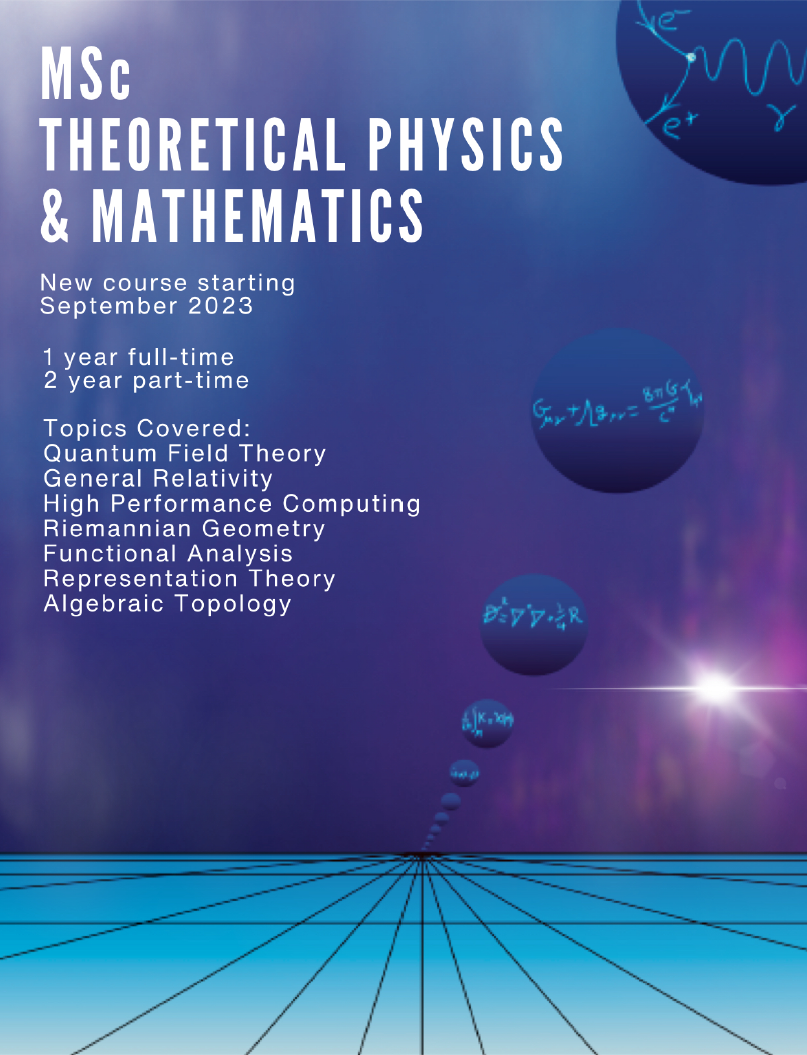
I know it’s the Easter holiday weekend but I couldn’t resist sharing the exciting news that we have just received approval for a brand new Masters course at Maynooth University in Theoretical Physics & Mathematics. The new postgraduate course will be run jointly between the Departments of Theoretical Physics and Mathematics & Statistics, with each contributing about half the material. The duration is one calendar year (full-time) or two years (part-time) and consists of 90 credits in the European Credit Transfer System (ECTS). This will be split into 60 credits of taught material (split roughly 50-50 between Theoretical Physics and Mathematics) and a research project of 30 credits, supervised by a member of staff in a relevant area from either Department.

This new course is a kind of follow-up to the existing undergraduate BSc Theoretical Physics & Mathematics at Maynooth, also run jointly . We think the postgraduate course will appeal to many of the students on that programme who wish to continue their education to postgraduate level, though applications are very welcome from suitably qualified candidates elsewhere.

Although the idea of this course has been on the cards for quite a while, the pandemic and other issues delayed it until now. This has so recently been agreed that it doesn’t yet exist on the University admissions webpages. This blog post is therefore nothing more than a sneak preview. There isn’t much time between now and September, when the course runs for the first time, which is why I decided to put this advanced notice on here! I will give fuller details on how to apply when they are available. You will also find further information on the Department’s Twitter feed, so if you’re interested I suggest you give them a follow.

Foirmlí agus Táblaí

Posted in Education, Maynooth with tags , , on April 1, 2023 by telescoper

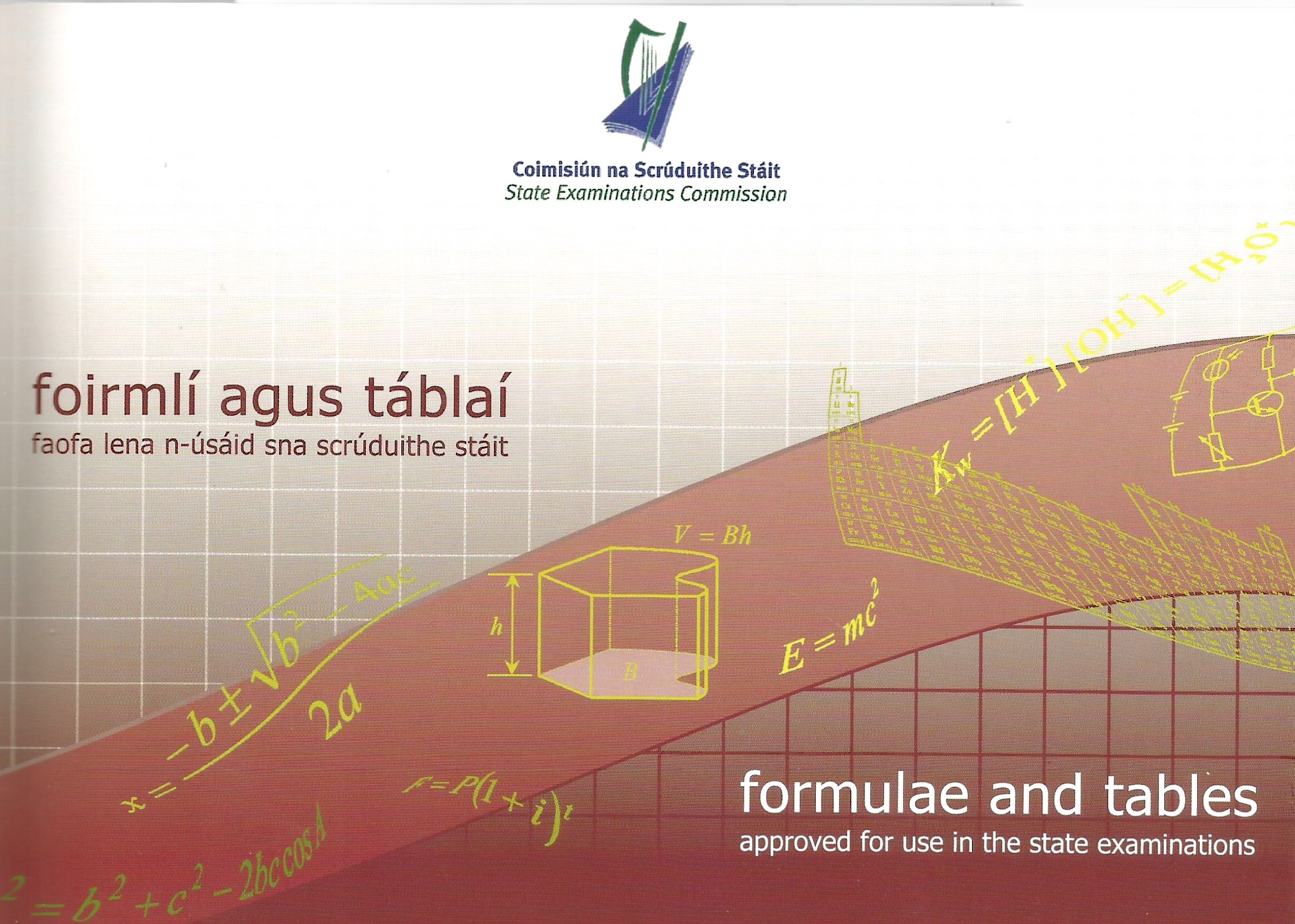
I’ve written on here before about Log Tables but since I’ve recently acquired a set of my own I thought I’d celebrate by mentioning them again. This is what the term “Log Tables” refers to in Ireland:

This book is in regular use in schools and colleges throughout Ireland, but that the term is a shorthand for a booklet containing a general collection of mathematical formulae, scientific data and other bits of stuff that might come in useful to students. There are a lot more formulae than tables, but everyone has calculators now so those aren’t really necessary. There is no table of logarithms in the Log Tables, actually. I suppose much older versions did have more tables, but as these were phased out the name just stuck and they’re still called Log Tables.

The official book costs €4. I bought it in Maynooth’s excellent local independent bookshop. The man who served me knew exactly what I meant when I asked for Log Tables.

I’m old enough to remember actually using tables of logarithms (and other mathematical tables  of such things as square roots and trigonometric functions, in the form of lists of numbers) extensively at school. These were provided in this book of four-figure tables (which you can now buy for 1p on Amazon, plus p&p).

As a historical note I’ll point out that I was in the first year at my school that progressed to calculators rather than slide rules (in the third year) so I was never taught how to use the former. My set of four-figure tables which was so heavily used that it was falling to bits anyway, never got much use after that and I threw it out when I went to university despite the fact that I’m a notorious hoarder.

Students in Theoretical Physics at Maynooth are allowed to ask for Log Tables in any formal examination. The formulae contained therein are elementary in terms of physics, so won’t help very much with more advanced examinations, but I have no problem with students consulting the Log Tables if their mind goes a bit blank.  It seems to me that an examination shouldn’t be a memory test, and giving students the basic formulae as a starting point if anything allows the examiner to concentrate on testing what matters much more, i.e. the ability to formulate and solve a problem. The greatest challenge of science education at University level is, in my opinion, convincing students that their brain is much more than a memory device.

Here’s an example page that shows some elementary formulae for Mechanics with explanations as Gaeilge in English.

These formulae come up in Physics and/or Applied Mathematics at Leaving Certificate but we don’t require students taking Mechanics in the first year to have done either of those subjects so many students find pages such as this very helpful.

I was interested to learn that colleagues in the Department of Mathematics and Statistics here in Maynooth do not allow the use of Log Tables in examinations. I don’t know why.

The Elements of Euclid

Posted in Euclid, mathematics, The Universe and Stuff with tags , , , , on February 15, 2023 by telescoper

My recent post pointing out that the name of the space mission Euclid is not formed as an acronym but is an homage to the Greek mathematician Euclid (actually Εὐκλείδης in Greek) prompted me to do a post about the Euclid of geometry and mathematics rather than the Euclid of cosmology, so here goes.

When I was a lad – yes, it’s one of those tedious posts about how things were better in the old days – we grammar school kids spent a disproportionate amount of time learning geometry in pretty much the way it has been taught since the days of Euclid. In fact, I still have a copy of the classic Hall & Stevens textbook based on Euclid’s Elements, from which I scanned the proof shown below (after checking that it’s now out of copyright).

This, Proposition 5 of Book I of the Elements, is in fact quite a famous proof known as the Pons Asinorum:

The old-fashioned way we learned geometry required us to prove all kinds of bizarre theorems concerning the shapes and sizes of triangles and parallelograms, properties of chords intersecting circles, angles subtended by various things, tangents to circles, and so on and so forth. Although I still remember various interesting results I had to prove way back then – such as the fact that the angle subtended by a chord at the centre of a circle is twice that subtended at the circumference (Book III, Proposition 20) – I haven’t actually used many of them since. The one notable exception I can think of is Pythagoras’ Theorem (Book I, Proposition 47), which is of course extremely useful in many branches of physics.

The apparent irrelevance of most of the theorems one was required to prove is no doubt the reason why “modern” high school mathematics syllabuses have ditched this formal approach to geometry. I think this was a big mistake. The bottom line in a geometrical proof is not what’s important – it’s how you get there. In particular, it’s learning how to structure a mathematical argument.

That goes not only for proving theorems, but also for solving problems; many of Euclid’s propositions are problems rather than theorems, in fact. I remember well being taught to end the proof of a theorem with QED (Quod Erat Demonstrandum; “which was to be proved”) but end the solution of a problem with QEF (Quod Erat Faciendum; “which was to be done”).

You can see what I mean by looking at the Pons Asinorum, which is a very simple theorem to prove but which illustrates the general structure:

  1. GIVEN
  2. TO PROVE
  3. CONSTRUCTION
  4. PROOF

When you have completed many geometrical proofs this way it becomes second nature to confront any  problem in mathematics (or physics) following the same steps, which are key ingredients of a successful problem-solving strategy

First you write down what is given (or can be assumed), often including the drawing of a diagram. Next you have to understand precisely what you need to prove, so write that down too. It seems trivial, but writing things down on paper really does help. Not all theorems require a “construction”, and that’s usually the bit where ingenuity comes in, so is more difficult. However, the “proof” then follows as a series of logical deductions, with reference to earlier (proved) propositions given in the margin.

This structure carries over perfectly well to problems involving algebra or calculus (or even non-Euclidean geometry) but I think classical geometry provides the ideal context to learn it because it involves visual as well as symbolic logic – it’s not just abstract reasoning in that compasses, rulers and protractors can help you!

I don’t think it’s a particular problem for universities that relatively few students know how to prove, e.g.,  the perpendicular bisector theorem, but it definitely is a problem that so many have no idea what a mathematical proof should even look like.

Come back Euclid, all is forgiven!

Putting girls off Physics

Posted in Education, mathematics, Maynooth, Politics with tags , , on January 9, 2023 by telescoper

I see that Katharine Birbalsingh has resigned from her job as UK Government commissioner for social mobility. Apparently she feels she was “doing more harm than good”. If only the rest of the Government had that level of self-awareness.

I wrote about Katharine Birbalsingh last year, and her departure gives me the excuse to repeat what I said then. Birbalsingh is Head of a school in which only 16% of the students taking physics A-level are female (the national average is about 23%) and tried to explain this by saying that girls don’t like doing “hard maths”.

..physics isn’t something that girls tend to fancy. They don’t want to do it, they don’t like it.

Gender stereotyping begins at school, it seems.

There is an easy rebuttal of this line of “reasoning”. First, there is no “hard maths” in Physics A-level. Most of the mathematical content (especially differential calculus) was removed years ago. Second, the percentage of students taking actual A-level Mathematics in the UK who are female is more like 40% than 20% and girls do better at Mathematics than boys at A-level. The argument that girls are put off Physics because it includes Maths is therefore demonstrably bogus.

An alternative explanation for the figures is that schools (especially the one led by Katharine Birbalsingh, where the take-up is even worse than the national average) provide an environment that actively discourages girls from being interested in Physics by reinforcing gender stereotypes even in schools that offer Physics A-level in the first place. The attitudes of teachers and school principals undoubtedly have a big influence on the life choices of students, which is why it is so depressing to hear lazy stereotypes repeated once again.

There is no evidence whatsoever that women aren’t as good at Maths and Physics as men once they get into the subject, but plenty of evidence that the system dissuades then early on from considering Physics as a discipline they want to pursue. Indeed, at University female students generally out-perform male students in Physics when it comes to final results; it’s just that there are few of them to start with.

Anyway, I thought of a way of addressing gender inequality in physics admissions about 8 years ago. The idea was to bring together two threads. I’ll repeat the arguments here.

The first is that, despite strenuous efforts by many parties, the fraction of female students taking A-level Physics has flat-lined at around 20% for at least two decades. This is the reason why the proportion of female physics students at university is the same, i.e. 20%. In short, the problem lies within the school system.

The second line of argument is that A-level Physics is not a useful preparation for a Physics degree anyway because it does not develop the sort of problem-solving skills or the ability to express physical concepts in mathematical language on which university physics depends. In other words it not only avoids “hard maths” but virtually all mathematics and, worse, is really very boring. As a consequence, most physics admissions tutors that I know care much more about the performance of students at A-level Mathematics than Physics, which is a far better indicator of their ability to study Physics at University than the Physics A-level.

Hitherto, most of the effort that has been expended on the first problem has been directed at persuading more girls to do Physics A-level. Since all UK universities require a Physics A-level for entry into a degree programme, this makes sense but it has not been very successful.

I believe that the only practical way to improve the gender balance on university physics course is to drop the requirement that applicants have A-level Physics entirely and only insist on Mathematics (which has a much more even gender mix). I do not believe that this would require many changes to course content but I do believe it would circumvent the barriers that our current school system places in the way of aspiring female physicists, bypassing the bottleneck at one stroke.

I suggested this idea when I was Head of the School of Mathematical and Physical Sciences at Sussex, but it was firmly rejected by Senior Management because we would be out of line with other Physics departments. I took the view that in this context being out of line was a positive thing but that wasn’t the view of my bosses so the idea sank.

In case you think such a radical step is unworkable, I give you the example of our Physics programmes in Maynooth. We have a variety of these, including Theoretical Physics & Mathematics, Physics with Astrophysics, and Mathematical Physics and/or Experimental Physics through our omnibus science programme. Not one of these courses requires students to have taken Physics in their Leaving Certificate (roughly the equivalent of A-level) though as I explained in yesterday’s post, Mathematics is a compulsory subject at Leaving Certificate. The group of about first-year 130 students I taught this academic year is considerably more diverse than any physics class I ever taught in the UK, and not only in terms of gender…

I contend that the evidence suggests it’s not Mathematics that puts female students off Physics, a large part of it is A-level Physics.

Writing Vectors

Posted in mathematics, The Universe and Stuff with tags , , , on October 11, 2021 by telescoper

Once again it’s time to introduce first-year Mathematical Physics students to the joy of vectors, or specifically Euclidean vectors. Some of my students have seen them before, but probably aren’t aware of how much we use them theoretical physics. Obviously we introduce the idea of a vector in the simplest way possible, as a directed line segment. It’s only later on, in the second year, that we explain how there’s much more to vectors than that and explain their relationship to matrices and tensors.

Although I enjoy teaching this subject I always have to grit my teeth when I write them in the form that seems obligatory these days.

You see, when I was a lad, I was taught to write a geometric vector in the following fashion:

\vec{r} =\left(\begin{array}{c} x \\ y \\ z \end{array} \right).

This is a simple column vector, where x,y,z are the components in a three-dimensional cartesian coordinate system. Other kinds of vector, such as those representing states in quantum mechanics, or anywhere else where linear algebra is used, can easily be represented in a similar fashion.

This notation is great because it’s very easy to calculate the scalar (dot) and vector (cross) products of two such objects by writing them in column form next to each other and performing a simple bit of manipulation. For example, the scalar product of the two vectors

\vec{u}=\left(\begin{array}{c} 1 \\ 1 \\ 1 \end{array} \right) and \vec{v}=\left(\begin{array}{c} 1 \\ 1 \\ -2 \end{array} \right)

can easily be found by multiplying the corresponding elements of each together and totting them up:

\vec{u} \cdot \vec{v} = (1 \times 1) + (1 \times 1) + (1\times -2) =0,

showing immediately that these two vectors are orthogonal. In normalised form, these two particular vectors appear in other contexts in physics, where they have a more abstract interpretation than simple geometry, such as in the representation of the gluon in particle physics.

Moreover, writing vectors like this makes it a lot easier to transform them via the action of a matrix, by multipying rows in the usual fashion, e.g.
\left(\begin{array}{ccc} \cos \theta & \sin\theta & 0 \\ -\sin\theta & \cos \theta & 0 \\ 0 & 0 & 1\end{array} \right) \left(\begin{array}{c} x \\ y \\ z \end{array} \right) = \left(\begin{array}{c} x\cos \theta + y\sin\theta \\ -x \sin \theta + y\cos \theta \\ z \end{array} \right)
which corresponds to a rotation of the vector in the x-y plane. Transposing a column vector into a row vector is easy too.

Well, that’s how I was taught to do it.

However, somebody, sometime, decided that, in Britain at least, this concise and computationally helpful notation had to be jettisoned and students instead must be forced to write a vector laboriously in terms of base vectors:

\vec{r} = x\hat{\imath} + y \hat{\jmath} + z \hat{k}

Some of you may even be used to doing it that way yourself. Why is this awful? For a start, it’s incredibly clumsy. It is less intuitive, doesn’t lend itself to easy operations on the vectors like I described above, doesn’t translate easily into the more general case of a matrix, and is generally just …well… awful. The only amusing thing about this is that you get to tell students not to put a dot on the “i” or the “j” – it always gets a laugh when you point out that these little dots are called “tittles“.

Worse still, for the purpose of teaching inexperienced students physics, it offers the possibility of horrible notational confusion. In particular, the unit vector \hat{\imath} is too easily confused with i, the square root of minus one. Introduce a plane wave with a wavevector \vec{k} and it gets even worse, especially when you want to write \exp(i\vec{k}\cdot \vec{x}), and if you want the answer to be the current density \vec{j} then you’re in big trouble!

Call me old-fashioned, but I’ll take the row and column notation any day!

(Actually it’s better still just to use the index notation, a_i which generalises easily to a_{ij} and, for that matter, a^{i}.)

Or perhaps being here in Ireland we should, in honour of Hamilton, do everything in quaternions.