Archive for mathematics

League Table Positions

Posted in Education, Football with tags , , , , , , , on May 26, 2015 by telescoper

Among the things I didn’t have time to blog about over a very busy Bank Holiday Weekend was the finish of the English Premiership season. I haven’t posted much about my own team, Newcastle United, this season because I haven’t been able to think of anything particularly positive to say. Since Alan Pardew quit in January to join Crystal Palace, Newcastle slumped to such an alarming extent that they went into their last game of the season (against West Ham) just two points above the drop zone. Had they lost their game, which did not seem unlikely on the basis of their recent form, and had Hull won against Manchester United, which did not seem unlikely on the grounds that Man Utd wwould finish in 4th place whatever happened in that game, then Newcastle would be relegated to the Championship. In the event, however, Newcastle won 2-0 which made them safe while Hull could only draw 0-0 which meant that Newcastle would have survived even if they had lost against West Ham. Moreover, Sunderland also lost their last game, which meant that the final Premier League Table looked like this:

Premiership_League

(courtesy of the BBC Website). The important places are 15 and 16, obviously. The natural order of things has been restored….

Another League Table came out over the Bank Holiday. This was the annual Guardian University Guide. I’m deeply sceptical of the value of these league tables, but there’s no question that they’re very important to potential students so we have to take them seriously. This year was pretty good for Sussex as far as the Guardian Table is concerned: the University of Sussex rose to 19th place overall and the two departments of the School of Mathematical and Physical Sciences both improved: Physics & Astronomy is back in the top 10 (at number 9, up from 11th place last year) and Mathematics rose 22 places to take 21st place. Gratifyingly, both finished well above Sunderland.

While these results are good news in themselves, at least around my neck of the woods, as they will probably lead to increased applications to Sussex from students next year, it is important to look behind the simplistic narrative of “improvements”. Since last year there have been several substantial changes to the Guardian’s methodology. The weighting given to “spend-per-student” has been reduced from 15% to 10% of the overall score and the method of calculating “value added” has excluded specific predictions based on “non-tariff” students (i.e. those without UK entry qualifications, especially A-levels). What the Guardian consistently fails to do is explain the relative size of the effect of arbitrary methodological changes on its tables compared to actual changes in, e.g., cash spent per student.

Imagine the outrage there would be if football teams were not told until the end of a Premier League season how many points would be awarded for a win….

A Problems Class in Complex Analysis

Posted in Education, The Universe and Stuff with tags , , , , , on May 15, 2015 by telescoper

My theoretical physics examination is coming up on Monday and the students are hard at working revising for it (or at least they should be) so I thought I’d lend a hand by deploying some digital technology in the form of the following online interactive video-based learning resource on Complex Analysis:

End of Term Balls

Posted in Biographical, Education with tags , , , , on April 18, 2015 by telescoper

I haven’t had time to post for the last couple of days because I’ve been too bust with end-of-term business (and pleasure). Yesterday (Friday) was the last day of teaching term and this week I had to get a lot of things finished because of various deadlines, as well as attending numerous meetings. It’s been quite an exhausting week, not just because of that but also because by tradition the two departments within the School of Mathematical and Physical Sciences at the University of Sussex, the Department of Mathematics and the Department of Physics & Astronomy, hold their annual Staff-Student Balls on consecutive days. When I arrived here just over two years ago I decided that I should attend both or neither, as to attend at only one would look like favouritism. In fact this is the third time I’ve attended both of them. Let no-one say I don’t take my obligations seriously.  It’s a tough job, but someone has to do it. Holding both balls so close together  poses some problems for a person of my age, but I coped and also tried to weigh them up relative to each other and see  which was  most impressive.

Actually, both were really well organized. The Mathematics Ball was held in the elegant Hilton Metropole hotel and the Physics one in the Holiday Inn, both on the seafront. As has been the case in previous years the Mathematics ball is a bit more refined and sedate, the Physics one a little more raucous. Also this year there was a very large difference in the number of people going, with over 200 at the Physics Ball and only just over half that number at the Mathematics one. In terms of all-round fun I have to declare the Physics Ball the winner last year, but both occasions were very enjoyable. I’d like to say a very public thank you to the organizers of both events, especially Sinem and Jordan for Mathematics and Francis for Physics. Very well done.

The highlight of the Physics Ball was an after-dinner speech by particle physicist Jon Butterworth, who has an excellent blog called Life and Physics on the Guardian website. I’ve actually been in contact with Jon many times through social media (especially Twitter) over a period of over six years, but we never actually met in person until last night. I think he was a bit nervous beforehand because he had never done an after-dinner speech before, in the end though his talk was funny and wise, and extremely well received. Mind you, I did make it easy for him by giving a short speech to introduce him, and after a speech by me almost anyone would look good!

Thereafter the evening continued with drinking and dancing. After a while most people present were rather tired and emotional.  I even think some might even have been drunk. I eventually got home about 2am, after declining an invitation to go to the after-party. I’m far too old for that sort of thing. Social events like this can be a little bit difficult, for a number of reasons. One is that there’s an inevitable “distance” between students and staff, not just in terms of age but also in the sense that the staff have positions of responsibility for the students. Students are not children, of course, so we’re not legally  in loco parentis, but something of that kind of relationship is definitely there. Although it doesn’t stop either side letting their hair down once in a while, I always find there’s a little bit of tension especially if the revels get a bit out of hand. To help occasions like this run smoothly I think it’s the responsibility of the staff members present to drink heavily in order to put the students at ease. United by a common bond of inebriation, the staff-student divide crumbles and a good time is had by all.

There’s another thing I find a bit strange. Chatting to students last night was the first time I had spoken to many of my students like that, i.e. outside the lecture  or tutorial. I see the same faces in my lectures day in, day out but all I do is talk to them about physics. I really don’t know much about them at all. But it is especially nice when on occasions like this students come up, as several did last night, and say that they enjoyed my lectures. Actually, it’s more than just nice. Amid all the bureaucracy and committee meetings, it’s very valuable to be reminded what the job is really all about.


P.S. Apologies for not having any pictures. I left my phone in the office on Friday when I went home to get changed. I will post some if anyone can supply appropriate images. Or, better still, inappropriate ones!


One Fine Conformal Transformation

Posted in Brighton, Cute Problems with tags , , , , , on March 25, 2015 by telescoper

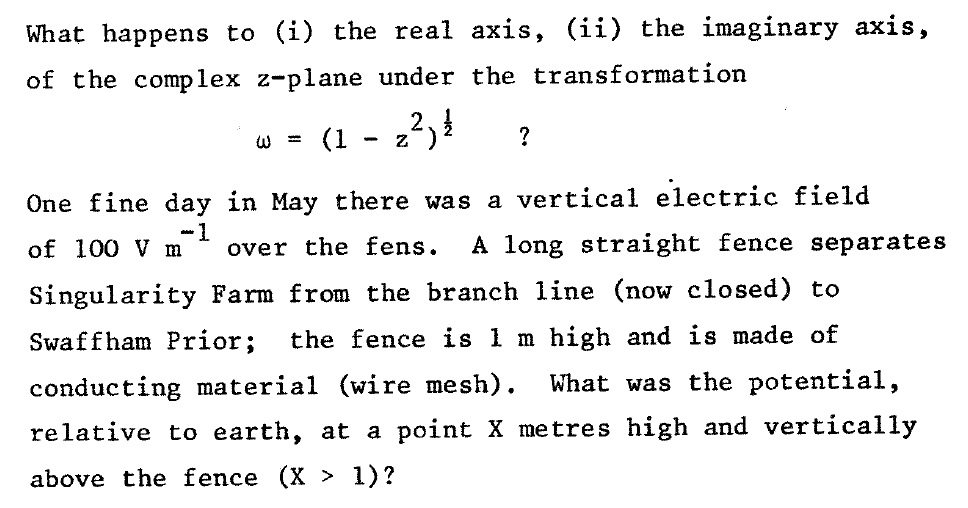
It’s been a while since I posted a cute physics problem, so try this one for size. It is taken from a book of examples I was given in 1984 to illustrate a course on Physical Applications of Complex Variables I took during the a 4-week course I took in Long Vacation immediately prior to my third year as an undergraduate at Cambridge.  Students intending to specialise in Theoretical Physics in Part II of the Natural Sciences Tripos (as I was) had to do this course, which lasted about 10 days and was followed by a pretty tough test. Those who failed the test had to switch to Experimental Physics, and spend the rest of the summer programme doing laboratory work, while those who passed it carried on with further theoretical courses for the rest of the Long Vacation programme. I managed to get through, to find that what followed wasn’t anywhere near as tough as the first bit. I inferred that Physical Applications of Complex Variables was primarily there in order to separate the wheat from the chaff. It’s always been an issue with Theoretical Physics courses that they attract two sorts of student: one that likes mathematical work and really wants to do theory, and another that hates experimental physics slightly more than he/she hates everything else. This course, and especially the test after it, was intended to minimize the number of the second type getting into Part II Theoretical Physics.

Another piece of information that readers might find interesting is that the lecturer for Physical Applications of Complex Variables was a young Mark Birkinshaw, now William P. Coldrick Professor of Cosmology and Astrophysics at the University of Bristol.

As it happens, this term I have been teaching a module on Theoretical Physics to second-year undergraduates at the University of Sussex. This covers many of the topics I studied at Cambridge in the second year, including the calculus of variations, relativistic electrodynamics, Green’s functions and, of course, complex functions. In fact I’ve used some of the notes I took as an undergraduate, and have kept all these years, to prepare material for my own lectures. I am pretty adamant therefore that the academic level at which we’re teaching this material now is no lower than it was thirty years ago.

Anyway, here’s a typically eccentric problem from the workbook, from a set of problems chosen to illustrate applications of conformal transformations (which I’ve just finished teaching this term). See how you get on with it. The first correct answer submitted through the comments box gets a round of applaud.

conformal transformation


Remembering Erdös

Posted in Biographical with tags , , on March 17, 2015 by telescoper

This poster, advertising a forthcoming Summer School in honour of the famous mathematician Paul Erdös arrived this morning, so I thought I’d advertise it through this blog.

Erdos

In case you didn’t know, Paul Erdős (who died in 1996) was an eccentric yet prolific Hungarian mathematician who wrote more than 1000 mathematical papers during his life but never settled in one place for any length of time. He travelled constantly between colleagues and conferences, mostly living out of a suitcase, and showed no interest at all in property or possessions. His story is a fascinating one, and his contributions to mathematics were immense and wide-ranging, and I’m sure the conference in his honour will be fascinating.

A strange offshoot of his mathematical work is the Erdős number, which is really a tiny part of his legacy, but one that seems to have taken hold. Some mathematicians appear to take it very seriously, but most treat it with tongue firmly in cheek, as I certainly do.

So what is the Erdős number? It’s actually quite simple to define. First, Erdős himself is assigned an Erdős number of zero. Anyone who co-authored a paper with Erdős then has an Erdős number of 1. Then anyone who wrote a paper with someone who wrote a paper with Erdős has an Erdős number of 2, and so on. The Erdős number is thus a measure of “collaborative distance”, with lower numbers representing closer connections. I say it’s quite easy to define, but it’s rather harder to calculate. Or it would be were it not for modern bibliographic databases. In fact there’s a website run by the American Mathematical Society which allows you to calculate your Erdős number as well as a similar measure of collaborative distance with respect to any other mathematician. Also, a list of individuals with very low Erdős numbers (1, 2 or 3) can be found here. I did a quick poll around the Department of Mathematics here at the University of Sussex and it seems that the shortest collaborative distance among the staff belongs to Dr James Hirschfeld who has an Erdos Number of 2. There is a paper of his, with M. Deza and P. Frankl, Sections of varieties over finite fields as large intersection families, Proc. London. Math. Soc. 50 (1985), 405-425 and both Michel Deza and Peter Frankl have joint papers with Paul Erdős.

Given that Erdős was basically a pure mathematician, I didn’t expect first to show up as having any Erdős number at all, since I’m not really a mathematician and I’m certainly not very pure. However, his influence is clearly felt very strongly in physics and a surprisingly large number of physicists (and astronomers) have a surprisingly small Erdős number. Anyway, my erstwhile PhD supervisor Professor John D. Barrow emailed to point out that he had written a paper with Robin Wilson, who once co-authored a paper (on graph theory) with Erdős himself. That means that John’s Erdős number is now 2, mine is consequently 3 (unless, improbably, I have unkowingly written a paper with someone who has written a paper with Erdős). Anyone I’ve ever written a paper with has an Erdős number no greater than 4; they of course may have other routes to Erdős than through me.

Anyway, none of that is important compared to the real legacy of Erdős, which is his mathematical work. I’m sure the Summer School will be both rewarding and enjoyable!

My Mathematical Valentines Message

Posted in Cute Problems with tags , on February 14, 2015 by telescoper

Here’s a little mathematical exercise with a Valentines theme:

Sketch the curve in the x-y plane described by the equation

\left(x^2 +y^2  + 2ay \right)^2 = 4a^2 \left( x^2 + y^2 \right)

for

x<3.

Geddit?

Answer: the equation is that of a cardioid:

cardioid-2

Mistaken Identity

Posted in Uncategorized with tags , on January 29, 2015 by telescoper


wpid-wp-1422539203608.jpeg

Achilles and the Tortoise(s)

Posted in Uncategorized with tags , , , on January 16, 2015 by telescoper

The inestimable Dorothy Lamb has yet again been doing her bit for our outreach effort here in the School of Mathematical and Physical Sciences at the University of Sussex. Charged with the task of coming up with some props to explain Zeno’s Paradox to schoolchildren. One famous version of this paradox features in the form of a story about Achilles and the Tortoise:

Achilles, the fleet-footed hero of the Trojan War, is engaged in a race with a lowly tortoise, which has been granted a head start. Achilles’ task initially seems easy, but he has a problem. Before he can overtake the tortoise, he must first catch up with it. While Achilles is covering the gap between himself and the tortoise that existed at the start of the race, however, the tortoise creates a new gap. The new gap is smaller than the first, but it is still a finite distance that Achilles must cover to catch up with the animal. Achilles then races across the new gap. To Achilles’ frustration, while he was scampering across the second gap, the tortoise was establishing a third. The upshot is that Achilles can never overtake the tortoise. No matter how quickly Achilles closes each gap, the slow-but-steady tortoise will always open new, smaller ones and remain just ahead of the Greek hero.

Anyway, we now have a splendid knitted Achilles along with not one but three lovely tortoises…DSC_0035

Achilles is a bit short in the leg, although I suppose that doesn’t necessarily mean that he can’t be fleet of foot, and we had to prop him up against the wall lest he should heel over, but nevertheless I think these are great. Could this be the next big thing in toys for mathematically inclined students?

Puzzle Time: Playing With Matches

Posted in Cute Problems with tags , , on January 13, 2015 by telescoper

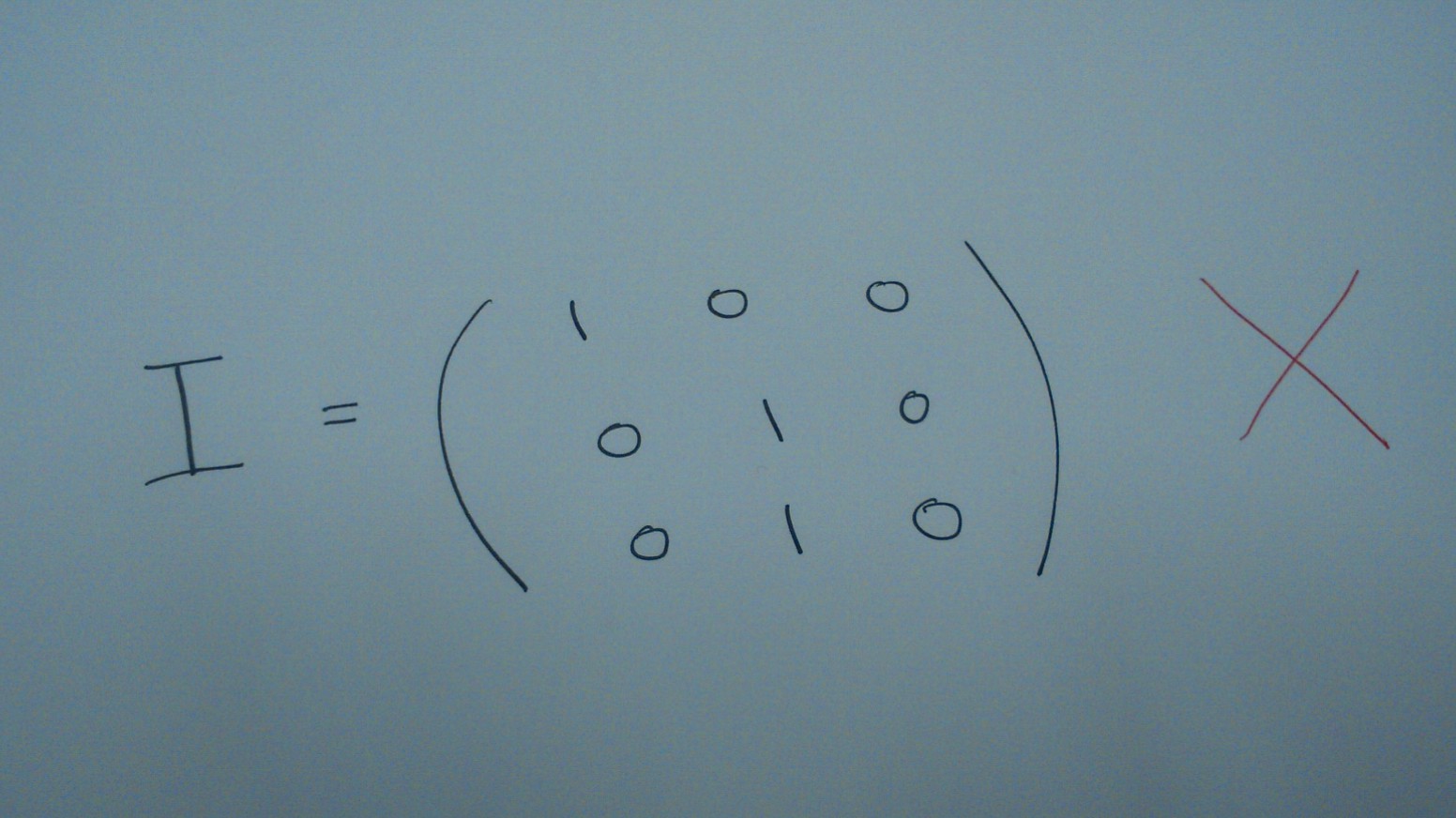
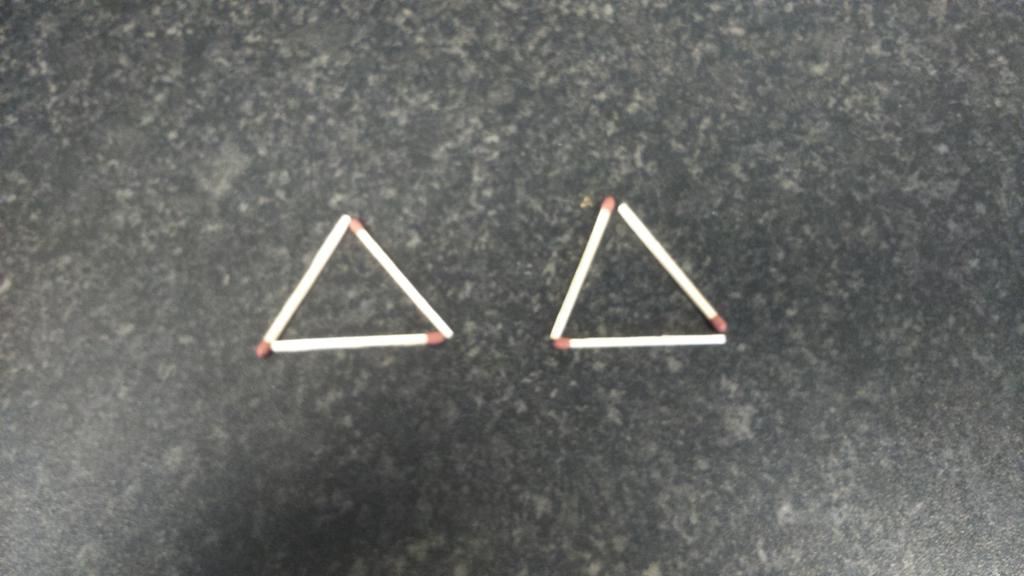
matchesPuzzle time! Move three (and only three) matches and position them to create just four, i.e four and only four,  (identical) triangles. No cutting the matches, either!

Click on to see the answer…

Continue reading

That Was The REF That Was..

Posted in Finance, Science Politics with tags , , , , , , on December 18, 2014 by telescoper

I feel obliged to comment on the results of the 2014 Research Excellence Framework (REF) that were announced today. Actually, I knew about them yesterday but the news was under embargo until one minute past midnight by which time I was tucked up in bed.

The results for the two Units of Assessment relevant to the School of Mathematical and Physical Sciences are available online here for Mathematical Sciences and here for Physics and Astronomy.

To give some background: the overall REF score for a Department is obtained by adding three different components: outputs (quality of research papers); impact (referrring to the impact beyond academia); and environment (which measures such things as grant income, numbers of PhD students and general infrastructure). These are weighted at 65%, 20% and 15% respectively.

Scores are assigned to these categories, e.g. for submitted outputs (usually four per staff member) on a scale of 4* (world-leading), 3* (internationally excellent), 2* (internationally recognised), 1* (nationally recognised) and unclassified and impact on a scale 4* (outstanding), 3* (very considerable), 2* (considerable), 1* (recognised but modest) and unclassified. Impact cases had to be submitted based on the number of staff submitted: two up to 15 staff, three between 15 and 25 and increasing in a like manner with increasing numbers.

The REF will control the allocation of funding in a manner yet to be decided in detail, but it is generally thought that anything scoring 2* or less will attract no funding (so the phrase “internationally recognised” really means “worthless” in the REF, as does “considerable” when applied to impact). It is also thought likely that funding will be heavily weighted towards 4* , perhaps with a ratio of 9:1 between 4* and 3*.

We knew that this REF would be difficult for the School and our fears were born out for both the Department of Mathematics or the Department of Physics and Astronomy because both departments grew considerably (by about 50%) during the course of 2013, largely in response to increased student numbers. New staff can bring outputs from elsewhere, but not impact. The research underpinning the impact has to have been done by staff working in the institution in question. And therein lies the rub for Sussex…

To take the Department of Physics and Astronomy, as an example, last year we increased staff numbers from about 23 to about 38. But the 15 new staff members could not bring any impact with them. Lacking sufficient impact cases to submit more, we were obliged to restrict our submission to fewer than 25. To make matters worse our impact cases were not graded very highly, with only 13.3% of the submission graded 4* and 13.4% graded 3*.

The outputs from Physics & Astronomy at Sussex were very good, with 93% graded 3* or 4*. That’s a higher fraction than Oxford, Cambridge, Imperial College and UCL in fact, and with a Grade Point Average of 3.10. Most other departments also submitted very good outputs – not surprisingly because the UK is actually pretty good at Physics – so the output scores are very highly bunched and a small difference in GPA means a large number of places in the rankings. The impact scores, however, have a much wider dispersion, with the result that despite the relatively small percentage contribution they have a large effect on overall rankings. As a consequence, overall, Sussex Physics & Astronomy slipped down from 14th in the RAE to 34th place in the REF (based on a Grade Point Average). Disappointing to say the least, but we’re not the only fallers. In the 2008 RAE the top-rated physics department was Lancaster; this time round they are 27th.

I now find myself in a situation eerily reminiscent of that I found myself facing in Cardiff after the 2008 Research Assessment Exercise, the forerunner of the REF. Having been through that experience I’m a hardened to disappointments and at least can take heart from Cardiff’s performance this time round. Spirits were very low there after the RAE, but a thorough post-mortem, astute investment in new research areas, and determined preparations for this REF have paid dividends: they have climbed to 6th place this time round. That gives me the chance not only to congratulate my former colleagues there for their excellent result but also to use them as an example for what we at Sussex have to do for next time. An even more remarkable success story is Strathclyde, 34th in the last RAE and now top of the REF table. Congratulations to them too!

Fortunately our strategy is already in hand. The new staff have already started working towards the next REF (widely thought to be likely to happen in 2020) and we are about to start a brand new research activity in experimental physics next year. We will be in a much better position to generate research impact as we diversify our portfolio so that it is not as strongly dominated by “blue skies” research, such as particle physics and astronomy, for which it is much harder to demonstrate economic impact.

I was fully aware of the challenges facing Physics & Astronomy at Sussex when I moved here in February 2013, but with the REF submission made later the same year there was little I could do to alter the situation. Fortunately the University of Sussex management realises that we have to play a long game in Physics and has been very supportive of our continued strategic growth. The result of the 2014 REF result is a setback but it does demonstrate that the stategy we have already embarked upon is the right one.

Roll on 2020!