Archive for Maynooth University

A Midweek Lecture

Posted in Biographical, Education with tags , , , , on May 3, 2023 by telescoper

It’s halfway through the last week of teaching term, and it’s been a busy day. Earlier on, I gave my final “proper” lecture of the Semester in Advanced Electromagnetism, about the reflection and transmission of electromagnetic waves at interfaces. That’s basically optics, but done in terms of the electric and magnetic fields. I have two more classes this week, on Friday, but these will be revision tutorials devoted to going through past examination questions etc. I’ve had special requests for problems involving conformal transformations and the method of images, so that should be fun!

Meanwhile, my Computational Physics class are working hard on their projects, due in on Friday. My office is opposite the lab so I’ve had a few students coming to ask for help, but mostly they are just beavering away. I hope most of them are writing up by now. I just did a quick check and nobody has submitted anything yet. I suppose that, as usual, they will all wait until the last minute!

I have a telecon coming up in a few minutes, but after that I’ll be attending this public lecture:

The speaker, Professor Clare Elwell is a physicist at University College London, where she is the Director of the Near Infrared Spectroscopy (NIRS) Group. Specifically, Prof Elwell develops non-invasive techniques to study brain function, paving the way for defining early markers of autism, developing more targeted care following brain injury, and for better understanding brain development in global health settings. Prof Elwell described her pioneering work in using invisible near infrared light to probe the human brain. Near Infrared Spectroscopy (NIRS) is a portable, wearable, low-cost brain imaging technology which can be used to study the brain in newborn babies, toddlers and adults in a range of different scenarios.

I’ll post an update when I get home after the lecture. Actually, there’s no need because the lecture was streamed and a recording is now available. The lecture starts a fairly long way in and the sound didn’t start until part-way through the introductions so I’ve cued the link to the start of the lecture itself.

It was a very interesting lecture by a very engaging speaker. The audience was smaller than I’d expected, though, with less than a hundred in the theatre. This might be because it was scheduled in the middle of the last week of teaching term, which is a very busy time of year for academic staff.

No Tension at Redshift Ten

Posted in Maynooth, The Universe and Stuff with tags , , , , , on April 29, 2023 by telescoper

I know it’s the Bank Holiday weekend but I could resist a quick post about a new paper that hit the arXiv yesterday (where all new astrophysics papers worth reading can be found). It is led by Joe McCaffrey who is a PhD student in the Department of Theoretical Physics at Maynooth University. The paper has been submitted to the Open Journal of Astrophysics, but obviously I am conflicted so have assigned it to another editor.

UPDATE: the paper is now published here.

As many of you will be aware, there’s been a considerable to-do not to mention a hoo-hah about the detections by JWST of some galaxies at high redshift. Some of these have been shown not to be galaxies at high redshift after all, but some around z=10 seem to be genuine.

Anyway, the abstract of Joe’s paper is this:

Recent observations by JWST have uncovered galaxies in the very early universe via the JADES and CEERS surveys. These galaxies have been measured to have very high stellar masses with substantial star formation rates. There are concerns that these observations are in tension with the ΛCDM model of the universe, as the stellar masses of the galaxies are relatively high for their respective redshifts. Recent studies have compared the JWST observations with large-scale cosmological simulations. While they were successful in reproducing the galaxies seen in JADES and CEERS, the mass and spatial resolution of these simulations were insufficient to fully capture the early assembly history of the simulated galaxies. In this study, we use results from the Renaissance simulations, which are a suite of high resolution simulations designed to model galaxy formation in the early universe. We find that the most massive galaxies in Renaissance have stellar masses and star formation rates that are entirely consistent with the observations from the JADES and CEERS surveys. The exquisite resolution afforded by Renaissance allows us to model the build-up of early galaxies from stellar masses as low as 104 M⊙ up to a maximum stellar mass of a few times 107 M⊙. Within this galaxy formation paradigm, we find excellent agreement with JADES and CEERS. We find no tension between the ΛCDM model and current JWST measurements. As JWST continues to explore the high redshift universe, high resolution simulations, such as Renaissance, will continue to be crucial in understanding the formation history of early embryonic galaxies.

arXiv:2304.13755

The key figure is this one:

The solid curves show the number of galaxies of a given mass one would expect to see as a function of redshift in fields comparable to those observed with estimated values from observations (star-shaped symbols). As you can see the observed points are consistent with the predictions. There’s no tension, so you can all relax.

A Draft Strategic Plan for Maynooth (via ChatGPT)

Posted in Education, Maynooth with tags , , on April 23, 2023 by telescoper

Senior managers at Maynooth University are currently engaged in the expensive and time-consuming process of compiling a new “Strategic Plan“. All universities seem to feel the need to have one of these, although I’ve never understood what purpose is served by such a document. They are all remarkably similar to one another in any case. Anyway, this is what ChatGPT produced for free in a matter of seconds in response to the query “please write a first draft strategic plan for Maynooth University”:

Introduction:

Maynooth University is a leading university in Ireland founded in 1795. The University aims to provide high-quality education to its students and prepare them for successful careers and to contribute positively to society as a whole. As a forward-thinking institution, Maynooth University recognizes the need for strategic planning to continue its legacy of excellence and ensure that it remains at the forefront of education and research.to conduct innovative research that address the challenges of the 21st century. In order to achieve its goals, the university needs to develop a strategic plan that outlines its priorities and the steps it needs to take to achieve them.

Vision:

The vision for Maynooth University is to become a world-class institution of higher education that promotes excellence in teaching, research and community engagement. The university will strive to provide a stimulating and inclusive environment that inspires its students, faculty and staff to achieve their full potential.

Mission:

The mission of Maynooth University is to provide a transformative student experience that prepares graduates to be leaders in their fields. The university will contribute to the creation and dissemination of new knowledge through its research and scholarship. It will engage with local, national and international communities to promote social and economic development.

Goals:

The following are the key goals of Maynooth University:

1. To enhance the quality of teaching and learning:

Maynooth University will provide its students with a challenging and engaging learning experience that equips them with the knowledge and skills required to succeed in their chosen fields. The university will invest in innovative teaching methods, modern teaching equipment, and professional development opportunities for its faculty to enhance their teaching skills and delivery.

2. To advance research and scholarship:

Maynooth University aims to become a leading research institution known for its excellence in research, innovation, and scholarship. The university will prioritize research funding and support for its faculty, students, and research teams. It will also invest in research infrastructure, facilities and equipment to support cutting-edge research across a range of disciplines.

3. To foster community engagement:

Maynooth University will strive to promote social and economic development through community engagement, public service, and outreach. The university will work with communities, government, and other stakeholders to address societal challenges and create positive social impact. Maynooth University will also prioritize outreach and engagement with schools, businesses, and cultural organizations in the region.

Strategies:

The following are the strategies that Maynooth University will use to achieve its goals:

  1. Develop innovative and relevant degree programs that meet the needs of employers and society.
  2. Support faculty development, recruitment, and retention to ensure that Maynooth University maintains its position as a leading research institution.
  3. Expand research partnerships, collaborations and funding through strategic alliances with other universities, government and industry.
  4. Foster a culture of interdisciplinary research, linking research with teaching and learning, and research with community engagement.
  5. Promote a sense of community and belonging among the Maynooth University community through effective communication and engagement strategies.

Conclusion:

Maynooth University is committed to providing a world-class education, conducting innovative research, and contributing to the social and economic development of communities. The strategic plan outlines the goals and strategies that the university will undertake to achieve its vision and mission. The university will continually review and update its strategies to ensure they are aligned with changes in the higher education landscape to maintain its standing as a leading institution of higher learning.

Maynooth Open Day Admissions

Posted in Education, Maynooth with tags , , on April 22, 2023 by telescoper
The Day Before The Open Day

Well, it’s Saturday 22nd April and it’s another Open Day at Maynooth University. I was there for the similar event at this time last year, and many others before that, but others are doing it this year so I’m sitting at home drinking coffee and writing this blog. I hope it’s going well (though it is raining quite heavily as I write this).

This year’s event is in the new TSI building on the North Campus, a change of venue since last year when it was in the Iontas building. I went in there last night on my way home to have a look at the setup. Our stand was pretty bare then but it will be a bit more exciting now (I hope).

In previous years I taught the first-year module in Mathematical Physics taken by new students, some of whom recognized me from an Open Day. I won’t be teaching the first-years this September, though. I won’t be teaching anyone else this September, either, as I’ll be away on sabbatical for the whole academic year.

The real problem facing first-years, however, is that it seems that yet again this year’s Leaving Certificate results will be late. Last year, new students started a week later than returning students, meaning their teaching term was truncated. The shift from August release to September was excusable during the Covid-19 pandemic, but its continuation is a farcical and is causing huge stress for new students, arising from difficulties in finding accommodation and no time for proper induction events on top of the delayed start to lectures. Well have to wait until June to see how much all this has affected progression rates.

There was an opinion piece about this in the Irish Times last week, from an academic at Trinity, which I agree with and I think is well worth reading. Here’s a quote:

This may all have once felt like an inevitable consequence of the pandemic, but the novelty has long since worn off. Students and universities alike have been left frustrated and hugely discommoded.

The word “discommoded” is a considerable understatement. Let’s just hope that the start of next year is less chaotic than the last three. The academic year at Maynooth starts and ends a bit later than other Irish third-level institutions, so our students have only lost a week at the beginning. Elsewhere more time has been lost: two weeks at Trinity, for example. I wonder if this particular selling-point will be mentioned to prospective students at the Open Day?

Teaching those who want to learn

Posted in Biographical, Education, mathematics, Maynooth with tags , , , on April 21, 2023 by telescoper

Yesterday afternoon I ran the last formal Computational Physics laboratory of the term. As is often the case with these sessions, the students were given a Python task to work through, with assistance available from myself and a demonstrator (and indeed other students). We have 25 students registered on this module, who are split into two groups, so about a dozen students were in yesterday’s session. That’s a comfortable number to make sure everyone can get some help.

This is the sixth year I’ve done this module, and I decided a long time ago that the best way to ensure that students learn the necessary skills is to give them things to do and let them work things out for themselves (with help where necessary). A couple of years ago, on my module feedback questionnaire, a student wrote an intended criticism along the lines of – “It’s like he expects us to learn to code by doing it ourselves, rather than him teaching us”. That is, of course, exactly what I intended, though we do give plenty of help during the labs.

Just as the best way to learn a foreign language is by speaking it, the best way to learn coding is by writing programs. Some of the students on this module have done any before, so for them the early stages of the module are rather straightforward. At least half the class, however, haven’t done any programming, so for them it’s a fairly steep learning curve.

Anyway, it being the last formal session of term this week’s task was a rather challenging one, involving the solution of a boundary value problem via the shooting method. It’s a good exercise because it brings together methods for solving ordinary differential equations with root-finding, as well as requiring some thought as to the general construction of a code that combines these two.

As expected, given the difference in background of the students, some finished this in good time, but others went more slowly. Some very excellent things happened, though, which made me very happy with the the whole experience.

One was that instead of leaving as soon as they had finished, a few of the students who had completed the task early stayed behind to help their friends. I encourage this, but it doesn’t always happen as much as yesterday. It’s called teamwork, and it’s essential not only in physics but also in everyday life.

The lab session was supposed to finish at 4pm, but not all students were done by then. Another excellent thing though was they didn’t just quit when they had run out of time. I stayed well past 4pm to help those who were determined to finish. In one case it was just a ‘0’ that should have been a ‘1’ in the index of an array that stopped it working. I don’t know why it took me so long to spot this, but we got there in the end.

One student, however, had another class at 4pm so left, only to return at five to continue. The student finally left, having completed the exercise, at about 6.45. The persistence shown by the students in refusing to be defeated was truly admirable. This harks back to a piece of advice I gave some time ago:

If you really want to develop as a physicist, don’t just solve a lot of easy problems; challenge yourself by tackling difficult ones too. Don’t be afraid to get “stuck” or make a mistake, as those are both necessary parts of the learning process. Above all, develop the confidence in your ability to take on a problem and back yourself to solve it and don’t be deterred if the answer doesn’t come quickly!

You may say that if it took some students much longer than the allocated time to finish then the problem was too difficult. That may be the case, but do you ever really learn if you’re not stretched? There is a place for straightforward formulaic tasks in higher education, but there’s much more to a university education than doing things like that.

Obviously the lab took up much more of my time as I had originally planned – more than double, in fact – but I went home pleased with a good day’s work. As I’ve said on this blog many times before, there are few things more rewarding than teaching students who want to learn.

Student Feedback and Lecture Recordings

Posted in Cardiff, Education, Maynooth with tags , , on April 19, 2023 by telescoper

This afternoon we had a very interesting meeting about teaching in the Department of Theoretical Physics at Maynooth University, involving teaching faculty and student representatives from each year of each of the courses we offer.

It was nice that most of the feedback gathered by the student reps from their peer groups was positive. For one thing, they really like the blackboard-based teaching we use to deliver most of our modules. Most of the negative comments, however, related directly to lack of resources.

A particular concern, expressed unanimously by all the student reps at the meeting, was the lack of lecture recordings. I don’t think I am alone among the teaching staff in the Department in saying that I wish we could offer lecture recordings as routine. Unfortunately, however, and much to my disappointment, the Senior Management at Maynooth University has discouraged lecture recording as a matter of policy and has not invested in the technology required to make this possible so it is not practicable anyway.

My two previous employers – the University of Sussex and Cardiff University – both had systems in place long before the Covid-19 pandemic and all lectures were recorded as standard . I blogged about this 8 years ago, in fact. In my view the benefits of lecture capture far outweigh the disadvantages, and we should incorporate recordings of lectures as part of our standard teaching provision, as a supplement to learning rather than to replace face-to-face sessions. Every student learns in a different way and we should therefore be doing as much as we possibly can to provide a diverse range of teaching resources so that each can find the combination that suits them best. Technology allows us to do this far better now than in the past.

Some really enjoy live in-person lecture sessions, especially the ability to interact with the lecturer and the shared experience with other students, but others don’t like them as much. Others have reasons (such as disability) for not being able to attend in-person lectures, so providing recordings can help them. Others still have difficulty attending all lectures because of a dratic shortage of student accommodation. Why not in any case provide recordings for everyone? That seems to me to be a more inclusive approach.

The problem with lecture capture in Maynooth is that we will need to improve the cameras and recording equipment in the large lecture rooms to make it possible for lectures with a significant mathematical content. The existing setups in teaching rooms do not easily allow the lecturer to record material on a whiteboard or blackboard. In Cardiff, for example, the larger rooms have more than one camera, usually one on the lectern and one on the screen or whiteboard (which has to be placed further away and therefore needs to be of higher resolution). In Maynooth we only have small podium cameras in the teaching rooms. In fact I have far better facilities in my study at home – provided at my own expense – than my employer is prepared to provide on campus.

My home teaching room

I’m baffled and frustrated by Maynooth’s decision in this matter, which is generating a great deal of negativity amongst faculty and students alike. I hope The Management can be persuaded to change its mind. Persisting with the current policy would send a clear message that teaching and learning are not valued at Maynooth. Maybe they just aren’t?

P.S. The single most common inquiry I have received about the new MSc course announced recently has been whether it is possible to take it remotely. Given our lack of recording facilities, regrettably the answer to this is “no”.

The Other Side of Easter

Posted in Biographical, Maynooth with tags , on April 16, 2023 by telescoper

I haven’t been reading my work email for a few days as I’ve been working from home during the recent Easter mini-break and wanted to catch up on a few things without too many distractions. Having to return to campus tomorrow, however, I decided with some trepidation to see what had accumulated in my inbox while I wasn’t looking and got a rather pleasant surprise.

Just before Easter I mentioned that I had been granted a half-year sabbatical for next academic year. Well, reading my email this morning I found a letter saying that it had been decided to change that to a full year, which is what I originally requested:

The period of sabbatical leave granted is from 1st September 2023 to 31st August 2024.

So having spent a bit of time thinking about how to spend the reduced period, I’m now back to square one (but in a good way). I’m not sure why the powers that be changed their mind on this. Perhaps they’re even keener to get me out of the way than I thought?

The revised schedule means that I will still be around in Maynooth for the August repeat examinations (and marking thereof), but I hope to leave shortly after that is all done and dusted. I’m sure I will miss the teaching next year, but I’m looking forward to being able to concentrate on research and to working in a different environment for a time.

All this means that we will shortly have an advertisement for a sabbatical replacement lecturer in the Department of Theoretical Physics at Maynooth University to cover my teaching while I’m absent. Watch this space. Obviously I will help advertise the position, but I can’t play any further role in the recruitment process.

Anyway, the immediate focus of my attention will be the remaining three weeks of teaching for this Semester. I have a couple more Computational Physics laboratory sessions to organize, as well as the final batch of lectures for Advanced Electromagnetism. That will be followed by an intense period of grading project work, revision lectures, and finally correcting examination scripts. The Examination Period in Maynooth starts on Friday 12th May, but the two with which I am directly involved take place on Thursday 18th and Saturday 20th.

But for now, back to my inbox…

Progress in Computational Cosmology

Posted in Maynooth, The Universe and Stuff with tags , , , , , , on March 23, 2023 by telescoper

We’ve had a visitor in Maynooth for the last couple of days in the form of Mathieu Schaller, who works at Leiden University in the Netherlands. Mathieu was here to work with John Regan’s group on cosmological simulations, but also gave a Theoretical Physics seminar yesterday to a general audience including some of our undergraduate students.

Mathieu’s talk was about a project called FLAMINGO – what is it with cosmologists and acronyms? – which is a suite of simulations designed to be virtual “twins” of the next generation of surveys. This suite includes the largest cosmological simulation ever run to the present time so it can simulate redshift surveys encompassing local volumes near redshift z=0 out to very distant sources at high redshift.

It was a very interesting talk which I thought I would mention here because of one thought that struck me, which is how much the field of computational cosmology has moved on since I started in the field in 1985, almost forty years ago. Not for the first time, it was a seminar that made me feel very old. I’ve been a spectator as far as this is concerned, of course, because I don’t do massive simulation work. Nevertheless these calculations have had a huge impact in the field, and play an important role in, for example, the Euclid mission. They are used both for planning survey strategies and for analyzing the result data.

Take a look at these two pictures, which I’ve chosen to illustrate the progress there has been in the field.

The simulation on the left shows the state-of-the-art when I started my PhD DPhil in 1985 from the classic “DEFW” paper by Davis Efstathiou, Frenk & White; the one on the right I took from Mathieu’s Twitter account. These do no simulate the same volume so the scale looks different, but the morphology of the cosmic web looks similar.

The most obvious change over the years has been the ability to generate colour graphics. The standard cosmological model has also evolved: the one on the right shows a model universe dominated by Cold Dark Matter with no dark energy, while the one on the right is the modern variant known as ΛCDM. The one on the left also is gravitational-only, i.e. no hydrodynamic effects arising from baryonic material., just the effect of the cold dark matter. The simulation on the right includes extensive modelling of baryonic physics. The largest gravity-only simulations that I’m aware of is the Euclid flagship simulation which produces mock galaxy catalogues like this:

The thing that struck me as an oldie, however, is the sheer scale of modern simulations. The DEFW simulations were done by moving N=323 particles around in a box in response to their mutual gravitational interactions. That’s just 32768 particles. The simulations Mathieu talked about involve N=50403 = 125,300,240,064 particles. That’s a factor of almost 4 million bigger. The Flagship simulations are about 16 times bigger than that, with about 2 trillion particles. Impressive! Moore’s Law is a wonderful thing…

Maynooth University Library Cat Update

Posted in Maynooth with tags , on March 8, 2023 by telescoper

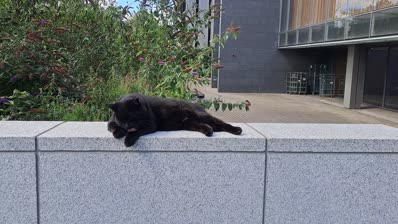
It has been very cold in Maynooth for the last couple of days and the forecast is for sioc, oighear, sneachta agus flichshneachta. In inclement conditions I tend to worry about our resident feline, but have been reassured by various social media posts showing him fit and well:

Better still, this afternoon on my way back to the office from lunch I spotted him, oriented North-South on the wall next to the library. Judging by the empty feeding bowls behind him seems likely he was having a post-prandial snooze so I didn’t disturb him, though I was jealous that I don’t get to take a nap after lunch…

Raising PhD Stipends

Posted in Education, Maynooth, Politics with tags , , on February 24, 2023 by telescoper

Although the Irish Government has kicked its planned review of postgraduate support into the long grass, the Board of Trinity College Dublin recently approved a proposal to increase stipends to for all its PhD students to €25,000. I applaud this decision, but would argue that it doesn’t go far enough.

A while ago Government of Ireland announced a new scheme intended to recruit “high-level researchers” to PhD programmes in Ireland. This scheme, which is a public-private partnership of around  €100 million, will fund around 400 PhD studentships with an annual stipend around €28K, which is substantially higher than the current rate for, e.g., ICR-funded students which is €18.5K. The justification for the higher €28K stipends is that they would be “in line with financial supports offered under similar global scholarships”. I take this as a statement that the Irish Government has acknowledged that the proper rate of pay for a PhD student is at this level, which seems to me to be about right. It seems to me to be logical that all PhD stipends should be increased to this level.

High levels of inflation are combining with spiraling rental costs to make it very difficult for a student to live on the current level of stipend (especially in the Greater Dublin area). This forces postgraduate students to undertake large amounts of tutoring or other work in order to get by financially. This situation is a direct result of the chronic underfunding of higher education in Ireland which means that there aren’t enough academic staff to cover the teaching required. Universities will argue that they don’t have any choice but to exploit PhD students to make up the shortfall, but that doesn’t make the situation is acceptable.

It is of course good for a research student to get some teaching experience during their PhD but this should be on a voluntary basis. A PhD student who chooses to teach will probably do a better job than one who is forced to do it in order to pay the rent. My basic point, though, is that a full-time research student should be funded to do research full time, and it is grossly unfair to pay them too little for this to be possible.

There needs to be a serious “levelling up” of PhD stipends across the entire third-level sector in Ireland. I hope in particular that my own institution, Maynooth University, will take the lead and increase its PhD studentships to the fair level of €28K per annum. This would be a good way to spend at least some of the surplus of €13.2M it ran up during the first year of the pandemic alone.

UPDATE: The Government has now opened a consultation on PhD supports to which you can contribute here.