Archive for Maynooth University

Ninth Level Ireland

Posted in Education, Maynooth with tags , , , , , , on September 7, 2018 by telescoper

Today I’ve been trying to finish off a couple of things before making a short trip back to Cardiff to sort out of a few personal matters. Next week the new intake of students starts to arrive in Maynooth. Officially Welcome Week begins on 17th September but in the second half of next week there are `Orientation Talks’ aimed at guiding new students through all the options they have in the first year. The flexibility of the degree programmes here really makes these talks essential.

Yesterday I blogged about some of the differences between the Higher Education systems in Ireland and the United Kingdom. Another couple came up today. The first is that `Orientation’ over here is what UK universities usually call `Induction’. One thing is common to both systems, though. When I made my annual `joke’ about `induction’ involving passing the students through a magnetic field in order to establish their potential, it fell just as flat here as it always has done on the UK.

Another difference is that over here we don’t have graduation ceremonies; they are called conferring ceremonies. On University Challenge there is no conferring. Moreover, the ceremonies are not in July (as graduation ceremonies usually are in the UK). In fact there are three sets of ceremonies, in mid-September, late October/November, and March. The first set is next week actually. That means I won’t be able to bore my readership with explanations of the Latin grammatical origins of the words graduand and graduate as I have done in the past.

Finally, I just wanted to mention that there is a site called Ninth Level Ireland which aggregates news items, blogs and other online items about Higher Education in Ireland. That site started reblogging my posts long before I moved to Ireland, actually. I know quite a few Irish academics follow Ninth Level Ireland , and if you’re interested in matters academical then it’s well worth looking at. As you can see, it even uses the same WordPress theme as this blog.

I don’t know whether it is automated (like a `bot’) or whether items are selected by hand, but if it’s the former I suspect this post might well end up the site!

Notes from Maynooth

Posted in Biographical, Cardiff, Education, Maynooth with tags , on September 6, 2018 by telescoper

A few people have asked me to comment a little bit on difference between Higher Education Institutes in the United Kingdom and here in Ireland from the point of view of teaching and learning. I can’t do that systematically of course because I’ve only ever been at one University in Ireland, Maynooth, and that for only a year. I have however held positions that involved teaching in several UK universities (Queen Mary, Nottingham, Cardiff and Sussex) so perhaps some comments based on my own experiences might be useful. And of course I’m just talking about Theoretical Physics here, so I won’t discuss labs. It’s a very big selling point for our Theoretical Physics courses here that students don’t have to do labs (apart from Computational Physics labs, of course).

To start with something rather trivial, the `load’ for a student in most UK universities is usually 120 credits while here in Ireland it is 60. The actual workload expected of a student is the same so this just means there’s an exchange rate of 2:1 between the UK and Ireland. In the UK the load is usually split into two equal semesters with examinations in January and May after each. In the UK the 60 credits of each semester is usually split into modules. In my experience in physics these can be either 10 or 20 credits (e.g. Cardiff) or 15 credits (e.g. Sussex). The standard size here in Maynooth is 5 credits (equivalent to 10 in the UK), so most comparisons will be with a standard 10-credit module based on the Cardiff model (which I think is more common than the Sussex model).

What goes into these standard modules differs slightly. Here in Maynooth there are twelve teaching weeks per semester plus a `Study Week’ half way through, so each is 13 weeks long. For a 5-credit module there are usually two lectures per week (so 24 in total, as there are no lectures in Study Week). On top of this there are weekly tutorials (usually done by PhD students). In Cardiff there are also 2 lectures a week for the directly comparable 10 credit module, though not all modules have tutorials associated with them. There is no mid-term Study Week in Physics & Astronomy at Cardiff and teaching term is only 11 weeks, so students typically have 22 lectures in a `standard’ module.

Continually-assessed coursework at Maynooth typically counts for 20% of a module mark (as it does in Cardiff), with 80% on an examination. In both Cardiff and Maynooth a `standard’ module has a two-hour examination at the end, but there’s a big difference in style: most of the papers in Maynooth require students to answer all the questions for full marks, whereas in Cardiff it’s two out of three or three out of four (usually). The Maynooth style makes it much harder for students to question-spot.

In summary, then, the amount of contact time for a student in Maynooth is greater than in Cardiff. The student-staff ratio in the Department of Theoretical Physics in Maynooth is about 15, which is a little higher than most UK physics departments (see Table here). There are only 7 full-time academic staff with full curriculum to deliver, means that teaching loads here are quite heavy compared to the UK.
Four modules per year is typical.

That might seem a lot to some people, but I actually enjoy teaching so don’t mind at all. In fact, with the mountain of administrative stuff I had to do at Sussex, it was only the fact that I taught a full module (on Theoretical Physics) that kept me (partially) sane. This year I shall be teaching, in the Autumn Semester, a 4th-year module on Astrophysics & Cosmology and a 2nd-year module on Vector Calculus and Fourier Series and, in the Spring Semest, 3rd-year Computational Physics 1 (again) and Engineering Mathematics (for First-year engineers). I’m not sure what to expect of that last one, but I’m not going to think about it until the New Year.

Most of our students do a four-year Bachelors programme in Science (as discussed briefly here) with a very general first year. Some, however, come directly into a programme called Theoretical Physics & Mathematics (TP&M, for short) which is three-year fast-track degree. It’s harder to get into TP&M than the `Omnibus’ Science course, but it does attract some very capable students.

I should mention that the really big difference between Ireland and the UK is that the system of teaching and learning here is much less centralized and much less rigid that UK universities. The small size of the Department means that it is possible to know all the students by name and students with difficulties can always find someone to talk to. That is increasingly not the case in UK universities, which are rapidly turning into teaching factories and are subject to the pressure to do well in league tables (often with a negative impact on teaching quality).

Subject to some conditions, first-time full-time undergraduate students in `Third-level’ education in Ireland do not pay tuition fees as such, and neither do students from other EU or EEA countries. There is however an annual ‘student contribution’ of €3000 which all students pay (unless they have a grant that covers it). As far as I can see, that is effectively a fee, though it is supposed to cover student services (e.g. libraries) and examinations rather than tuition. Students taking repeat examinations generally have to pay extra for them. If you consider the `student contribution’ to be a fee (which is effectively what it is) then the Irish funding system is similar to the pre-2012 UK system, i.e. before the introduction of the current £9K fee.

Finally, one of the most striking differences between Ireland and the UK is that here a much higher proportion of students live at home with their parents while studying and commute into campus daily (some of them from quite a distance). That is quite unusual in the UK, but is fairly typical in other EU countries (e.g. Italy). The cost of accommodation is undoubtedly a factor, but I think it’s also a more general cultural thing. I’ve also noticed something here that I’ve never seen in the UK, which is that some student accommodation is let on a Monday-Friday basis, the tenant being expected to go back to the parental home at the weekends. On Fridays in term-time, you can see quite a lot of students with their bags waiting for coaches or trains to take them away for the weekend…

In a future post I might comment on non-academic differences between Ireland and the UK (e.g. tax, public services, cost of living, etc) but I think that will do for now.

Golf and other Hazards

Posted in History, Maynooth, Sport with tags , , , , , on August 27, 2018 by telescoper

Back in the office with a few minutes to go before a meeting starts I thought I’d give a little insight into life in the throbbing metropolis that is Maynooth, County Kildare. This week sees the start of the World Amateur Team Golf Championships, which is being held at Carton House (above) which is a short walk from downtown Maynooth. Some of the competitors will be staying on Maynooth University campus for the duration, which will no doubt provide welcome revenue.

Now the game of golf is obviously of no conceivable interest to anyone, but the venue – Carton House – is quite fascinating. The current house was built on the Carton Estate in the 18th Century to accommodate the Earl of Kildare, when their fortunes had slowly recovered after Thomas Fitzgerald (`Silken Thomas’) the 10th Earl of Kildare was executed, along with several others of the Fitzgerald family, by Henry VIII for plotting a rebellion against the English. If you have been paying attention you will know that it was the Fitzgeralds who built the stone castle in Maynooth that was destroyed in the 16th Century. Carton House is at the other end of town, and is approached by a very pleasant tree-lined avenue. The extensive grounds are also surrounded by a wall. The latter-day Fitzgeralds obviously wanted to keep the hoi polloi at arm’s length.

Anyway, to cut a long story short, Carton House fell into disrepair in the second half of the 20th Century and was eventually sold off and turned into a hotel and spa resort, with two golf courses.

In the meantime, among many other things, Carton House and it its grounds were used as one of the locations for Stanley Kubrick’s (1975) film Barry Lyndon. That was of course before the beautiful landscaped gardens were destroyed and turned into golf courses. I went for a pleasant walk in the grounds earlier this summer, during the heatwave, but the path runs alongside a small lake beside one of the fairways where a group of people were openly committing acts of golf. A not-very-competent member of this group sent several balls into the water before finally managing to hit dry land with a tee shot. For a while I wished I’d brought a tin hat with me.

Results Day Advice!

Posted in Education with tags , , , , on August 15, 2018 by telescoper

Today’s the day in Ireland that students get the results of their school Leaving Certificate examinations and, over the other side of the Irish Sea, tomorrow is when A-level results come out. For many there will be joy at their success, and I particularly look forward to meeting those who made their grades to get into Maynooth University shortly.

Others will no doubt receive some disappointing news.

For those of you who didn’t get the grades you needed or expected, I have one piece of very clear advice:

1-dont-panic

In particular, if you didn’t get the Leaving Certificate points you needed for entry to your first University in Ireland or the A-levels needed to do likewise in the United Kingdom, do not despair. There are always options.

For example, in Ireland, you could try looking at alternative choices on the Available Courses, where any places remaining unfilled in particular courses after all offers have been made and the waiting lists of applicants meeting minimum entry requirements have been exhausted, will be advertised.

In the United Kingdom the Clearing system will kick into operation this week. It’s very well organized and student-friendly, so give it a go if you didn’t make your offer.

Summer Open Day in Maynooth

Posted in Education, Maynooth with tags , on June 22, 2018 by telescoper

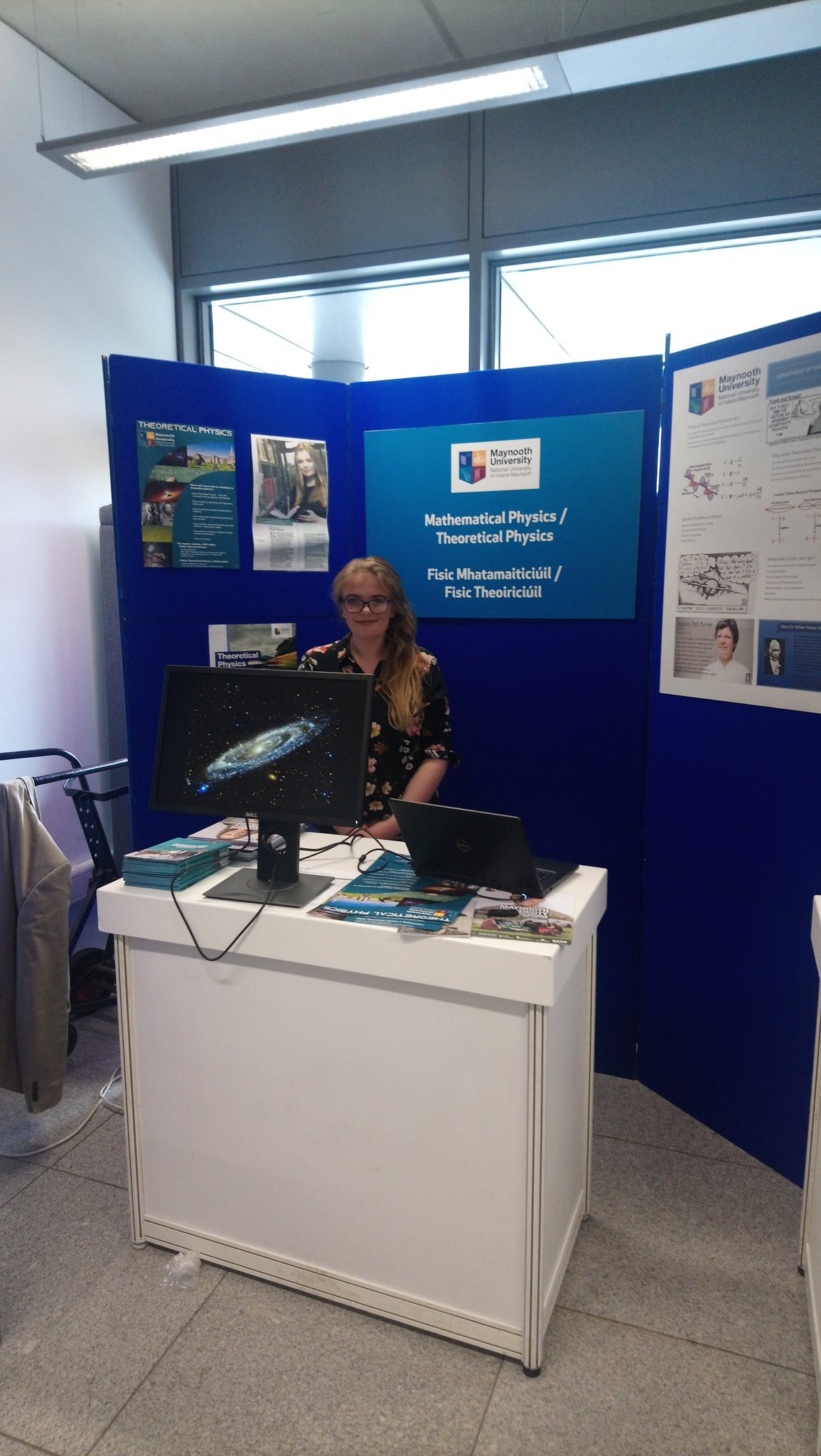
It seems I have volunteered to represent the Department of Theoretical Physics at Maynooth University’s Open Day tomorrow, so I’ll be giving a talk as well as answering questions, handing out leaflets etc on the Theoretical Physics stall (with the aid of some current students). It’s a bit of a flashback to Sussex days, actually, when I used to have to do this sort of thing quite regularly on Saturdays throughout the year. At least the weather looks like it’s going to be nice, even if the post-solstitial nights are now drawing in.

If you’re planning to come tomorrow, the event starts at 10.30 am and the first talk is at 11.15, but I’m not on until 13.35. Lots of information is available here. Please come and say hello if you’ve read this here blog post!

Anyway, Maynooth University has made a nice little video about the Open Day so I thought I’d share it here, mainly to give readers a look at the lovely campus, which is bathed in sunshine as I write this!

Other People’s Code

Posted in Education, mathematics with tags , , , on March 16, 2018 by telescoper

I don’t know if this is just me being useless, but one of the things I’ve always found difficult is debugging or rewriting computer programs written by other people. This is not a complaint about people who fail to document their code sufficiently to see what’s going on, it’s that even when the code is documented it seems much more difficult to spot errors in code written by other people than it is when you’ve written the program yourself.

I’ve been thinking a lot since I’ve been teaching Computational Physics here in Maynooth University. One of the standard elements of the assessment for this module is a task wherein the students are given a Python script intended to perform a given task (e.g. a numerical integral) but which contains a number of errors and asked to identify and correct the errors. This is actually a pretty tough challenge, though it is likely to be one that a graduate might have to meet if they get a job in any environment that involves programming.

Another context in which this arises is our twice-weekly computing laboratory sessions. Twice in the last couple of weeks I’ve been asked for a bit of help by students with code that wasn’t working, only to stare at the offending script for ages and fiddling with a number of things that made no difference, without seeing what turned out to be an obvious mistake. Last week it was an incorrect indent in Python (always a hazard if you’ve been brought up on Fortran). This week it was even simpler, a sign error in a line that was just supposed to calculate the mid-point of an interval. I should have been able to spot these very quickly, but I couldn’t.

What makes this so difficult? When given a mathematical calculation to mark I can usually spot errors reasonably easily (unless the working is illegible), but with code it’s different (at least for me). If I’d been given it on a piece of paper as part of a formula, I reckon I would have spotted that minus sign almost immediately.

One possibility is just that I’m getting old. While that may well be true, it doesn’t explain why I found debugging other people’s code difficult even when I was working on software at British Gas when I was 18. In that context I quite often gave up trying to edit and correct software, and instead just deleted it all and wrote my own version from scratch. That’s fine if the task is quite small, but not practicable for large suites written by teams of programmers.

I think one problem is that other people rarely approach a programming task exactly the same way as one would oneself. I have written programs myself to do the tasks given to students in the computing lab, and I’m always conscious of the method I’ve used. That may make it harder to follow what others have tried to do. Perhaps I’d be better off not prejudicing my mind doing the exercises myself?

Anyway, I’d be interested to know if anyone else has the same with other people’s code and if they have any tips that might improve my ability to deal with it. The comments box is at your disposal…

A Rambling Post

Posted in Biographical, Maynooth with tags , , , , on March 15, 2018 by telescoper

Thursdays are busy days for me, starting with a 9am lecture on Computational Physics in Physics Hall, followed in the afternoon by a two-hour laboratory session on the same subject. Today we did exercises on root-finding and numerical integration, but didn’t get through as many examples as I had hoped. In between I had a number of jobs to do, including a lunchtime meeting off campus with my landlord to pay the rent (which he collects in person). I was a bit late back for the lab and, after apologizing, complained that I was too old for all this running around. One of the students kindly said that `age is only a number’. I replied `I know, but unfortunately in my case it’s a rather large one..’

I now have a bit of a break from teaching in Maynooth. There is no teaching next week as it is `Study Week’ and Monday 19th March is a public holiday (for St Patrick’s Day, 17th March, which this year falls on a Saturday). Study week is followed by a week’s holiday because of Easter. Teaching resumes here on Tuesday April 3rd. Somewhat surprisingly the Easter break here is shorter than in the UK.

The four-week batch of strikes in UK universities over pensions in which I have been participating ends tomorrow, which means that I will be lecturing in Cardiff again next Tuesday (20th March). This lecture will be Lecture 8 of 11, with lectures 5, 6 and 7 missing in action (industrial action, to be precise). Cardiff students are then on vacation for three weeks for the Easter break, with lectures resuming on 16th April. All of this means that for the next three weeks I won’t have to do the mid-week trip from Cardiff to Maynooth (which I am beginning to find rather tedious). I plan to stay all next week in Wales and return to Ireland the following week, as I have been invited to give a seminar then at the Dublin Institute for Advanced Studies (which I have never visited before).

Anyway, all that rambling just serves to illustrate that it’s a complicated business being in a superposition of jobs. I’m looking forward to the summer, when my wavefunction will collapse onto Ireland (if I haven’t collapsed from exhaustion before that).

To end on a very sad note, I heard today that Emeritus Professor David Bailin passed away yesterday. I knew David from both times I was at Sussex (as a graduate student and postdoc in the 1980s, and as Head of School of Mathematical and Physical  Sciences from 2013 to 2016). He was a very fine theoretical physicist and a very nice man who was held in a very high regard by all who worked with him. Condolences to his family, friends and colleagues.

Maynooth in the Snow

Posted in Maynooth with tags , on February 28, 2018 by telescoper

There has been very little snow in Cardiff (so far) but there have been heavy falls in Maynooth. The above picture was tweeted by Maynooth University this morning, along with an announcement that the campus is closed today (and probably until Friday, as more snow is on the way).

Under normal circumstances I would be in Ireland from today until the weekend, but I have to be in London tomorrow (Thursday) so arranged cover for my teaching. Looks like teaching will be cancelled tomorrow anyway.

UPDATE: Maynooth University campus will be closed until Monday.

Whether I can make it to and from London, or whether the event I’m supposed to attend tomorrow will be cancelled, remains to be seen…

Learning Technology

Posted in Biographical, Cardiff, Education, Maynooth with tags , , , , , , , , on February 20, 2018 by telescoper

I’m just taking a tea break in the Data Innovation Research Institute. Today has been a very day as I have to finish off a lot of things by tomorrow, for reasons that I’ll make clear in my next post…

It struck me when I was putting on the brew how much more technology we use for teaching now than when I was a student. I think many of my colleagues make far more effective use of the available technology than I do, but I do my best to overcome my Luddite tendencies. Reflecting on today’s teaching makes me feel just a little less like a dinosaur.

This morning I gave a two-hour lecture on my Cardiff module Physics of the Early Universe which, as usual, I recorded using our Panopto system. Although there was a problem with some of the University’s central file storage this morning, which made me a bit nervous about whether the lecture recording would work, it did. Predictably I couldn’t access the network drives from the PC in the lecture theatre, but I had anticipated that and took everything I needed on a memory stick.

After a short break for lunch I checked the lecture recording and made it available for registered students via the Virtual Learning Environment (VLE), known to its friends as Learning Central. I use this as a sort of repository of stuff connected with the module: notes, list of textbooks, problem sets, model answers, instructions and, of course, recorded lectures. The students also submit their coursework assignment (an essay) through this system, through the plagiarism detection software Turnitin.

This afternoon the students on my Computational Physics course in Maynooth University had a lab test, the first of four such tests, this one consisting of a short coding exercise. There are two lab sessions per week for this class, one on Thursdays (when I am normally in Maynooth to help supervise) and another on Tuesdays (when I am normally in Cardiff). I have a number of exercises, which are similar in scope but different in detail (to prevent copying) and the Tuesday lab has a completely different set of exercises from the Thursday one. In each exercise the students have to write a simple Python script to plot graphs of a function and its derivative (computed numerically) using matplotlib. The students upload their script and pictures of the plot to the VLE used in Maynooth, which is called Moodle.

In the manner of a TV chef announcing `here’s one I did earlier’, this a sample output produced by my `model’ code:

I wonder if you can guess of what function this is the derivative? By the way in this context `model’ does not mean `a standard of excellence’ but `an imitation of something’ (me being an imitation of a computational physicist). Anyway, students will get marks for producing plots that look right, but also for presenting a nice (commented!) bit of code

This afternoon I’m on Cardiff time but I was able to keep an eye on the submissions coming in to Moodle in case something went wrong. It seemed to work out OK, but the main problem now is that I’ve got 20-odd bits of code to mark! That will have to wait until I’m properly on Maynooth time!

Now, back to the grind…

Lunch with Pugin

Posted in Architecture, Maynooth with tags , , , on February 9, 2018 by telescoper

I usually have a sandwich lunch when I’m in Maynooth because I’m quite busy, but it’s rather cold (though bright) today so I decided to get myself a hot lunch at Pugin Hall, which is situated in St Patrick’s House on the South Campus of Maynooth University. I stayed in St Patrick’s House briefly before Christmas, and had my breakfasts in Pugin Hall. It’s a nice place to have an expensive but filling meal. It was particularly cosy today because of the sunlight streaming in through the windows:

The hall is named, of course, in honour of architect Augustus Pugin. He didn’t design St Patrick’s House itself – construction of that building started before he was born – but did lay out the quadrangles elsewhere that make up much of the South Campus.