After yesterday’s holiday it was back to teaching full-time this morning with the first lecture of my module on Particle Physics. I just about managed to get everything ready in time for the teaching session at 1pm which, because it was an introductory lecture with lots of pictures, I decided to do via powerpoint rather than my usual chalk-and-talk. That didn’t get off to a very good start because the podium PC in my room had decided to do a Windows update just before I started and I had to wait for that to finish before I could show my slides. I suppose that happened because this was the first day of teaching after a lengthy break so nobody had used the room recently.
Most of the lecture was devoted to introducing natural units, which I intend to use throughout the module, like I have on previous occasions I have taught this sort of material for reasons I explained here. The last time I taught particle physics was some 15 years ago, so I had to update some things, especially the picture of the components of the standard model to include the Higgs. After extensive research (by which I mean looking at wikipedia) I found the above; the Higgs is on the right. Unfortunately the particle masses – which reveal themselves if you click on the image above – are not given in natural units, but have pesky factors of c-squared in them. You can’t have everything.
The bit I’m looking forward to most is doing the Dirac Equation which, years ago when I was at Sussex, was once the subject of a cake:
That particular cake was a lemon drizzle cake which unfortunately is not one of the flavours represented in the standard model.
Today would be the first day of teaching in Semester 2 at Maynooth University, were it not for the fact that it is a Bank Holiday in Ireland. The holiday marks Imbolc, an old Celtic festival occurring halfway between the winter solstice and vernal equinox in the Northern hemisphere. In the modern calendar the date is 1st February. In Ireland Imbolc is often referred to as a Lá Fhéile Bríde,St Brigid’s Day, after St Brigid of Kildare, whose feast day is 1st February. In the old pagan calendar, this day is regarded as the first day of spring, as it is roughly the time when the first spring lambs are born, daffodils, etc, start to appear, and the days get noticeably longer. It corresponds to the Welsh Gŵyl Fair y Canhwyllau and is also sometimes called, rather beautifully, The Quickening of the Year. It’s a time for rebirth and renewal after the darkness of winter.
I noticed some scepticism on social media about 1st February being the first day of spring, but it makes sense to me. I feel the same way about May being the start of summer too. From living 7 years in Ireland, I’ve always found May/June the most summery months – as far as that means anything in Ireland!
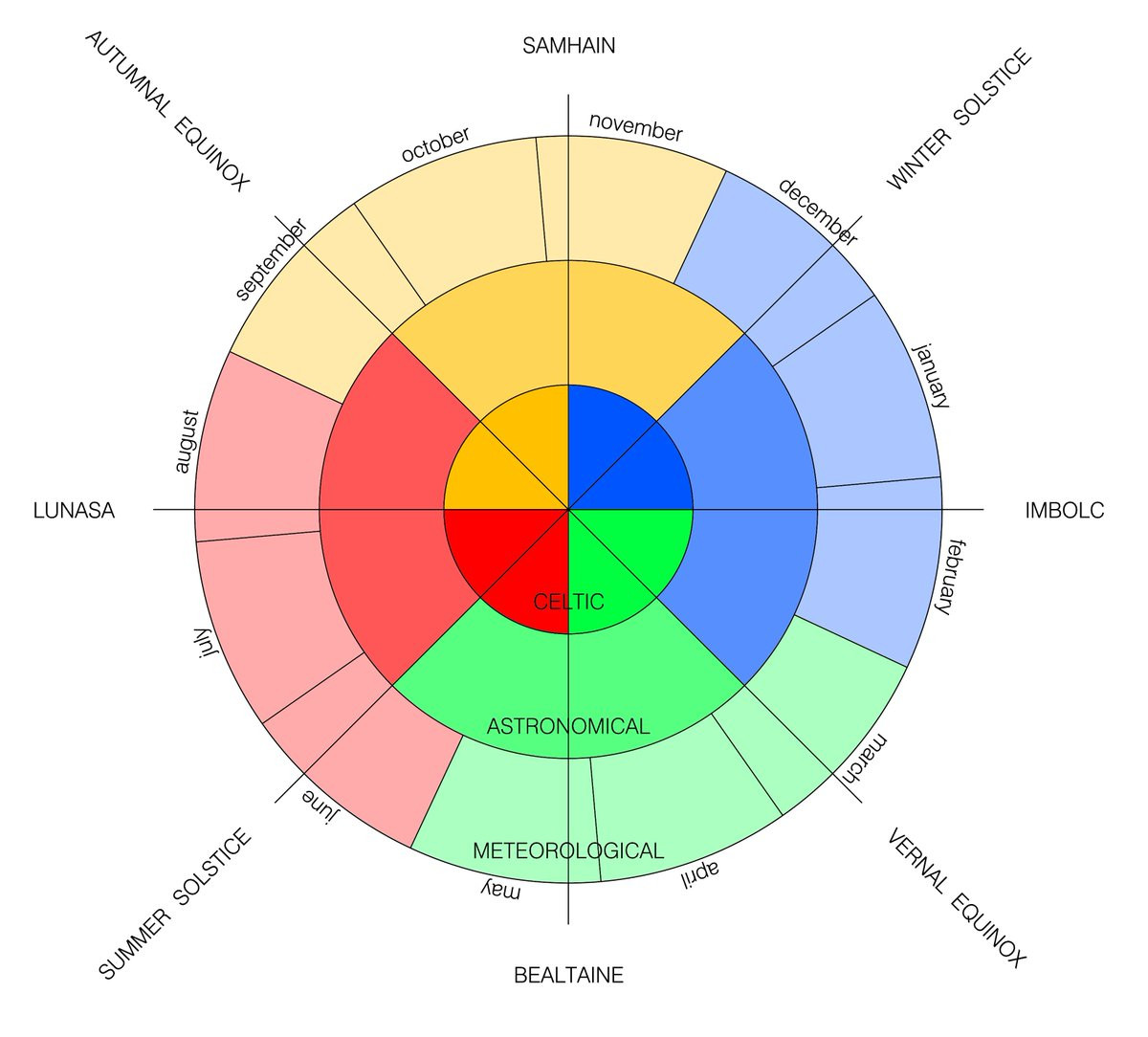
In the Northern hemisphere, in astronomical terms, the solar year is defined by the two solstices (summer, around June 21st, and winter, around December 21st) and the equinoxes (spring, around March 21st, and Autumn, around September 21st). These four events divide the year into four roughly equal parts of about 13 weeks each. If you divide each of these intervals in two you divide the year into eight pieces of six and a bit weeks each. The dates midway between the astronomical events mentioned above are the cross-quarter days, of which Imbolc is one. Here they are represented on a diagram:
The timings are rough because the dates of the equinoxes and solstices vary from year to year. Imbolc is often taken to be the 2nd of February (Groundhog Day) and Samhain is sometimes taken to be October 31st, Halloween but hopefully you get the point that although the Pagan festivals have been appropriated by the Christian church, they have much older origins.
Until 2023 only three of the four cross-quarter days were associated with public holidays in Ireland; there wasn’t a holiday for Imbolc. In 2022 however, the Government decided to create a new Bank Holiday that corrected this anomaly by introducing a new St Brigid’s Day holiday on the first Monday on or after 1st February (or on Friday if 1st February falls on that day), which also happens to be the first national holiday in Ireland to be named after a woman. The first such holiday was Monday, 6th February 2023 and the second was on Monday 5th February 2024. This is the third.
But I digress.
I am glad to have today’s holiday just before teaching starts. Having completed my examination marking duties promptly I was planning to use last week to get my teaching materials ready. Unfortunately I wasn’t at all well for most of the week – though I recovered by Friday – and am way behind schedule. Fortunately, I’ve taught one of the modules (Computational Physics) many times before so not much preparation is required although it is a bigger class than I’ve had on previous occasions which means extra work in due course grading the CA components. The other module, Particle Physics is new for me at Maynooth, though I have taught it elsewhere. This also has a bigger class than I was expecting for a final-year module and my first lecture on it is tomorrow. I’m going to have to spend most of today quickening the writing of the lecture notes and preparing assignments.
P.S. Not particularly relevantly, Particle Physics is an anagram of Happier Cyclists.
We haven’t been able to make an appointment so far, despite trying! One of the reasons was undoubtedly that the two previous Departments of Theoretical Physics and Experimental Physics were in the throes of a merger and it was by no means certain at that time what the outcome of that process would look like in terms of the structure of the new Department. However, we now have a single Department of Physics so that at least is much clearer. So we’re trying again now.
The job announcement can be found here. It will appear on other sites shortly. Update: it is now on the Times Higher Jobs page here. The deadline is 31st March. I hope readers of this blog will help spread the news of this opportunity through their own networks.
The key rationale for these SALI positions is clear from the statement from Simon Harris, the (then) Minister responsible for Third Level education in Ireland:
“Championing equality and diversity is one of the key goals of my department. The Senior Academic Leadership Initiative (SALI) is an important initiative aimed at advancing gender equality and the representation of women at the highest levels in our higher education institutions.
We have a particular problem with gender balance among the staff in Physics in Maynooth, especially on the theoretical side, where all the permanent staff are male, and the lack of role models has a clear effect on our ability to encourage more female students to study with us.
The wider strategic case for this Chair revolves around broader developments in the area of astrophysics and cosmology at Maynooth. Currently there are two groups active in research in these areas, one in the former Department of Experimental Physics (which is largely focussed on astronomical instrumentation) and the other, in the former Department of Theoretical Physics, which is theoretical and computational. We want to promote closer collaboration between these research strands. The idea with the new position is that the holder will nucleate and lead a research programme in the area between these existing groups as well as getting involved in outreach and public engagement.
It is intended that the position to appeal not only to people undertaking observational programmes using ground-based facilities (e.g. those provided by ESO, which Ireland recently joined), or those exploiting data from space-based experiments, such as Euclid, as well as people working on multi-messenger astrophysics, gravitational waves, and so on.
Exciting as this position is in itself, it is part of wider developments and we are expecting to advertise further job opportunities in physics and astronomy very soon! I’d be happy to be contacted by any eligible person wishing to discuss this position (or indeed the general situation in Maynooth) on an informal basis:
P. S. For those of you reading this from outside Ireland the job includes a proper public service pension, a defined benefit scheme way better than the UK’s USS.
This afternoon, for the first time in a while, I encountered Maynooth University Library Cat at his customary position. Unfortunately he didn’t seem favourably disposed and when I tried to take his picture he turned his back on me. Luckily I was with a colleague who was strategically positioned to take the snap above.
I’ve been at home marking examinations almost all day and have decided to knock off until tomorrow when hopefully I can finish the job. I say almost all day because I took a break this afternoon to back to campus to collect some papers that I didn’t get yesterday because they were from students sitting the examination for various reasons in alternative venues on campus rather than the main examination room.
What I do with examination scripts is mark one question at a time rather than one script at a time. What I mean by that is that I go through every script marking all the attempts at Question 1, then I start again and do all the Questions 2, etc. I find that this is much quicker and more efficient than marking all the questions in each script then moving onto the next script. The reason for this is that I can upload into my mind the model answer for Question 1 so that it stays there while I mark dozens of attempts at it so I don’t have to keep referring to the marking scheme. Other advantages are that it’s easier to be consistent in giving partial credit when you’re doing the same question over and over again, and that also you spot what the common mistakes are more easily.
It’s a fairly monotonous job and I find my concentration starts to wander if I try to do too many in one go. Fortunately the exam papers are organized in batches (separated by elastic bands as in the photograph) so I usuallly take a break – as a sort of self-reward- after each batch to break things up. Each batch usually takes a couple of hours or so, so the breaks often end up as times to have lunch and tea. In terms of the timing it’s rather like a game of cricket, actually.
Today I corrected Question 1 in two batches before lunch, then another between lunch and tea. At that point I took a walk into town to do a few errands and then collected the remaining scripts from campus, which I have now just finished correcting. Some people will accuse me of being lazy, taking breaks like this, but I think it’s more efficient to do it this way. Trying to mark examinations for hours on end inevitably leads to more errors, so in the long run it takes longer to complete the job. Slow and steady does it.
I remember using a similar approach when I wrote my thesis many years ago. That’s a much bigger job, of course, but I found what worked for me was to plan out each chapter in terms of sections of roughly equal length, write each in turn and take a break when I’d finished it. Writing a thesis of around 200 pages may seem a daunting task, but if you split it into 1000-word chunks spread over three months or so it’s quite manageable – and you can plan to take time out for relaxtion along the way to avoid getting too burned out by the process.
Anyway, I’ve now finished all the attempts at Question 1 in this examination, including those in the extra scripts I picked up today. Question 1 consists of a set of short problems and is altogether worth 50% of the examination mark, so I’m actually abouty halfway through the marking. There three questions left, each longer than the pieces of Question 1 and worth 25% of the overall mark. Students are supposed to answer two. I’ll start on Question 2 in the morning and hopefully by this time tomorrow evening I will have marked all three, and that will be that. Until the next one…
The January examination period starts tomorrow (10th January), so I thought I’d do a quick post on the topic of examinations. First of all let me wish the very best of luck everyone at Maynooth or elsewhere taking examinations in the next few weeks. I hope at least that the exam halls are nice and warm!
As the first examination for which I have responsibility is not until Monday 13th – unlucky for some! – I’ll have to wait to find out how any of my students have done but let me take this opportunity to pass on a few quick tips.
Try to get a good night’s sleep before the examination and arrive in plenty of time before the start. This is especially important when there’s bad weather that may disrupt travel. It is your responsibility to get to the examination on time!
Read the entire paper before starting to answer any questions. In particular, make sure you are aware of any supplementary information, formulae, etc, given in the rubric or at the end.
Start off by tackling the question you are most confident about answering, even if it’s not Question 1. This will help settle any nerves.
Don’t rush! Students often lose marks by making careless errors. Check all your numerical results on your calculator at least twice and – PLEASE – remember to put the units!
Don’t panic! You’re not expected to answer everything perfectly. A first-class mark is anything over 70%, so don’t worry if there are bits you can’t do. If you get stuck on a part of a question, don’t waste too much time on it (especially if it’s just a few marks). Just leave it and move on. You can always come back to it later.
Readers of this blog are welcome to add other tips through the comments box below!
This morning I saw an announcement (dated 19th December 2024) that the Université Paris-Saclay has, to its credit, ceased its activity on the social media platform formerly known as Twitter and now known as Elon Musk’s personal mouthpiece. I have written about why individuals and institutions should leave Twitter several times before, e.g. here.
According to the Saclay announcement:
It comes following changes to the platform’s content policy, which is no longer in compliance with the European Union’s Code of Practice on Disinformation, making the platform incompatible with the universal values that the university and its community share.
Bravo!
But why are so many other universities still supporting Twitter/X? I suppose it may be because many of them have specifically employed staff to broadcast news about themselves on this platform and without it they’d have nothing to do. That’s not a very good argument, in my opinion. I’m sure other bullshit jobs can be found. Another possibility, of course, is that they just don’t care. Given the prevalence of toxic management in higher education these days, this may well be the real reason. Whatever the motivation I find it deeply shaming to be working for an institution that is still happy to tout for trade in a neo-Nazi chatroom.
I very much doubt my own institution’s management will take the correct ethical course. The Maynooth University leadership doesn’t even follow the institution’s own Statutes, so I doubt that a mere EU Code of Conduct will have any influence on them. I do hope, however, the decision by the mega-University Saclay – one of the world’s top research institutions may influence others to do the right thing. As well all known, University “leadership” these days largely involves copying what others do.
It’s not only universities, and not only via Xitter, that institutions are being degraded by their association with Elon Musk. The venerable Royal Society still counts him as a Fellow, despite his overtly antiscientific dissemination of false information and his support for far-right extremism. I don’t know how Musk was elected an FRS in 2018, perhaps before the worst of his character became widely known, but the fact that he remains a Fellow tarnishes the reputation of that organization.
The forthcoming week is the second-to-last week of teaching term at Maynooth and, as usual at this stage of the Semester, we’re getting busier and busier.
The examinations for January have been sent off for printing and are (presumably) ready to go, so that’s one item crossed off the to-do list. I’m still behind on the coursework grading for one of my two modules, but should be able to catch up in the next few days. Other than that, I am miraculously on schedule as far as teaching is concerned. I should finish covering the respective syllabuses by Friday 13th, which means the following week will be devoted to revision. I expect attendance on campus will be fairly sparse in the last week of term, especially later on. I’ll be there until the bitter end, however, as I have a lecture scheduled on Friday 20th and have to attend final-year student presentations that afternoon. After that I will probably collapse in a state of exhaustion into the welcoming arms of the Christmas break.
While the week ahead will be fairly normal from the point of view of teaching itself, there are quite a few extra things in my calendar, as people try to get various things done before the break. Extra items for next week including a meeting about a staff recruitment (of which, hopefully, more anon) and another about the possible reorganization of teaching in the light of the merger of the Departments of Theoretical and Experimental Physics. Rationalization of teaching could lead to an improvement in the courses offered and also, by removing duplication, reduce our very heavy teaching workloads. Whether it will actually be possible to achieve either or both of these aims remains to be seen. In any case I’m not sure if any significant changes to teaching will be implemented before I retire, but I’ll probably go along to the meeting anyway in case there’s anything I can contribute.
I’ve also agreed to give a talk on Wednesday to the student Pride Society which I am looking forward to, although such events invariably make me feel very old!
As it happens, Friday 13th December is the date for the first Christmas dinner of the newly formed Department of Physics; previously, the Departments of Theoretical Physics and Experimental Physics held separate celebrations. It will be a much bigger group this time and, it being on a Friday evening we’ll have the weekend to recover before the last week of term.
Anyway, although it’s a Sunday I’ll be working all afternoon as I have a task to finish that is due tomorrow so I had better sign off. When I was younger I used to look forward to Christmas as a time for feasts and parties and socialising. Now that I’m older I look forward to it more than anything as a time for the sense of relaxation that comes from the lack of deadlines.
We’re in Week 9 of teaching in the Autumn Semester at Maynooth University, which means we’ve got one eye on the forthcoming Examination Period, which starts on 10th January 2025. Examination papers have already been prepared in draft form, and are now being checked ahead of printing. A draft examination timetable has also been released to staff, but not yet to students in case it has to be revised because of clashes.
I’m still on schedule with both my modules to finish the actual content in time to do use the last week for revision classes, going through past examination papers and generally helping the students prepare for the ordeals of January. There is a continuously-assessed component of both my modules, which counts 20% of the overall grade. One purpose of these assignments is to give the students some practice at the sort of problems they might encounter in the examinations: if they can do the assignments, they shouldn’t be too fazed by the examination questions. The purpose of the coursework is not just about passing examinations, however. I think the only way really to learn about mathematical physics is by doing it; the coursework is at least as important as the lectures and tutorials in terms of actually learning the subject. I think that modern higher education involves drastic over-assessment. Too much emphasis on grades and scores can be detrimental to real learning, but assessment that is formative can be extremely beneficial. Continuous assessment provides a way to give feedback to students on how they are doing, and to lecturers on how well the message is getting across; giving grades to such coursework is really just an incentive to the students to do it. It’s not primarily intended to be summative.
Anyway, back to examinations. One big difference between our examinations in Theoretical Physics in Maynooth and those at other institutions at which I’ve taught (in the UK) is that most of the papers here offer no choice of questions to be answered. Elsewhere it is quite common to find a choice of two or three questions from four or five on the paper. In my module on Differential Equations and Complex Analysis, for example, there are four questions on the examination paper and students have to do all of them for full marks.
One advantage of our system is that it makes it much harder for students to question-spot in the hope that they can get a good grade by only revising a fraction of the syllabus. If they’re well designed, a few longish questions can cover most of the syllabus for a module, which they have to in order to test all the learning outcomes. To accomplish this, questions can be split into parts that may be linked to each other to a greater or lesser extent in order to explore the connections between different ideas, but also sufficiently separate that a student who can’t do one part can still have a go at others. With such a paper, however, it is a dangerous strategy for a student to focus only on selected parts of the material in order to pass.
As an examiner, the Maynooth style of examination also has the advantage that you don’t have to worry too much if one question turns out to be harder than the others. That can matter if different students attempt different questions, as students might be penalized if they chose a particularly hard one, but not if everyone has to do everything.
But it’s not just the number of questions that’s important, it’s the duration. I’ve never felt that it was even remotely sensible for undergraduate physics examinations to be speed tests, which was often the case when I was a student. Why the need for time pressure? It’s better to be correct than to be fast, I think. I always try to set examination questions that could be done inside two hours by a student who knew the material, including plenty of time for checking so that even a student who made a mistake would have time to correct it and get the right answer. If a student does poorly in this style of examination it will be because they haven’t prepared well enough rather than because they weren’t fast enough.
It has been an unusually mild November until today, when it has suddenly turned colder and wetter. This alteration does not seem to have pleased Maynooth University Library Cat.
The views presented here are personal and not necessarily those of my employer (or anyone else for that matter).
Feel free to comment on any of the posts on this blog but comments may be moderated; anonymous comments and any considered by me to be vexatious and/or abusive and/or defamatory will not be accepted. I do not necessarily endorse, support, sanction, encourage, verify or agree with the opinions or statements of any information or other content in the comments on this site and do not in any way guarantee their accuracy or reliability.