The scientific community has been waiting for several weeks to find out precisely how heavily the Trump/Musk axe would fall on the National Aeronautics and Space Administration (NASA); this article reveals the shocking scale of the proposed cuts.
Under the proposal, NASA’s Science Mission Directorate (SMD) would receive almost a 50% reduction in its Budget. Within the individual SMD Divisions:
Planetary Science would have its budget cut from the current level of $2,717 Million to $1,929 Million;
Earth Science would see a cut from the current budget level of $2,195 Million to $1,033 Million;
Astrophysics would decrease from its current level of $1,530 Million to $487 Million;
Heliophysics budget would decrease from its current level of $805 M to $455 M.
It’s very bad news all round for NASA science, but the worst hit is Astrophysics (which includes cosmology) where the proposed cut is about two-thirds, which would be truly devastating. According to the American Astronomical Society,
The proposed cut to the astrophysics budget is likely to result in the cancellation of the Nancy Grace Roman Space Telescope, a Great Observatory that would revolutionize our understanding of dark matter and dark energy while also detecting hundreds of thousands of planets in other solar systems. As the Roman Space Telescope is already fully assembled and on budget for a launch in two years, a cancellation of the mission would be a significant waste of taxpayer dollars.
The Nancy Grace Roman Space Telescope (formerly known as WFIRST) is in many ways complementary to Euclid, though it will survey a smaller area of sky it has an telescope twice the diameter of Euclid so will reach fainter magnitudes. It has been threatened before, in Trump’s previous administration, but it survived. It is not clear that it will do so again as the current composition of Congress is not weighted favourably.
Those of us outside the United States can do little, but in case anyone reading this is in America the AAS has an Action Alert for you to contact your representative(s) to vote against the proposal.
The only thing that has surprised me about Donald Trump’s assault on Diversity, Equity and Inclusion is the speed with which he has imposed his bigotry on individuals and federal institutions. The first step came within hours of the Felon-in-Chief assuming office with an Executive Order intended to dismantle crucial protections for transgender people and deny the validity of gender identity itself. The new order withdraws a range of executive orders issued by Joe Biden, including those allowing transgender people to serve in the military, advancing the health and well-being of lesbian, gay, bisexual, and transgender (LGBT) youth, and interpreting federal sex discrimination protections in domains like education, housing, and immigration to prohibit discrimination based on sexual orientation or gender identity. And this is just the start, and I don’t think it will be confined to the USA for very long.
The attack on LGBTQ+ rights is part of a wider assault on the Diversity, Equity and Inclusion policies intended to create a level playing field for women and minorities. The intention is to turn the Federal government into a system of oppression operated by people of Trump’s hate-filled mindset that diversity is a threat to white male privilege and must be crushed. He and his crony Elon Musk got where they are not by merit but through inherited wealth. It’s no surprise that they wish to deny others the chance to succeed.
I have addressed the question “why should we care about diversity?” many times on this blog in many contexts, though usually in science and usually in reference to LGBTQ+ rights. The obvious answer _ think – is based on notions of fairness: we should do everything we can to ensure that people have equal opportunity to advance their career in whatever direction appeals to them. But I’m painfully aware that there are some people for whom arguments based on fairness simply don’t wash. Trumpists, for example. For them there’s another argument that should work better. As scientists whose goal is – or should be – the advancement of knowledge, the message is that we should strive as hard as possible to recruit the brightest and most creative brains into our subject. That means ensuring that the pool from which we recruit is as large and as diverse as possible. In large and complex research collaborations, such as the Euclid Consortium (of which I am a member), the range of ideas and perspectives is a real asset when it comes to solving problems. The problem is that this argument doesn’t work either as they are driven purely by mean-spirited ideology and the desire to fill the institutions of state with those of a similar ilk.
The effects of the latest reactionary steps are already starting to show in the area of astronomy. The Diversity and LGBT+ channels on the Vera Rubin-LSST Slack (which is a Federal project, funded by the National Science Foundation and the Department of Energy) have already been deleted. A similar fate has befallen the Space Telescope Science Institute (funded by NASA). It seems to me unlikely that NASA itself will survive long as Musk will have his eyes on dismantling it and using its resources for his own vanity projects.
Over the past year I have given a few talks about my own career in research as an LGBTQ+ person; see for example here. In giving these talks I tried to strike a relatively positive tone, showing how LGBTQ+ rights have improved over the 40 years or so I’ve been involved in cosmological research since I started my graduate studies in 1985. I have, however, ended with a warning that the forces of reaction were gathering, and all the progress we have made could easily be put into reverse. That is exactly what is happening now in the USA.
The question in my mind is who will stand up for diversity? I can quote examples from my own life that prove that some individual institutions have never really taken LGBTQ+ bullying and discrimination seriously. Others may be genuinely supportive, but perhaps that is wishful thinking. It is notable how enthusiastically some US organizations have preemptivly cooperated with Trump’s edicts, even when paused through legal challenge. I grew up in the 1980s when the climate was filled with homophobic hate. It is naive to imagination that all that hate simply disappeared. We will find out very soon whether our self-styled “allies” have only ever been fair weather friends who will happily abandon us when we become politically inconvenient.
Since it’s been a couple of weeks since Euclid commenced its routine survey operations, I thought I would share this little video from the European Space Agency that shows how the surveying will proceed over the next six years with explanatory text adapted from here:
This animation shows the location of the fields on the sky that will be covered by Euclid’s wide (blue) and deep (yellow) surveys. The sky is shown in the Galactic coordinate system, with the bright horizontal band corresponding to the plane of our Milky Way.
The wide survey will cover more than one third of the sky as shown in blue. Other regions are avoided because they are dominated by Milky Way stars and interstellar matter, or by diffuse dust in the Solar System – the so-called zodiacal light. The wide survey is complemented by a deep survey, taking about 10% of the total observing time and repeatedly observing just three patches of the sky called the Euclid Deep Fields, highlighted in yellow.
The Euclid Deep Field North – towards the top left – has an area of 20 square degrees and is located very close to the Northern Ecliptic Pole. The proximity to the ecliptic pole ensures maximum coverage throughout the year; the exact position was chosen to obtain maximum overlap with one of the deep fields surveyed by NASA’s Spitzer Space Telescope.
The Euclid Deep Field Fornax – in the lower right of the image – spans 10 square degrees and is located in the southern constellation Fornax, the furnace. It encompasses the much smaller Chandra Deep Field South, a 0.11 square degree region of the sky that has been extensively surveyed in the past couple of decades with the Chandra and XMM-Newton X-ray observatories, as well as the Hubble Space Telescope and major ground-based telescopes.
The third and largest of the fields is the Euclid Deep Field South – between the Large Magellanic Cloud and the Euclid Deep Field Fornax. It covers 20 square degrees in the southern constellation of Horologium, the pendulum clock. This field has not been covered to date by any deep sky survey and so has a huge potential for new, exciting discoveries. It has been planned to be observed from the ground by the Vera C. Rubin Observatory.
P.S. According to my latest calculations, I shall have retired by the time the Wide survey is completed.
I’ve blogged before about the problematic naming of the James Webb Space Telescope. Its name was changed in 2002 from the Next Generation Space Telescope to the James Webb Space Telescope after James E. Webb, a civil servant who was NASA’s chief administrator from 1961 to 1968.
It’s not uncommon for scientific space missions like this to be named after people once the proposal has moved off the drawing board and into serious planning. That happened with the European Space Agency’s Planck and Herschel to give two examples. In any case Next General Space Telescope was clearly never anything but a working title. Yet naming this important mission after a Government official always seemed a strange decision to me. Then news emerged that James Webb had enthusiastically cooperated in a McCarthyite purge of LGBT+ people working in government institutions, part of a wider moral panic referred to by historians as the Lavender Scare. There have been high-profile protests (see, e.g., here) and a petition that received over a thousand signatures, but NASA has ruled out any change of name.
The main reason NASA give is that they found no evidence that Webb himself was personally involved in discrimination or persecution. I find that very unconvincing. He was in charge, so had responsibility for what went on in his organization. If he didn’t know then why didn’t he know? Oh, and by the way, he didn’t have anything to do with infrared astronomy either…
I still think it’s a shame that this fantastic telescope should have its image so tarnished by the adoption of an inappropriate name.
Anyway, yesterday I saw that the Royal Astronomical Society has issued a statement about this issue, which I encourage you to read in full. It begins
At its meeting in July the governing council of the Royal Astronomical Society (RAS) took a decision to write to the UK Space Agency, the European Space Agency (ESA) and NASA to express its concerns about the original JWST naming process, the apparent failure to investigate James Webb’s background and the dismissal of requests to rename the telescope.
Until that investigation takes place and the results are made public, the RAS now expects authors submitting scientific papers to its journals to use the JWST acronym rather than the full name of the observatory. In this case, the previous requirement for the acronym to be spelled out at first mention will not be observed. This change will also be reflected in our communications more generally.
This does at least acknowledge the problematic nature of the name and the message it sends to LGBT+ scientists around the world and it the statement as a whole is to be welcome.
I think I’ll continue to use the name James Webb Space Telescope on this blog, though, as a reminder that the name should just be changed. Even in shorthand it’s an insult.
Following yesterday’s excitement about the new images from the James Webb Space Telescope I thought I’d share this video documentary that explains why the choice of name for this facility is highly inappropriate and should be changed. This is a matter I’ve blogged about previously, in fact, but the video is new.
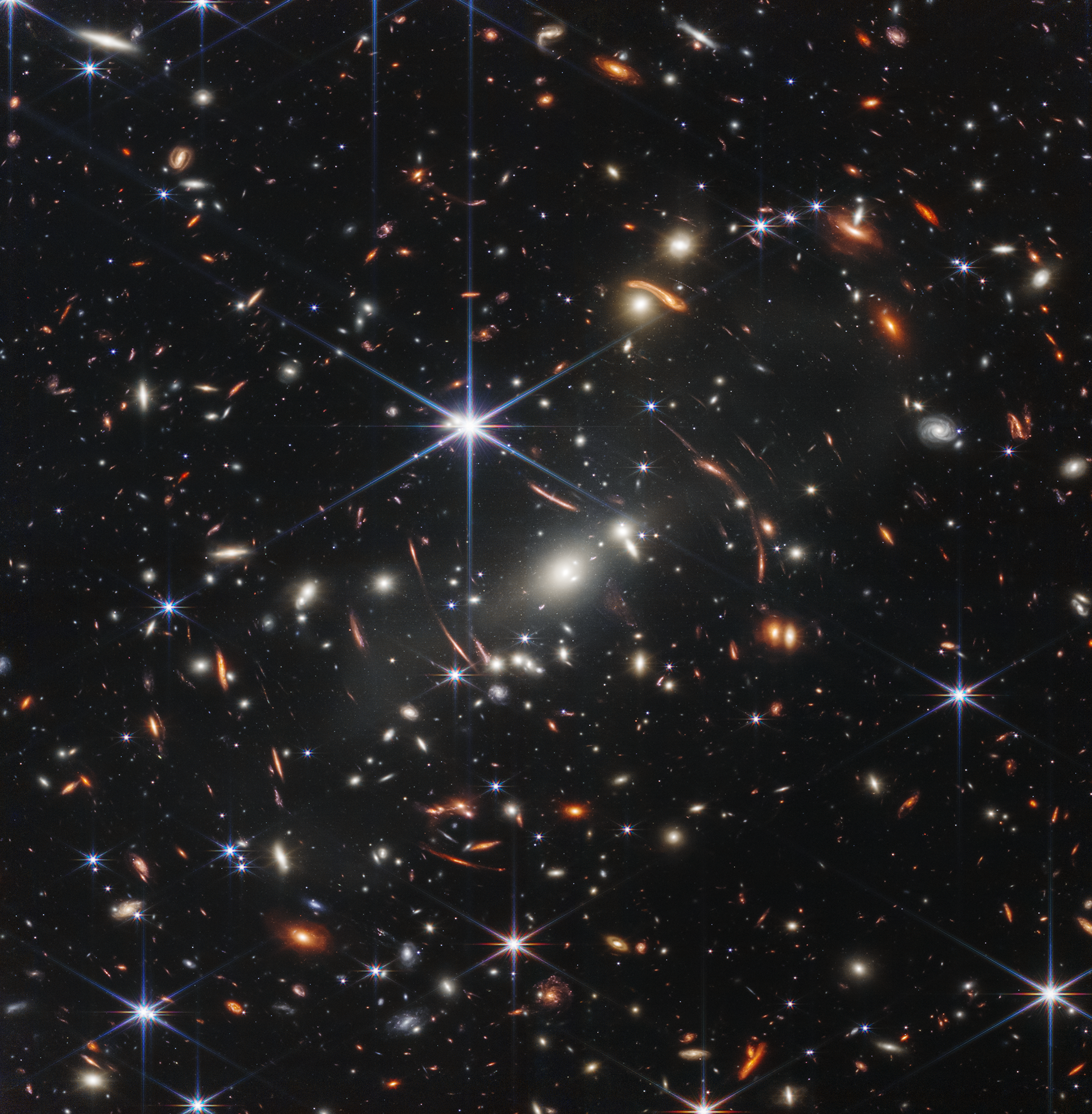
I have to say that I didn’t stay up to watch the live stream of last night’s preview of this afternoon’s release of the first images from the James Webb Space Telescope. It started very late and I got sick of listening to the dreary music on the feed so went to bed. Nevertheless here is the first picture:
Credits: NASA, ESA, CSA, and STScI
This is a deep field image taken using JWST’s NIRCAM (Near-Infrared Camera). Note that the artifacts you see around some objects are diffraction spikes which occur around bright sources; their six-fold symmetry reflects the hexagonal structure built into the JWST’s mirror assembly. Sources sufficiently bright and compact enough to cause these spikes in deep field images are foreground stars: the extended, fainter objects are all much more distant galaxies.
The description from the NASA page is:
NASA’s James Webb Space Telescope has produced the deepest and sharpest infrared image of the distant universe to date. Known as Webb’s First Deep Field, this image of galaxy cluster SMACS 0723 is overflowing with detail.
Thousands of galaxies – including the faintest objects ever observed in the infrared – have appeared in Webb’s view for the first time. This slice of the vast universe is approximately the size of a grain of sand held at arm’s length by someone on the ground.
This deep field, taken by Webb’s Near-Infrared Camera (NIRCam), is a composite made from images at different wavelengths, totaling 12.5 hours – achieving depths at infrared wavelengths beyond the Hubble Space Telescope’s deepest fields, which took weeks.
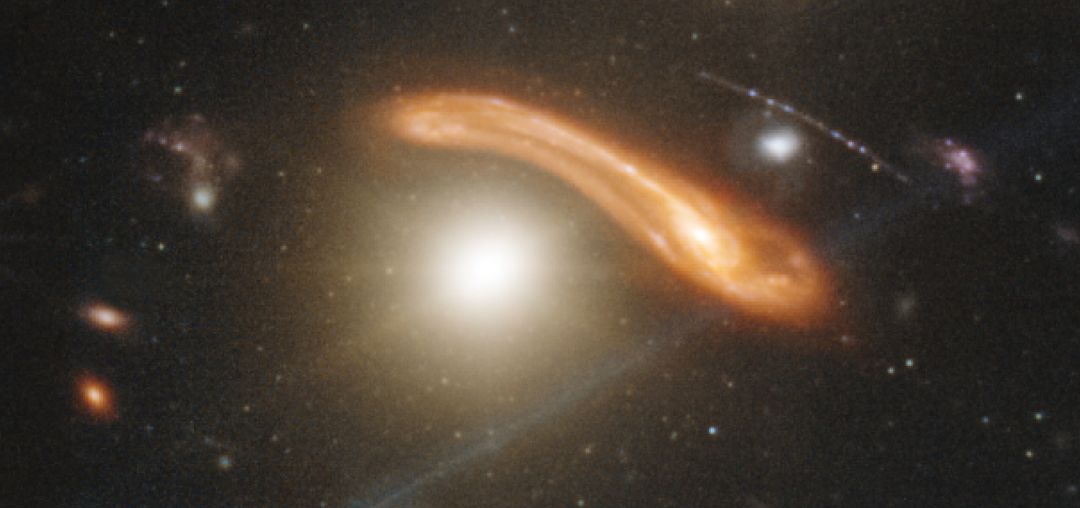
The image shows the galaxy cluster SMACS 0723 as it appeared 4.6 billion years ago. The combined mass of this galaxy cluster acts as a gravitational lens, magnifying much more distant galaxies behind it. Webb’s NIRCam has brought those distant galaxies into sharp focus – they have tiny, faint structures that have never been seen before, including star clusters and diffuse features. Researchers will soon begin to learn more about the galaxies’ masses, ages, histories, and compositions, as Webb seeks the earliest galaxies in the universe
Here is a close-up of one of the distorted galaxy images and othe features produced by gravitational lensing:
We’re having a special viewing in Maynooth this afternoon of the press conference which will unveil more new images from JWST – nice telescope, shame about the name. I may add comments on here if anything particularly exciting turns up. You can watch it here:
Professor Gene Parker, May 18, 2017. (Photo by Jean Lachat)
I was very sad to hear via the NASA website of the death, yesterday at the age of 94, of Professor Eugene N. Parker (known to all as “Gene”). He was best known for his work on solar magnetism and the solar wind, but he made important contributions across a wide range of astrophysics; he wrote an excellent book entitledCosmical Magnetic Fields: Their Origin and Activity which I bought many years ago. Most recently NASA’s Parker Solar Probe was named in his honour.
I only met Gene Parker once, many years ago, and was a bit in awe of him because of his intellectual reputation but he came across as a very likeable and friendly man.
We have lost a giant in the field of astrophysics who leaves a huge legacy and will be greatly missed. I send my condolences to his family, friends and colleagues at the University of Chicago where he worked since 1955.
The James Webb Space Telescope looks nothing like the Hubble Space Telescope shown here.
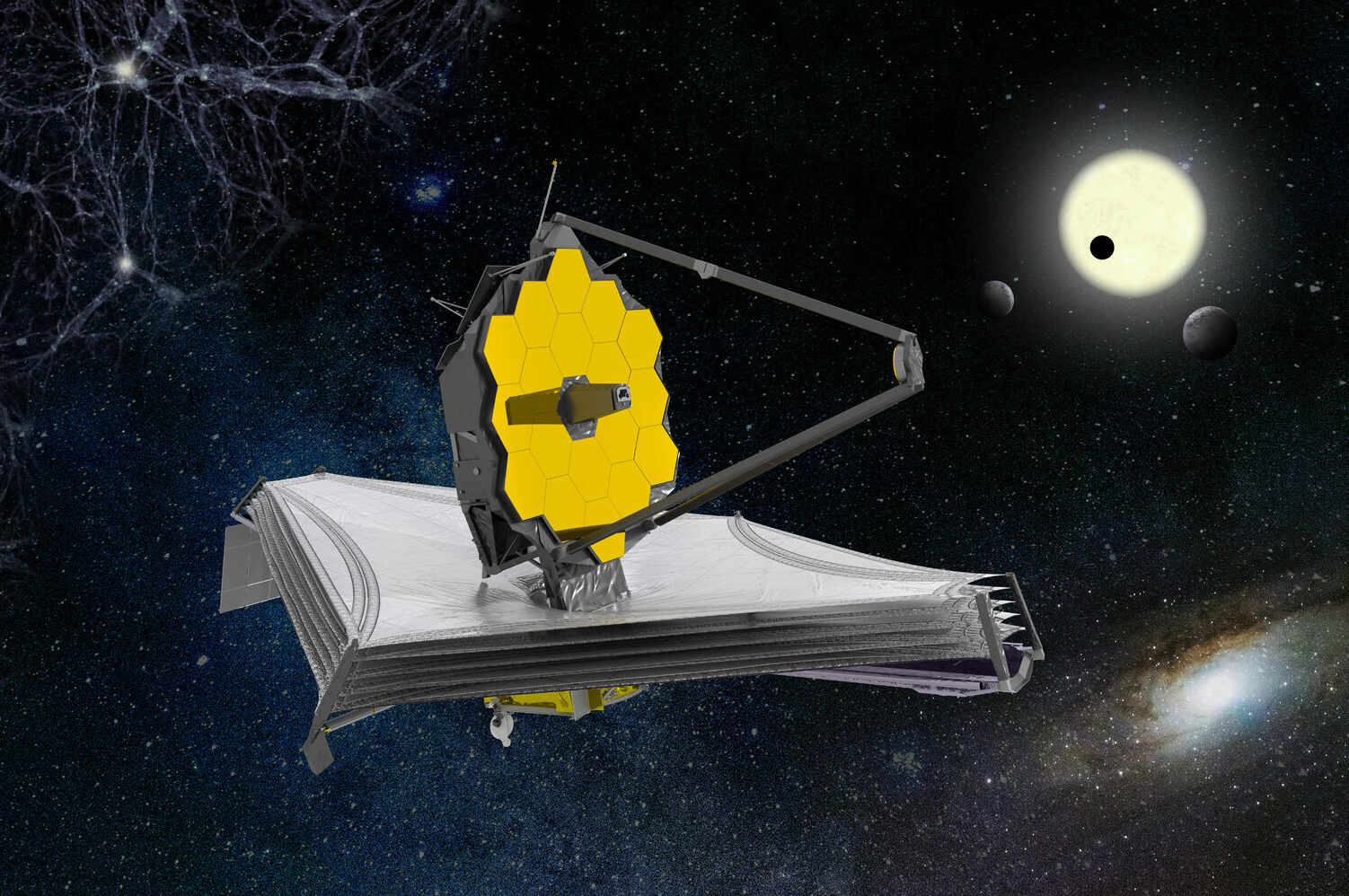
As excitement mounts ahead of the launch of the James Webb Space Telescope (JWST) later this month I thought I would, as a service to the community, for the edification of the public at large, and despite popular demand, present my list of Top Ten JWST Facts.
The JWST spacecraft will orbit the Sun near the Second Lagrange Point, L2, because it took so long to get built that tickets were no longer available for L1.
JWST cost $10bn but its telescope is so sensitive that it can see back to redshifts greater than ten, meaning that it sees light that was emitted when its budget was less than $1 bn.
To provide secure backup storage of the complete JWST data set, NASA has commandeered the world’s entire stock of 3½ inch floppy disks.
As well as observing the Universe’s first galaxies and revealing the birth of stars and planets, JWST will look for signs that there might be intelligent life somewhere in the Universe.
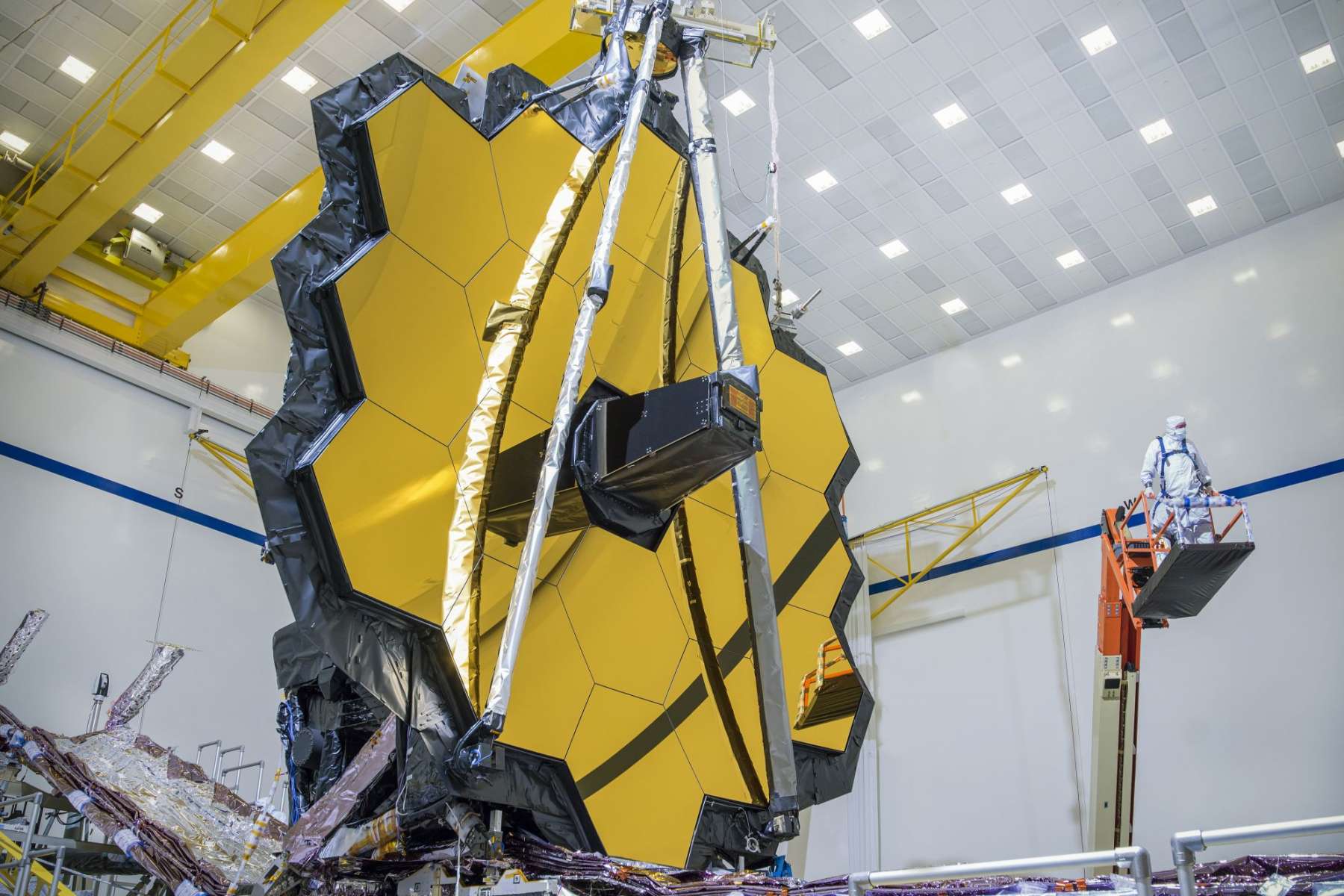
JWST’s unique 6.5m deployable mirror was especially designed by experts from the IKEA company in Sweden who are famous for making items for ‘easy self-assembly’.
The angular resolution of JWST is 0.1 arc seconds, which means it could resolve a football at a distance of 550 km (or even further if it had Sky Sports).
The Near-Infrared Spectrograph on JWST will be able to make simultaneous measurements of up to 100 sources while at the same time making a cup of coffee and washing the dishes.
The BBC will be shortly be broadcasting a new 26-part TV series about JWST. Entitled WOW! JWST! That’s Soo Amaazing… it will be presented by Britain’s leading expert on infra-red astronomy, Professor Brian Cox.
Delayed by a year, the 2020 US Decadal Survey of Astronomy -full title Pathways to Discovery in Astronomy and Astrophysics for the 2020s – is now out.
It’s a hefty document of more than 600 pages so I haven’t had time to do anything but skim it. The top priority for NASA for the next decade seems to be a 6-m class space telescope capable of imaging Earth-like worlds orbiting sun-like stars, something that can’t be done with much larger telescopes from the ground though the plan does involve bringing very large ground-based telescopes (the Giant Magellan Telescope in Chile and the Thirty Metre Telescope in Hawaii) into service more quickly than currently scheduled. Any new space telescope won’t be built and launched on the timescale of course: it probably won’t fly until the 2040s by which time I’ll probably be retired,
I also noticed in the section on the Cosmic Microwave Background we have
Recommendation: The National Science Foundation and the Department of Energy should jointly pursue the design and implementation of the next generation ground-based cosmic microwave background experiment (CMB-S4).The panel suggests that third-generation CMB experiments aligned with CMB-S4―specifically, the SPO (South Pole Observatory) and the “nominal” version of the SO (Simons Observatory)―be high priorities for federal support.
The clarifications in parentheses are my additions.
The shopping list is a lot longer than these items however. There is plenty of discussion in the media already. See, for example, here. I may comment further if time allows.
UPDATE: there is a very user-friendly interactive overview of the survey here.
This is of course an American survey but Astronomy is a truly international enterprise so astronomers all round the globe will be studying it and trying to work out its implications for their own research environment.
And of course there’s a box below for comments from you!
I heard last week that the ship carrying the James Webb Space Telescope (JWST) arrived safely in French Guiana and is now being prepared for launch on an Ariane-5 rocket at the European Space Agency’s facility at Kourou. Since the telescope cost approximately $10 billion there was some nervousness it might have been hijacked by pirates on the way.
I’m old enough to remember JWST when it was called the Next Generation Space Telescope NGST); it was frequently discussed at various advisory panels I was on about 20 years ago. Although the basic concept hasn’t changed much – it was planned to be the successor to the Hubble Space Telescope working in the infrared and with a deployable mirror – at that time it was going to have an even bigger mirror than the 6.5m it ended up with, was going to be launched in or around 2010, and was to have a budget of around $600 million. About a decade ago cost overruns, NASA budget problems, and technical hitches led to suggestions that it should be cancelled. It turned out however that it was indeed too big too fail. Now it is set for launch in December total cost greater than ten times the original estimate.
I know many people involved in the JWST project itself or waiting to use it to make observations, and I’ll be crossing my fingers on launch day and for the period until its remarkable folding mirror is deployed about a fortnight later. I hope it goes well, and look forward to the celebrations when it does.
There is a big problem with JWST however and that is its name, which was changed in 2002 from the Next Generation Space Telescope to the James Webb Space Telescope after James E. Webb, a civil servant who was NASA’s chief administrator from 1961 to 1968.
It’s not uncommon for scientific space missions like this to be named after people once the proposal has moved off the drawing board and into serious planning. That happened with the European Space Agency’s Planck and Herschel to give two examples. In any case Next General Space Telescope was clearly never anything but a working title. Yet naming this important mission after a Government official always seemed a strange decision to me. Then news emerged that James Webb had enthusiastically cooperated in a McCarthyite purge of LGBT+ people working in government institutions, part of a wider moral panic referred to by historians as the Lavender Scare. There have been high-profile protests (see, e.g., here) and a petition that received over a thousand signatures, but NASA has ruled out any change of name.
The main reason NASA give is that they found no evidence that Webb himself was personally involved in discrimination or persecution. I find that very unconvincing. He was in charge, so had responsibility for what went on in his organization. If he didn’t know then why didn’t he know? Oh, and by the way, he didn’t have anything to do with infrared astronomy either…
It’s a shame that this fantastic telescope should have its image so tarnished by the adoption of an inappropriate name. The name is a symbol of a time when homophobic discrimination was even more prevalent than it is now, and as such will be a constant reminder to us that NASA seems not to care about the many LGBT+ people working for them directly or as members of the wider astronomical community.
P.S. As an alternative name I suggest the Lavender Scare Space Telescope (LSST)…
The views presented here are personal and not necessarily those of my employer (or anyone else for that matter).
Feel free to comment on any of the posts on this blog but comments may be moderated; anonymous comments and any considered by me to be vexatious and/or abusive and/or defamatory will not be accepted. I do not necessarily endorse, support, sanction, encourage, verify or agree with the opinions or statements of any information or other content in the comments on this site and do not in any way guarantee their accuracy or reliability.





 In the Dark