Archive for Newcastle University

End Unnecessary Redundancies at Newcastle University!

Posted in Education, Politics with tags , , on May 26, 2025 by telescoper

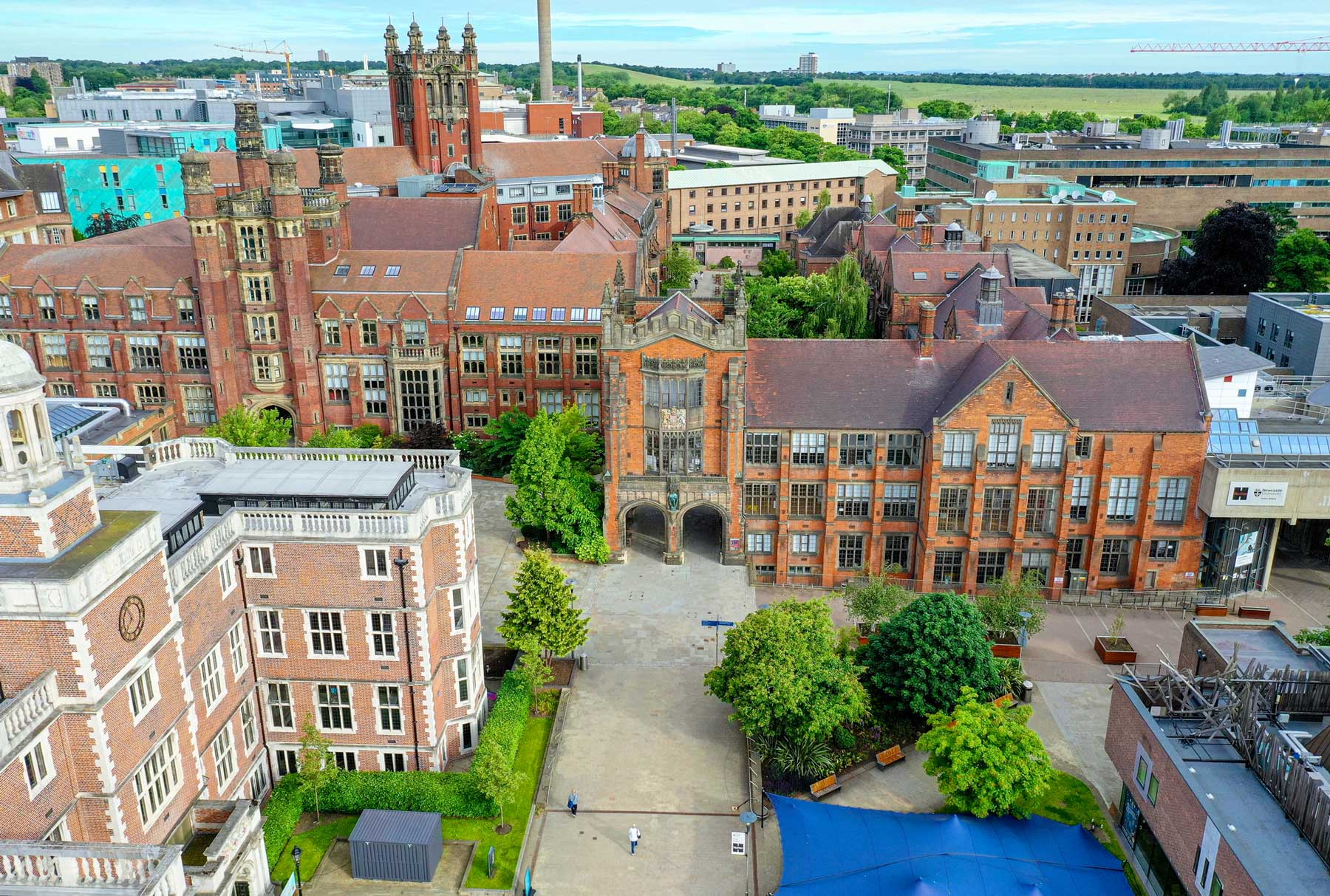
A petition is being circulated to halt a programme of redundancies at Newcastle University. Academic staff positions are being cut while the University, like so many others, suffers Death by a Thousand Managers. I understand that staff in Physics are directly threatened by the plans.

Here is the description of the issue you can find on the petition:

Newcastle University staff are in dispute with their senior management over the threat of ill-considered and unnecessary redundances that are imperilling the future of our institution. We call on the University Executive Board (UEB) to abandon this destructive policy.

On Thursday 8th May 2025, 153 academic colleagues were summoned at short notice to meetings with UEB where they were told they have been placed in ‘redundancy pools’ with 38 of them to be laid off. In an unpleasant twist, they will be forced to compete against each other in an academic equivalent of ‘The Hunger Games.’ 

To add insult to injury, on the day staff were threatened with redundancy they were also invited to a ‘Doodling for Wellbeing’ session. ‘Let your pen dance across the page,’ they were told, as ‘a perfect escape from the everyday hustle and bustle.’ 

Such crassness is emblematic of the disregard for genuine staff wellbeing that has dogged this unhappy episode. For example, for migrant staff members recruited only months previously, after paying for skilled worker visas, the NHS surcharge, and moving young families from abroad, dismissal threatens the loss of all that, and even deportation. 

For many more, these redundancies will be career-ending. But even for those not immediately at risk, the climate of uncertainty and fear unleashed by UEB is demoralising. As one academic put it, this ‘callous’ policy shows ‘no thought to people as people; we are just figures on a spreadsheet.’

We recognise that this is a tough financial environment for universities. But Newcastle has a relatively strong cash and borrowing position. Through voluntary redundancies and other cost-cutting measures, we have achieved £15.8m of savings against a target of £20m. Nevertheless, UEB is pressing ahead with compulsory redundancies, even though other institutions have stepped back. 

There are other options. Debts could be renegotiated and the pace of cuts slowed. Recently announced capital expenditure projects – including a £274m student accommodation block replete with luxuries like a cinema and gym, and even plans for a campus in India – should be reviewed or delayed. 

Costs could also be cut by pruning management salaries and structures. Since tuition-fee rises in 2012, the number of staff drawing six-figure pay-cheques has mushroomed. 

Worried about their own futures and the future of the university, hard-working frontline staff are taking industrial action. As a result of the turmoil unleashed by what the UEB euphemistically calls ‘Workforce Resizing,’ many academics are looking for jobs elsewhere and students are seeking to transfer to other universities. Reputational damage will make future staff and student recruitment harder. Current redundancy plans risk forcing our great university into a death cycle. 

We urge the University Executive Board to abandon these cuts and work with all their colleagues to secure the future of Newcastle University.

Please sign the petition here.
Flying Visit(s)

Posted in Biographical, Education, The Universe and Stuff with tags , , , , , , , on June 2, 2024 by telescoper

So here I am, not in Barcelona. On Thursday night I flew to the fine city of Newcastle upon Tyne to act as external examiner for a PhD candidate. Since I knew I would be arriving quite late I stayed in a hotel near Newcastle Airport. It was just as well I did so because, it being Ryanair, I arrived even later than expected. On Friday morning I took the Metro from the Airport to Haymarket and spent the morning in the School of Mathematics, Statistics and Physics at Newcastle University ahead of the viva voce examination.

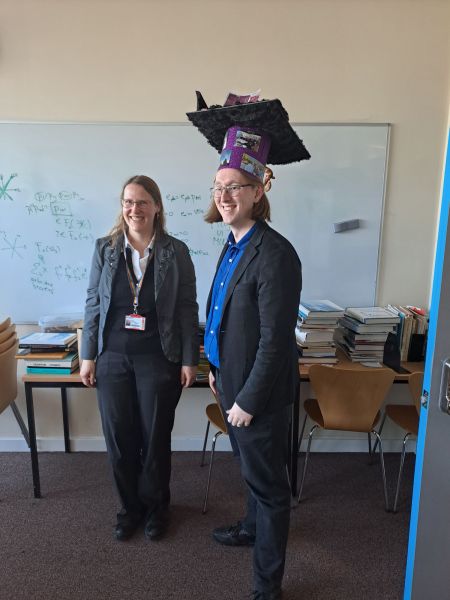
The PhD candidate was Alex Gough (pictured right, after the examination, with supervisor Cora Uhlemann). Cora being German we were treated to the tradition of successful PhD candidates having to wear a elaborate hat, after the examination (fortunately not during it). Some champagne was consumed, followed by dinner at a nice Indian restaurant on Clayton Street.

For those of you not familiar with how the PhD system works in the UK, it involves doing research into a particular topic and then writing up what you’ve done in a thesis. The thesis is a substantial piece of work, often in the region of 100,000 words (200 pages or so), which is then assessed by two examiners (one internal to the university at which the research was done, and one external). They read copies of the thesis and then the candidate has to defend it in an oral examination, which was what happened on Friday, after which they make a recommendation to the university about whether the degree should be awarded.

There aren’t many rules for how a viva voce examination should be conducted or how long it should last, but the can be as short as, say, 2 hours and can be as long as 5 hours or more. The examiners usually ask a mixture of questions, some about the details of the work presented and some about the general background. The unpredictable content of a viva voce examination makes it very difficult to prepare for, and it can be difficult and stressful for the candidate (as well as just tiring, as it can drag on for a long time). However, call me old-fashioned but I think if you’re going to get to call youself Doctor of Philosophy you should expect to have to work for it. Some might disagree.

Obviously I can’t give details of what went on in the examination except that it was quite long primarily because the thesis was very interesting and gave us lots to discuss. At the end internal examiner Danielle Leonard and I agreed to recommend the award of a PhD. In Newcastle as in other UK universities, the examiners simply make a recommendation to a higher authority (e.g. Board of Graduate Studies) to formally award the degree, but they almost always endorse the recommendation. I’ve never been sure exactly when a successful candidate is allowed to call themselves “Doctor”, actually, but congratulations to Dr Gough!

Anyway, the celebratory dinner ended just after Women’s International football match between England and France (which France won) had finished at St James’ Park and the Metro was consequently crammed full, but I got back to the hotel at a reasonable hour. Thank you to everyone in the group, especially Cora and Ian Moss, for being so friendly and making me feel so welcome during this brief visit.

Tomorrow I shall be heading to the part of not-Barcelona known as Oxford, where I believe there is a University of some sort, to give a lecture about which I’ll post more tomorrow.

Newcastle Joins the Resurgence of UK Physics

Posted in Education, Science Politics, The Universe and Stuff with tags , , , on August 17, 2014 by telescoper

I’ve posted a couple of times about how Physics seems to undergoing a considerable resurgence in popularity at undergraduate level across the United Kingdom, with e.g. Lincoln University setting up a new programme. Now there’s further evidence in that Newcastle University has now decided to re-open its Physics course for 2015 entry.

The University of Newcastle had an undergraduate course in Physics until 2004 when it decided to close it down, apparently owing to lack of demand. They did carry on doing some physics research (in nanoscience, biophysics, optics and astronomy) but not within a standalone physics department. The mid-2000s were tough for UK physics,  and many departments were on the brink at that time. Reading, for example, closed its Physics department in 2006; there is talk that they might be starting again too.

The background to the Newcastle decision is that admissions to physics departments across the country are growing at a healthy rate, a fact that could not have been imagined just ten years ago. Times were tough here at Sussex until relatively recently, but now we’re expanding on the back of increased student numbers and research successes. Indeed having just been through a very busy clearing and confirmation period at Sussex University, it is notable that its the science Schools that have generally done best.  Sussex has traditionally been viewed as basically a Liberal Arts College with some science departments; over 70% of the students here at present are not studying science subjects. With Mathematics this year overtaking English as the most popular A-level choice, this may well change the complexion of Sussex University relatively rapidly.

I’ve always felt that it’s a scandal that there are only around 40 UK “universities” with physics departments Call me old-fashioned, but I think a university without a physics department is not a university at all; it’s particularly strange that a Russell Group university such as Newcastle should not offer a physics degree. I believe in the value of physics for its own sake as well as for the numerous wider benefits it offers society in terms of new technologies and skills. Although the opening of a new physics department will create more competition for the rest of us, I think it’s a very good thing for the subject and for the Higher Education sector general.

That said, it won’t be an easy task to restart an undergraduate physics programme in Newcastle, especially if it is intended to have as large an intake as most successful existing departments (i.e. well over 100 each year). Students will be applying in late 2014 or early 2015 for entry in September 2015. The problem is that the new course won’t figure in any of the league tables on which most potential students based their choice of university. They won’t have an NSS score either. Also their courses  will probably need some time before it can be accredited by the Institute of Physics (as most UK physics courses are).

There’s a lot of ground to make up, and my guess is that it will take some years to built up a significant intake.The University bosses will therefore have to be patient and be prepared to invest heavily in this initiative until it can break even. The decision a decade ago to cut physics doesn’t exactly inspire confidence that they will be prepared to do this, but times have changed and so have the people at the helm so maybe that’s an unfair comment.

There are also difficulties on the research side (which is also vital for a proper undergraduate teaching programme), there are also difficulties. Grant funding is already spread very thin, and there is little sign of any improvement for the foreseeable future  in the “flat cash” situation we’re currently in. There’s also the stifling effect of theResearch Excellence Framework I’ve blogged about before. I don’t know whether Newcastle University intends to expand its staff numbers in Physics or just to rearrange existing staff into a new department, but if they do the former they will have to succeed against well-established competitors in an increasingly tight funding regime. A great deal of thought will have to go into deciding which areas of research to develop, especially as their main regional competitor, Durham University, is very strong in physics.

On the other hand, there are some positives, not least of which is that Newcastle is and has always been a very popular city for students (being of course the finest city in the whole world). These days funding follows students, so that could be a very powerful card if played wisely.

Anyway, these are all problems for other people to deal with. What I really wanted to do was to wish this new venture well and to congratulate Newcastle on rejoining the ranks of proper universities (i.e. ones with physics departments). Any others thinking of joining the club?