Archive for Newgrange

Newgrange and JWST

Posted in History, The Universe and Stuff with tags , , on August 18, 2024 by telescoper

Although I won’t myself be able to attend, I’m happy to be able to use the medium of this blog to advertise the above public event which is taking place in the first week of September on the back of a week-long conference to celebrate the career of Professor Tom Ray of the Dublin Institute for Advanced Studies. That in turn follows hard on the heels of the Irish National Astronomy Meeting (INAM) which takes place in Galway on 29th and 30th August.

Anyway, the public event on 3rd September is free to attend but you need to register here, where it is described thusly:

The Newgrange Passage Tomb, a prehistoric monument in County Meath, Ireland, is one of the most remarkable examples of Neolithic art and architecture, dating back to around 3200 BC. This ancient structure, with its intricate stone carvings and precise alignment with the winter solstice sunrise, reflects the sophisticated astronomical knowledge of its builders.

With starkly different technology, the James Webb Space Telescope (JWST), launched in 2021, represents the pinnacle of modern astronomical achievement. JWST is designed to peer into the farthest reaches of the universe, capturing images and data from the formation of the earliest galaxies to the atmospheres of planets outside of/beyond our solar system.

Despite being separated by millennia, both Newgrange and JWST underscore humanity’s enduring quest to understand our place in the cosmos through the study of the stars and the universe.

As part of the celebration of the career of Professor Tom Ray the Dublin Institute for Advanced Studies and the Institute of Physics are delighted to host a public event on Newgrange and JWST. This is in recognition of Tom’s long interest in archaeoastronomy and Newgrange in particular, and his involvement with the JWST through the Mid-Infrared instrument (MIRI).

The talk will be delivered by Dr. Frank Prendergast, archaeoastronomer and Emeritus Research Fellow at Technological University Dublin, and Professor Gillian Wright, European Principal Investigator of MIRI and Director of the UK Astronomy Technology Centre in Edinburgh.
The Winter Solstice 2021

Posted in The Universe and Stuff with tags , , , on December 21, 2021 by telescoper

So it comes around again. The winter solstice in the Northern hemisphere happens today, Tuesday 21st December, at 15.59 Irish Time. Among other things, this means that tomorrow is the shortest day of the year in the Northern hemisphere. Days will get steadily longer from then until the Summer Solstice next June.  The  the shortest day – defined by the interval between sunrise and sunset – is today. Tomorrow will be two whole seconds longer. Make the most of it!

This does not, however,  mean that sunrise will happen earlier tomorrow than it did this morning.  Actually, sunrise will carry on getting later until the new year, the length of the day nevertheless increasing because sunset occurs even later. Sunrise yesterday morning (20th December) was at 08.37 Dublin Time while today it was 08.38; the latest sunrise will be on 29th December (08.40). Sunset last night was at 16.07 and tonight it will be at 16.08. The earliest sunset this year was actually on 13th December (16:06).

These complications arise because there is a difference between mean solar time (measured by clocks) and apparent solar time (defined by the position of the Sun in the sky), so that a solar day does not always last exactly 24 hours. A description of apparent and mean time was given by Nevil Maskelyne in the Nautical Almanac for 1767:

Apparent Time is that deduced immediately from the Sun, whether from the Observation of his passing the Meridian, or from his observed Rising or Setting. This Time is different from that shewn by Clocks and Watches well regulated at Land, which is called equated or mean Time.

The discrepancy between mean time and apparent time arises because of the Earth’s axial tilt and the fact that it travels around the Sun in an elliptical orbit in which its orbital speed varies with time of year (being faster at perihelion than at aphelion).

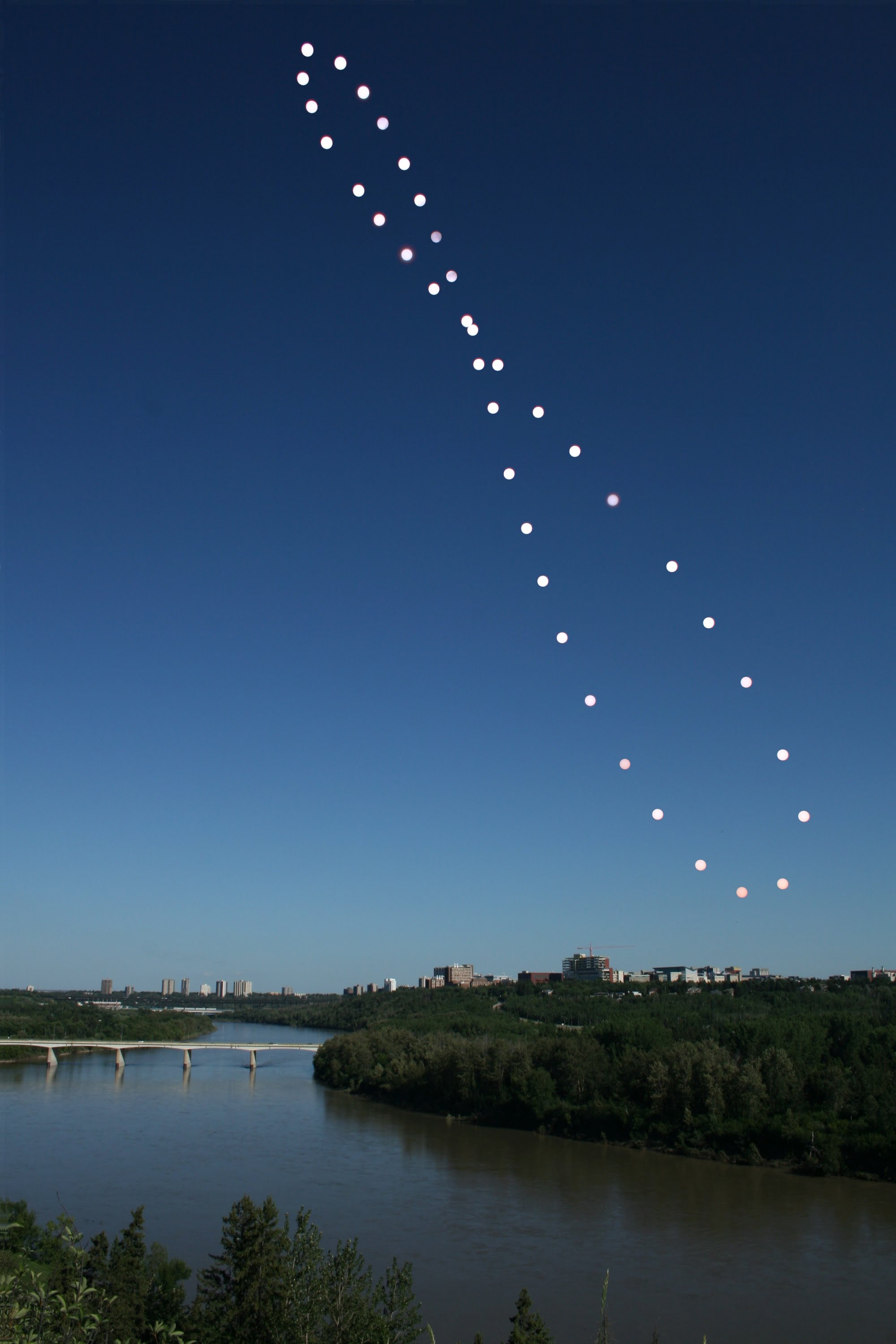
In fact if you plot the position of the Sun in the sky at a fixed time each day from a fixed location on the Earth you get a thing called an analemma, which is a sort of figure-of-eight shape whose shape depends on the observer’s latitude. Here’s a photographic version taken in Edmonton, with photographs of the Sun’s position taken from the same position at the same time on different days over the course of a year:

maxresdefault

The winter solstice is the lowermost point on this curve and the summer solstice is at the top. These two turning points define the time of the solstices much more precisely that the “shortest day” or  “longest night”.

Anyway, the north–south component of the analemma is the Sun’s declination, and the east–west component arises from the  equation of time which quantifies the difference between mean solar time and apparent solar time. This curve can be used to calculate the earliest and/or latest sunrise and/or sunset.

Using a more rapid calculational tool (Google), I found a table of the local mean times of sunrise and sunset for Dublin around the 2020  winter solstice. This shows that today is indeed the shortest day (with a time between sunrise and sunset of 7 hours 29 minutes and 57 seconds).

P.S. As usual, crowds gathered at the spectacular neolithic monument at Newgrange in County Meath to observe the sunrise at the Solstice. As usual it was cloudy.

Sunrise at the Winter Solstice at Newgrange

Posted in History, The Universe and Stuff with tags , on December 20, 2020 by telescoper

The prehistoric passage tomb at Newgrange in the Boyne Valley North of Dublin is about 1000 years older than Stonehenge. At dawn, around the Winter Solstice, the Sun’s rays penetrate into the inner chamber, as they have done for over 5000 years.

A live stream of this extraordinary sight took place this morning (20th December) and there will be others on Monday 21st and Tuesday 22nd. This is a recording of this morning’s stream.


The New Henge at Newgrange

Posted in History with tags , , , , on July 26, 2018 by telescoper

Following on from a post last week, and thanks to this website, here is an amazing aerial video, shot from a drone, of a new archaeological discovery at the Newgrange site in County Meath that has been revealed through parch marks in the ground following the recent period of very dry weather.

Newgrange is already established as major prehistoric site, most famous for a neolithic burial mound (which means that it was built before Stonehenge or the pyramids at Giza in Egypt). More recent studies, including a passage tomb found at Dowth, also in County Meath, show that the area around Newgrange, in the Boyne valley near Drogheda, was of major importance in the neolithic era.

You can read much more about the new henge at Newgrange and its place in Irish prehistory here.