Archive for Newtonian Mechanics

Weekly Update from the Open Journal of Astrophysics: 05/07/2025

Posted in OJAp Papers, Open Access, The Universe and Stuff with tags , , , , , , , , , , , , , , , , , on July 5, 2025 by telescoper

It’s Saturday so, once again, it’s time for the weekly update of papers published at the Open Journal of Astrophysics. Since the last update we have published three new papers, which brings the number in Volume 8 (2025) up to 85, and the total so far published by OJAp  up to 320.

The three papers published this week, with their overlays, are as follows. You can click on the images of the overlays to make them larger should you wish to do so.

The first paper to report is “Stellar reddening map from DESI imaging and spectroscopy” by Rongpu Zhou (Lawrence Berkeley National Laboratory, USA) and an international case of 56 others too numerous to mention individually. This paper was published on 1st July 2025 in the folder marked Astrophysics of Galaxies. It describes maps of stellar reddening by Galactic dust inferred from observations obtained using the Dark Energy Spectroscopic Instrument, and a comparison with previous such maps. The overlay is here:

You can find the final, accepted, version on arXiv here.

Next one up is “On inertial forces (indirect terms) in problems with a central body” by Aurélien Crida (Université Côte d’Azur, France) and 17 others – again too numerous to be listed individually – based in France, Italy, Germany, Mexico and the USA. This paper discusses the indirect terms that arise the Newtonian dynamics of multi-body systems dominated by a central massive body, upon which other bodies exert a gravitational pull, when the massive body is treated as the origin of the coordinate system. This one, also published on July 1st 2025, is in the folder marked Earth and Planetary Astrophysics.

The overlay is here:

You can find the officially accepted version on arXiv here.

The last paper of this batch is “Stellar ejection velocities from the binary supernova scenario: A comparison across population synthesis codes” by Tom Wagg (U. Washington, USA), David D. Hendriks (U. Surrey, UK), Mathieu Renzo (U. Arizona, USA) and Katelyn Breivik (Carnegie Mellon U., USA). It was published on July 2nd 2025 in the folder Solar and Stellar Astrophysics and it presents comparison of the ejection velocities of stars ejected from binary systems by supernova explosions predicted in three different population synthesis codes.

The overlay is here:

You can read the final accepted version on arXiv here.

That’s all the papers for this week. I’ll post another update next weekend.

The Mechanics of the Pole Vault

Posted in Sport, The Universe and Stuff with tags , , , on August 11, 2024 by telescoper

One of the many highlights of the 2024 Olympics was the amazing achievement of Armand Duplantis in winning the Gold Medal in Pole Vault and in the process breaking his own world record at a height of 6.25m. Here he is

He seemed to clear that height quite comfortably, actually, so I dare say he’ll break quite a few more records in his time. On the other hand, when I first wrote about this back in 2011 the world record for the pole vault was held by the legendary Ukrainian athlete Sergey Bubka at a height of 6.14m which he achieved in 1994. That record stood for almost 20 years but has since been broken several times since. The fact that the world record has only increased by 11 cm in 30 years tells you that the elite pole vaulters are working at the limits of what the human body can achieve. A little bit of first-year mechanics will convince you why, as I have pointed out in previous posts (e.g. here).

What a pole-vaulter does is rather complicated and requires a lot of strength, flexibility and skill, but as in many physics problems one can bypass the complications and just look at the beginning and the end and use an energy conservation argument. Basically, the pole is a device that converts the horizontal kinetic energy of the vaulter \frac{1}{2} m v^2,  as he/she runs in, to the gravitational potential energy m g h acquired at the apex of his/her  vertical motion, i.e. at the top of the vault.

Now assume that the approach is at the speed of a sprinter, i.e. about 10 ms^{-1}, and work out the height h = v^2/2g that the vaulter can gain if the kinetic energy is converted with 100% efficiency. Since g = 9.8 \, ms^{-2} the answer to that little sum turns out to be about 5 metres.
This suggests that  6.25 metres should not just be at, but beyond, the limit of a human vaulter,  unless the pole were super-elastic. However, there are two things that help. The first is that the centre of mass of the combined vaulter-plus-pole does not start at ground level; it is at a height of a bit less than 1m for an an average-sized person.  Note also that the centre of mass of pole (which weighs about 15 kg and is about 5 m long) only ends up about 2.5 m off the ground when it is vertical, so there’s a significant effect there.  Note also that the centre of mass of the vaulter does not actually pass over the bar after letting go of the pole.  That  doesn’t happen in the high jump, either. Owing to the flexibility of the athlete’s back, the arc is such that the centre of mass remains under the bar while the different parts of the athlete’s body go over it.

Moreover, it’s not just the kinetic energy related to the horizontal motion of the vaulter that’s involved. A human can jump vertically from a standing position using elastic energy stored in muscles. In fact the world record for the standing high jump is an astonishing 1.9m. In the context of the pole vault it seems likely to me that this accounts for at least a few tens of centimetres.

Despite these complications, it is clear that pole vaulters are remarkably efficient athletes. And not a little brave either – as someone who is scared of heights I can tell you that I’d be absolutely terrified being shot up to 6.25 metres on the end of  a bendy stick, even with something soft to land on!

The Atwood Machine

Posted in Barcelona, Cute Problems, Education, Maynooth with tags , , , on November 14, 2023 by telescoper

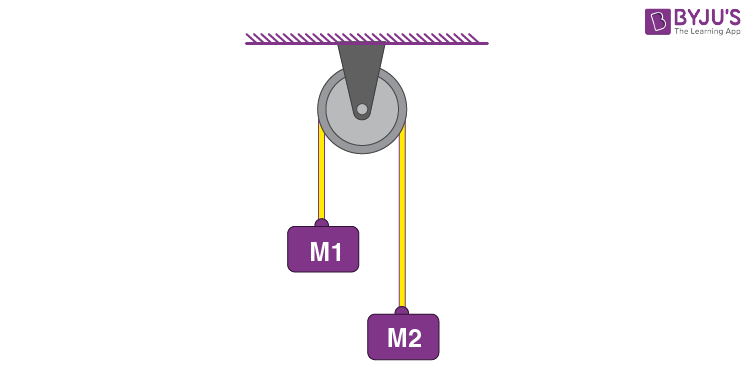
In the foyer of the Physics Department at the University of Barcelona you will find, as well as a fine refracting telescope, an example of the Atwood Machine. For some years before my current sabbatical I have been teaching Newtonian Mechanics to first-year students in Maynooth and used this as a simple worked example. I have to admit I’ve never seen an actual Atwood machine before, and what I’ve done in lectures is the simplified form on the right rather than the actual machine on the left.

The illustration on the right depicts the essential elements, but you can can see that the actual machine has a ruler which, together with a timing device, can be used to determine the acceleration of the suspended mass and how that varies with the other mass. You can work this out quite easily in the simplest case of a frictionless pulley by letting the tension in the string (which is light and inextensible) be T (say) and then eliminating it from the equations of motion for the two masses. I leave the rest as an exercise for the reader. A more interesting problem, for the advanced student, is when you have to take into account the rotational motion of the pulley wheel…

The Physics of the Pole Vault Revisited

Posted in Sport, The Universe and Stuff with tags , , , on November 29, 2022 by telescoper

In yesterday’s Mechanics lecture I decided to illustrate the use of energy conservation arguments with an application to the pole vault. I have done this a few times and indeed wrote a blog post about it some years ago. At the time I wrote that post however the world record for the pole vault was held by the legendary Ukrainian athlete Sergey Bubka at a height of 6.14m which he achieved in 1994. That record stood for almost 20 years but has since been broken several times, and is now held by Armand Duplantis at a height of 6.21m.

Here he is breaking the record on July 24th 2022 in Eugene, Oregon:

He seemed to clear that height quite comfortably, actually, and he’s only 23 years old, so I dare say he’ll break quite a few more records in his time but the fact that world record has only increased by 7cm in almost 30 years tells you that the elite pole vaulters are working at the limits of what the human body can achieve. A little bit of first-year physics will convince you why.

Basically, the pole is a device that converts the horizontal kinetic energy of the vaulter \frac{1}{2} m v^2,  as he/she runs in, to the gravitational potential energy m g h acquired at the apex of his/her  vertical motion, i.e. at the top of the vault.

Now assume that the approach is at the speed of a sprinter, i.e. about 10 ms^{-1}, and work out the height h = v^2/2g that the vaulter can gain if the kinetic energy is converted with 100% efficiency. Since g = 9.8 \, ms^{-2} the answer to that little sum turns out to be about 5 metres.

This suggests that  6.21 metres should not just be at, but beyond, the limit of a human vaulter,  unless the pole were super-elastic. However, there are two things that help. The first is that the centre of mass of the combined vaulter-plus-pole does not start at ground level; it is at a height of a bit less than 1m for an an average-sized person.  Nor does the centre of mass of the vaulter-pole combination reach 6.21 metres.

The pole does not go over the bar, but it’s pretty light so that probably doesn’t make much difference. However, the centre of mass of the vaulter actually does not actually pass over the bar.  That  doesn’t happen in the high jump, either. Owing to the flexibility of the jumper’s back the arc is such that the centre of mass remains under the bar while the different parts of the jumper’s body go over it.

Moreover, it’s not just the kinetic energy related to the horizontal motion of the vaulter that’s involved. A human can in fact jump vertically from a standing position using elastic energy stored in muscles. In fact the world record for the standing high jump is an astonishing 1.9m. In the context of the pole vault it seems likely to me that this accounts for at least a few tens of centimetres.

Despite these complications, it is clear that pole vaulters are remarkably efficient athletes. And not a little brave either – as someone who is scared of heights I can tell you that I’d be absolutely terrified being shot up to 6.21 metres on the end of  a bendy stick, even with something soft to land on!

The Mechanics of Nursery Rhymes

Posted in Cute Problems, The Universe and Stuff with tags , , , , on December 30, 2020 by telescoper

I’ve always been fascinated by Nursery Rhymes. Some people think these are little more than nonsense but in fact they are full of interesting historical insights and offer important advice for the time in which they were written. One such story, for example, delivers a stern warning against the consequences of placing sleeping babies in the upper branches of trees during windy weather.

Another important role for nursery rhymes arises in physics education. Here are some examples that students of elementary mechanics may find useful in preparation for their forthcoming examinations.

1. The Grand Old Duke of York marched 10,000 men up to the top of a hill and marched them down again. The average mass of his men is 65 kg and the height of the hill is 500m.

(a) Estimate the total work done in marching the Duke of York’s men up to the top of the hill.

(b) If, instead of marching down again, the men take turns sliding down a frictionless slide back to where they started, estimate the average speed of a man when he reaches the bottom of the hill.

(You may assume without proof that when they were up they were up, and when they were down they were down and, moreover, when they were only half way up they were neither up nor down.)

2. By calculating the combined rest-mass energy of half a pound of tuppenny rice and half a pound of treacle, and assuming a conversion efficiency of 10%, estimate the energy released when the weasel goes pop. (Give your answer in SI units.)

3. The Moon’s orbit around the Earth can be assumed to be a circle of radius r. A cow of mass m is standing on the Earth (which has mass M, and radius R). Derive a formula in terms of r, R, M, m and Newton’s Gravitational Constant G for the energy the cow needs in order to jump over the Moon.

(The Earth, Moon and cow may be assumed spherical. You may neglect air resistance and udder frictional effects. )

Feel free to contribute similar problems through the Comments Box.

Dreams, Planes and Automobiles

Posted in Biographical, Covid-19, Education, Maynooth, The Universe and Stuff with tags , , , , , on November 20, 2020 by telescoper

I’ve blogged before about the strange dreams that I’ve been having during this time of Covid-19 lockdowns, but last night I had a doozy. I’ve recently been doing some examples of Newtonian Mechanics problems for my first-year class: blocks sliding up and down planes attached by pulleys to other blocks by inextensible strings; you know the sort of thing.

Anyway, last night I had a dream in which I was giving a lecture about cars going up and down hills taking particular account of the effects of friction and air resistance. The lecture was in front of a camera and using a portable blackboard and chalk, but all that was set up outside in the middle of a main road with traffic whizzing along either side and in the presence of a strong gusty wind. I had to keep stopping to pick up my notes which had blown away, dodging cars as I went.

It would undoubtedly make for much more exciting lectures if I recorded them in such a situation, but I think I’d be contravening traffic regulations by setting up in the middle of the Straffan Road. On the other hand, I could buy myself a green screen and add all that digitally in post-production…