Archive for Nick Kaiser

R.I.P. Nick Kaiser (1954-2023)

Posted in R.I.P., The Universe and Stuff with tags , , on June 14, 2023 by telescoper
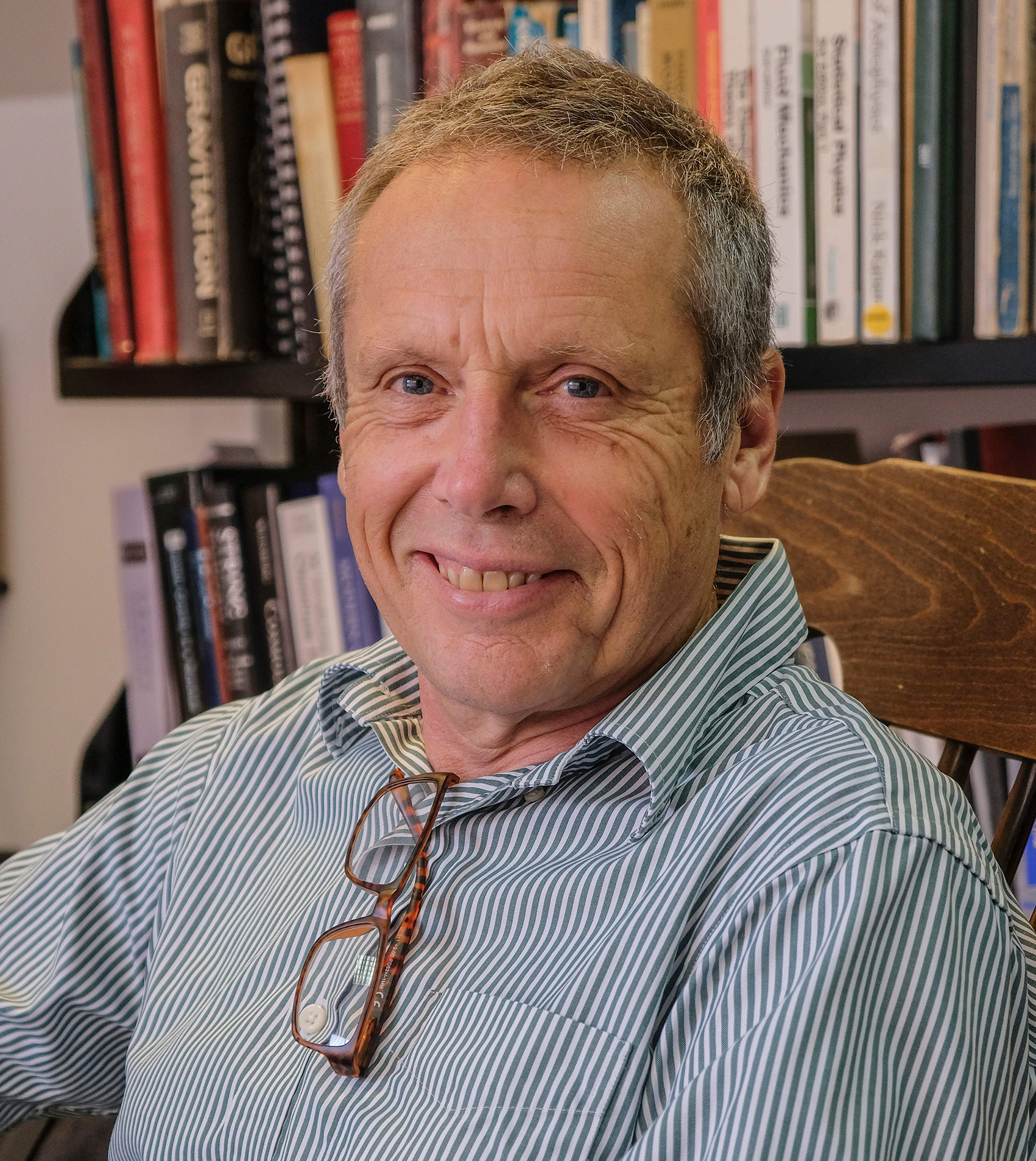
Nick Kaiser (1954-2023)

It was with a sense of shock that I heard this afternoon of the death of the age of 68 of cosmologist Nick Kaiser. It seems like only yesterday that we were celebrating the award of the Gruber Prize to Nick, but that was back in 2019. In a field filled with very clever people, Nick was one of the cleverest and also one of the nicest.

I have never worked directly with Nick Kaiser but he had an enormous influence on me, especially early on in my career. When I was doing my PhD, Nick was based in Cambridge and if I remember correctly he was the first person ever to ask me a question during a conference talk when I gave one there in 1987. Nick was never shy about making such interventions, sometimes somewhat mischievously. At first he terrified me because I didn’t know him except by scientific reputation, and didn’t realize what a nice guy he was. His question was actually very helpful, as it allowed me explain something that I’d skipped because I was under time pressure. His response to my explanation was very complimentary and supportive, which encouraged me a lot, and we chatted for quite a while after the session (in a pub). He was very friendly and approachable, and very far from the intimidating character I’d expected. Anyway, his 1984 paper on cluster correlations was the direct motivation for my very first publication (in 1986).

I mentioned yesterday that many of the papers published by the Open Journal of Astrophysics over the last few years have been in the field of weak gravitational lensing. It is safe to say that is a field that was basically created by Nick; see the paper by Kaiser & Squires (1993) that kicked it all off. You could also say the same about the use of redshift-space distortions, concerning which he wrote a seminal paper in 1987. These are two techniques that will be applied in the analysis of data from the Euclid spacecraft, to be launched next month.

These are just a few of things that Nick did. He did many others, always original and always interesting. In recognition of his achievements he was made a Fellow of the Royal Society in 2008, won the Gold Medal of the Royal Astronomical Society in 2017, the Daniel Chalonge and Hector de Vega Medals in 2018, and the Gruber Prize for Astronomy in 2019.

It’s hard to characterize someone of such intellectual breadth, but it always seemed to me that his approach was driven by a very deep physical insight. He was often able to identify what were the fundamental aspects of apparently complicated phenomena and build simple models that captured most of the physics. Using this approach he could penetrate the thickets in which others might get lost. He was perfectly capable of undertaking more complicated calculations to elaborate the details, but he always started by focussing on the basics.

I met Nick many times here and there, usually at conferences. He was always enthusiastic and energetic and entertaining, and was great company to talk to over a drink or several. You always had a good laugh talking to Nick, but you always learnt something too. His son studied in Cardiff some years ago, while I was working there, and Nick sometimes came to visit on the pretext of giving a seminar. I remember once he almost missed his own talk because we were sitting in a pub chatting.

Nick spent recent years in Paris; I remember his presence when I did an online colloquium for the Daniel Chalonge – Hector de Vega School in 2021. He certainly seemed in fine health and good spirits then. Indeed, he gave a talk in the same series that year which you can download here.

Nick’s untimely death is particularly shocking because he was ultra-fit. I think he got hooked on ultra-endurance events while living in Hawaii, as the first Ironman events were held there. Mere marathons were not enough for him. I think I last saw him in person in 2016 during a meeting in Italy. While most of us laboured on the “easy” hiking trails, Nick found them uninteresting and went running off looking for greater challenges.

It still hasn’t really sunk in that Nick has gone. I know I’m not the only one who feels that way. I think the sense of loss will pervade the cosmological community for a considerable time. I send deepest condolences to his family, friends, colleagues and co-workers. He’ll be hugely missed by a huge number of people.

Rest in peace, Nick.

The 2019 Gruber Prize for Cosmology: Nick Kaiser and Joe Silk

Posted in The Universe and Stuff with tags , , , , , , , on May 9, 2019 by telescoper

I’ve just heard that the Gruber Foundation has announced the winners of this year’s Gruber Prize for cosmology, namely Nick Kaiser and Joe Silk. Worthy winners the both of them! Congratulations!

Here’s some text taken from the press release:

The recipients of the 2019 prize are Nicholas Kaiser and Joseph Silk, both of whom have made seminal contributions to the theory of cosmological structure formation and to the creation of new probes of dark matter. Though they have worked mostly independently of each other, the two theorists’ results are complementary in these major areas, and have transformed modern cosmology — not once but twice.

The two recipients will share the $500,000 award, and each will be presented with a gold medal at a ceremony that will take place on 28 June at the CosmoGold conference at the Institut d’Astrophysique de Paris in France.

The physicists’ independent contributions to the theory of cosmological structure formation have been instrumental in building a more complete picture of how the early Universe evolved into the Universe as astronomers observe it today. In 1967 and 1968, Silk predicted that density fluctuations below a critical size in the Cosmic Microwave Background, the remnant radiation “echoing” the Big Bang, would have dissipated. This phenomenon, later verified by increasingly high precision measurements of the CMB, is now called “Silk Damping”.

In the meantime, ongoing observations of the large-scale structure of the Universe, which evolved from the larger CMB fluctuations, were subject to conflicting interpretations. In a series of papers beginning in 1984, Kaiser helped to resolve these debates by providing statistical tools that would allow astronomers to separate “noise” from data, reducing ambiguity in the observations.

Kaiser’s statistical methodology was also influential in dark matter research; the DEFW collaboration (Marc Davis, George Efstathiou, Carlos Frenk, and Simon D. M. White) utilised it to determine the distribution and velocity of dark matter in the Universe, and discovered its non-relativistic nature (moving at a velocity not approaching the speed of light). Furthermore, Kaiser devised an additional statistical methodology to detect dark matter distribution through weak lensing — an effect by which foreground matter distorts the light of background galaxies, providing a measure of the mass of both. Today weak lensing is among cosmology’s most prevalent tools.

Silk has also been impactful in dark matter research, having proposed in 1984 a method of investigating dark matter particles by exploring the possibilities of their self-annihilations into particles that we can identify (photons, positrons and antiprotons). This strategy continues to drive research worldwide.

Both Kaiser and Silk are currently affiliated with institutions in Paris, Kaiser as a professor at the École Normale Supérieure, and Silk as an emeritus professor and a research scientist at the Institut d’Astrophysique de Paris (in addition to a one-quarter appointment at The John Hopkins University). Among their numerous significant contributions to their field, their work on the CMB and dark matter has truly revolutionised our understanding of the Universe.

I haven’t worked directly with either Nick Kaiser or Joe Silk but both had an enormous influence on me, especially early on in my career. When I was doing my PhD, Nick was in Cambridge and Joe was in Berkeley. In fact I think Nick was the first person ever to ask me a question during a conference talk – which terrified the hell out of me because I didn’t know him except by scientific reputation and didn’t realize what a nice guy he is! Anyway his 1984 paper on cluster correlations was the direct motivation for my very first publication (in 1986).

I don’t suppose either will be reading this but heartiest congratulations to both, and if they follow my advice they won’t spend all the money in the same shop!

P.S. Both Nick and Joe are so distinguished that each has appeared in my Astronomy Lookalikes gallery (here and here).

Is there a kinematic backreaction in cosmology?

Posted in The Universe and Stuff with tags , , , , , on March 28, 2017 by telescoper

I just noticed that a paper has appeared on the arXiv with the confident title There is no kinematic backreaction. Normally one can be skeptical about such bold claims, but this one is written by Nick Kaiser and he’s very rarely wrong…

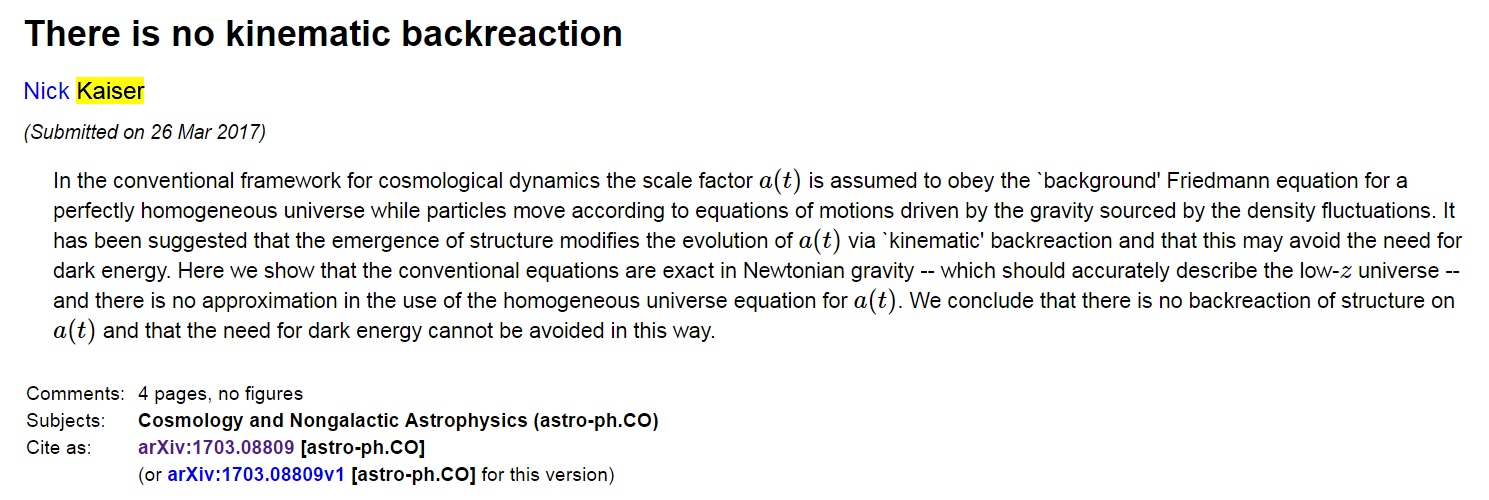
The article has a very clear abstract:

Kaiser

This is an important point of debate, because the inference that the universe is dominated by dark energy (i.e. some component of the cosmic energy density that violates the strong energy condition) relies on the assumption that the distribution of matter is homogeneous and isotropic (i.e. that the Universe obeys the Cosmological Principle). Added to the assumption that the large-scale dynamics of the Universe are described by the general theory of relativity, this means that we evolution of the cosmos is described by the Friedmann equations. It is by comparison with the Friedmann equations that we can infer the existence of dark energy from the apparent change in the cosmic expansion rate over time.

But the Cosmological Principle can only be true in an approximate sense, on very large scales, as the universe does contain galaxies, clusters and superclusters. It has been a topic of some discussion over the past few years as to whether the formation of cosmic structure may influence the expansion rate by requiring extra terms that do not appear in the Friedmann equations.

Nick Kaiser says `no’. It’s a succinct and nicely argued paper but it is entirely Newtonian. It seems to me that if you accept that his argument is correct then the only way you can maintain that backreaction can be significant is by asserting that it is something intrinsically relativistic that is not covered by a Newtonian argument. Since all the relevant velocities are much less than that of light and the metric perturbations generated by density perturbations are small (~10-5) this seems a hard case to argue.

I’d be interested in receiving backreactions to this paper via the comments box below.

Astronomy Look-alikes, No. 27

Posted in Astronomy Lookalikes with tags , , on May 28, 2010 by telescoper

A few years ago Professor Nick Kaiser mentioned to me that people said he reminded them of Austin Powers. More recently, however, I’ve noticed that Nick looks less like the International Man of Mystery and more like his arch-rival, Dr Evil. He must have been spending too much time using a Mac.

Professor Kaiser

Doctor Evil