Archive for numerical simulations

Weekly Update at the Open Journal of Astrophysics – 08/03/2025

Posted in OJAp Papers, Open Access, The Universe and Stuff with tags , , , , , , , , , , , , , , , , , , , , on March 8, 2025 by telescoper

Time for the weekly Saturday morning update of papers published at the Open Journal of Astrophysics. Since the last update we have published four new papers, which brings the number in Volume 8 (2025) up to 25 and the total so far published by OJAp up to 260.

In chronological order of publication, the four papers published this week, with their overlays, are as follows. You can click on the images of the overlays to make them larger should you wish to do so.

The first paper to report is “Partition function approach to non-Gaussian likelihoods: information theory and state variables for Bayesian inference” by Rebecca Maria Kuntz, Heinrich von Campe, Tobias Röspel, Maximilian Philipp Herzog, and Björn Malte Schäfer, all from the University of Heidelberg (Germany). It was published on Wednesday March 5th 2025 in the folder Cosmology and NonGalactic Astrophysics and it discusses the relationship between information theory and thermodynamics with applications to Bayesian inference in the context of cosmological data sets.


You can read the officially accepted version of this paper on arXiv here.

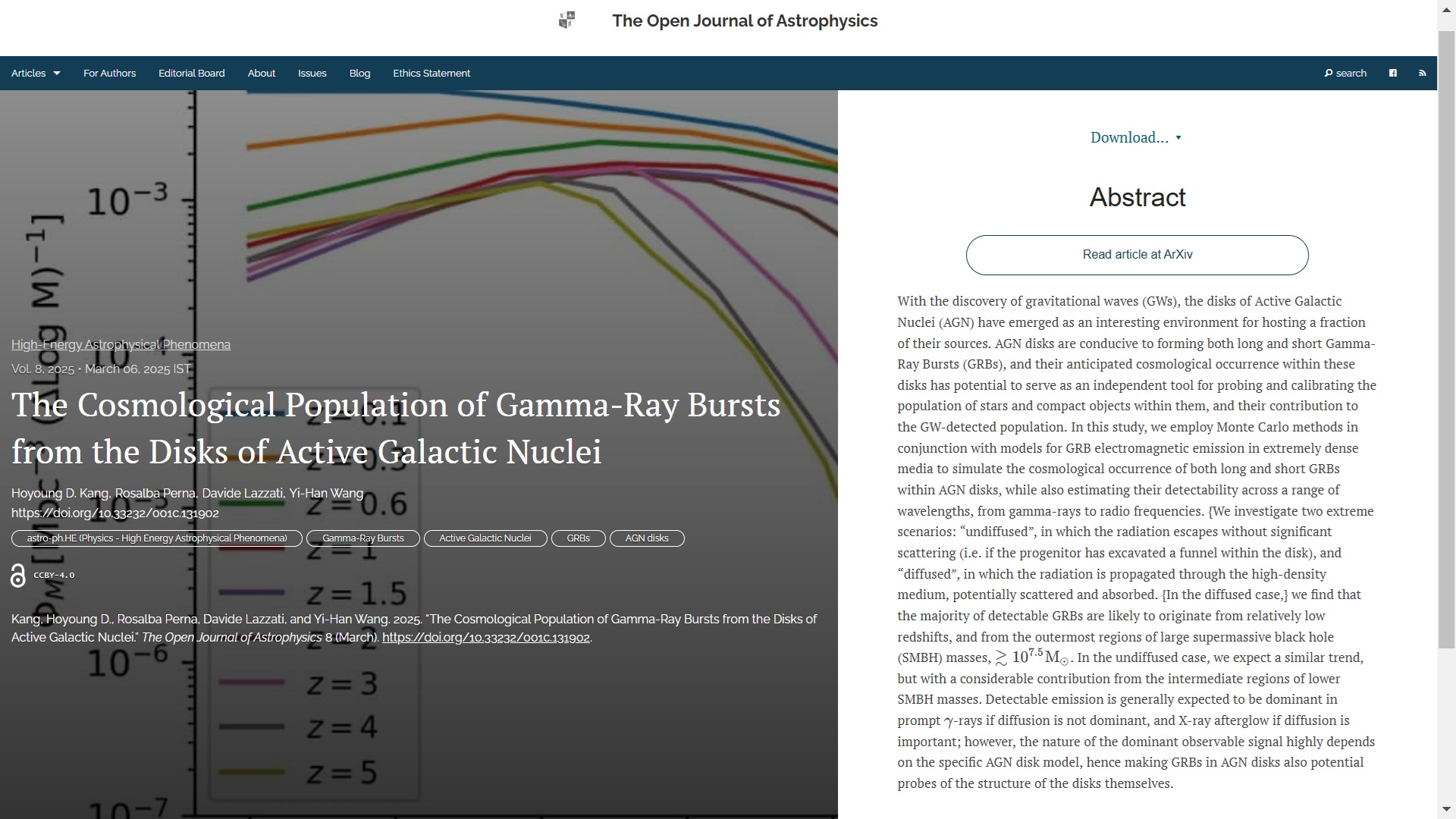
The second paper of the week  is “The Cosmological Population of Gamma-Ray Bursts from the Disks of Active Galactic Nuclei” by Hoyoung D. Kang & Rosalba Perna (Stony Brook), Davide Lazzati (Oregon State), and Yi-Han Wang (U. Nevada), all based in the USA. It was published on Thursday 6th March 2025 in the folder High-Energy Astrophysical Phenomena. The authors use models for GRB electromagnetic emission to simulate the cosmological occurrence and observational detectability of both long and short GRBs within AGN disks
You can find the officially accepted version of this paper on arXiv here.

The next two papers were published on Friday 7th March 2025.

The distribution of misalignment angles in multipolar planetary nebulae” by Ido Avitan and Noam Soker (Technion, Haifa, Israel) analyzes the statistics of measured misalignment angles in multipolar planetary nebulae implies a random three-dimensional angle distribution limited to <60 degrees. It is in the folder Solar and Stellar Astrophysics.

Here is the overlay:


The official published version can be found on the arXiv here.

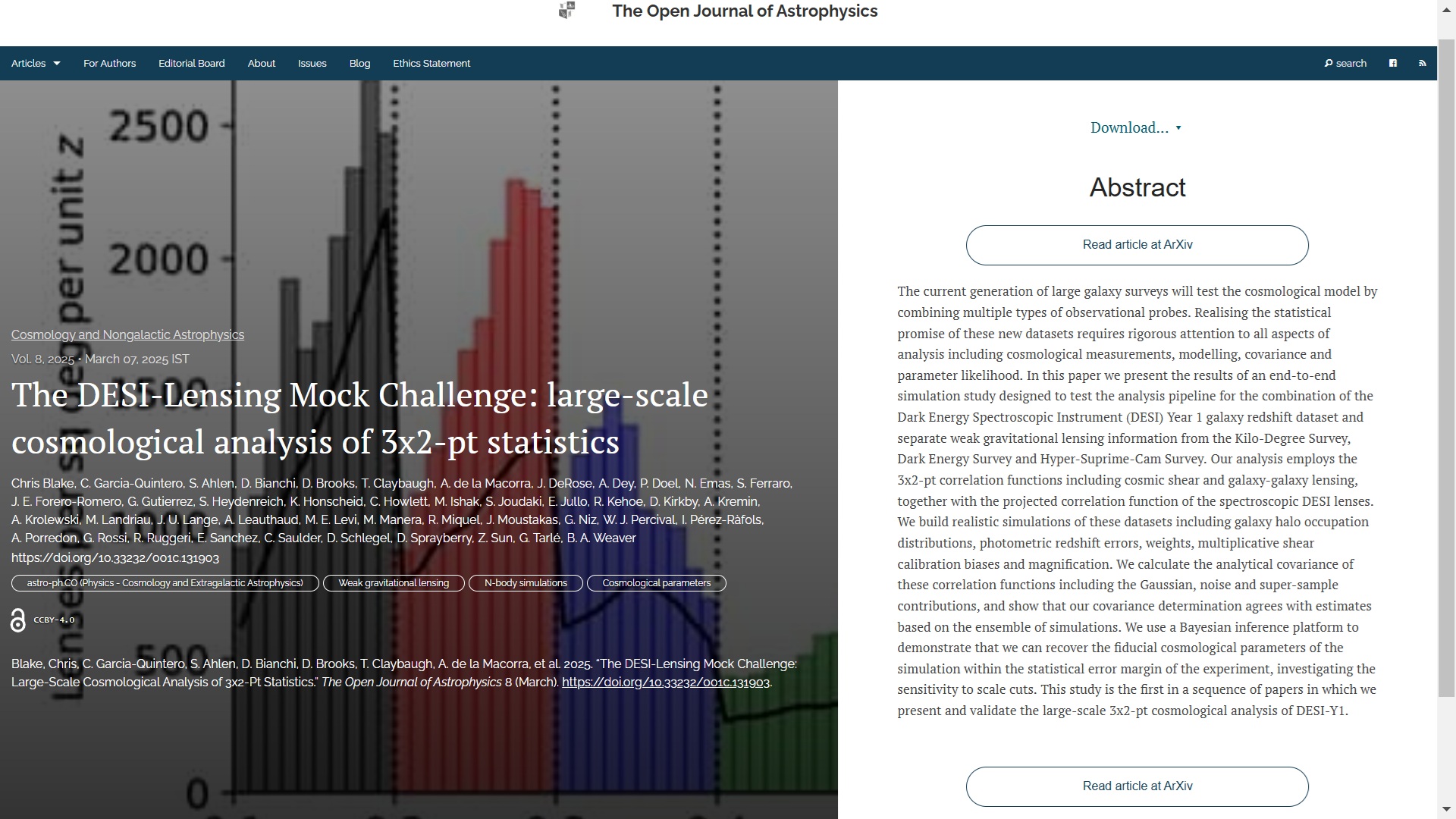
The last paper to report this week is “The DESI-Lensing Mock Challenge: large-scale cosmological analysis of 3×2-pt statistics” by Chris Blake (Swinburne, Australia) and 43 others; this is a large international collaboration and I apologize for not being able to list all the authors here!

This one is in the folder marked Cosmology and NonGalactic Astrophysics; it presents an end-to-end simulation study designed to test the analysis pipeline for the Dark Energy Spectroscopic Instrument (DESI) Year 1 galaxy redshift dataset combined with weak gravitational lensing from other surveys.

The overlay is here:
 

You can find the “final” version on arXiv here.

That’s all for this week. It’s good to see such an interesting variety of topics. I’ll do another update next Saturday

Weekly Update from the Open Journal of Astrophysics – 15/02/2025

Posted in OJAp Papers, Open Access, The Universe and Stuff with tags , , , , , , , , , , on February 15, 2025 by telescoper

Time for another quick update of papers published at the Open Journal of Astrophysics. Since the last update we have published two new papers, which brings the number in Volume 8 (2025) up to 14 and the total so far published by OJAp up to 249.

Here are quick descriptions of the two papers concerned; you can click on the images of the overlays to make them larger should you wish to do so.

First one up is “AI-assisted super-resolution cosmological simulations IV: An emulator for deterministic realizations” by Xiaowen Zhang & Patrick Lachance (Carnegie Mellon), Ankita Dasgupta (Penn State), Rupert A. C. Croft & Tiziana Di Matteo (Carnegie Mellon), Yueying Ni (Harvard), Simeon Bird (UC Riverside) and Yin Li (Shenzhen University, China).  It presents a method of achieving super-resolution to rapidly enhance low-resolution runs with statistically correct fine details to generate accurate simulations and mock observations for large galaxy surveys and was published on Monday 10th February 2025 in the folder marked Cosmology and NonGalactic Astrophysics.


You can find the officially accepted version of this paper on arXiv here.

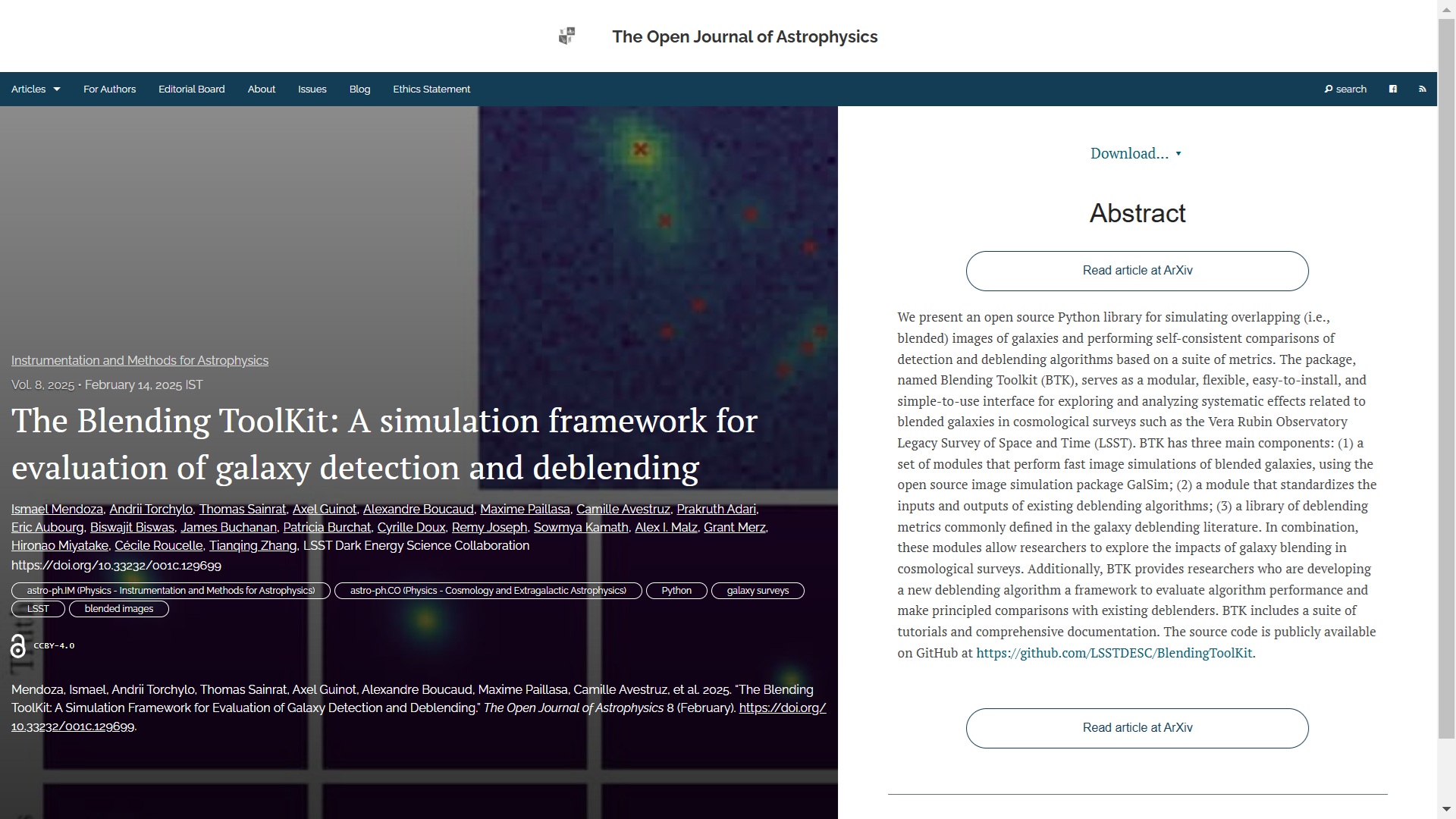
The second paper, published on Friday 14th February 2025 in the folder Instrumentation and Methods for Astrophysics is “The Blending ToolKit: A simulation framework for evaluation of galaxy detection and deblending” which describes a modular suite of Python software for exploring and analyzing systematic effects related to blended galaxy images in cosmological surveys. It was written by Ismael Mendoza (U. Michigan, Ann Arbor, USA) and 19 others, on behalf of the LSST Dark Energy Science Collaboration. I don’t have time to list all the authors here but you can find them on the overlay here:


The accepted version of this paper can be found on the arXiv here.

That’s all for this week. I’ll do another update next week, when I expect to be able to report that we have passed the 250 publication mark.

New Publication at the Open Journal of Astrophysics

Posted in OJAp Papers, The Universe and Stuff with tags , , , on January 11, 2024 by telescoper

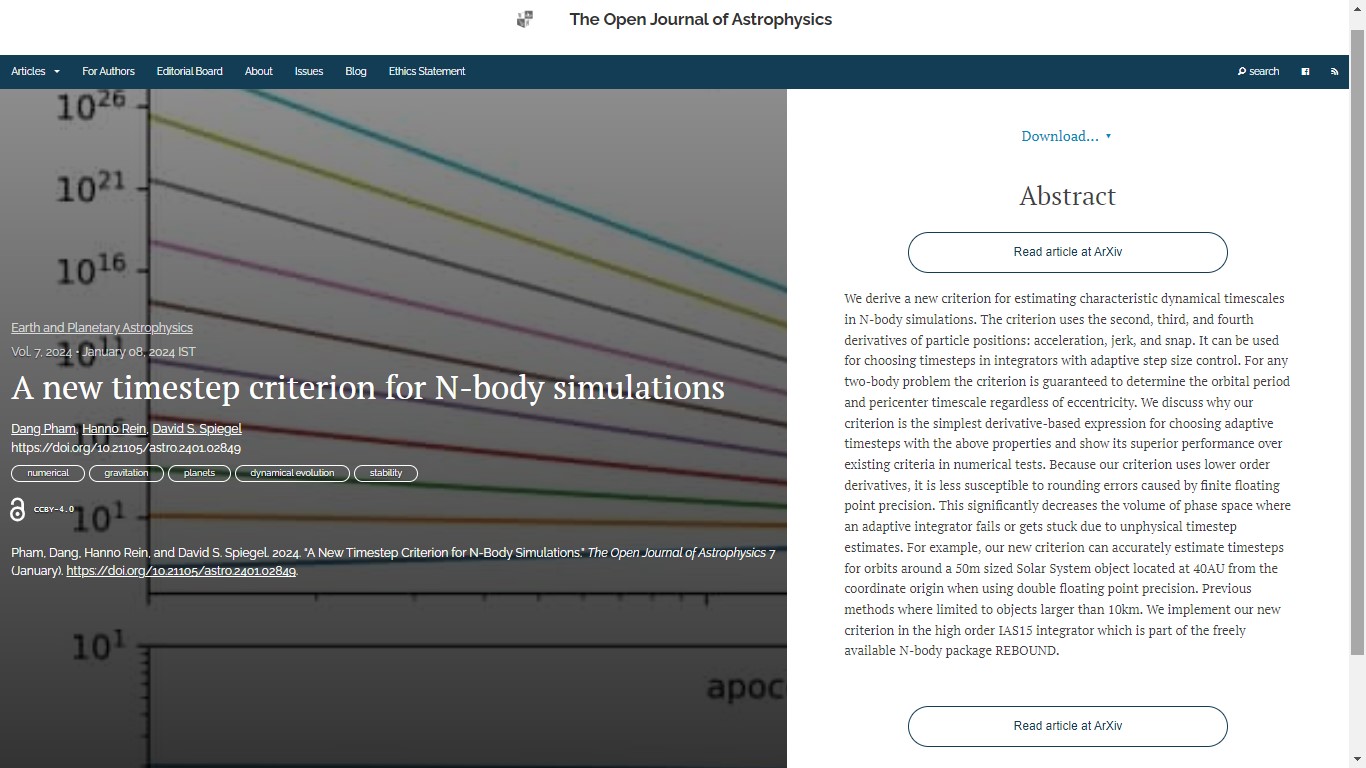
Well, it’s 2024 and time to start a new volume – the seventh – of the Open Journal of Astrophysics with the very first paper of the new year. The paper in question is the 1st paper in Volume 7 (2024)  and the 116th altogether. This one was published on 8th January 2024.

The title is “A new timestep criterion for N-body simulations” and it presents a new method for estimating characteristic dynamical timescales in N-body simulations, based on derivatives up to fourth order, which can be used to adjust timesteps used in numerical computations. The paper is in the folder marked Earth and Planetary Astrophysics as the paper discusses applications to orbital dynamics in planetary systems, but the method is of much wider applicability.

The authors are Dang Pham & Hanno Rein  (University of Toronto, Canada) and David S. Spiegel (Google, USA).

Here is the overlay of the paper containing the abstract:


You can click on the image of the overlay to make it larger should you wish to do so. You can find the officially accepted version of the paper on the arXiv here.

Gruber Prize 2020: Volker Springel & Lars Hernquist

Posted in Open Access, The Universe and Stuff with tags , , , , , on May 8, 2020 by telescoper

I’m delighted to be able to pass on the news released yesterday that the 2020 Gruber Prize for Cosmology has been awarded to Lars Hernquist (left) and Volker Springel (right) for their work on numerical simulations.

The citation reads:

The Gruber Foundation is pleased to present the 2020 Cosmology Prize to Lars Hernquist and Volker Springel for their transformative work on structure formation in the universe, and development of numerical algorithms and community codes further used by many other researchers to significantly advance the field. The contributions of Hernquist and Springel have led to profound insights spanning billions of years of cosmic evolution, including simulations of the growth of early density fluctuations through to present-day galaxies, the influence of galaxy mergers on star formation, and the close coevolution of supermassive black holes with their host galaxies.

I’ll just add that as well as being enormously influential in purely scientific terms both these scientists have contributed to the culture of open science through making codes (such as GADGET) freely available to the community.

Heartiest congratulations to Volker Springel and Lars Hernquist on their very well deserved award.