Archive for Open Access

The Open Journal for Astrophysics Project

Posted in Open Access with tags , , , , on May 10, 2014 by telescoper

I owe many people various apologies for not posting anything for a while about the Open Journal for Astrophysics. For a start I have to admit that the call for test submissions last year was a bit premature. I should have been more patient and ensured that the system was complete before going public. I hope nobody has been too seriously inconvenienced by the ongoing delay.

The project has got stalled a bit largely because I have just had too many things to do to devote enough time to complete the final stages needed to go fully live and also one of the people helping with the project Arfon Smith moved to a new job. Arfon and Chris Lintott have posted an account of the project so far which gives a bit more detail about how we wanted to realize the project (hosted by GitHub); the code development has involved major work by Robert Simpson and Stuart Lynn in addition to Arfon and Chris.  In essence they say that the job is now about 80% complete. I would have said it was more like 75%, so the OJFA is in some sense just the OJF at the moment! Much of what remains is not actual programming stuff but administrative stuff involved with, e.g., arranging the assignment of  digital object identifiers (DOIs) and so on, all of which has been on my to-do list for several months now.

Anywhere, just to show you that the whole project isn’t just hot air here is a demonstration of the snazzy user interface which we plan to use to facilitate the online refereeing process:

However, in the spirit not only of open access publishing but also of open source programming, Arfon has made available all the codes that have been developed so far. One intention of this is that  these can be adapted  for other OJFs hence the construction of a generic website (theoj.org) as well as the hope that some folks out there might help us bright the OJFA itself to completion. Anyone out there with the requisite skills is welcome to volunteer, either through the comments box here or through the OJ repository. If we can get enough volunteers we can meet and put together a plan to bring this idea to completion at last.

Despite being forced to accept that my own workload makes it difficult for me to be as involved as I’d like to be in this project I’d still really love to get this project off the ground. I hope I can use the time freed up by no longer being a member of RAS Council to work on the OJFA. I no longer have a conflict of interest in that regard either; like many other learned societies the RAS currently makes a large fraction of its income from academic publishing!

As Arfon mentions in his piece, the recent BICEP2 episode in particular provides pretty strong motivation that we need a new concept of academic publishing. Practical difficulties may have intervened for now but the motivation for the project itself is stronger now than it has ever been.

Research Hive on Open Access

Posted in Open Access, The Universe and Stuff with tags , , , , on March 21, 2014 by telescoper

Near the end of a week that has been both exciting and exhausting, I had the opportunity to take part in a seminar on Open Access publishing. I agreed to do this last year sometime, and only remembered that it was today because I got an email reminder a couple of days ago! Anyway it was nice to have an excuse to visit the iconic Library of the University of Sussex for this event.

Fortunately, as things turned out, I had plenty of topical material to draw on for inspiration and spent some time discussion the possibilities of community peer review with reference with what’s been happening with BICEP2. Here’s me in the middle of the talk on that very subject showing the Live Discussion Facebook page:

Hive

I shared the bill with Rupert Gatti from Open House Press which publishes mainly in the Arts and Humanities area; generally speaking these disciplines are a long way behind astrophysics in terms of their readiness for the age of Open Access but I think change across all academia is inevitable.

For those of you interested I realize that an update on the Open Journal For Astrophysics is long overdue. I’ve just been too busy with other things to devote much time to it. I do hope to have further news very soon…

BICEP2, Social Media and Open Science

Posted in Open Access, The Universe and Stuff with tags , , , on March 20, 2014 by telescoper

I’ve been finding it a bit difficult to keep up with all the BICEP2 excitement in between all the other things I’ve had to do this week but at least the blog has been generating some interest and there’s no sign of that abating yet.  In fact, according to the wordpress elves, today is the busiest day I’ve ever had on In the Dark – and it’s not even 6pm yet!

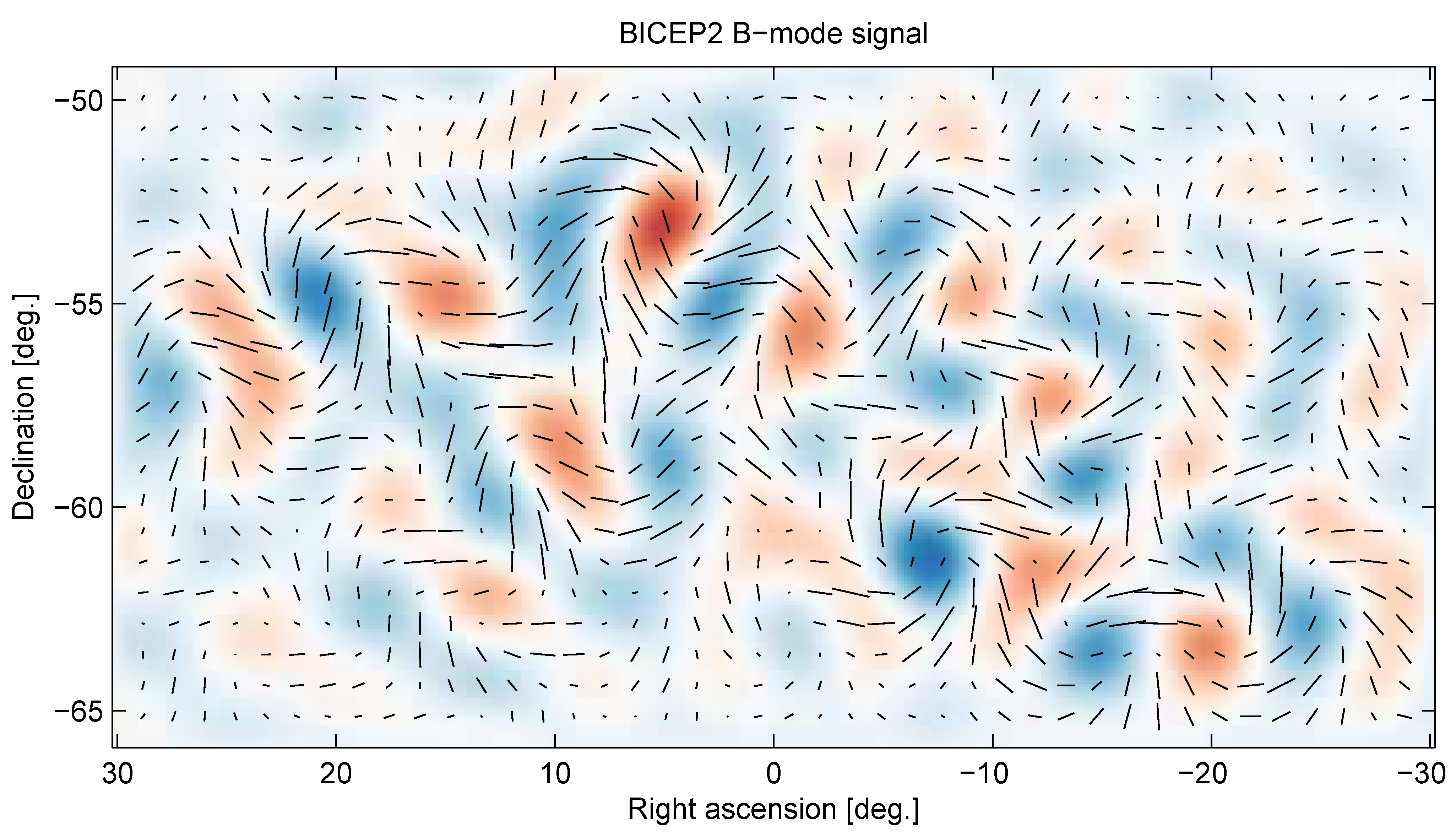
I realize that I’ve posted several items on B-modes without ever showing a picture of what they look like, so here you go, an image of the B-mode polarization seen by the BICEP2 experiment:

b_over_b_rect_BICEP2

When the BICEP2 team announced that  a “major astrophysics discovery” would be announced this Monday I have to admit that I was quite a bit uncomfortable about the way things were being done. I’ve never been keen on “Science by Press Release” and when it became clear that the press conference would be announcing results that hadn’t yet been peer-reviewed my concerns deepened.

However, the BICEP2 team immediately made available not only the “discovery” paper but also the data products, so people with sufficient expertise (and time) could try to unpick the content. This is fully in the spirit of open science and I applaud them for it. Indeed one could argue that putting everything out in the open the way they have is ensuring that that their work is being peer-reviewed in the open by the entire cosmological community not secretly and by one or two anonymous individuals. The more I think about it the more convinced I am becoming that this is a better way of doing peer review than the traditional method, although before I decide that for sure I’d like to know whether the BICEP2 actually does stand up!

One of the particularly interesting developments in this case is the role social media are playing in the BICEP2 story. A Facebook Group was set up in advance of Monday’s announcement and live discussion started immediately the press conference started. The group now has well over 700 members, including many eminent cosmologists. And me. There’s a very healthy scientific discussion going on there which may well prove to be a model of how such things happen in the future. Is this a sign of a major change in the way science is done, the use of digital technology allowing science to break free from the shackles placed on it by traditional publication processes? Maybe.

Anyway, no time to write any more. I just remembered I have to participate in a seminar on Open Access publishing and I have to start thinking about what I’m going to say!

P.S. The Vernal Equinox happened at 16.:57 GMT today, so welcome to Spring!

Elsevier’s Confidentiality Clauses

Posted in Open Access with tags , on December 22, 2013 by telescoper

I came across this a little while ago (here, where the context is explained in more detail). It comes from a conference about the future of scientific publishing, and features David Tempest of Elsevier responding to a question from Dr Stephen Curry.

I hadn’t realised before this question that Elsevier not only charges eye-wateringly expensive subscription rates for its journals but also often requires institutional libraries to sign a confidentiality clause under which they are forbidden from revealing how much the subscription costs. Here Mr Tempest attempts to explain this policy:

So there you have it. If people actually knew what other people were being charged there’s a danger that prices would be driven relentlessly downward. Shocking.

You have to feel some sympathy for Elsevier, struggling along on a profit margin of a mere 36%. It must be so difficult for them to make ends meet…

Elsevier is taking down papers from Academia.edu

Posted in Open Access with tags , on December 12, 2013 by telescoper

Yet another example of an academic publisher (Elsevier) acting in a manner clearly detrimental to research.

Mike Taylor's avatarSauropod Vertebra Picture of the Week

Lots of researchers post PDFs of their own papers on their own web-sites. It’s always been so, because even though technically it’s in breach of the copyright transfer agreements that we blithely sign, everyone knows it’s right and proper. Preventing people from making their own work available would be insane, and the publisher that did it would be committing a PR gaffe of huge proportions.

Enter Elsevier, stage left. Bioinformatician Guy Leonard is just one of several people to have mentioned on Twitter this morning that Academia.edu took down their papers in response to a notice from Elsevier. Here’s a screengrab of the notification:

oLI5n9w

And here is the text (largely so search-engines can index it):

Hi Guy

Unfortunately, we had to remove your paper, Resolving the question of trypanosome monophyly: a comparative genomics approach using whole genome data sets with low taxon sampling, due to a take-down notice from…

View original post 403 more words

Boycott Nature and Science!

Posted in Open Access, Science Politics with tags , , , , on December 11, 2013 by telescoper

On Tuesday Randy Schekman, joint winner of the 2013 Nobel Prize for Physiology or Medicine hit out at academic publishers for the way the most “prestigious” journals (specifically Cell, Nature and Science) publish only the “flashiest” research.  I see his announcement as part of a groundswell of opinion that scientists are being increasingly pressured to worry more about the impact factors of the journals they publish in than about the actual science that they do. Cynics have been quick to point out that his statements have emerged only after he received the Nobel Prize, and that it’s difficult for younger researchers who have to build their careers in a world to break free from the metrics that are strangling many disciplines. I feel, as do some of my colleagues (such as Garret Cotter of Oxford University), that it’s time for established researchers to make a stand and turn away from those publishers that we feel are having a negative impact on science and instead go for alternative modes of publication that are in better keeping with the spirit of open science.

In future, therefore, I’ll be boycotting Nature and Science (I don’t publish in Cell anyway) and I call upon my colleagues to do likewise. Here’s a nice logo (courtesy of Garrett Cotter) that you might find useful should you wish to support the boycott.

CNS

ps. For the record I should point out that during my career I have published four papers in Nature and one in Science.

The Open Journal for Astrophysics is Open for Test Submissions!

Posted in Open Access with tags , , , on November 17, 2013 by telescoper

Just a quick announcement that we’re stepping up the testing phase of the Open Journal for Astrophysics and would really appreciate it if astrophysicists and cosmologists out there would help us out by submitting papers for us to run through our swish new refereeing system.

Just to remind you The Open Journal for Astrophysics is completely free both for submission and for access; there are no Author Processing Charges and no subscription payments. All papers will be fully peer-reviewed using a system which is, as far as I’m concerned, far better than any professional astrophysical journal currently offers. All this is provided free by members of the astrophysics community as a service to the astrophysics community.

I know that many will be nervous about submitting the results of their research to such a new venture, but I hope there will be plenty among you who agree with me that the only way we can rid ourselves of the enormous and unnecessary financial burdens placed on us by the academic publishing industry is by proving that we can do the job better by ourselves without their intervention.

The project has changed a little since I suggest the idea last year, but the submission procedure is basically that which I originally envisaged. All you have to do is submit your paper to the arXiv and let us know its reference when this has been accomplished. Our software will then pick up the arXiv posting automatically and put it into our refereeing pipeline.

In future we will have our own latex template to produce a distinctive style for papers, but this is not needed for the testing phase so feel free to use any latex style you wish for your submission.

For the time being the OJFA website and associated repositories are not publicly available, but that’s just so we can test it thoroughly before it goes fully live, probably early in the new year; at that point all the papers passing peer review during the test phase will be published. I’m really excited about the forthcoming launch which will, I hope, generate quite a lot of publicity about the whole issue of open access publishing.

If anyone has any questions about this please feel free to ask via the comments box. Also please pass this on via twitter, etc. The more, and the more varied, papers we get to handle over the next couple of months the quicker we can get on with the revolution! So what are you waiting for? Let’s have your papers!

Open Access Repositories should be based on Subject, not Institution

Posted in Open Access with tags , , , , on September 18, 2013 by telescoper

Just when we thought that the powers that be might be starting to see the light on Open Access, round comes another circular from the Higher Education Funding Council for England (HEFCE) that shows that policymakers have an unlimited ability to get things wrong at the most basic level.

The document concerned opens a “Consultation on open access in the post-2014 Research Excellence Framework” by putting forward a number of proposals.

Now it’s depressing enough that the entire document is predicated on the assumption that there will be another Research Excellence Framework, perhaps in 2020. The current REF is such a disaster that one might have hoped somebody up there would have decided that enough is enough. But then we thought that about Research Assessment Exercise in 2008. Even the most pessimistic of us hope that the REF would have a “lighter touch” than the RAE, but as it has turned out it’s many times worse both in the time it has taken to prepare submissions and the ridiculous game-playing and dodgy employment practices that it has encouraged among participation institutions.

I hope there’s still time to drive a stake through the heart of the runaway bureaucracy that keeps imposing this idiocies on us. After all, a new Chief Executive about to take over at HEFCE. Perhaps a new broom will be wielded? I hope against hope.

However, setting all that to one side, I had a look at the proposals for Open Access after 2014 contained in the document. Here is the summary of the proposals:

HEFCE

Aarrgh!

Why on Earth should the proposals favour national institutional repositories over international subject-based ones? A shining example of the latter is the arXiv which has, for Physics and Astronomy, become the basic resource for researchers around the world; it’s a one-stop shop at which one can access research from all around the world. By contrast, having work in the same field stored over a plethora of institutional repositories will serve no useful purpose at all, because UK research will not  treated in the same way as work from other countries and in any case individual repositoes will lead to an absurd level of duplication of infrastructure and other resources. This requirement is particularly indefensible in Physics and Astronomy, as it would require us to duplicate in (probably inferior) institutional repositories what we already do with the arXiv.

The UK Funding Councils need realize that the solution to many of the challenges of Open Access has already been found. In fact, the European Research Council seems to have acknowledged this and is now directly funding the arXiv. The UK Research Councils should be required to construct similar archives for their disciplines. That shouldn’t be difficult, because all the hard work has already been done. There is a working model.

I’ll be responding to the consultation document in no uncertain terms. The Royal Astronomical Society is also collating responses for a collective submission. We have to resist these, and other proposals such as another REF, which are being foisted on us by people who have no idea what they’re doing and no idea what damage they’re causing.

Seeing Sense on Open Access

Posted in Open Access, Politics, Science Politics with tags , , on September 10, 2013 by telescoper

Just time for a quick post to pass on the news that the Parliamentary Select Committee on Open Access has published its report. A PDF file of the whole thing is available here. I was eagerly anticipating this publication for many reasons, including the fact that this blog (inadvertently) provided evidence to it:

A senior academic wrote on his blog that “the publisher was deliberately and disgracefully misleading the author about the RCUK policy on open access in order to take money from them”. I could go on, but can you convince us otherwise, because if that is the case, this is one of the less helpful pieces of the work that the Government has decided to do?

Anyway, the good news is that the Select Committee has seen sense and produced a report that is very critical of the government’s rush to Gold Open Access. Here are the main conclusions:

92. The Government’s committed and pro-active stance to increasing access to published research findings is admirable, as is its desire to achieve full open access. Gold open access, at scale, is a desirable ultimate goal, and we acknowledge that the recommendations of the Finch Report, and the Government and RCUK’s open access policies were formulated with this end in mind.

93. However, almost without exception, our evidence has pointed to gaps in both the qualitative and quantitative evidence underpinning the Finch Report’s conclusions and recommendations, most significantly a failure to examine the UK’s Green mandates and their efficacy. This has been replicated in the formulation of the Government and RCUK’s open access policies and their mistaken focus on the Gold solution as the primary route to achieving open access at scale in the UK. The major mechanism of transition must be Green open access, specifically through strong immediate self-archiving mandates set by funders and institutions, either as a funding condition or tied to research assessment as appropriate.

94. Given the emphasis the Government has placed on the benefits of open access, the Government should seek a derogation in relation to VAT on e-journals as a matter of urgency.

95. The Minister for Universities and Science and members of the Finch working group are due to meet in September 2013 to assess impact and progress of open access policy. RCUK has said it intends to review its policy in 2014, to assess how developments compare to their expectations, and to meet annually after that. As part of those reviews, both Government and RCUK must fully consider and address the conclusions and recommendations set out in this Report.

Item 93 is pretty strong stuff and I agree with every word of it! I have long believed that the Finch Report, which precipitated the Government’s present policy, was hijacked by vested interests in the academic publishing industry, greatly to the detriment of the academic community. The government needs to reverse its policy, and fast, before more money that should be spent on research and scholarship is wasted on subsidies for greedy publishers. It remains to be seen whether the government has the courage to change course.

UPDATE: See here for a more detailed and considered report by Stephen Curry

The Open Journal for Astrophysics – Update and Request

Posted in Open Access, The Universe and Stuff with tags , , , , , on August 22, 2013 by telescoper

I’ve been getting quite a few questions about my modest proposal The Open Journal for Astrophysics. I don’t want to give too much away before the site is revealed, but I can say that after a very positive meeting in London last week the project is right on track and will go live pretty soon for beta testing. We have an Editorial Board (names to be revealed in due course), a very nice website, a web team, and an excellent interface for editors and reviewers which, in my opinion, is far better than any offered by a “professional” journal. When the site does go live I’ll explain in more detail how it works and introduce all the people whose contributions enabled this project to get off the ground.

We are going to test everything extensively before the OJFA goes public, however, so please be patient. We will be testing the site initially using papers in a relatively restricted area of astrophysics (largely extragalactic astrophysics and cosmology), but hope to expand by the addition of other members to the Editorial Board. In anticipation of this future expansion, volunteers in areas of astrophysics outside this specialism are welcome!

That’s the update. Now time for the request. Although not essential for the initial testing phase of the project, we do think that it would benefit from a distinctive layout for the papers, which would be easily achieved by having our own Latex style. This came up in discussion some time ago when I first floated the idea of this project and somebody emailed me offering to design an appropriate Latex package. Unfortunately, however, in transit from Cardiff to here I appear to have lost the email and can’t remember who sent it. I’m therefore going to enlist the help of the blogosphere to remedy this act of incompetence. Is there anybody out there among the interwebs who is sufficiently keen and has the necessary expertise to construct a latex style for our new journal? If so please contact me, either through the comments or via email. I can’t do it myself because I have never had any sense of style…

Please pass this on via Twitter, etc.