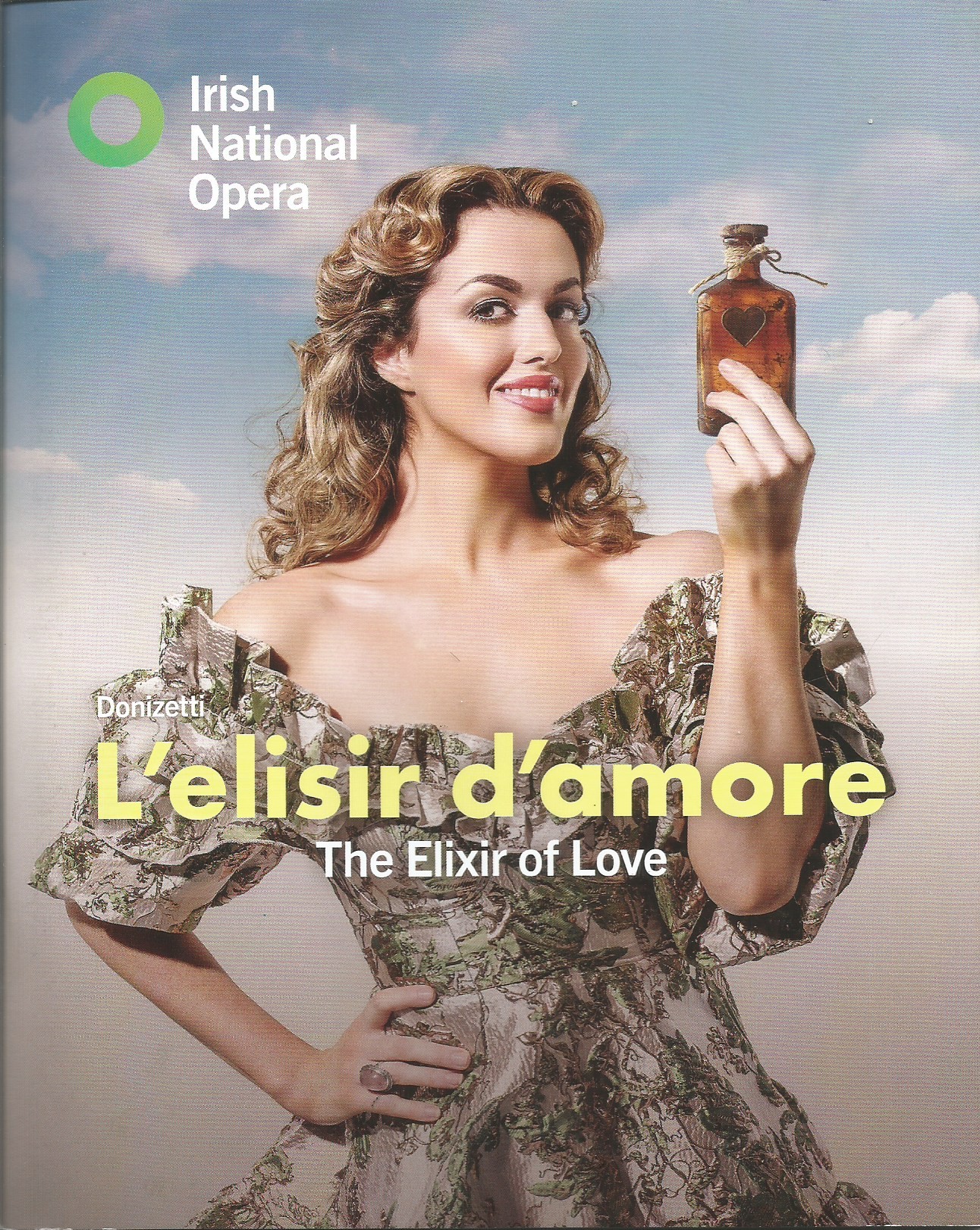
My trip to Wexford was to mark a special occasion by paying my first ever visit to the National Opera House to see a performance of Donizetti’s comic opera L’elisir d’amore by Irish National Opera. It was well worth the trip, as it was a wonderfully entertaining production with lovely singing and lots of laugh-out-loud moments. In short, it was a blast.
Billed as a melodramma giocoso, but more usually called an opera buffa, this was the first Donizetti opera to be performed in Ireland, in 1838; its world premiere was in 1832 in Milan and it has been in the operatic repertoire ever since. The show-stopping Una furtiva lagrima in Act II is one of the most recorded tenor arias, the first recording of which dates back to 1904 (by Enrico Caruso).
In case you’re not aware of the opera, it tells the story of a lowly peasant (Nemorino, tenor) who is in love with the wealthy Adina (soprano), who does not return his love – understandably not just because he’s poor but because he’s a bit of a drip. In despair Nemorino turns to the fake doctor Dulcamara (bass-baritone) “famous throughout the Universe and certain other places” who has arrived in town to peddle potions and quack remedies, no doubt made from snake oil. Nemorino asks him for a philtre that will make Adina fall for him. Dulcamara has sold all his potions, but fills an empty medicine bottle with wine and tells him it’s the love potion he needs. After drinking it, Nemorino feels more confident, but Adina still isn’t interested. Worse, Adina has agreed to marry to soldier Belcore. That’s Act I.
In Act II, desperate to stop the marriage, Nemorino wants to buy some more of the love potion but he has no money so he agrees to join the army for which he is entitled to a joining fee. He spends the money on more wine and gets completely wasted, so much so that he misses the news that a rich uncle has died and left him a large inheritance. When the women of the town find out that he is now rich, they all start showing an interest in Nemorino, which he assumes is because of the love-potion. At this point Adina decides she really does love Nemorino, buys out his contract with the army, and calls off the wedding with Belcore. The soldier shrugs off his loss. Dulcamara convinces himself that he really has magical powers…
Summarizing the plot doesn’t really do justice to the opera, however, as there are numerous musical interludes, with dancing, and slapstick comedy. Donizetti’s music is wonderful, and keeps the pace going. It’s basically a theatrical farce set to music, with the score keeping everything moving at the speed that is essential to make such a thing work. Erina Tashima conducted the Orchestra of Irish National Opera with great verve.
This production is set in a comical Wild West of America, with a relatively simple set but wonderful very witty costumes. Nemorino (Duke Kim) was dressed like Woody from Toy Story, for example. We also had appearances from Calamity Jane, Laurely & Hardy (who do their “Way Out West” dance), Abraham Lincoln and even the couple from Grant Wood’s painting American Gothic. Adina (Claudia Boyle) has no fewer than five costume changes, each one into a frock more glamorous than the previous. Dulcamara was the wonderful John Molloy and there is great comedy between him and his diminutive sidekick Truffaldino (a non-singing part played by Ian O’Reilly). Belcore’s troops are kitted out like the US Cavalry, and their dancing and messing about delivers laugh after laugh. There are also sundry “peasants”, i.e. cowboys and women of the town adding to the hilarity. I give 10/10 to the members of the chorus, their Director Richard McGrath and choreographer Paula O’Reilly.
All the principles were great too. Claudia Boyle sang beautifully, but also conveyed the comic aspects of her role. Duke Kim was perfectly cast as the boyish Nemorino; he has a light and agile tenor voice, which he used to bring the house down with the big number Una Furtiva Lagrima in Act II. Belcore was baritone Gianluca Margheri (whom I saw perform in Maynooth a couple of years ago). His physique matches the muscular quality of his voice, and he wasn’t shy in showing it off by taking off his shirt onstage! John Molloy’s singing was as impeccable as his comic timing in the role of Dulcamara. I think he got the most laughs, in a production that produced many.
This triumphant production plays L’elisir d’amore for laughs and wins by a knockout. Sadly there’s only one performance left in this run, in Cork on Saturday 7th June. Do go if you can!
I’m just back from my second night at the Sydney Opera House, at which I saw Opera Australia’s production of Mozart’s The Magic Flute. What has been a very warm day turned into a very sultry evening, and it was nice to take my drink outside during the interval to admire the view:
I’ve lost track of how many different productions I have seen of this strange and wonderful masterpiece, and this was a distinctly Australian version. Technically it’s not an opera, but a singspiel: the recitative – the bit in between the arias – is spoken rather than sung. It’s really more like a musical comedy in that sense, and was originally intended to be performed in a kind of burlesque style.
The Magic Flute also has many points of contact with the pantomime tradition, including the character of the villainous Monostatos who, in this performance, was reminiscent of Rolf Harris. Papageno was a working class Australian, sporting a mullet, and carrying an Esky in place of the usual array of nets and birdcages. On her first entrance, the Queen of the Night put me in mind of Gloria Swanson in Sunset Boulevard. Sarastro, with long hair and flowing robes, looked like the leader of some sort of New Age cult; his acolytes were dressed in everyday casual clothes. The three boys – referred to as “spirits” in this production – were actually two boys and a girl, but “spirit” is a gender-neutral term so that’s fine.
I won’t even attempt to explain the plot, if you can call it that, because it’s completely daft. It’s daft, though, in a way that much of life is daft, and I think that’s the secret of its enduring popularity. Mozart’s music carries you along and constantly seems to be telling you not to take it all too seriously. It seems to me that it must be hard to get the balance right between the comedy (which frequently border on the slapstick) and the serious. The worst thing to do is to make it too pompous. This production doesn’t fall into that trap, but in playing it virtually entirely for laughs I think it misses the depths that make a truly successful version. The ending – in which the rays of the Sun are supposed to dispel the darkness – involved a big reveal to a picnic with the chorus in beach wear and sunglasses. There’s a lot to be said for sunshine, and I found the idea mildly amusing, but there should be more to the end of this Opera than that. On the other hand, Pamina’s aria in Act II, when she is heartbroken because she thinks Tamino has abandoned her, was intensely moving, so it wasn’t all shallow.
The sets are simple but use clever devices to suggest the extraordinary scene changes required by the libretto, including pyramids, forests, waterfalls and flames. The ordeals by fire and water, for example, are depicted using reflective strip curtains, red for fire and blue for water. The dragon in Act I is conjured up by shadow puppets against a translucent curtain.
Papageno, played by an understudy whose name I didn’t catch, was the pick of the performers but overall the cast was not particularly strong vocally. David Parkin’s basso wasn’t nearly profundo enough for Sarastro and he struggled with the lowest notes. I’m not sure either why he also played The Speaker, who is a distinct role. Giuseppina Grech as the Queen of the Night looked fabulous and hit her high notes, but the elaborate coloratura passages were not well articulated.
This probably seems very negative than I intended. There is much to enjoy in this production. It’s very entertaining, and at times riotously funny. It was just a bit too superficial for my taste.
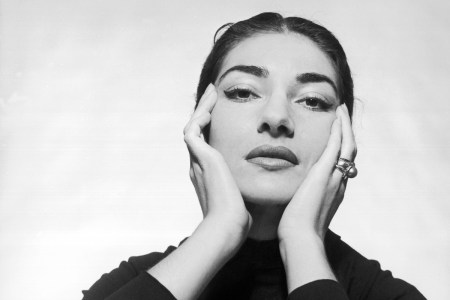
Today, 2nd December 2023, is the centenary of the birth of the most renowned opera singer of her time, Maria Callas. I couldn’t let this occasion pass without posting a tribute, Tonight I’ll be sipping wine and listening to some historic recordings of her. I think every classical radio station in the world will tonight be paying tribute to this remarkable artist.
Maria Callas was born on December 2nd 1923 in New York city, of Greek parents who had moved there the previous year, and christened Maria Anna Sofia Cecilia Kalogeropoulou. Her mother, disenchanted with her deteriorating marriage, abandoned her husband (Maria’s father) and took Maria and her sister back to Athens in 1937. Maria enrolled at the National Conservatoire of Greece the same year after winning a scholarship with the quality of her voice, which
was warm, lyrical, intense; it swirled and flared like a flame and filled the air with melodious reverberations.
At this age, Maria was a rather plump young lady with a rather deep singing voice. Initially, she aspired to be a contralto but at the Conservatoire she was encouraged instead to become a dramatic soprano. Accordingly, she underwent special training to raise her natural pitch (or tessitura) and learned how to control her remarkable voice more accurately so she could sing in a sufficiently disciplined fashion that she could take on the dazzling coloratura passages that she would perform in later years with such success. She also worked on her chest tones to broaden the scope of her voice in the mezzo region. Although she became more technically refined as a singer during this period, there were some things that didn’t change. One was the sheer power of her voice, which is something that we tend to notice less in these days of microphones and studio recordings. People who heard her sing live confess to being shocked at the sheer scale of sound she could deliver without amplification. Perhaps more tellingly, she eschewed many of the devices sopranos tended to use to control the highest notes (usually involving some alteration of the throat to produce accuracy at the expense of a thinner and more constricted tone). When Callas went for a high note, she always did so in a full-throated manner. This often produced a piercing sound that could be intensely dramatic, even to the extent of almost knocking you out of your seat, but it was a very risky approach for a live performance. Audiences simply weren’t used to hearing a coloratura sing with such volume and in such a whole-hearted way. It wasn’t always pretty, but it was certainly remarkable and often very moving. It was this aspect of her voice that led her friend Tito Gobbi (who sang with her in Tosca) to call it una grande vociaccia, which I translate in my schoolboy Italian as meaning something like “a big ugly voice”. That isn’t meant to be as disparaging as it sounds (Gobbi was a great admirer of Callas’ singing).
Having listened to lots of recordings of Maria Callas I have to admit that they are certainly not all good. Sometimes the voice didn’t come off at all. Unkindly, one colleague said that she “sang with her ovaries”. When she talked about her own voice, Callas herself often referred to it as if it were some independent creature over which she had very little control. Anyway, whatever the reason, when she was bad she was definitely bad. But I adopt the philosophy that one should judge artists (and scientists, for that matter) by their best work rather than their worst, and when Callas was good she was simply phenomenal, like a sublime and irresistible force of nature. Nobody else could bring characters to life in the same way. That’s why they called her La Divina.
Although her talent was very raw in the beginning there was no question that she always had a voice of exceptional power and dramatic intensity. When she started singing professionally she immediately attracted lavish praise from the critics not just for her voice but also for her acting. As a young soprano she sang in an astonishing variety of operas, including Wagner‘s Tristan und Isoldeand Die Walküre, neither of which one would now associate with Callas.
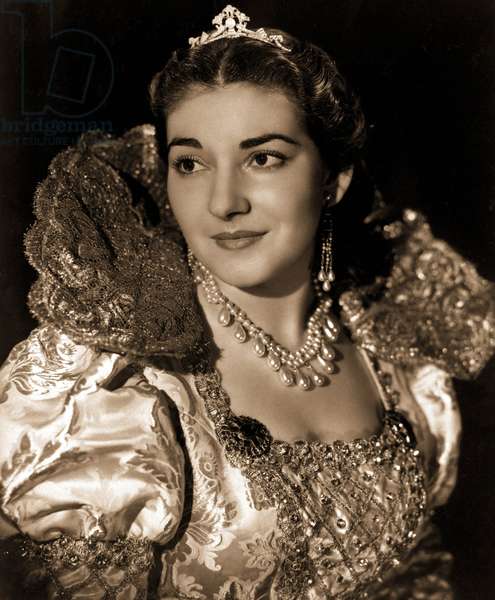
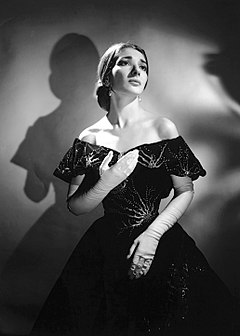
Maria Callas as Elvira in ‘I Puritani’, Teatro la Fenice, Venice, 1949Maria Callas as Violetta in `La Traviata’, Covent Garden, London, 1958
It was in the late 1940s that Callas began to take an interest in the type of opera that would really make her name. Bel canto opera was rather unfashionable at that time, probably because audiences preferred the grittier and more realistic verismo style. Virtually single-handed, Callas resurrected the bel canto canon by injecting a true sense of drama into works which had previously just been seen as vehicles for the singers to demonstrate their art. Callas brought an entirely new dimension to the great operas by Bellini (Norma, I Puritani, La Somnambula…) and Donizetti (Lucia di Lammermoor, Anna Bolena), although she was sufficiently versatile to also perform brilliantly in the verismo syle of Verdi and Puccini as well as lesser known composers such as Giordano (Andrea Chenier). Recordings of many of these performances are available, but it is sad that this glorious period of her singing career happened just a bit before high quality equipment was available so the true glory of her voice isn’t always evident.
In 1953, Callas decided that she wanted to change her appearance, perhaps so she would look more appropriate for the parts she was playing on stage. At the time she weighed almost 200lbs. In order to lose weight as quickly as possible, she followed the barbarous but highly effective expedient of swallowing a tapeworm. She lost 80lbs in a matter of months. The dramatic loss of weight changed her body and her face, emphasizing her high angular cheekbones and giving her a striking look very well suited to the opera stage. But it also affected her voice somewhat, especially at the upper end where she seems to have found it more difficult to avoid the dreaded “wobble” which was one of the alleged imperfections that critics tended to dwell upon.
Callas also had very poor eyesight which required her to wear very thick spectacles in order to see at all, a thing she refused to do onstage with the result that she was virtually blind during performances. In fact, during a performance of Tosca at Covent Garden she leant too far over a candle and her hair caught fire. Improvising magnificently, Tito Gobbi, as the loathsome Scarpia, extinguished the fire by throwing water at her before the audience had noticed. Although they weren’t much use for seeing with, her eyes were a great asset for her acting, in turns flashing like a demon then shining like an angel.
After her weight loss, Callas was suddenly no longer just a wonderful singer but also a strikingly beautiful woman. Her career took a back seat as she started to revel in the glamorous lifestyle that opened up in front of her. Her voice deteriorated and she performed rather less frequently. Eventually she embarked on a love affair with Aristotle Onassis, a notorious serial collector of trophy women. She hoped to marry him but he abandoned her to marry Jackie Kennedy, widow of John F. Kennedy.
She never really recovered from the failure of this affair, retired from singing and lived out the last years of her life as a virtual recluse in her apartment in Paris. She died in 1977.
I had heard a lot about Maria Callas when I was younger, but the recordings that I listened to (generally from the 1960s) were really not very good, as her voice was undoubtedly much diminished by then. I just assumed that, as is the case with many artists, the legend of Callas was all mere hype. Then, about 20 years ago, I was listening to BBC Radio 3 and they played the final scenes of the great 1954 recording of Norma with Callas in the title role, conducted by Tullio Serafin. I was completely overwhelmed by the emotion of it and tears flowed freely from my eyes. I’ve always had a tendency to blub when I hear really beautiful music, but as I’ve got older I’ve learned not to be embarrassed by it.
In England, Callas is probably best remembered for her performances in Tosca in Covent Garden. I have recordings of her in that role and they are really wonderful. But there are many fine recordings of Tosca by other singers, some of which are almost as good. In the case of Norma, though, there isn’t any other performance that comes within a mile of the Callas version. Or if there is, I’ve yet to hear it.
Now I know that there are some people, even opera lovers, who just don’t get Callas at all (just look at the comment boards on Youtube, etc). I grant that she wasn’t always the most accurate singer, and I don’t think you could say her voice had a purely classical beauty. But even if you don’t like her voice you have to admit that she revitalized the opera stage and brought a new public into the theatres. I can’t imagine what the state of opera would be now, if there hadn’t been a Callas, and you can’t argue that she is now an iconic figure. What I admire most about her is that, like it or loath it, her voice is instantly recognizable. In this sense, she always puts me in mind of a kind of operatic version of Billie Holliday. She’s a far cry from the many bland mediocrities that pass themselves off as opera singers nowadays.
I’m going to end with the obligatory clips from Youtube. There’s a lot of Callas on there, not all of it good. I’ve chosen a couple of items, although neither of them has a proper video. The first was performed live in 1955 in front of the notoriously difficult audience at La Scala in Milan and recorded from a radio broadcast so that the sound quality is very poor. A studio recording of this aria, from Andrea Chenier, features most movingly in the film Philadelphia. This live version, however, is notable for a number of reasons. One is that you get some idea of the power of the Callas voice in the way she pushes aside the entire orchestra and is even able to cut through the distortions introduced by the rather primitive recording technology. The second thing is that she sings it so beautifully, with such feeling, lovely phrasing, and so much colour and vitality. Listen to the way the texture of her voice matches perfectly her changing emotions as she tells her story. The shattering, climactic high C that occurs near the end is a perfect example of what I was saying above. She stabs this note out like her life depended on it. It sends shivers down my spine and clearly had the same effect on the audience. The thunderous applause that follows the end of this aria is quite frightening in its intensity, but gives a good idea how much her public adored her. If you can put up with the lo-fi recording, this is certainly a better performance than the studio version.
The final piece has to be from Norma. I think Bellini is a wonderful composer of opera, but he doesn’t make life easy for the singers. There’s never any doubling of the vocal line by the orchestra so the singer is very exposed. This doesn’t bother Maria Callas. This is the famous aria Casta Diva, which has become a kind of signature tune for her and it’s one of the pieces that she always seemed to perform beautifully. It might be a bit hackneyed but I love it and, after all, it’s my blog. There’s also a nice compilation of pictures.
I wonder how many times and in how many places, Casta Diva is being played today?
By way of a small tribute to marking the passing of one of the true greats, here she is singing the beautiful aria Signore, ascolta! from the Opera Turandot by Giacomo Puccini. As the title suggests, you should listen to the whole thing because it’s lovely, but be prepared for something truly astonishing from about 2.16 onwards as the singer demonstrates unbelievable control by holding that final high note in a way that doesn’t seem humanly possible..
Thursdays are always busy so today I’ll just put this here. It’s the great operatic baritone Tito Gobbi as Baron Scarpia in Tosca, a role he sang almost a thousand times in his career. This is the Te Deum scene, at the end of Act I, in which Scarpia after sending his men to follow Tosca to her lover Cavaradossi, he sings of his lustful desire as worshippers gather fora service at the Church in which the action takes place.
There have been many excellent interpreters of the role of Tosca (in which role I think Renata Tebaldi was every bit as good as Maria Callas) but Tito Gobbi (who sang the role with both Callas and Tebaldi) was the Scarpia of his age, and perhaps of any…
My current schedule takes me back and forth across the Irish Sea, making it a bit of challenge to take in as many musical events as I’d like to, but I did manage to get to see yesterday’s performance of Tosca at Welsh National Opera. I don’t usually go for afternoon performances, but this was basically my option. Not surprisingly there was a packed house in the Wales Millennium Centre for a tale of jealousy and murder set to gorgeous music by Giacomo Puccini.
Tosca is an opera in three acts (which means two intervals wine breaks…). It’s a melodrama, and is set in Rome in 1800. Each act takes place in a very specific location within the Eternal City. Act I is in the Church of Sant’Andrea della Valle, Act II in the Palazzo Farnese, and the final denouement of Act III takes place among the battlements at the top of the Castel Sant’ Angelo overlooking the Tiber. The setting is so specific to time and place that it resists being monkeyed about with, done in modern dress, staged in a chip shop or whatever. Thankfully, Michael Blakemore’s production (of which this is a revival) is very firmly of the period and location required. As a longstanding opera bore, I have to admit that I have been on a Tosca pilgrimage and have visited all three locations in Rome. The scenery used in last night’s performance isn’t exactly as the real locations but it definitely evokes them very well.
Floria Tosca (Claire Rutter) is a celebrated opera singer who is in love with an artist (and political radical) by the name of Mario Cavaradossi (Hector Sandoval), who helps to hide an escaped political prisoner while working on a painting in Act I. The odious Baron Scarpia (Mark Doss), Chief of Police, comes looking for the convict and decides to catch Tosca and Cavaradossi too. He lusts after Tosca and hates Cavaradossi. In Act II, we find Scarpia at home eating dinner for one while Cavaradossi is being tortured in order to find out the location of the escapee. Tosca turns up to plead for his life, but she hasn’t bargained with the true depths of Scarpia’s depravity. He wants to have his way with her, and to put pressure on he lets her listen to the sound of her lover being tortured. She finally consents, in return for Scarpia’s promise to let Cavaradossi go and grant free passage to the two of them. This he seems to do, but while she is waiting for him to write the letter of conduct she sees a knife. Instead of letting Scarpia defile her, she grabs it and stabs him to death. Act III begins with Cavaradossi facing execution, sure he is about to die. Tosca is convinced that this is just a charade and that Scarpia ordered them to pretend to shoot Cavaradossi so he wouldn’t look like he was being merciful, which would be out of character. The firing squad fire and Cavaradossi falls. But it was no fake. He is dead. Tosca is distraught and bewildered. Shouts offstage reveal that the police have found Scarpia’s body and that Tosca must have murdered him. To avoid capture she hurls herself from the battlements. Her last words are “O Scarpia, avanti a Dio!” – “I’ll meet you before God, Scarpia”.
Hector Sandoval (Cavaradossi) and Claire Rutter (Tosca). Picture credit: WNO.
The opera wasn’t particularly well received when it was first performed in 1900, being famously described by one critic as “a shabby little shocker”, but it has become a firm favourite with audiences around the world and is now acknowledged as a masterpiece of music drama. So how did Puccini manage to transform a penny-dreadful plot into a great work of art? I don’t think it’s hard to see why it works so well.
First and foremost, there’s the music, which is wonderful throughout, but it is always plays an essential part in keeping everything moving. Of course there are the great arias: Vissi d’arte, Vissi d’amoresung by Tosca in Act II and E Lucevan le Stellefrom Act III, sung by Cavaradossi; but even apart from those tremendous set-pieces, Puccini uses the music to draw out the psychology of the characters and underline the drama. Although not usually associated with the use of leitmotifs, Puccini deploys them throughout: Scarpia’s arrival is announced with a suitably menacing theme that recurs whenever he is present or even just referred to. This theme is actually the first thing we hear as the Opera starts. It also plays Scarpia out at the end of Act 1 when he sings his magnificently chilling Va Tosca over a setting of the Te Deum. Time does stand still for Tosca’s great Act II aria, the dramatic fulcrum of the Opera, but that just emphasises the pace of the rest of the piece. This is a work with no spare flesh or padding anywhere, and a perfect interplay between music and action. The moment when Tosca sees the knife with which she will kill Scarpia is signalled by the orchestra.
And that leads to the second point. Each of the three principals could have been very two-dimensional: Cavaradossi the good guy.; Scarpia the bad guy; Tosca the love interest. But all the characters have real credibility and depth. Cavaradossi is brave and generous, but he succumbs to despair before his death. No superhero this, just a man. Scarpia is a nasty piece of work all right, but at times he is pathetic and vulnerable. He is monstrous, but one is left with the impression that something made him monstrous. And then there’s Tosca, proud and jealous, loving but at the same time capable of violence and spite. It is a truly shocking moment when she kills Scarpia. In this production, she doesn’t just stab him once: she chases him around the room repeatedly plunging the knife into him, then stands over him as he begs for help. There’s no attempt to sanitise the violence of his death. It’s all so real. I guess that’s why this type of opera is called Verismo!
Top marks for the Orchestra of Welsh National Opera, under the direction of Carlo Rizzi, who did full justice to Puccini’s magnificent score. Claire Rutter has a fine voice for the role, and I thought Hector Sandoval sang and acted wonderfully. The big numbers in Tosca are quite familiar, but they still sounded fresh and were performed with great feeling. Best of all, Mark Doss has a dark baritone voice that gave Scarpia a tremendous sense of power and danger. He even got a few pantomime boos at the end.
So, to get away from the world for a short while I went on Saturday to the opening night of the new season by Welsh National Opera at the Wales Millennium Centre in Cardiff – a tale of poverty and doomed love, ending in a tragic death. Well, what did you expect from an Opera, a happy ending?
I suppose the story of La Bohème will be familiar to anyone with even a passing interest in Opera, but I’ll give a quick synopsis anyway. It’s a boy-meets-girl love story, of course. The boy in this case is the poet Rodolfo (Dominick Chenes) and the girl, actually named Lucia but known as Mimi (Marina Costa-Jackson). The setting is Paris around 1830, and the poet and his painter friend Marcello (Gary Griffiths) are starving and freezing, as it is winter and they have no money. Act I is set on Christmas Eve, but the two friends have nothing to eat and nowhere to go. Fortunately, their musician friend Schaunard (Gareth Brynmor John) turns up with money and provisions. After various comings and goings – including the arrival of philosopher Colline (Jihoon Kim) and an untimely visit from the landlord (Howard Kirk) everyone but Rodolfo leaves to spend Christmas Eve out on the town; Rodolfo has to finish a piece for a journal, and promises to join them when he is done. However, he is interrupted by the arrival of Mimi, who lives nearby and whose candle has gone out. It’s love at first sight…
The later stages of Act I are built around Rodolfo’s aria Che Gelida Manina (“your tiny hand is frozen”) and Mimi’s Mi Chiamano Mimi. These beautiful songs follow one another in quick succession, and are then rounded off with a wonderful duet O Soave Fanciulla in a manner guaranteed to melt the stoniest of hearts. And, before you ask, yes I did cry again. Just a little bit. I don’t think anyone noticed.
But it’s not just the ravishing music that makes this passage so special, it’s also Puccini’s gift as a story-teller: after the two arias by Rodolfo and Mimi, the audience knows everything they need to know about these characters. It’s a great example of why I think Puccini is a far greater writer of Opera than, say, Wagner. Puccini understood much better than Wagner how to vary pace and colour without allowing the story to bogged down, and he knew exactly how to use his big tunes to maximum dramatic effect (i.e. without excessive repetition). In fact, La Bohème is in four acts, but its running time is just about 2 hours and 15 minutes, packed full of gorgeous music and compelling drama. It’s a supreme example of Puccini’s artistry as a composer of Opera.
Anyway, back to the plot. Act II finds Rodolfo and Mimi joining in the party started by Marcello and his buddies. There’s a huge contrast here between the dingy garret in which Act I is set, as this is set in the Latin Quarter of gay Paris (with a few drag queens in this production thrown in to make the point). Marcello gets off with the object of his desire, the coquettish Musetta (Lauren Fagan), and all seems well with the world as we go into the interval.
In Act III we find things have changed. Rodolfo’s love for Mimi has soured and, overcome by jealousy and suspicion, he has left her. Clearly unwell, Mimi wanders around looking for Rodolfo and he hears her coughing. They clearly still love each other, but find it difficult to live with each other. If Opera were Facebook they would both have “It’s complicated” on their status.
The last act finds us back in the garret, Rodolfo and Mimi having separated. But Mimi has been wandering the streets in the freezing cold and turns up, clearly gravely ill. Rodolfo’s friends quickly pawn some meagre possessions and Marcello and Musetta rush out to buy medicine and summon a doctor. They return with the medicine but, before the doctor arrives, Mimi dies.
People say that this is a romantic opera but it’s a pretty bleak story when you think about it. The lovers’ happiness is brief and it all ends in despair and death in surroundings of poverty and squalor. That’s what Opera Verismois all about. In this production Mimi really does looks ill at the end, making the ending all the more heartbreaking.
All the principals were very good. I thought the voice of Dominick Chenes sounded a little thin at the start and was worried that he might have to force it during the big arias, but he warmed up magnificently. Lauren Fagan was a very sassy as the “tart-with-a heart” Musetta. The other person who deserves a particular mention was the bass Jihoon Kim as Colline, who has a superb voice.
And a word for the production. This revival of Annabel Arden’s design – slightly different from the last time I saw it, with a different case, five years ago – managed to bring fresh elements to what is basically a straightforward interpretation of the Opera. The visual effects, such as the animated snow, were clever but not intrusive. There was no attempt to translate the action into a different period or location nor was there an attempt to preach about disease as a metaphor for moral failings. In this respect it’s very faithful to what I think Puccini’s intentions were, i.e. to let the audience make their own mind up about what message they want to take away. The only slight departure I spotted was that in Act I Mimi actually blows her own candle out deliberately in order to get Rodolfo to light it again. Methinks she’s a bit more forward than usual in this production.
This was the first performance of this run of La Bohème. If you love Opera and can get to Cardiff, then do go and see it. It’s very special.
P.S. I was a little amused by the image of the skyline of 19th Century Paris projected in front of the curtains before the show started. It did much to set the atmosphere, but I really don’t think those TV aerials should have been there…
Time for a Friday lunchtime end-of-the-week kind of a post. This is the great Montserrat Caballé singing the beautiful aria Signore, ascolta! from the Opera Turandot by Giacomo Puccini. As the title suggests, you should listen to the whole thing because it’s lovely, but be prepared for something truly astonishing from about 2.16 onwards as the singer demonstrates unbelievable control by holding that final high note in a way that doesn’t seem humanly possible..
I seem to have spent more time in London than in Brighton over the last week, and on Saturday I was in the Big Smoke again, for a Night at the Opera. This was a trip I’ve been looking forward to for some time, because it was made possible by the good folks of the School of Physics & Astronomy at Cardiff University: when I left at the end of January this year they presented me with a gift voucher for the Royal Opera House in Covent Garden, which I’ve only just around to using. So before going on, let me take the opportunity express my gratitude for such a lovely gift!
The Opera I went to see was Elektra by Richard Strauss, in a revival of Charles Edwards’s production that first ran in 2003. Elektra is a complex story (geddit?) set in ancient Mycenae, whose ruling class is gripped by a terrible family feud. The Opera begins with Elektra deranged with grief because of the murder of her father, Agamemnon, by her mother, Clytemnestra. She resolves to take revenge on her mother and her allies. Her hopes are initially thwarted when her sister Chrysothemis refuses to help and she hears of the death of her brother Orestes. However, Orestes is not dead; he returns to the Palace and, together with a companion, goes on a bloody rampage. The final scenes see the stage covered with dead bodies and the murderers drenched in blood. Elektra rejoices that her revenge is complete, but the fulfilment of her goal leaves her with nothing left to live for; the collapses and dies.
That’s what you go to the Opera for, a happy ending!
I thoroughly enjoyed the performance. Elektra is an opera in one Act, so it runs for about two hours without an interval. Christine Goerke was absolutely outstanding as Elektra, as was Iain Paterson as Orestes. The music by Richard Strauss is full of contrasts: at times dark and brooding, but at others with a radiant beauty. Those extremes represent the psychological extremes of the story: Elektra’s obsession with revenge is a distorted reflection of her love for her father. The Orchestra of the Royal Opera House conducted by Christopher Willis, standing in for Andris Jansons who was ill, added excellent colour and dynamics to the action on stage.
With all the corpses coming back to life in bloodstained costumes, the curtain call looked the Zombie Apocalypse had started, but we managed to escape and made it to an excellent Italian restaurant in time for a splendid supper followed by too much grappa. I didn’t get back to Brighton until late this afternoon…
I thought I’d try out the WordPress app for my Blackberry by posting this old picture, taken in the Arena di Verona while we were waiting for the start of the sumptuous production of Verdi’s Aida on 30th July 2006. The Opera doesn’t start there until it gets dark, but the evening sun was glinting on the gold pyramid sitting in the centre of the stage, so I couldn’t resist getting a picture. The late start meant we enjoyed a nice dinner before the performance, along with a very nice bottle of Amarone…
The views presented here are personal and not necessarily those of my employer (or anyone else for that matter).
Feel free to comment on any of the posts on this blog but comments may be moderated; anonymous comments and any considered by me to be vexatious and/or abusive and/or defamatory will not be accepted. I do not necessarily endorse, support, sanction, encourage, verify or agree with the opinions or statements of any information or other content in the comments on this site and do not in any way guarantee their accuracy or reliability.




 In the Dark