Archive for Orion Nebula

New Views of the Orion Nebula

Posted in The Universe and Stuff with tags , , on October 3, 2023 by telescoper

The Orion Nebula, a stellar nursery about 400 pc away from Earth, is a much-studied object that has yielded considerable insights into the processes of star formation. If you thought that there wasn’t much more to be learned about this object, though, you’d be very wrong. A set of JWST images has been released by the European Space Agency and they are amazing. You can see them all here, but here’s a taster in the form of a detail from one of the pictures. The following image is entitled “Explosion fingers from the BN-KL region in Orion” but to me it looks like demons rising up from the Underworld, like in the last act of Don Giovanni…

Here’s the blurb:

This cutout from the new NASA/ESA/CSA James Webb Space Telescope short-wavelength infrared image of the Orion Nebula shows bright ‘fingers’ of gas racing away from an explosion that occurred roughly 500 to 1000 years ago in the heart of a dense molecular cloud behind the nebula, perhaps as two young massive stars collided. The dense cloud is called Orion Molecular Cloud 1 and lies to the northwest of the visible Trapezium stars in Orion.

The fingers are predominantly red, indicating emission from molecular hydrogen gas that has been shocked by the immense energy pouring out from the explosion site. Near the tips of some of the fingers, the emission turns green due to hot iron gas and even white in some cases where the gas is at its hottest. Further down, the fingers seem mostly turbulent, but in some places, the flow appears laminar.

The Orion Nebula lies roughly 1300 light-years from Earth in the so-called ‘sword’ of the constellation of Orion the Hunter, and the image shows a region that is 4 by 2.75 light-years in size.

Image description: The image shows a series of red fingers of shocked molecular gas expanding from the bottom of the image towards the top and top right. Each of the fingers comprises a series of bright arcs of emission like bow waves, expanding behind tips, the latter often appearing green. There are many stars spread across the image with the characteristic eight spikes due to diffraction in the optics of Webb, and there is a foreground haze of wisp blue clouds due to the Orion Nebula, which lies in front of the fingers.
Maynooth Astronomy Picture of the Week!

Posted in Maynooth, The Universe and Stuff with tags , , , , on April 17, 2023 by telescoper
“A Stellar Sprinkler”

I think for the first time, Maynooth astronomers have been featured in the European Space Agency’s Picture of the Week. Here is the blurb from ESO:

–o–

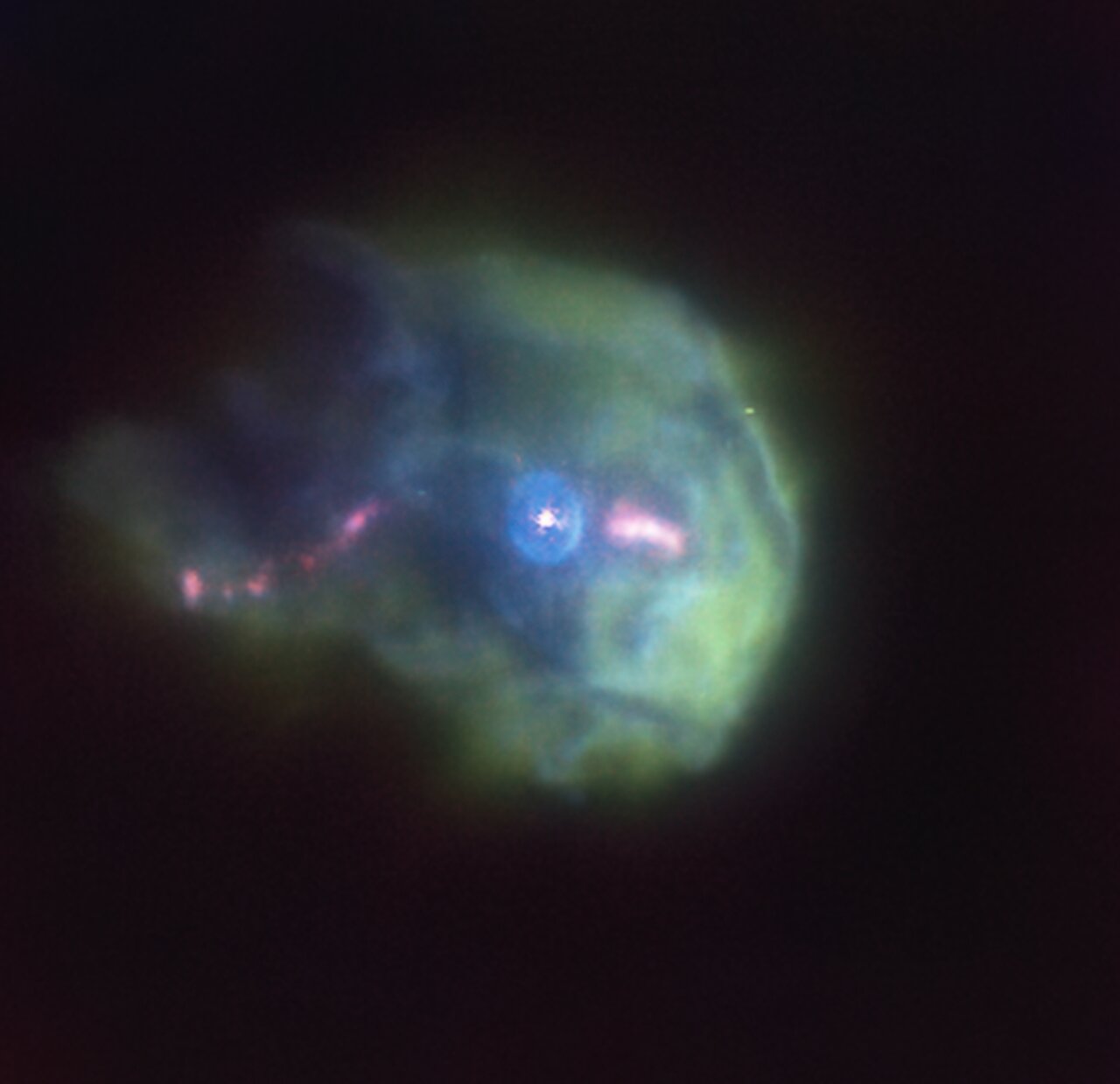
This Picture of the Week shows the young stellar object 244-440 in the Orion Nebula observed with ESO’s Very Large Telescope (VLT) –– the sharpest image ever taken of this object. That wiggly magenta structure is a jet of matter launched close to the star, but why does it have that shape?

Very young stars are often surrounded by discs of material falling towards the star. Some of this material can be expelled into powerful jets perpendicularly to the disc. The S-shaped jet of 244-440 suggests that what lurks at the center of this object isn’t one but two stars orbiting each other. This orbital motion periodically changes the orientation of the jet, similar to a water sprinkler. Another possibility is that the strong radiation from the other stars in the Orion cloud could be altering the shape of the jet.

These observations, presented in a new paper led by Andrew Kirwan at Maynooth University in Ireland, were taken with the Multi Unit Spectroscopic Explorer (MUSE) instrument at ESO’s VLT in Chile. Red, green and blue colours show the distribution of iron, nitrogen and oxygen respectively. But this is just a small fraction of all the data gathered by MUSE, which actually takes thousands of images at different colours or wavelengths simultaneously. This allows astronomers to study not only the distribution of many different chemical elements but also how they move. 

Moreover, MUSE is installed at the VLT’s Unit Telescope 4, which is equipped with an advanced adaptive optics facility that corrects atmospheric turbulence, delivering images sharper than Hubble’s. These new observations will therefore allow astronomers to study with unprecedented detail how stars are born in massive clouds like Orion.

–o–

There’s also a little video showing how the picture was made using MUSE:

Congratulations to Andrew Hirwan and supervisor Emma Whelan from the Department of Experimental Physics for this coup!

Henry Draper’s Photograph of M42

Posted in History, The Universe and Stuff with tags , , , , on July 29, 2016 by telescoper

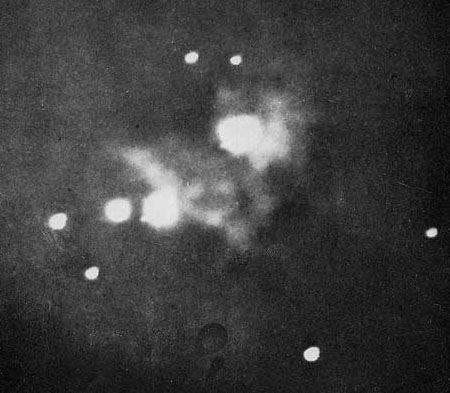
I just remembered that last night I happened across an interesting episode of The Essay on Radio 3. It was about the first ever photograph of an astronomical nebula, which happened to be of the Orion Nebula (M42). The programme features Omar Nasim, a lecturer in History at Kent University, and is available on iPlayer or as a download here. It’s only 15 minutes long, but absolutely fascinating.

Here is the photograph concerned, taken by Henry Draper in 1880:

Henry_Drape_Orion_nebula_1880_inverted

The stars of the constellation Orion are clearly over-exposed in order to reveal the much fainter light from the nebula, and the resolution is poor compared to, e.g., this glorious Hubble Space Telescope image:

Hubble's sharpest view of the Orion Nebula

The Orion Nebula seen by Hubble. Credit: ESA/NASA/Hubble Space Telscope

Nevertheless the Draper photograph is of great historical importance, as it changed the way astronomers made images of such objects (by photography rather than by drawing) and ushered in a new era of scientific research.

Hat’s off to Henry Draper!

Orion Nebula (Herschel, after Turner)

Posted in Art, The Universe and Stuff with tags , , , on September 6, 2013 by telescoper

I stumbled across this wonderful image (and associated description) yesterday and thought I’d share it. It’s a region of the Orion Nebula (which is located in the  Midlands region of Orion’s “sword”, i.e. the long thing hanging down below his belt).  It’s a turbulent region of dust and gas in which stars are forming. This image was taken in the far-infrared part of the spectrum by the Herschel Space Observatory, which is now defunct but much data remains to be analysed. Because the image was taken at wavelengths much longer than optical light, the colours are obviously “false”. I don’t work on star formation so I tend to see images like this just as beautiful things to be enjoyed for themselves rather than as a subject for scientific research. In fact, I have no difficulty at all in describing this picture as a work of art, slightly reminiscent of the cloudscapes and seascapes of  J.M.W Turner in that it is, at the same time, both a representation of a natural phenomenon and  an abstract creation that transcends it. You can click on the image to make it larger…

Orion_A

UPDATE: I see that someone else has thought of the parallel with Turner!