I had been looking forward to attending last week’s Irish National Astronomy Meeting in the fine city of Galway but unfortunately I couldn’t go because I had an appointment I couldn’t reschedule (which also kept me offline for a couple of days). This was a shame because it turns out that one of our undergraduate SPUR students at Maynooth, Jake Feeney, together with two colleagues, John Regan and Paddy Kavanagh, won the prize for the best poster at INAM.
There’s a new paper in Science featuring observations using the MIRI and NIRSpec instruments on JWST of Supernova SN1987A in the Large Magellanic Cloud. I couldn’t resist doing a short post about this result, partly because the paper features Maynooth colleague Paddy Kavanagh, and partly because I’m old enough to remember when this supernova was detected, in 1987. In fact I was doing my PhD at the time. When I started lecturing a few years later I used to use it as an example of a Type II (core-collapse) supernova. At first I would say “you will remember SN1987A” then, as the years passed, I realized that students would have been quite young in 1987 so I changed this to “some of you will remember SN1987A”. Still later, I realized that none of my students had even been born in 1987 so I forgot about the remembering bit and just talked about SN1987A. As of 2024, nobody under the age of 37 was born in 1987. Tempus has a distinct tendency to Fugit.
In 1987 I was in Sussex and I remember Roger Tayler getting very excited about the detection of anti-neutrinos from SN1987A at the Kamioka Observatory in Japan. There weren’t many – 12 altogether – but he wanted to do a statistical analysis of the arrival times to see if there was any evidence that might indicate the neutrinos had mass. Being rather “old-school”, he did a Monte Carlo experiment involving drawing numbers written on bits of paper out of a cardboard box. After a brief chat I suggested I could do a much better job using a random-number generator on a computer so I wrote a bit of code and did the computation. The results showed no evidence for neutrino mass.
Anyway, this type of supernova should produce a neutron star or black hole sitting inside a ring-shaped remnant. The ring has been well studied, but in 37 years of observation the central object has not been detected. The results in the latest paper (by Fransson et al.) involve a spectroscopic study of the emission lines of ionized argon from the SN1987a remnant at sufficiently high spectral resolution to map the velocity structure. The results suggest that ionizing radiation from a neutron star is illuminating gas from the inner parts of the remnant.
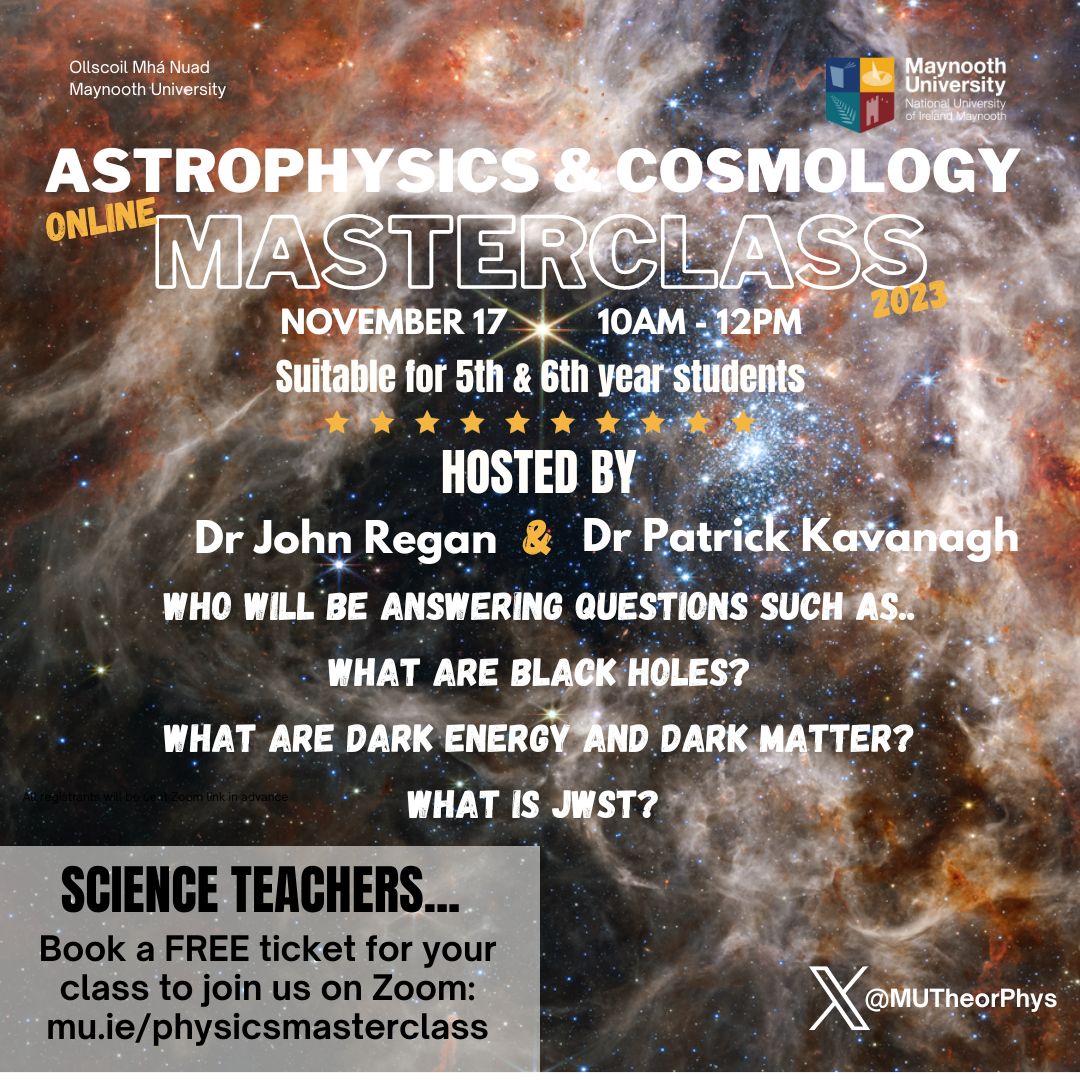
Both my regular readers may remember that for the last couple of years at this time of year there has been an Astrophysics & Cosmology Masterclass at Maynooth; see here and here for the previous incarnations. Not being in Maynooth I almost forgot about this year’s Masterclass, which has a different line-up with Dr Paddy Kavanagh adding some observational content alongside Dr John Regan.
This event is online only from 10am to 12pm on Friday 17th November 2023 and you can find out more details and register here.
The views presented here are personal and not necessarily those of my employer (or anyone else for that matter).
Feel free to comment on any of the posts on this blog but comments may be moderated; anonymous comments and any considered by me to be vexatious and/or abusive and/or defamatory will not be accepted. I do not necessarily endorse, support, sanction, encourage, verify or agree with the opinions or statements of any information or other content in the comments on this site and do not in any way guarantee their accuracy or reliability.



 In the Dark