Archive for Particle Physics

Probing the Higgs-like Particle

Posted in The Universe and Stuff with tags , , on November 21, 2012 by telescoper

After my little dabble in particle physics yesterdays I thought I’d reblog this from a proper particle physicist – it’s a long and rather technical post about the Higgs-like Boson recently discovered at the LHC. Enjoy.

Michael Schmitt's avatarCollider Blog

We are in the process of ascertaining the properties of the Higgs-like particle discovered by CMS and ATLAS last July 4th. It must be a boson because it decays to pairs of bosons. Since it decays to a pair of massless photons, it cannot be spin-1. The relative rates of decays to WW and ZZ on the one hand, and γγ on the other, are close to what is expected for spin-0 boson and not what is expected for a spin-2 graviton. John Ellis, Veronica Sanz and Tevong You wrote a nice paper about this earlier this week (arXiv:1211.3068, 13-Nov).

So let’s assume that the new particle X(126) is a Higgs boson (and I will use the symbol “H” for it). If it is the standard model Higgs boson, then its CP eigenvalue must be +1. If it is a member of a two-Higgs-doublet model, then its CP…

View original post 1,086 more words

Particle physics volunteers to be fleeced….

Posted in Open Access with tags , , , , on September 26, 2012 by telescoper

I heard the news yesterday that a body called the Sponsoring Consortium for Open Access Publishing in Particle Physics (SCOAP3) has arranged a deal whereby virtually all articles in particle physics will be available for free on journal websites. The deal will mean that authors will not have to pay thousands of dollars up-front in “article processing charges” in order to have their work available via Open Access media.

So far so good, you’re probably thinking. But read a little bit more about it and it becomes absolutely clear that SCOAP3 has walked straight into a trap laid by the academic publishers with whom it brokered the agreement. The principal deterrent to authors publishing via the “Gold” Open Access model has been that they would have to pay up-front fees, potentially around $2000 for each paper. Any sensible researcher would rather spend $2000 supporting their research than lining the profits of greedy publishers, so would probably opt for a “green” mode instead. Indeed many particle physicists already do this, putting their work on the arxiv where it is available for free anyway.

The publishing industry realises that most authors would simply bypass it and go for self-publication if they could, so it is naturally very keen on deals like this. What actually happens in the SCOAP3 agreement is that an author’s institution pays fees directly to the publisher. According to Nature News:

The consortium will pay the contracts from an annual budget of €10 million, which is funded not by authors or research grants, but by pledges from more than a thousand libraries, funding agencies and research consortia across the world. In effect, existing journal subscription fees are being repurposed to provide the open-access funds.

And there’s the rub. “Existing journal subscription fees” are already extortionately high, and out of all proportion to the actual cost of disseminating scientific knowledge. Authors may think that they’re not paying for Open Access under the new agreement, but in fact they are. It’s just a bit less direct. Their grants will continue to be top-sliced to pay for the SCOAP3 arrangement and, since science budgets are unlikely to rise for the foreseeable future, that means the cash available for actually doing research will fall. This agreement is very good for the publishers, but very bad for science.

The average cost for Open Access publication in Physics Review D. under the new scheme will be $1900 per paper. Ouch! And how does the publisher justify this cost? “To maintain revenue levels…”. I rest my case.

More of the  is going to happen in the UK, where £10M is being set aside from existing Research Council budgets, nominally to “pay for the transition to Open Access” but actually in order to maintain profit levels at the big academic publishing houses. Much of that £10M will no doubt disappear in deals like the one brokered by SCOAP3.  And that means continuing high profits for the publishers at the expense of falling levels of research funding. The whole thing stinks.

And if as an author you decide that you have a moral objection to being scammed in this way, under the SCOAP3 agreement you now have no way out. Even if you bypass the arrangement and just publish on the arXiv, the publishers will get their money directly anyway. You have to admit it’s a clever sting, but I’m still surprised the particle physics community has fallen for it.

This development convinced me even more that the research community has to take matters into its own hands, and organize its own publication strategy. Traditional journals are already virtually redundant and I confidently predict they will die a natural death in just a few years, but while they linger on their publishers will continue to fleece the academic community as long as they can. The sooner we put a stop to it the better.

Short but sweet – Higgs (1964)

Posted in The Universe and Stuff with tags , , , , on August 31, 2012 by telescoper

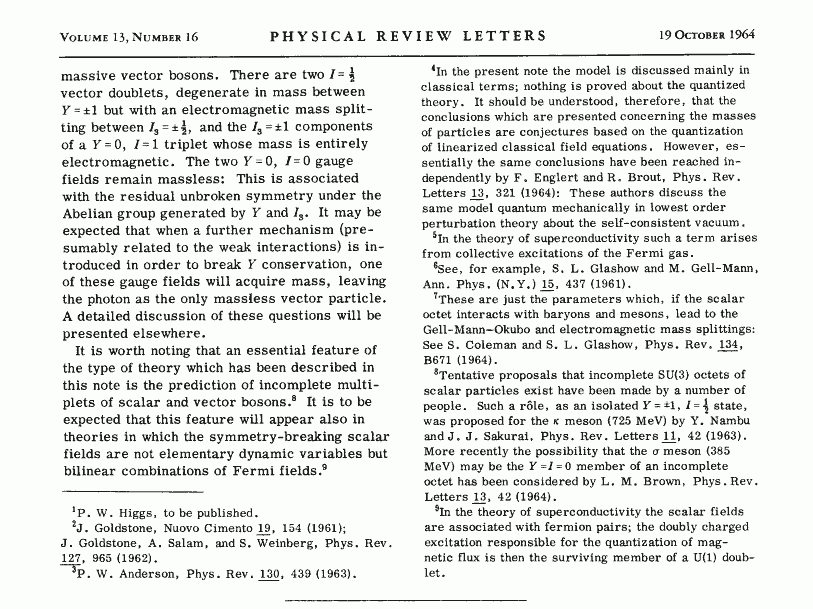
In the light of all this Malarkey about the (claimed) discovery of the Higgs Boson at the Large Hadron Collider, I thought you might be interested to see the original paper by Higgs (1964) in its entirety. As you can see, it’s surprisingly small. The paper, I mean, not the boson…

p.s. The paper is freely available to download from the American Physical Society website; no breach of copyright is intended.

p.p.s. The manuscript was received by Physical Review Letters on 31st August 1964, i.e. 48 years ago today.

The Low-down on the LHC Boson

Posted in Open Access, The Universe and Stuff with tags , , , , , , on August 2, 2012 by telescoper

Although it’s a little late I thought I’d just put up a brief post to draw your attention to the news that a couple of technical papers have appeared on the arXiv giving updated details of the recent discovery at the Large Hadron of a new scalar particle that could be the Higgs boson. I don’t think it’s yet absolutely proven that this is what the new particle is, which is why I’ve called it the “LHC boson” in the title.

The ATLAS paper reports the detection of a Higgs-like particle with a 5.9 sigma confidence level, up from the 5.0 sigma reported on July 4. Here’s the abstract:

A search for the Standard Model Higgs boson in proton-proton collisions with the ATLAS detector at the LHC is presented. The datasets used correspond to integrated luminosities of approximately 4.8 fb^-1 collected at sqrt(s) = 7 TeV in 2011 and 5.8 fb^-1 at sqrt(s) = 8 TeV in 2012. Individual searches in the channels H->ZZ^(*)->llll, H->gamma gamma and H->WW->e nu mu nu in the 8 TeV data are combined with previously published results of searches for H->ZZ^(*), WW^(*), bbbar and tau^+tau^- in the 7 TeV data and results from improved analyses of the H->ZZ^(*)->llll and H->gamma gamma channels in the 7 TeV data. Clear evidence for the production of a neutral boson with a measured mass of 126.0 +/- 0.4(stat) +/- 0.4(sys) GeV is presented. This observation, which has a significance of 5.9 standard deviations, corresponding to a background fluctuation probability of 1.7×10^-9, is compatible with the production and decay of the Standard Model Higgs boson.

The paper from CMS reinforces the discovery of a Higgs-like particle with a mass of 125 GeV at a 5-sigma level of confidence:

Results are presented from searches for the standard model Higgs boson in proton-proton collisions at sqrt(s)=7 and 8 TeV in the CMS experiment at the LHC, using data samples corresponding to integrated luminosities of up to 5.1 inverse femtobarns at 7 TeV and 5.3 inverse femtobarns at 8 TeV. The search is performed in five decay modes: gamma gamma, ZZ, WW, tau tau, and b b-bar. An excess of events is observed above the expected background, a local significance of 5.0 standard deviations, at a mass near 125 GeV, signalling the production of a new particle. The expected significance for a standard model Higgs boson of that mass is 5.8 standard deviations. The excess is most significant in the two decay modes with the best mass resolution, gamma gamma and ZZ; a fit to these signals gives a mass of 125.3 +/- 0.4 (stat.) +/- 0.5 (syst.) GeV. The decay to two photons indicates that the new particle is a boson with spin different from one.

I’ll refrain from commenting on the use of frequentist language in both these papers, but instead just comment that these extremely important papers are available for free on the arXiv. Open access, we call it.

PS. There’s an interesting blog post related to these papers, about citations in particle physics here.

Student Comments

Posted in Biographical, Education, The Universe and Stuff with tags , , , , , on July 14, 2012 by telescoper

I sneaked into the department this morning to pick up some things from the office and leave some other things that I’ve finished with. I went quite early, to avoid the Saturday crowds there and back.

One of the things I found in my pigeonhole was a packet of student questionnaires about the third-year module Nuclear and Particle Physics for which I was responsible. It seems like a decade since I finished teaching it and marked the exams, but it can only be a couple of months. I was dreading reading the responses this time because I know I struggled a bit with this module, partly because it’s the first time I taught the Nuclear Physics part and partly for other reasons I won’t go into.

In fact the students were very kind and gave me quite good reviews; the only score that let me down really was that they thought the material was rather difficult. I’m not really surprised by that, because I think it is. However, as I’ve said before, I don’t think it’s a physics lecturer’s job to pretend that the subject  is easy; it is  a lecturer’s job to try to convince students that they can do things that are difficult. I don’t mean making  things difficult just for the sake of it, but trying to get the message across that a brain is made for thinking with and figuring difficult things out can be intensely rewarding.

The main criticism that students wrote in the space provided for their own comments was that they didn’t like the fact that I used powerpoint for some lectures. Actually, I don’t like using powerpoint for lectures either, but unfortunately I had no choice on some occasions. First I had a rather large class (85 students) and one of the rooms I had to use had a very small whiteboard; I was worried about its visibility from the back and the need to keep cleaning it every five minutes. Also in that room the projector screen covers the same area as the whiteboard, so it’s a pain to keep changing between powerpoint and whiteboard. Anyway, it’s a fair criticism. I’ll try to work out a better way of doing it next year.

To be perfectly honest I don’t like whiteboards much either. Call me old-fashioned, but  chalkboards are much better. Received wisdom, however, is that we have to have whiteboards, with all the ludicrous cost and environmental unfriendliness of the accompanying dry-wipe marker pens. But I digress.

Anyway, next Wednesday afternoon will see our graduation ceremony. Graduation day always reminds me of something somebody told me years ago when I attended my first one, at Queen Mary (and Westfield College, as it was then).  The essence of the comment was that what you have to remember as a lecturer is that when the students do well it’s their achievement; but when they don’t it’s your fault. Life’s like that, it’s never as symmetrical as particle physics.

Many of the students who took  Nuclear and Particle Physics will be graduating on Wednesday. I’m distraught that I won’t be able to go myself; this will be the first ceremony I’ve missed since I moved here five years ago.  If any of the graduating Physics class from Cardiff University happens to read this, I really hope you have a great day on Wednesday. I wish I could be there to shake your hand and wish you a very fond goodbye, but sadly that’s just not possible on this occasion.

The Higgs? A Definite Maybe..

Posted in The Universe and Stuff with tags , , , , , , on July 4, 2012 by telescoper

This is really something for expert particle physicists to blog about, but I couldn’t resist saying something about this morning’s dramatic physics news.

Well, after yesterday’s preview here is the actual press release from CERN:

Geneva, 4 July 2012. At a seminar held at CERN1 today as a curtain raiser to the year’s major particle physics conference, ICHEP2012 in Melbourne, the ATLAS and CMS experiments presented their latest preliminary results in the search for the long sought Higgs particle. Both experiments observe a new particle in the mass region around 125-126 GeV.

“We observe in our data clear signs of a new particle, at the level of 5 sigma, in the mass region around 126 GeV. The outstanding performance of the LHC and ATLAS and the huge efforts of many people have brought us to this exciting stage,” said ATLAS experiment spokesperson Fabiola Gianotti, “but a little more time is needed to prepare these results for publication.”

“The results are preliminary but the 5 sigma signal at around 125 GeV we’re seeing is dramatic. This is indeed a new particle. We know it must be a boson and it’s the heaviest boson ever found,” said CMS experiment spokesperson Joe Incandela. “The implications are very significant and it is precisely for this reason that we must be extremely diligent in all of our studies and cross-checks.”

“It’s hard not to get excited by these results,” said CERN Research Director Sergio Bertolucci. “ We stated last year that in 2012 we would either find a new Higgs-like particle or exclude the existence of the Standard Model Higgs. With all the necessary caution, it looks to me that we are at a branching point: the observation of this new particle indicates the path for the future towards a more detailed understanding of what we’re seeing in the data.”

The results presented today are labelled preliminary. They are based on data collected in 2011 and 2012, with the 2012 data still under analysis.  Publication of the analyses shown today is expected around the end of July. A more complete picture of today’s observations will emerge later this year after the LHC provides the experiments with more data.

The next step will be to determine the precise nature of the particle and its significance for our understanding of the universe. Are its properties as expected for the long-sought Higgs boson, the final missing ingredient in the Standard Model of particle physics? Or is it something more exotic? The Standard Model describes the fundamental particles from which we, and every visible thing in the universe, are made, and the forces acting between them. All the matter that we can see, however, appears to be no more than about 4% of the total. A more exotic version of the Higgs particle could be a bridge to understanding the 96% of the universe that remains obscure.

“We have reached a milestone in our understanding of nature,” said CERN Director General Rolf Heuer. “The discovery of a particle consistent with the Higgs boson opens the way to more detailed studies, requiring larger statistics, which will pin down the new particle’s properties, and is likely to shed light on other mysteries of our universe.”

Positive identification of the new particle’s characteristics will take considerable time and data. But whatever form the Higgs particle takes, our knowledge of the fundamental structure of matter is about to take a major step forward.

There’s a hive of internet activity related to this announcement, and I can’t possibly link to all the excellent expert commentary going on, but for details you can do no better that Sean Carroll’s live blog from Geneva or the Guardian’s live blog.

In a nutshell, there’s definitely something in both CMS and Atlas data which, if it really is a new particle,  is definitely a boson and which weighs in around 125 GeV. The two-photon decays are consistent with what a standard model Higgs boson would be expected to produce, for example. The consistency between the two experiments is very compelling.

The overall level of significance is around 5σ. I’ll refrain from making churlish comments about the frequentist language and just say that the LHC certainly seems to have detected something that could definitely be the Higgs. This is genuinely exciting because it has come more quickly than most people expected. That’s a tribute to the LHC teams, I’d say.

However, it isn’t yet proven that the Higgs what this particle is. If it’s a new particle that’s not the Higgs that could be even more interesting. To establish the identity of the particle that has been discovered will require a lot more work,  looking at much more detailed aspects of its behaviour as revealed by collision data. But it’s certainly possible that it is the Higgs, and I venture to suggest that’s what most particle physicists think it is.

So a discovery. A palpable discovery. Now comes the exploration…

Higgs Preview

Posted in Science Politics, The Universe and Stuff with tags , , , , , , on July 3, 2012 by telescoper

I’m a bit slow to post anything about the ongoing bout of Higgs-steria that’s been engulfing the interwebs in recent days. Even Andy Lawrence got there ahead of me.  What’s caused all the commotion is an announcement about an announcement from CERN at a special seminar tomorrow (Wednesday 4th July) at 9am CEST, which is 8am British “Summer” Time.  Here’s a bit of the press release:

CERN will hold a scientific seminar at 9:00 CEST on 4 July to deliver the latest update in the search for the Higgs boson. At this seminar, coming on the eve of this year’s major particle physics conference, ICHEP, in Melbourne, the ATLAS and CMS experiments will deliver the preliminary results of their 2012 data analysis.

“Data taking for ICHEP concluded on Monday 18 June after a very successful first period of LHC running in 2012,” said CERN’s Director for Accelerators and Technology, Steve Myers. “I’m very much looking forward to seeing what the data reveals.”

The 2012 LHC run schedule was designed to deliver the maximum possible quantity of data to the experiments before the ICHEP conference, and with more data delivered between April and June 2012 than in the whole 2011 run, the strategy has been a success. Furthermore, the experiments have been refining their analysis techniques to improve their efficiency in picking out Higgs-like events from the millions of collisions occurring every second. This means that their sensitivity to new phenomena has significantly increased for both years’ data sets.  The crunching of all this data has been done by the Worldwide LHC Computing Grid, which has exceeded its design specifications to handle the unprecedented volume of data and computing.

“We now have more than double the data we had last year,” said CERN Director for Research and Computing, Sergio Bertolucci, “that should be enough to see whether the trends we were seeing in the 2011 data are still there, or whether they’ve gone away. It’s a very exciting time.”

I won’t try to repeat what’s been said better and more authoritatively elsewhere; a nice collection of video material at the STFC website and a piece by Sean Carroll (also here) are worth mentioning if you’re not up on why the Higgs Boson is so important.

I wrote  a rather facetious post about the last episode of Higgs-mania way back in December because I found the actual announcement to be a bit of a damp squib and the associated hype rather irritating. This time there are even more rumours flying around – not to everyone’s approval – but it’s obviously best to wait and see what is actually announced rather than comment on them.

The main question in my mind is whether it’s sufficiently interesting to get up in time to watch the seminar 8am tomorrow morning…

Brian Cox is 44.

The Higgs Buzz

Posted in The Universe and Stuff with tags , , , , on June 19, 2012 by telescoper

Reaction to rumours about the Higgs, and a not-entirely good-tempered comment thread about the ethics of blogging. All in a day’s work for a particle physicist, I guess! Read the inside story on this post…

..and if you read this article you’ll see where the rumour originated.

Matt Strassler's avatarOf Particular Significance

The rumors about the Higgs particle at the Large Hadron Collider [LHC] have begun again, and since that’s all anyone is going to want to talk about until we actually get the news for real, at the ICHEP conference in Melbourne in a couple of weeks, we may as well get started.

[This is especially true since we learned last year that some well-known non-particle-physicist bloggers have information pipelines directly into the experiments.  It is perhaps inevitable that there are scientists who see it in their best interest to subvert the scientific process.]

The current hot rumor is that the LHC experiments ATLAS and CMS have seen, in the new 2012 data, very roughly what they saw last December in the 2011 data, at least as far as the signal from a Higgs decaying to two photons (particles of light) in the mass range of 125 GeV/c2

View original post 1,101 more words

Bayes’ Theorem and the Search for Supersymmetry

Posted in The Universe and Stuff with tags , , , , on May 13, 2012 by telescoper

Interesting comments about Bayes’ theorem and the prospects for detecting supersymmetry at the Large Hadron Collider. This piece explains how a non-detection isn’t always “absence of evidence” but can indeed by “evidence of absence”. It’s also worth reading the comments if you’re wondering whether what people say about Lubos Motl is actually true…

Phi G's avatarviXra log

Here’s a puzzle. There are three cups upside down on a table. You friend tells you that a pea is hidden under one of them. Based on past experience you estimate that there is a 90% probability that this is true. You turn over two cups and don’t find the pea. What is the probability now that there is a pea underneath? You may want to think about this before reading on.

Naively you might think that two-thirds of the parameter space has been eliminated, so the probability has gone from 90% to 30%, but this is quite wrong. You can use Bayes Theorem to get the correct answer but let me give you a more intuitive frequentist answer. The situation can be models by imagining that there are thirty initial possibilities with equal probability. Nine of them have a pea under the first cup, nine more under the second and nine more under the third…

View original post 880 more words

A New Baryon on the Block

Posted in The Universe and Stuff with tags , , , , , on April 29, 2012 by telescoper

I just chanced upon the news that a new particle has been discovered at the Large Hadron Collider. This is probably old hat for people who work at CERN, but for those of us following along in their wake it definitely belongs to the category of things marked Quite Interesting.

The new particle is a baryon, which means that it consists of three quarks. These quarks are held together by the colour force (which I refuse to spell the American way); baryonic states exist by virtue of the colours of constituent quarks being a red-green-blue mixture that is colourless.

Quarks are fermions with spin 1/2. The new particle has spin 3/2 which contrasts with the most familiar baryons, the proton and the neutron, which also consist of three quarks but which have spin 1/2. The difference can be understood from basic quantum mechanics: spins have to be added like vectors, so the three individual quark spins can be added to produce total spin 3/2 or 1/2.

The most familiar spin 3/2 baryons are made from the lightest quarks (the up, down and strange) as shown in the diagram below:

The top row contains no strange quarks, only up and down. In fact the Δ0 and Δ+ contain exactly the same quark compositions as the proton and the neutron (udd and uud respectively), but differ in spin. The next row down contains one strange quark (e.g. uds) , the one below two (e.g uss), and the particle at the bottom is a very famous one called the Ω which is entirely strange (sss). For reasons I’ve never really understood, a strange quark carries a strangeness quantum number S=-1 (why not +1?) and the electrical charge is labelled by q in the diagram.

There are six quark flavours altogether so one can construct further baryonic states by substituting various combinations of heavier quarks (c,b and t) in the basic configurations shown above. There are also excited states with greater orbital energy; all the particles shown above have quarks in the lowest state of orbital angular momentum (L=O). There is then a potential plethora of baryonic particles,  but because all are unstable you need higher and higher energies to bring them into existence. Bring on the LHC.

The new particle is called the Ξb*, and it consists of a combination of up, strange and bottom quarks that required collision energies of 7 TeV to make it. The nomenclature reflects the fact that this chap looks a bit like the particles in the third row of the figure, but with one strange quark replaced by a much more massive bottom quark; this one has zero electrical charge because the charges on the u, s and b are +2/3, -1/3 and -1/3 respectively.

Anyway, here’s the graph that represents the detection of the new baryon on the block:

Only 21 events, mind you, but still pretty convincing. For technical details, see the arXiv preprint here.

Whether you really think of this as a new particle depends on how fundamental you think a particle should be. All six quark species have been experimentally detected and in a sense those are the real particles. Things like the Ξb* are merely combinations of these states. You probably wouldn’t say that an excited state of the hydrogen atom (say with the electron in the 2s energy level) is actually a different particle from the ground state so why do different permutations of the same quarks warrant distinct names?

The answer to this I guess is the fact that the mass of an excited hydrogen atom differs from the ground state by only a tiny amount; electronic energy levels correspond to electron-volt scales compared to the 1000 MeV or so that is the rest-mass energy of the nucleus. It’s all very different when you’re talking about energy levels of quarks in baryonic particles. In such situations the binding energies of the quarks are comparable to, or even larger than, their rest masses because the colour force is very strong and the quarks are whirling around inside baryons  with correspondingly enormous energies. When two creatures have enormously different masses, it’s difficult to force yourself to think of them as different manifestations of the same beast!

Anyway, the naming of this particle isn’t really the important thing. A rose by any other name would smell as sweet. What matters is that existence of this new quark state provides another example of a test of our understanding of quark-quark interactions based on the theory of quantum chromodynamics. You might say that it passed with flying colours…