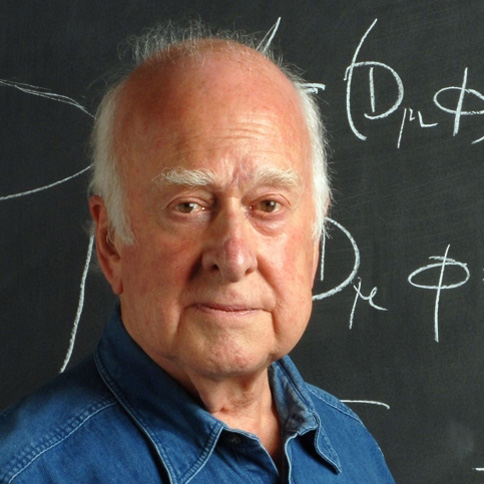
I was very sad this afternoon to hear of the death of theoretical physicist Peter Higgs, on Monday 8th April 2024, at the age of 94. I never met Peter Higgs but I know how greatly liked and respected he was (see, e.g. here) and that he leaves an important legacy as a physicist, particularly the work that led to the award of the 2013 Nobel Prize for Physics (jointly with François Englert) . Condolences to his family, friends and colleagues.
You can read the very nice Guardian obituary here; there are many others published in media from elsewhere in the world (including Ireland and Barcelona).
I’ll add two extremely slight connections. One is that Peter Higgs visited Maynooth University in 2012, not long before his Nobel Prize was announced. The other is that he was born in the Elswick area of Newcastle upon Tyne, not far from Benwell, where I grew up.
Well, there we are. After an excruciating (and unexplained) delay the 2013 Nobel Prize for Physics has gone to François Englert and Peter Higgs. You can find the full press release here; the first section of text reads:
François Englert and Peter W. Higgs are jointly awarded the Nobel Prize in Physics 2013 for the theory of how particles acquire mass. In 1964, they proposed the theory independently of each other (Englert together with his now deceased colleague Robert Brout). In 2012, their ideas were confirmed by the discovery of a so called Higgs particle at the CERN laboratory outside Geneva in Switzerland. The awarded theory is a central part of the Standard Model of particle hysics that describes how the world is constructed. According to the Standard Model, everything, from flowers and people to stars and planets, consists of just a few building blocks: matter particles. These particles are governed by forces mediated by force particles that make sure everything works as it should. The entire Standard Model also rests on the existence of a special kind of particle: the Higgs particle. This particle originates from an invisible field that fills up all space. Even when the universe seems empty this field is there. Without it, we would not exist, because it is from contact with the field that particles acquire mass. The theory proposed by Englert and Higgs describes this process.
Anyway, congratulations to the two Laureates. I did get a bit excited when the rumour started that the winner this year would be someone born in Newcastle upon Tyne whose first name is Peter, but I guess I’ll have to wait until next year..
Oh, and François Englert is the first ever Belgian winner of the Nobel Prize for Physics!
I have to head off to London for a Parliamentary Reception organized by the Science & Technology Facilities Council, so I’ll have to leave it there but please feel free to add reactions to the announcement via the Comments Box.
I’m back in circulation just in time for tomorrow’s announcement of the 2013 Nobel Prize for Physics. The smart money is going on an award for the discovery of the Higgs Boson, but to whom should it be awarded. Today’s Grauniad summarizes the difficulties thus:
The committee can contrive the wording of the prize to narrow the number downwards and this is likely to happen. The prize could go to François Englert, who published the idea first, and Peter Higgs, who was second, but crucially was first to flag up the new particle. But that would rebuff the trio of Gerald Guralnik, Carl Richard Hagen and Tom Kibble, who developed the theory separately and published just a month after Higgs. The possibility has already caused acrimony among the scientists. Guralnik and Hagen, two US researchers, believe European physicists have conspired to erase their contribution from history.
This doesn’t seem to me to be entirely accurate, though. As far as I understand it, Higgs was the only one of the names above to mention a massive scalar particle, There is, I believe, therefore a strong case that the Nobel Prize should be awarded to Peter Higgs outright. Or if not to him, to some other person called Peter who was born in the North East…
However, I am used to being in a minority of one so there will undoubtedly be many others who feel differently. Time for a poll! This one is different from my usual ones, in that you are allowed to vote more than once. Please use up to three votes: if you think Peter Higgs should win it outright vote three times for him. If you think it should be a three way split then vote for three different people, etc.
I should say that I don’t think the Nobel Committee for Physics is allowed to make an award to an institution such as CERN, but I’ve left that option in to see whether folks think that tradition should change..
The announcement this morning of the 2012 Nobel Prize for Medicine or Physiology reminded me that tomorrow will see the announcement of the 2012 Nobel Prize for Physics. This is due to happen tomorrow morning at 11.45 CET (which I think is 10.45 BST) or thereabouts. It would be unseemly to speculate on the outcome, of course, so that’s what I’ll do.
Although the discovery of a scalar particle at the Large Hadron Collider that may well be the Higgs boson happened only recently, and is yet to be definitively proven to be the Higgs, the smart money has to be on an award relating to that, presumably to Peter Higgs. However, given that the award can go to up to three individuals, who else might earn a share? Gerald Guralnik, Tom Kibble and Carl Richard Hagen came up with the same idea about the same time as Higgs, but all four of them can’t win according to the rules. Answers to that little conundrum on a postcard…
But of course the Prize might go to something else altogether. An interesting bet would be Alain Aspect for his important work on experimental studies of quantum entanglement. Also with an outside chance is Sir Michael Berry for his brilliant work on the Geometric Phase.
That’s by no means an exhaustive list of runners and riders, but I have to get back to business now. I’d be interested to have further nominations via the comments box and will of course be getting an early night ahead of the expected phone call from Stockholm tomorrow morning…
As the media frenzy abates after the latest experimental results from the Large Hadron Collider show tantalising but inconclusive evidence for the existence of the Higgs boson, it’s perhaps now time to focus on the hard facts surrounding this elusive particle. At yesterday’s Christmas lunch I stumbled upon one piece of information of which I was previously unaware and which is clearly of national importance. The eponymous creator of the Higgs particle, Professor Peter Higgs, was in fact born in the fine city of Newcastle upon Tyne, which really is in The North. This fact identifies him as a Geordie, although having just heard him on the radio I think there’s not much sign of it in his accent.
Anyway, in honour of this important discovery I respectfully submit that The Large Hadron Collider should be given a more appropriate name, i.e. The Geet Big Hadron Basher. And I’m sure God won’t mind if the Higg’s boson is henceforth known as the Geordie Particle.
The views presented here are personal and not necessarily those of my employer (or anyone else for that matter).
Feel free to comment on any of the posts on this blog but comments may be moderated; anonymous comments and any considered by me to be vexatious and/or abusive and/or defamatory will not be accepted. I do not necessarily endorse, support, sanction, encourage, verify or agree with the opinions or statements of any information or other content in the comments on this site and do not in any way guarantee their accuracy or reliability.
 As the
 In the Dark