Archive for PhD

Viva Chair

Posted in Biographical, Maynooth with tags , , , , on December 5, 2025 by telescoper

Yesterday afternoon I acted as Chair of the viva voce examination for a PhD degree in the Department of Mathematics & Statistics at Maynooth University. I have done this once before at Maynooth, in the Department of Biology, but had to look back through my archive of blog posts to find out when that was: it was in June 2023.

For those of you not familiar with how this works, a PhD involves doing research into a particular topic and then writing up what you’ve done in a thesis. The thesis is a substantial piece of work, often in the region of 100,000 words (200 pages or so), which is then assessed by two examiners (one internal to the university at which the research was done, and one external). They read copies of the thesis and write preliminary reports on it. Then the candidate has to defend it in an oral examination, which was what happened yesterday, after which they make a recommendation to the university about whether the degree should be awarded.

There aren’t many rules for how a viva voce examination should be conducted or how long it should last, but the can be as short as, say, 90 minutes and can be as long as 5 hours or more. The examiners usually ask a mixture of questions, some about the details of the work presented and some about the general background. Sometimes, especially in Mathematics, the candidate might be asked to use the chalkboard to explain something, as was the case yesterday.

The unpredictable content of a viva voce examination makes it very difficult to prepare for, and it can be difficult and stressful for the candidate (as well as just tiring, as it can drag on for a long time). However, call me old-fashioned but I think if you’re going to get to call youself Doctor of Philosophy you should expect to have to work for it. 

I found it interesting when I first arrived here that viva voce examinations at Maynooth follow a similar practice to those at my previous institution, Cardiff University my previous institution, in that each viva has a Chair as well as the usual internal and external examiners. The Chair is really only present to ensure fair play, that proper procedure is followed, and that all the paperwork is done in timely fashion. The Chair is rarely (if ever) called upon to intervene in the viva itself, though I have on some previous occasions done so, mainly to ask if the candidate and/or examiners would like to take a comfort break. Other than that it’s just a matter of sitting quietly and getting on with something else while the viva proceeds.

I have done quite a lot of examinations as internal or external examiner over the years and most institutions don’t have a Chair – only the two examiners and the candidate are present. Cardiff University is an exception: I chaired a quite a few vivas when I was there. The difference there was that the Chair was from the same School (Physics & Astronomy) as the candidate, whereas in Maynooth the Chair must be from a different Department (which is why I was asked to Chair examinations in Biology and, more recently, Mathematics).

I think having an independent Chair is a good idea, but I do understand that it involves finding a person willing to do it which, it seems, sometimes slows down the organization of a viva, as the process does not start until a Chair is appointed.

Anyway, in this case it all went well. The candidate passed, the forms were filled in and sent to the relevant people. Now there are just minor corrections to be done, everything approved at the relevant Faculty meeting, and then the PhD degree can be conferred.
Moving On

Posted in Education, Maynooth with tags , , , , , , , on August 22, 2025 by telescoper

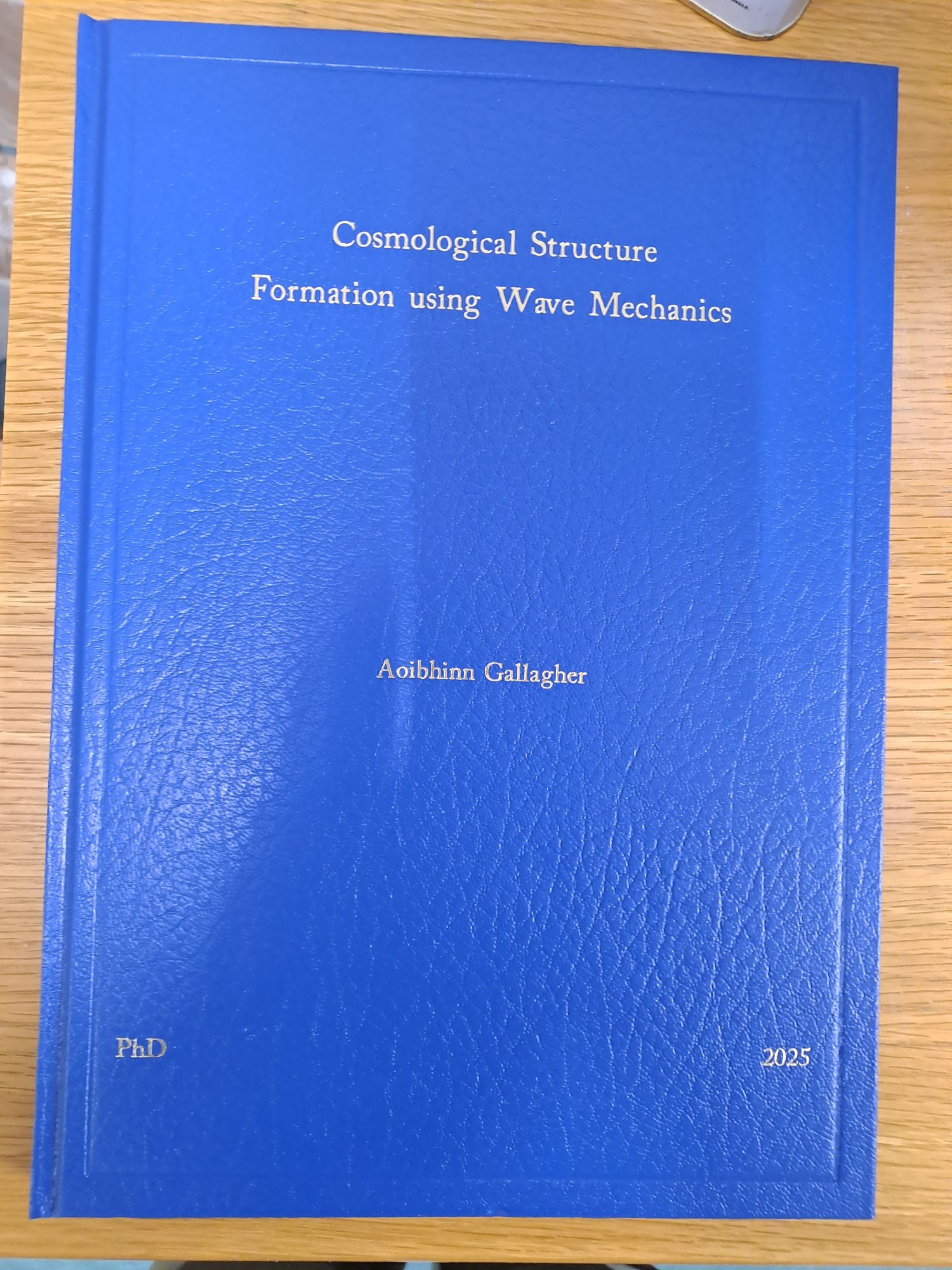
Last week I wrote a post about the loose ends of the academic year, one of which concerned my PhD student Aoibhinn, who passed her viva voce examination way back in May, who had to submit a bound copy of the thesis to the relevant office by September 6th so that her degree could be ratified by Faculty and Academic Council. She has now done that, and in the process kindly made me an extra copy of the Authorized Version to put on my shelf:

It will be easy to find on my shelf because it’s a different colour from the others. Aoibhinn will be off to Germany for a postdoctoral fellowship after her conferring ceremony in October.

In subsequent post I mentioned a plethora of meetings to take place this week, all of which went off without much incident. The various Departmental Examination Boards did their business and students will receive their results on September 5th. Students involved in these will be moving on in various ways: some will be graduating, some progressing to the next year of their course and others – though not very many at all – will be leaving without qualifying.

Meanwhile, elsewhere in Ireland, students in the Class of 25 have today been receiving their school Leaving Certificate results. As expected, the proportion at the highest grade (H1) is down significantly compared 2024. On the other hand, the total number of students taking  Leaving Certificate examinations is significantly higher  than last year. You can find all the national statistics here.

How these nationwide effects  will work their way through to undergraduate admissions at Maynooth remains to be seen. Applicants will get offers through the CAO system next week; the points required by each higher education institution should be available online on Wednesday 27th. The Irish Times traditionally publishes a pull-out supplement showing all the offers for all courses at all universities across the sector the following day, i.e. on Thursday 28th September.

By the end of next week, therefore, we’ll have some sort of an idea how many students we will have entering the University in September 2025 and can begin moving on to the next academic year. One thing I’ve already got sorted out – way ahead of previous years – is my teaching timetable for Semester 1. Usually I’ve been happy if I had this before the first week of term! My new timetable makes Tuesdays and Thursdays my heaviest teaching days, but gives me Wednesday free for research and other things that I’ve started planning already.

Recommendation Letters in Astronomy

Posted in Uncategorized with tags , , , , , , on December 16, 2024 by telescoper

There’s an interesting paper on arXiv with the title On the Use of Letters of Recommendation in Astronomy and Astrophysics Graduate Admissions and the abstract

Letters of recommendation are a common tool used in graduate admissions. Most admissions systems require three letters for each applicant, burdening both letter writers and admissions committees with a heavy work load that may not be time well-spent. Most applicants do not have three research advisors who can comment meaningfully on research readiness, adding a large number of letters that are not useful. Ideally, letters of recommendation will showcase the students’ promise for a research career, but in practice, the letters often do not fulfill this purpose. As a group of early and mid-career faculty who write dozens of letters every year for promising undergraduates, we are concerned and overburdened by the inefficiencies of the current system. In this open letter to the AAS Graduate Admissions Task Force, we offer an alternative to the current use of letters of recommendation: a portfolio submitted by the student, which highlights e.g., a paper, plot, or presentation that represents their past work and readiness for grad school, uploaded to a centralized system used by astronomy and astrophysics PhD programs. While we argue that we could eliminate letters in this new paradigm, it may instead be advisable to limit the number of letters of recommendation to one per applicant.

Barron et al, arXiv:2412.0871

This reminds me of an old post (from 2009) on the topic of recommendation letters or testimonials that proved quite controversial at the time. I’ll rehash part of it now because my views have changed, though the situation is similar to the UK where I was based when I wrote the original post.

In my view, the role a reference letter should be as factual as possible, and probably the most important thing it contains is confirmation that the information given by a student in their application is accurate. This could be done in a simple pro forma, and referees are often asked to complete such things nowadays. I think this is reasonable, but the questionnaires concerned are frequently so poorly designed as to be useless.

The principal bone of contention with my earlier post was whether a Professor should ever write critical or even negative comments when asked to recommend a student for a place on a graduate course. In most of my career I haven’t really thought of these letters as much “recommendations” as “references” or “testimonials” which are supposed to describe the candidate’s character and abilities in a manner that is useful to those doing the recruitment. They are not meant to be written in absurdly hyperbolic terms nor are they meant to ignore any demonstrable shortcomings of the applicant. They are supposed to advise the people doing the recruitment of the suitability of the candidate in a sober, balanced and objective way. Fortunately, most students applying to graduate schools are actually very good so there are many more positives than negatives, but if there are weaknesses in my view these must be mentioned. Hype should not be involved. The point is that the referee is not only providing a service for the student but also for the recruiting school. On this basis, it is, I think, perfectly valid to include negative points as long as they can be justified objectively. I – and I’m sure others on this side of the pond – have been criticized by our transatlantic colleagues for writing very reserved recommendation letters, but having one year received references from a US institution on behalf of 4 different students all of whom were apparently the best student that institution had ever had in physics, I think I prefer the understated style.

However, references transcripts and other paperwork can only establish whether a student has reached the threshold level of technical competence that is needed to commence a research degree. That’s a necessary but not sufficient condition for their success as a scientist. The other factors – drive, imagination, commitment, diligence, etc – are much harder to assess. I think this part has to be done at interview. You can’t just rely on examination results because it’s by no means true that the best students at passing examinations necessarily evolve into the best graduate students.

A big change in the 15 years since I wrote my original post is that undergraduate programmes now often include some form of research project and students often have access to internships of various kinds. The performance of a student on such programmes is clearly important in determining their likely performance as a graduate student, so comments on these could be invaluable to a selection committee.

To respond to the paper above, therefore, I would say there is a case for reducing the number of reference letters to one, factual letter, and to base most of the selection on interviews. This would I think make the system fairer, but would not reduce workload as the interviews would take longer to organize and carry out.


The Mark Brake Scandal, 15 years on…

Posted in Cardiff, Education with tags , , , , on October 20, 2024 by telescoper

This blog has been going for over 16 years now. Those readers who have been following it all that time will remember that in October 2009, 15 years ago, I posted an item about Mark Brake, a Professor at the University of Glamorgan who falsely claimed on a funding application that he had a PhD from Cardiff University. I thought for old times’ sake I would post the article again…

P.S. This story was responsible for me being threatened with a libel action. My response was to pass on the name and address of my solicitor with the message “Go ahead. Make my day” (or words to that effect). I never heard back.

P.P.S. The University of Glamorgan no longer exists as such, as in April 2013 it merged with University of Wales, Newport, to form the University of South Wales

Mental Health and Graduate Studies

Posted in Biographical, Mental Health with tags , , , , , , , , on October 3, 2024 by telescoper

There has been a lot of comment on social media about a recent article in Nature about the mental health of graduate students and the numbers looking for treatment. There are many sources of stress that can have a negative effect on mental health, including financial pressures and poor accommodation to name but two. These aren’t really specific to graduate studies. One that is is the pressure to produce results. That actually continues throughout an academic career – burnout is a very real phenomenon – but it’s probably worse during the “apprenticeship” phase when one is inexperienced and still learning the trade.

“Productivity” is indeed important but should not be interpreted as having to work ridiculously long hours. I remember many years ago commenting on an article that claimed 80-100 hours a week was not unusual. There are people who can sit at their desks for 12 hours a day without producing anything very much at all. It’s not the hours that matter, but what you do with them. In no way will indulging your outside interests (sporting, cultural, political, or “other”…),  or simply relaxing, detract from your ability to do research. As a matter of fact, I think such diversions actually improve your work, as well as (of course) your general well-being.

I think it is fair to say that you have to work hard to do a PhD. I worked hard on mine back in the day. But don’t think that means it has to be a grim slog. I can only speak for myself, but I greatly enjoyed my time as a graduate student. I think this was at least in part because when I was doing my PhD I had plenty of outside interests (including music, sport and (ahem) “nightlife”)  and took time out regularly to indulge them. I did experience mental health problems later during my PhD, but these were not caused by being a research student.

I can think of many times during my graduate studies when I was completely stuck on a problem – to the extent that it was seriously bothering me. On such occasions I learned to take a break. I often found that going for a walk, doing a crossword, or just trying to think about something else for a while, allowed me to return to the problem fresher and with new ideas. I think the brain gets into a rut if you try to make it work in one mode all the time.

There were indeed many times during my time as a research student – and have been since – that I worked extremely long hours – all night sometimes. I wouldn’t say exactly that was because I “enjoyed” it, but that I wanted to know an answer and couldn’t get the problem out of my head.  I’ve stayed up into the early hours of the morning trying to finish a crossword too. Not because I had to, but because I couldn’t put it down unfinished. I know that makes me a saddo in many minds, but I think that’s the sort of obsessiveness and tenacity a researcher needs: becoming so absorbed by the task in hand that you don’t notice the passage of time.

I don’t think anyone should try to infer too much from these personal reflections, but I do think there’s one important point that I try to point to every graduate student I advise and that is to look after your mental health. Perhaps the Nature article has a positive side, in that at least graduate students are seeking help. Recognizing that you might have a problem is a very important first step.

Flying Visit(s)

Posted in Biographical, Education, The Universe and Stuff with tags , , , , , , , on June 2, 2024 by telescoper

So here I am, not in Barcelona. On Thursday night I flew to the fine city of Newcastle upon Tyne to act as external examiner for a PhD candidate. Since I knew I would be arriving quite late I stayed in a hotel near Newcastle Airport. It was just as well I did so because, it being Ryanair, I arrived even later than expected. On Friday morning I took the Metro from the Airport to Haymarket and spent the morning in the School of Mathematics, Statistics and Physics at Newcastle University ahead of the viva voce examination.

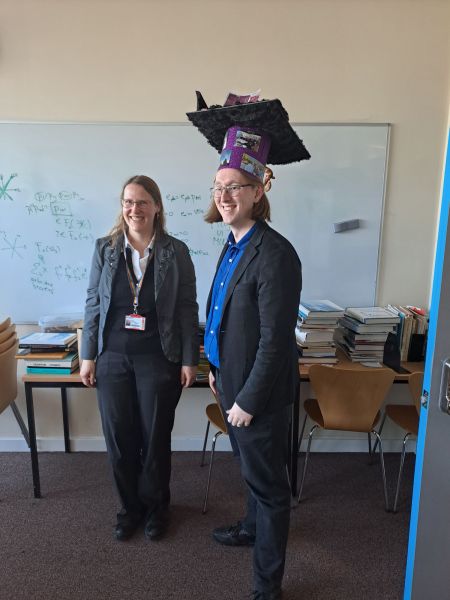
The PhD candidate was Alex Gough (pictured right, after the examination, with supervisor Cora Uhlemann). Cora being German we were treated to the tradition of successful PhD candidates having to wear a elaborate hat, after the examination (fortunately not during it). Some champagne was consumed, followed by dinner at a nice Indian restaurant on Clayton Street.

For those of you not familiar with how the PhD system works in the UK, it involves doing research into a particular topic and then writing up what you’ve done in a thesis. The thesis is a substantial piece of work, often in the region of 100,000 words (200 pages or so), which is then assessed by two examiners (one internal to the university at which the research was done, and one external). They read copies of the thesis and then the candidate has to defend it in an oral examination, which was what happened on Friday, after which they make a recommendation to the university about whether the degree should be awarded.

There aren’t many rules for how a viva voce examination should be conducted or how long it should last, but the can be as short as, say, 2 hours and can be as long as 5 hours or more. The examiners usually ask a mixture of questions, some about the details of the work presented and some about the general background. The unpredictable content of a viva voce examination makes it very difficult to prepare for, and it can be difficult and stressful for the candidate (as well as just tiring, as it can drag on for a long time). However, call me old-fashioned but I think if you’re going to get to call youself Doctor of Philosophy you should expect to have to work for it. Some might disagree.

Obviously I can’t give details of what went on in the examination except that it was quite long primarily because the thesis was very interesting and gave us lots to discuss. At the end internal examiner Danielle Leonard and I agreed to recommend the award of a PhD. In Newcastle as in other UK universities, the examiners simply make a recommendation to a higher authority (e.g. Board of Graduate Studies) to formally award the degree, but they almost always endorse the recommendation. I’ve never been sure exactly when a successful candidate is allowed to call themselves “Doctor”, actually, but congratulations to Dr Gough!

Anyway, the celebratory dinner ended just after Women’s International football match between England and France (which France won) had finished at St James’ Park and the Metro was consequently crammed full, but I got back to the hotel at a reasonable hour. Thank you to everyone in the group, especially Cora and Ian Moss, for being so friendly and making me feel so welcome during this brief visit.

Tomorrow I shall be heading to the part of not-Barcelona known as Oxford, where I believe there is a University of some sort, to give a lecture about which I’ll post more tomorrow.

In Praise of the Public Thesis Defence

Posted in Barcelona, Education, The Universe and Stuff with tags , , , , , on April 12, 2024 by telescoper

The ICCUB is quite large, which means that there are quite a few talks to go to, including seminars and colloquia but also thesis defences, such as one I attended this morning. The format for these events is a talk by the candidate in the presence of a panel of experts, who ask questions at the end, but the whole thing is open to the general public. After the panel questions there is an opportunity for questions from the audience, but only from those who have a doctorate. I was tempted, but didn’t put my hand up.

Anyway, this morning’s talk was well attended and of very high quality and, as usual, the whole event lasted getting on for two hours. It’s a very different experience from the form of viva voce examinations used for PhDs in the UK and Ireland.

I like to attend these public thesis defences because they’re a very good way of finding out about the research going on in areas away from my own specialism. In physics the people who are really working at the coal face are the PhD students so one often learns more about the details from such talks than from colloquia from senior folk, which are usually cover a wider area but at a more superficial level.

Another nice thing is that there is a little gathering afterwards (on the right) with a selection of food and drink available to celebrate the candidate’s success. In fact it was a double celebration as the candidate was offered a postdoctoral research position just two days ago. I abstained from the champagne as alcohol at lunchtime usually sends me to sleep in the afternoon, and I have a lot to do in the rest of today.

My First Maynooth PhD!

Posted in Maynooth, The Universe and Stuff with tags , , , , , , on March 14, 2024 by telescoper

Today saw the viva voce examination of the first PhD student at Maynooth to have completed their degree under my supervision, although in this case the student started his postgraduate degree under another supervisor and I only took over responsibility when that person retired, a few years ago.

Anyway, I delayed my return to Barcelona so I could be present today. It’s not normal practice for the supervisor of a PhD to be present at the examination of the candidate. The rules allow for it – usually at the request of the student – but the supervisor must remain silent unless and until invited to comment by the examiners. I think it’s a very bad idea for both student and supervisor, and the one example that I can recall of a supervisor attending the PhD examination of his student was a very uncomfortable experience. My presence today was limited to supplying a couple of anticipatory bottles of champagne and then waiting nervously for the examination to finish.

I always feel nervous when a student of mine is having their viva voce examination, probably because I’m a bit protective and such an occasion always brings back painful memories of the similar ordeal I went through thirty-odd years ago. However, this is something a PhD candidate has to go through on their own, a sort of rite of passage during which the supervisor has to stand aside and let them stand up for their own work.

The examination turned out to be quite a long one – about three and a half hours – but ended happily. Unfortunately, I had to leave the celebrations early in order to do yet another Euclid-related Zoom call but when that was over I was able to find the pub to which everyone had adjourned and had a pint there with them. I have a feeling the celebrants might make a night of it tonight, but I’m a bit too tired after recent exertions to join them.

The student’s name, by the way, is Aonghus Hunter-McCabe and the title of the thesis is Differential geometric and general relativistic techniques in non-relativistic laboratory systems. If you’re looking for a postdoc to work in related areas then Aonghus might just be the person you want!

P.S. About a decade ago I did a post on the occasion of the PhD examination of another student of mine, Ian Harrison. I found out recently that Ian now has a permanent position at Cardiff University. Congratulations to him!

The Land of Inadequate Research Stipends

Posted in Education with tags , , , on October 13, 2023 by telescoper

I noticed yesterday that the Irish Government has announced that the stipend for PhD research supported by Science Foundation Ireland (SFI) and the Irish Research Coucil (IRC) will increase by €3,000 a year. The increase will bring the rate of stipend to €22,000 a year for doctoral researchers from January 2024. While this is €3,000 less than the €25,000 recommended by a report published earlier this year, and the Government itself has already tacitly admitted that a level of €28,000 is needed to attract the best students, this is at least a step in the right direction.

Current levels of funding for research students are simply exploitative, forcing research students to take on extra work – often low-paid teaching duties – in order to make enough money to make ends meet. That is, unless they are students from affluent backgrounds. The discriminatory aspect of this policy is plain for all to see: should a career in research only be possible for the wealthy?

Of course this applies only to PhD students funded by SFI and IRC. It remains to be seen whether other funders – particularly Universities themselves – will match this increase. If they don’t, it will create an unhealthy division between students doing similar work but receiving vastly different levels of remuneration.

In related news I notice the Irish Universities Association has proudly announced a new agreement to fund Chilean students undertaking PhD and Research Masters courses in Ireland. Sounds great, I thought when I saw the announcement, astronomy being a likely area for research projects involving Chilean students.

Strangely (?) the website advertising this scheme doesn’t mention the level of stipend offered, but I found out independently that it is $15,000 per annum. That’s about €14,250, completely inadequate for a research student in Ireland, especially in the Dublin area, and especially for one who has travelled halfway round the world to get to Ireland. I certainly won’t be encouraging any students to apply for this scheme unless and until the miserly bursary is increased to the same level as SFI/IRC.

The IUA, of course, knows full well that this stipend is insupportable, so it is reprehensible for it to have agreed to these terms, the only possible outcome of them being to create an underclass within an underclass.

I had my university education for free, without tuition fees and with a full maintenance grant. The stipend I received for my PhD, although by no means luxurious, was adequate too. At times like this I wonder yet again why my generation spends so much time shitting on the young?

Postgraduate Programmes in Theoretical Physics at Maynooth University

Posted in Education, Maynooth, The Universe and Stuff with tags , , on March 2, 2021 by telescoper

We have a (virtual) Postgraduate Open Day coming up on Tuesday 9th March at Maynooth University (for which you can register here). To go with that here is a short video of our new Postgraduate Coordinator Dr John Regan answering some frequently asked questions about the programmes we offer in the Department of Theoretical Physics:

If you have any other questions then you can register for the Open Day where we will have staff on hand to answer them in a live Q&A session.

You could also follow the Department’s Twitter feed here: