Just to mention that tomorrow morning (October 5th 2021) will see the announcement of this year’s Nobel Prize for Physics. I must remember to make sure my phone is fully charged…
I do, of course, already have a Nobel Prize Medal of my own already, dating from 2006, when I was lucky enough to attend the prize-giving ceremony and banquet.
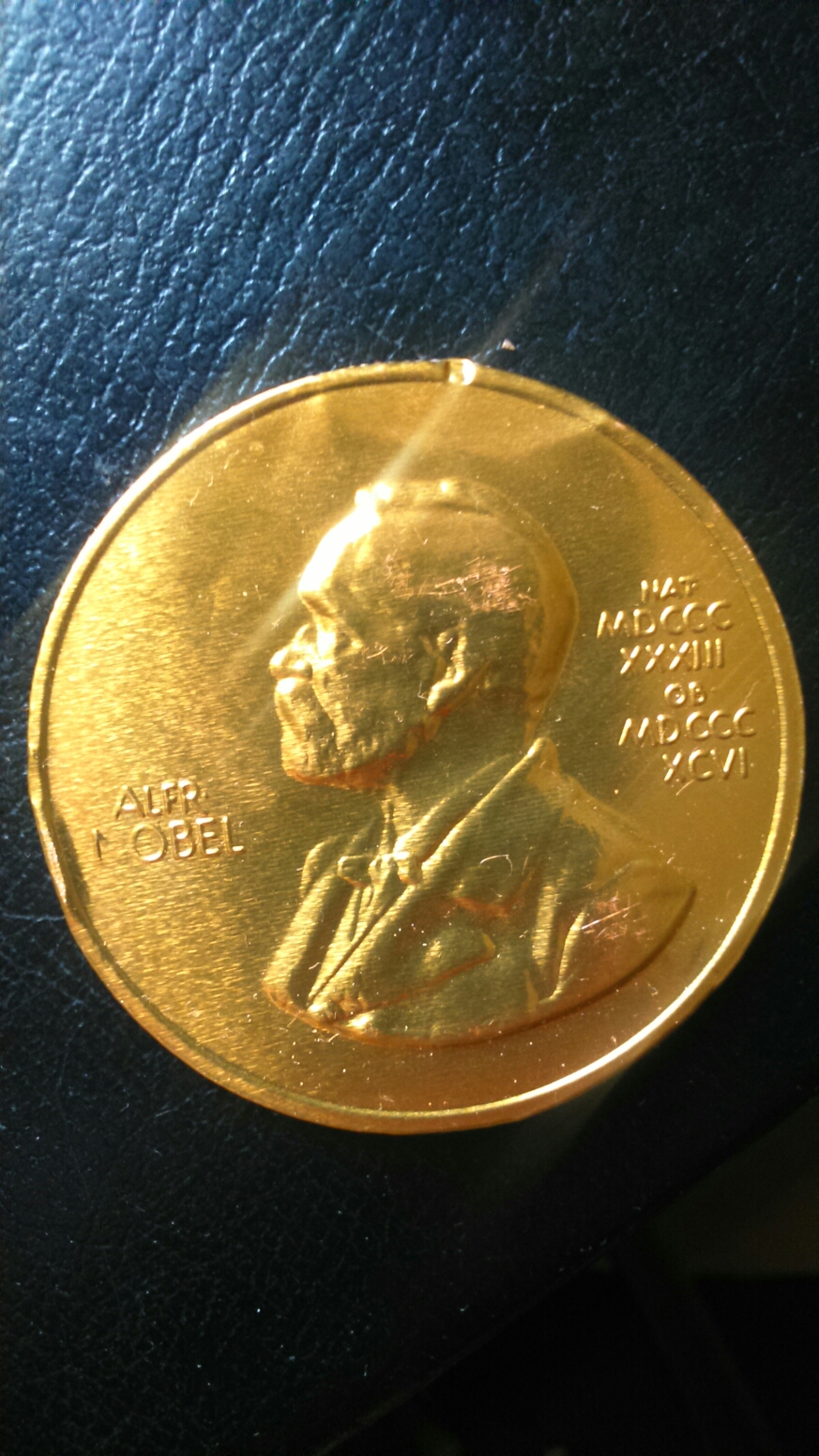
I was, however, a guest of the Nobel Foundation rather than a prizewinner, so my medal is made of chocolate rather than gold. I think after 15 years the chocolate is now inedible, but it serves as a souvenir of a very nice weekend in Stockholm!
I have a spectacular bad track record at predicting the Physics Nobel Prize winner. Most pundits have, actually. I certainly didn’t see the last two coming. I couldn’t resist having a go again however.
It’s been a good few years for cosmology and astrophysics, with Jim Peebles (2019), Roger Penrose, Andrea Ghez & Reinhard Genzel (2020) following on from Kip Thorne, Rainer Weiss and Barry Barish (2017) for the detection of gravitational waves. Although I said so last year only to be proved wrong, I think it’s very unlikely that it will be in this area again. I have no idea who will win but if I had to take a punt I would suggest Alain Aspect, Anton Zeilinger and John Clauser for their Bell’s inequality experiments and contributions to the understanding of quantum phenomena, including entanglement. I’m probably wrong though.
Feel free to make your predictions through the comments box below.
To find out you’ll have to wait for the announcement, around about 10.45 (UK/Irish time) tomorrow morning. I’ll update tomorrow when the wavefunction has collapsed.
Anyway, for the record, I’ll reiterate my opinion that while the Nobel Prize is flawed in many ways, particularly because it no longer really reflects how physics research is done, it does at least have the effect of getting people talking about physics. Surely that at least is a good thing?
UPDATE: Unsurprisingly, I was wrong again. The 2021 Nobel Prize for Physics goes to Syukuro Manabe and Klaus Hasselmann (1/4 each) and Giorgio Parisi (1/2). Manabe and Hasselmann were cited for their work in “the physical modeling of Earth’s climate, quantifying variability and reliably predicting global warming”. The second half of the prize was awarded to Parisi for “the discovery of the interplay of disorder and fluctuations in physical systems from atomic to planetary scales.” Congratulations to them all!
Follow @telescoper

 In the Dark