Archive for Physics

Thinking of Applying for a PhD Place in Physics or Astronomy?

Posted in Education with tags , , , , , , on October 12, 2016 by telescoper

This morning I am to give a short talk to interested students within the School of Physics & Astronomy here at Cardiff University about postgraduate research in which I aim to pass on some, hopefully useful,  information about how to go about applying for PhDs  in Physics  and Astronomy. Since I’ve finished writing the talk more than the usual few minutes before I have to deliver it, I thought I’d jot down here a few general remarks that might be useful to people elsewhere who are thinking of taking the plunge when they graduate. I’m aiming this primarily at UK students applying for places in the UK; special considerations apply for students wanting to do graduate research abroad.

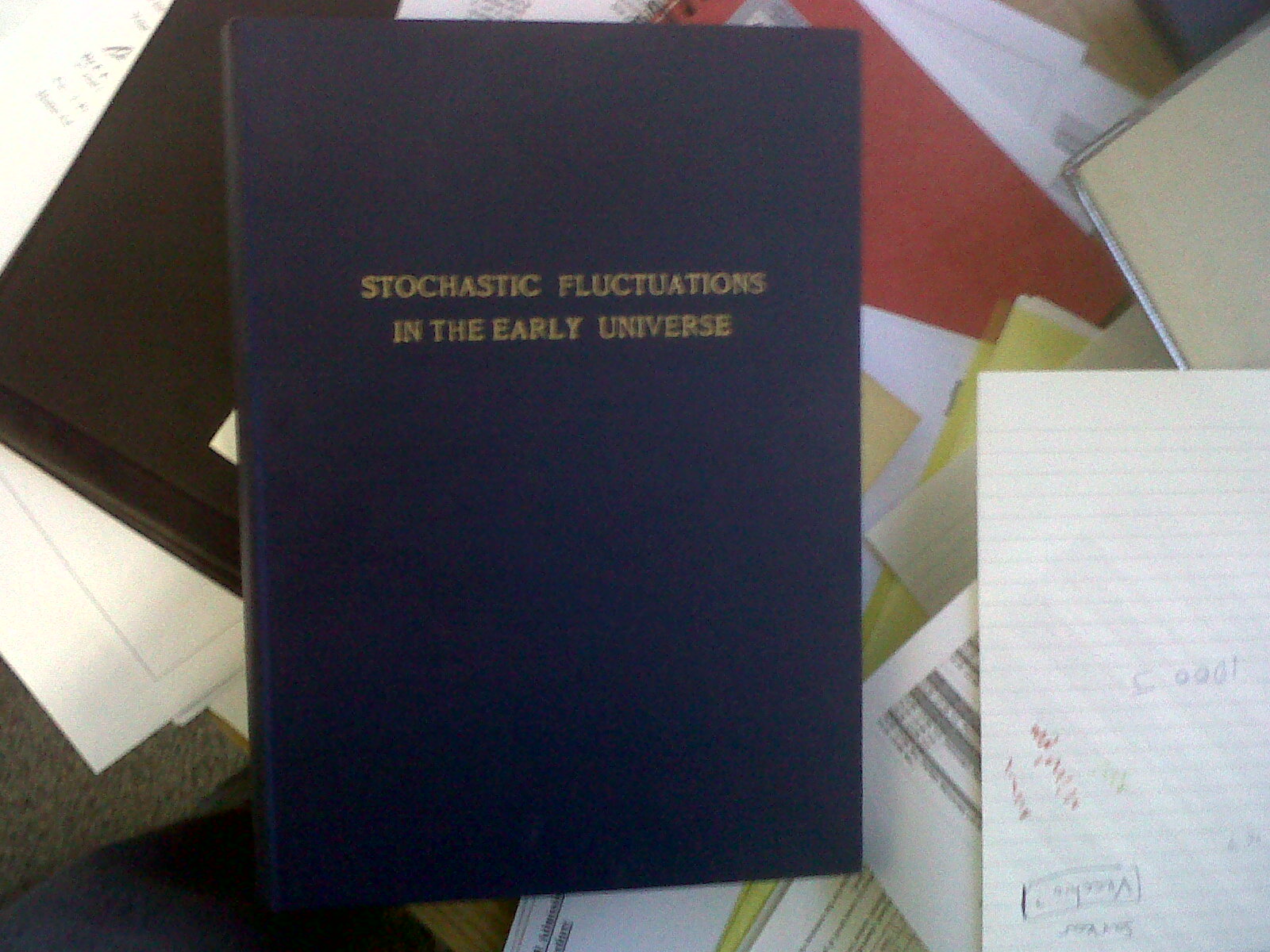
What is a PhD? The answer to that is relatively easy; it’s a postgraduate research degree. In order to obtain a PhD you have to present a thesis like that shown on the left (which happens to be mine, vintage 1988), typically in the range 100-250  pages long. A thesis has to satisfy two conditions for the award of the degree: it should contain original research, which is publishable in an academic journal; and it should present a coherent discussion of that original work within the context of ongoing work in the area of study. In Physics & Astronomy, the PhD is pretty much a prerequisite for any career in academic research, and it usually takes between 3 and 4 years to complete. After submission of the thesis you will have to undergo a viva voce examination conducted by two examiners, one internal and one external. This is quite a tough test, which  can last anywhere between about 2 and about 6 hours, during which you can be asked  detailed questions about your research and wide-ranging questions about the general area.

The Money Side. In the UK most PhDs are supported financially by the research councils, either EPSRC (most physics) or STFC (nuclear & particle physics, astronomy). These generally award quotas of studentships to departments who distribute them to students they admit. A studentship will cover your fees and pay a stipend, currently £14296 pa. That doesn’t sound like a lot, but you should at least remember that it is a stipend rather than a wage; it is therefore not taxed and there is no national insurance payable. There is a fee (currently £4121) payable for a PhD course, but that only comes into play if you are planning to fund yourself. If you receive a studentship it will normally cover the fee as an additional component. What I mean by that is you don’t need to pay it out of the stipend, it is separate. In top of that, research council funding also supplies a Research Training Grant which covers, e.g., travel and small items of equipment so you don’t need to pay for those out of your stipend either.

How do I choose a PhD? During the course of a postgraduate degree you are expected to become an expert in the area in which you specialize. In particular you should reach the point where you know more about that specific topic than your supervisor does. You will therefore have to work quite a lot on your own, which means you need determination, stamina and enthusiasm. In my view the most important criterion in your choice of PhD is not the institution where you might study but the project. You need to be genuinely excited by the topic in order to drive yourself to keep through the frustrations (of which there will be many). So, find an area that interests you and find the departments that do active research in that area by looking on the web. Check out the recent publications by staff in each department, to ensure that they are active and to have something to talk about at interview!

Qualifications. Most universities have a formal requirement that candidates for admission to the PhD should have a “good honours degree”, which basically means at least an Upper Second Class Honours degree. Some areas are more competitive than others, however, and in many disciplines you will find you are competing with a great many applicants with First Class degrees.

How to apply successfully. The application procedure at most universities is quite simple and can be done online. You will need to say something about the area in which you wish to do research (e.g. experiment/theory, and particular field, e.g. cosmology or star formation). You’ll also need a CV and a couple of references. Given the competition, it’s essential that you prepare. Give your curriculum vitae some attention, and get other people (e.g. your personal tutor) to help you improve it. It’s worth emphasizing particular skills (e.g. computing). If you get the chance, make use of your summer vacations by taking on an internship or other opportunity to get a taste of research; things like that will undoubtedly give your CV an edge.

The Interview. Good applicants will be invited for an interview, which is primarily to assess whether you have the necessary skills and determination, but also to match applicants to projects and supervisors. Prepare for your interview! You will almost certainly be asked to talk about your final-year project, so it will come across very badly if you’re not ready when they ask you. Most importantly, mug up about your chosen field. You will look really silly if you haven’t the vaguest idea of what’s going on in the area you claimed to be interested in when you wrote your  application!

Don’t be shy! There’s nothing at all wrong with being pro-active about this process. Contact academic staff at other universities by email and ask them about research, PhD opportunities. That will make a good impression. Also, don’t be afraid to ask for advice. Although we’re all keen to recruit good PhD students for our own departments, we academics are  conscious that it is also our job to give impartial advice. Ask your tutor’s opinion.

How many places should I apply for? Some research areas are more fashionable than others so the level of competition varies with field. As a general rule I would advise applying for about half-a-dozen places, chosen because they offer research in the right area. Apply to fewer than that and you might lose out to the competition. Apply to many more and you might not have time to attend the interviews.

What’s the timetable?  Most applications come in early in the new year for entry to the PhD in the following September/October. The Christmas break is therefore a pretty good time to get your applications sorted out. Interviews are normally held in February or March, and decisions made by late March. STFC runs a deadline system whereby departments can not force students to accept or decline offers before the end of March, so there should be ample time to visit all your prospective departments before having to make any decisions.

That’s all I can think of for now. I hope at least some of these comments are useful to undergraduates anywhere in the UK thinking of applying for a PhD. If there are any further questions, please feel free to ask through the comments box. Likewise if I’ve missed anything important, please feel free to suggest additions in the same manner…

Worrying Times for UK Physics

Posted in Education, The Universe and Stuff with tags , on August 19, 2016 by telescoper

As I’m more-or-less in between jobs at the moment, this is the first August in many that I haven’t been involved the clearing and confirmation process that helps students find places at university after the A-level results are released. I know how stressful it is for admissions staff and prospective students alike, so I’m not sorry to be out of it for once!

On the other hand I did notice something worrying that seems to be the continuation of a trend I noticed last year.  I quote from a piece issued by the Institute of Physics about the number of students taking A-level physics last year:

Although there was an overall rise of 2% in the number of A-level entries, the number taking physics fell to 36,287 compared with 36,701 last year – the first time numbers have fallen since 2006. The number of girls taking physics rose by 0.5%, however.

That decline is slight, of course, and it was  obviously too early to decide whether it indicated whether or not the UK has reached “Peak Physics”. Well, this year has confirmed that trend. According to a piece by the Wellcome Trust the number of entrants for physics A-level has fallen further this year, from 36,287 in 2015 to 35,344 in 2016. The Institute of Physics has also commented.

Virtually all students who get a Physics A-level do go to university, but by no means all do physics. It is also a qualifying subject for engineering and technology programmes, as well as medicine. It’s not clear yet whether the decline in A-level entry reflects a decline in the number of students going to start physics degrees at University this year, but this seems probable. This is good news if you’re an applicant with a Physics A-level, of course, because it increases the chances of you getting a place, but it’s no so good for physics as academic discipline.

Physics departments in UK universities are already competing for a very small pool of students with a Physics A-level.  The removal of student number controls allows  large universities to recruit as many students as they like, so the competition between universities for such a small number of applicants is extremely intense. Moreover, some universities, e.g. Newcastle and Hull, have opened up physics courses that they had previously closed, and others have started  new programmes based on what was anticipated to be an overall increase in demand. To support this expansion, many institutions have recruited extra numbers of teaching faculty assuming the salary costs would be covered from tuition fees. If the decline in overall student numbers continues then the budgets of many physics departments are going to look pretty grim, with potentially serious  consequences for the long-term sustainability of physics in many institutions.

I have to confess I’m worried. The physics community urgently needs to find out what is behind this fall. It’s not restricted to physics, in fact. Both biology and chemistry have also experienced a decline in the number of A-level entrants (from 44,864 to 43,242 and from 52,644 to 51,811 respectively), but the effect on physics is likely to be greater for the reasons I discussed above.

Mathematics numbers have also fallen, but by a much smaller percentage and from a much higher level: from 92,711 to 92,163.  I‘ve argued before that there’s a case on a number of grounds for scrapping the physics A-level as a requirement for entry to university as long as the student has mathematics. That may be a step too far for some, but it’s clear that if physics is to prosper we all have to think more creatively about how to increase participation. But how? Answers on a postcard – or through the comments box – please!


Private Eye on Physics Graduation

Posted in Education, The Universe and Stuff with tags , , on July 19, 2016 by telescoper

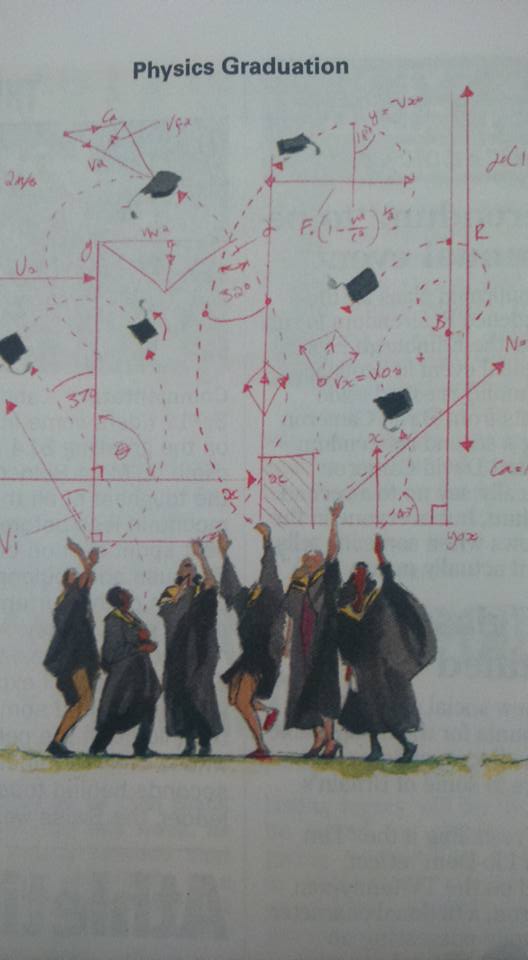
Given the occasion I thought I’d just post this rather excellent cartoon I saw last year  Private Eye

Physics Graduation

To Cambridge Again

Posted in Biographical, Education with tags , , , on June 13, 2016 by telescoper

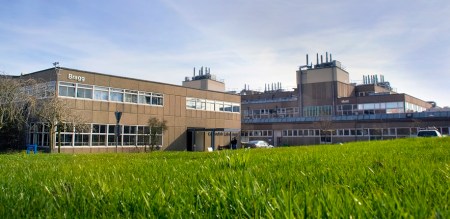
The annual cycle of academic life brings me once again to my duties as External Examiner for Physics at the famous Midlands University called Cambridge, so I’m getting ready to take the train there. Here’s a picture of the Cavendish laboratory where I’ll be working for the next three days:

bragg_building_110309

It hasn’t changed much since I was an undergraduate there (I graduated 31 years ago), but the area around it has certainly been heavily developed in the intervening years.

Anyway, I’d better be going. Toodle-pip!

R.I.P. Tom Kibble (1932-2016)

Posted in The Universe and Stuff with tags , , , , , on June 2, 2016 by telescoper

Yet again, I find myself having to use this blog pass on some very sad news. Distinguished theoretical physicist Tom Kibble (below) passed away today, at the age of 83.

Kibble

Sir Thomas Walter Bannerman Kibble FRS (to give his full name) worked on  quantum field theory, especially the interface between high-energy particle physics and cosmology. He has worked on mechanisms ofsymmetry breaking, phase transitions and the topological defects (monopoles, cosmic strings or domain walls) that can be formed in some theories of the early Universe;  he is  probably most famous for introducing the idea of cosmic strings to modern cosmology in a paper with Mark Hindmarsh. Although there isn’t yet any observational support for this idea, it has generated a great deal of very interesting research.

Tom was indeed an extremely distinguished scientist, but what most people will remember best is that he was an absolutely lovely human being. Gently spoken and impeccably courteous, he was always receptive to new ideas and gave enormous support to younger researchers. He will be very sadly missed by friends and colleagues across the physics world.

Rest in peace, Tom Kibble (1932-2016).


Examination Time Yet Again

Posted in Biographical, Education with tags , , , , , on May 12, 2016 by telescoper

Once again the return of glorious weather heralds the return of the  examination season at the University of Sussex, so here’s a lazy rehash of my previous offerings on the subject that I’ve posted around this time each year since I started blogging.

My feelings about examinations agree pretty much with those of  William Wordsworth, who studied at the same University as me, as expressed in this quotation from The Prelude:

Of College labours, of the Lecturer’s room
All studded round, as thick as chairs could stand,
With loyal students, faithful to their books,
Half-and-half idlers, hardy recusants,
And honest dunces–of important days,
Examinations, when the man was weighed
As in a balance! of excessive hopes,
Tremblings withal and commendable fears,
Small jealousies, and triumphs good or bad–
Let others that know more speak as they know.
Such glory was but little sought by me,
And little won.

It seems to me a great a pity that our system of education – both at School and University – places such a great emphasis on examination and assessment to the detriment of real learning. On previous occasions, before I moved to the University of Sussex, I’ve bemoaned the role that modularisation has played in this process, especially in my own discipline of physics.

Don’t get me wrong. I’m not opposed to modularisation in principle. I just think the way modules are used in many British universities fails to develop any understanding of the interconnection between different aspects of the subject. That’s an educational disaster because what is most exciting and compelling about physics is its essential unity. Splitting it into little boxes, taught on their own with no relationship to the other boxes, provides us with no scope to nurture the kind of lateral thinking that is key to the way physicists attempt to solve problems. The small size of many module makes the syllabus very “bitty” and fragmented. No sooner have you started to explore something at a proper level than the module is over. More advanced modules, following perhaps the following year, have to recap a large fraction of the earlier modules so there isn’t time to go as deep as one would like even over the whole curriculum.

In most UK universities (including Sussex), tudents take 120 “credits” in a year, split into two semesters. In many institutions, these are split into 10-credit modules with an examination at the end of each semester; there are two semesters per year. Laboratories, projects, and other continuously-assessed work do not involve a written examination, so the system means that a typical  student will have 5 written examination papers in January and another 5 in May. Each paper is usually of two hours’ duration.

Such an arrangement means a heavy ratio of assessment to education, one that has risen sharply over the last decades,  with the undeniable result that academic standards in physics have fallen across the sector. The system encourages students to think of modules as little bit-sized bits of education to be consumed and then forgotten. Instead of learning to rely on their brains to solve problems, students tend to approach learning by memorising chunks of their notes and regurgitating them in the exam. I find it very sad when students ask me what derivations they should memorize to prepare for examinations. A brain is so much more than a memory device. What we should be doing is giving students the confidence to think for themselves and use their intellect to its full potential rather than encouraging rote learning.

You can contrast this diet of examinations with the regime when I was an undergraduate. My entire degree result was based on six three-hour written examinations taken at the end of my final year, rather than something like 30 examinations taken over 3 years. Moreover, my finals were all in a three-day period. Morning and afternoon exams for three consecutive days is an ordeal I wouldn’t wish on anyone so I’m not saying the old days were better, but I do think we’ve gone far too far to the opposite extreme. The one good thing about the system I went through was that there was no possibility of passing examinations on memory alone. Since they were so close together there was no way of mugging up anything in between them. I only got through  by figuring things out in the exam room.

I think the system we have here at the University of Sussex is much better than I’ve experienced elsewhere. For a start the basic module size is 15 credits. This means that students are usually only doing four things in parallel, and they consequently have fewer examinations, especially since they also take laboratory classes and other modules which don’t have a set examination at the end. There’s also a sizeable continuously assessed component (30%) for most modules so it doesn’t all rest on one paper. Although in my view there’s still too much emphasis on assessment and too little on the joy of finding things out, it’s much less pronounced than elsewhere. Maybe that’s one of the reasons why the Department of Physics & Astronomy does so consistently well in the National Student Survey?

We also have modules called Skills in Physics which focus on developing the problem-solving skills I mentioned above; these are taught through a mixture of lectures and small-group tutorials. I don’t know what the students think of these sessions, but I always enjoy them because the problems set for each session are generally a bit wacky, some of them being very testing. In fact I’d say that I’m very impressed at the technical level of the modules in the Department of Physics & Astronomy generally. I’ve been teaching Green’s Functions, Conformal Transformations and the Calculus of Variations to second-year students this semester. Those topics weren’t on the syllabus at all in my previous institution!

Anyway, my Theoretical Physics paper is next week (on 19th May) so I’ll find out if the students managed to learn anything despite having such a lousy lecturer. Which reminds me, I must remember to post some worked examples online to help them with their revision.

In Praise of Natural Sciences

Posted in Biographical, Education with tags , , , , on April 24, 2016 by telescoper

The other day I was chatting with some students in the Department of Physics & Astronomy at the University of Sussex. One thing that came up was the fact that I’m basing the material for my Second Year Theoretical Physics module on the notes I took when I was a second-year undergraduate student at Cambridge over thirty years ago. I mentioned that to counter suggestions that are often made that the physics curriculum has been excessively “dumbed down” over the years. It may have been elsewhere, of course, but not on my watch. In fact, despite the misfortune of having me as a lecturer, many of the students in my class are picking up things far faster than I did when I was their age!

Anyway, that led to a general discussion of the changing nature of university education. One point was that in my day there weren’t any four-year “Integrated Masters” degrees, just plain three-year Bachelors. Teaching was therefore a bit more compressed than it is now, especially at Cambridge with its shorter teaching terms. We teach in two 12-week blocks here at Sussex. Week 11 of the Spring Term is about to start so we’re nearing the finishing line for this academic year and soon the examinations will be upon us.

The other thing that proved an interesting point of discussion was that the degree programme that I took was the Natural Sciences Tripos That meant that I did a very general first year comprising four different elements that could be chosen flexibly. I quickly settled on Physics, Chemistry and  Mathematics for Natural Sciences to reflect my A-level results but was struggling for the fourth. In the end I picked the one that seemed most like Physics, a course called Crystalline Materials. I didn’t like that at all, and wish I’d done some Biology instead – Biology of Cells and Biology of Organisms were both options – or even Geology, but I stuck with it for the first year.

Having to do such a wide range of subjects was very challenging. The timetable was densely packed and the pace was considerable. In the second year, however, I was able to focus on Mathematics and Physics and although it was still intense it was a bit more focussed. I ended up doing Theoretical Physics in my final year, including a theory project.

My best teacher at School, Dr Geoeff Swinden,  was a chemist (he had a doctorate in organic chemistry from Oxford University) and when I went to Cambridge I fully expected to specialise in Chemistry rather tha Physics. I loved the curly arrows and all that. But two things changed. One was that I found the Physics content of the first year far more interesting – and the lecturers and tutors far more inspiring – than Chemistry, and the other was that my considerable ineptitude at practical work made me doubt that I had a future in a chemistry laboratory. And so it came to pass that I switched allegiance to Physics, a decision I am very glad I made. It was only towards the end of my degree that I started to take Astrophysics seriously as a possible specialism, but that’s another story.

As we are now approaching examination season I’ve been dealing with some matters in my role as External Examiner for Natural Sciences (Physics) at Cambridge, a position I have held since last year. It’s certaintly extremely interesting to see things from the other side of the fence, thirty years on since my finals. In particular I was struck last year by how many senior physicists there are at Cambridge who actually came as undergraduates expecting, like I did, to do Chemistry but also then switched. No doubt some moved in the opposite direction too, but the point is that the system not only allowed this but positively encouraged it.

Looking back, I think  there were great educational advantages in delaying  the choice of speciality the way a Natural Sciences degree did. New students usually have very little idea how different the subject is at university compared to A-level, so it seems unfair to lock them into a programme from Year 1. Moreover – and this struck me particularly talking to current students last week – a Natural Sciences programme might well prove a way of addressing the gender imbalance in physics by allowing female students (who might have been put off Physics at school) to gravitate towards it. Only 20% of the students who take Physics A-level are female, and that’s roughly the same mix that we find in the undergraduate population. How many more might opt for Physics after taking a general first year?

Another advantage of this kind of degree is that it gives scientists a good grounding in  a range of subjects. In the long run this could encourage greater levels of interdisciplinary thinking. This is important, since some of the most exciting areas of physics research lie at the interfaces with, e.g. chemistry and biology. Unfortunately, adminstrative structures often create barriers that deter such cross-disciplinary activities.


“British physics” – A Lesson from History

Posted in History, Politics, Science Politics, The Universe and Stuff with tags , , , , , , , , , , , , , , , , on March 13, 2016 by telescoper

The other day I came across the following tweet

The link is to an excellent piece about the history of European science which I recommend reading; as I do with this one.

I won’t pretend to be a historian but I can’t resist a comment from my perspective as a physicist. I am currently teaching a course module called Theoretical Physics which brings together some fairly advanced mathematical techniques and applies them to (mainly classical) physics problems. It’s not a course on the history of physics, but thenever I mention a new method or theorem I always try to say something about the person who gave it its name. In the course of teaching this module, therefore, I have compiled a set of short biographical notes about the people behind the rise of theoretical physics (mainly in the 19th Century). I won’t include them here – it would take too long – but a list  makes the point well enough: Laplace, Poisson,  Lagrange, Hamilton, Euler, Cauchy, Riemann, Biot, Savart, d’Alembert, Ampère, Einstein, Lorentz, Helmholtz, Gauss, etc etc.

There are a few British names too  including the Englishmen Newton and Faraday and the Scot Maxwell. Hamilton, by the way, was Irish. Another Englishman, George Green, crops up quite prominently too, for reasons which I will expand upon below.

Sir Isaac Newton is undoubtedly one of the great figures in the History of Science, and it is hard to imagine how physics might have developed without him, but the fact of the matter is that for a hundred years after his death in 1727 the vast majority of significant developments in physics took place not in Britain but in Continental Europe. It’s no exaggeration to say that British physics was moribund during this period and it took the remarkable self-taught mathematician George Green to breath new life into it.
I quote from History of the Theories of the Aether and Electricity (Whittaker, 1951) :

The century which elapsed between the death of Newton and the scientific activity of Green was the darkest in the history of (Cambridge) University. It is true that (Henry) Cavendish and (Thomas) Young were educated at Cambridge; but they, after taking their undergraduate courses, removed to London. In the entire period the only natural philosopher of distinction was (John) Michell; and for some reason which at this distance of time it is difficult to understand fully, Michell’s researches seem to have attracted little or no attention among his collegiate contemporaries and successors, who silently acquiesced when his discoveries were attributed to others, and allowed his name to perish entirely from the Cambridge tradition.

I wasn’t aware of this analysis previously, but it re-iterates something I have posted about before. It stresses the enormous historical importance of British mathematician and physicist George Green, who lived from 1793 until 1841, and who left a substantial legacy for modern theoretical physicists, in Green’s theorems and Green’s functions; he is also credited as being the first person to use the word “potential” in electrostatics.

Green was the son of a Nottingham miller who, amazingly, taught himself mathematics and did most of his best work, especially his remarkable Essay on the Application of mathematical Analysis to the theories of Electricity and Magnetism (1828) before starting his studies as an undergraduate at the University of Cambridge ,which he did at the age of 30. Lacking independent finance, Green could not go to University until his father died, whereupon he leased out the mill he inherited to pay for his studies.

Extremely unusually for English mathematicians of his time, Green taught himself from books that were published in France. This gave him a huge advantage over his national contemporaries in that he learned the form of differential calculus that originated with Leibniz, which was far more elegant than that devised by Isaac Newton (which was called the method of fluxions). Whittaker remarks upon this:

Green undoubtedly received his own early inspiration from . . . (the great French analysts), chiefly from Poisson; but in clearness of physical insight and conciseness of exposition he far excelled his masters; and the slight volume of his collected papers has to this day a charm which is wanting in their voluminous writings.

Great scientist though he was, Newton’s influence on the development of physics in Britain was not entirely positive, as the above quote makes clear. Newton was held in such awe, especially in Cambridge, that his inferior mathematical approach was deemed to be the “right” way to do calculus and generations of scholars were forced to use it. This held back British science until the use of fluxions was phased out. Green himself was forced to learn fluxions when he went as an undergraduate to Cambridge despite having already learned the better method.

Unfortunately, Green’s great pre-Cambridge work on mathematical physics didn’t reach wide circulation in the United Kingdom until after his death. William Thomson, later Lord Kelvin, found a copy of Green’s Essay in 1845 and promoted it widely as a work of fundamental importance. This contributed to the eventual emergence of British theoretical physics from the shadow cast by Isaac Newton. This renaissance reached one of its heights just a few years later with the publication of a fully unified theory of electricity and magnetism by James Clerk Maxwell.

In a very real sense it was Green’s work that led to the resurgence of British physics during the later stages of the 19th Century, and it was the fact that he taught himself from French books that enabled him to bypass the insular attitudes of British physicists of the time. No physicist who has taken even a casual look at the history of their subject could possibly deny the immense importance of mainland Europe in providing its theoretical foundations.

Of course science has changed in the last two hundred years, but I believe that we can still learn an important lesson from this particular bit of history. Science moves forward when scientists engage with ideas and information from as wide a range of sources as possible, and it stagnates when it retreats into blinkered insularity. The European Union provides all scientific disciplines with a framework within which scientists can move freely and form transnational collaborations for the mutual benefit of all. We need more of this, not less. And not just in science.

Preparing for a PhD Interview in Physics

Posted in Biographical, Education, The Universe and Stuff with tags , , , on February 1, 2016 by telescoper

The other day I was chatting to a group of our 4th-year MPhys students about the process for applying  (and hopefully being interviewed) for a PhD. This is the time when students in the UK have started to apply and are awaiting decisions on whether they have to go for an interview. Final decisions are usually made by the end of March so those with interviews have a busy couple of months coming up.

I actually quite enjoy doing PhD interviews, because that involves giving excellent young scientists their first step on the ladder towards a research career. I’m sure it’s not so pleasant for the candidates though. Nerves sometimes get the better of the students in these interviews, but experienced interviewers can calibrate for that. And if you’re nervous, it means that you care…

Anyone reading this who is nervous about doing a PhD interview (or has experienced nerves in one they’ve already had) might reflect on my experience when I was called to interview for a PhD place in Astronomy at the University of Manchester way back in 1985. I was very nervous before that, and arrived very early for my grilling. I was told to wait in a sort of ante-room as the previous interview had only just started. I started to read a textbook I had brought with me. About five minutes later, the door of the interview room opened and the interviewers, Franz Kahn and John Dyson, both of whom are sadly no longer with us, carried out the unconscious body of the previous candidate. It turned out that, after a couple of friendly preliminary questions, the two Professors had handed the candidate a piece of chalk and told him to go to the blackboard  to work something out, at which point said candidate had fainted. When it was my turn to be handed the chalk I toyed with the idea of staging a mock swoon, but resisted the temptation.

The question, in case you’re interested, was to estimate the angle through which light  is deflected by the Sun’s gravity. I hadn’t done any general relativity in my undergraduate degree, so just did it by dimensional analysis which is easy because an angle is dimensionless. That gets you within a factor of a two of the correct answer which, in those days, was pretty goood going for cosmology. That seemed to go down well and they offered me a place … which I turned down in favour of Sussex.

In those days, before detailed information about research in University departments was available online, the interview generally consisted of a discussion of the various projects available and a few odd questions about Physics (and possible Astronomy) to see if the candidate was able to think on their feet (i.e. without fainting).

Nowadays it’s a bit different. You can still expect a bit of questioning about undergraduate material but that is normally preceded by the chance to talk about your final-year project. One reason for that is that selectors are interested in project work because it can provide evidence of an aptitude for research. The other is simply that it gives the candidate a chance to get over any initial nerves by talking about something that they hopefully know well, as they will have been working on it for some time.

My first piece advice for students who have been offered an interview, therefore, is to prepare a short (~10 minute) verbal summary of your project work so you’re not wrong-footed if asked to talk about it.

Students nowadays are also expected to know a bit more about the thesis topic in advance, so my second tip is to  read up a bit of background so you can talk reasonably intelligently about the proposed research. If, for example, you have decided to work on Dark Energy (as many seem to these days), you won’t come across very well if you don’t know what the main issues are. What’s the observational evidence? What kind of theories are there? What are the open questions? Same goes for other fields. It also will do no harm if you read a couple of recent papers by your prospective supervisor, for reasons of flattery if nothing else.

Anyway, I think those are the two main things. If anyone has other advice to offer prospective PhD students, please feel free to add via the comments box.


Why is General Relativity so difficult?

Posted in The Universe and Stuff with tags , , on November 26, 2015 by telescoper

Just a brief post following yesterday’s centenary of General Relativity, after which somebody asked me what is so difficult about the theory. I had two answers to that, one mathematical and one conceptual.

einstein-equation1

The Field Equations of General Relativity are written above. In the notation used they don’t look all that scary, but they are more complicated than they look. For a start it looks like there is only one equation, but the subscripts μ and ν can each take four values (usually 0, 1, 2 or 3), each value standing for one of the dimensions of four-dimensional space time. It therefore looks likes there are actually 16 equations. However, the equations are the same if you swap μ  and ν around. This means that there are “only” ten independent equations. The terms on the left hand side are the components of the Einstein Tensor which expresses the effect of gravity through the curvature of space time and the right hand side describes the energy and momentum of “stuff”, prefaced by some familiar constants.

The Einstein Tensor is made up of lots of partial derivatives of another tensor called the metric tensor (which describes the geometry of space time), which relates, through the Field Equations, to how matter and energy are distributed and how these components move and interact. The ten equations that need to be solved simultaneously are second-order non-linear partial different equations. This is to be compared with the case of Newtonian gravity in which only ordinary different equations are involved.

Problems in Newtonian mechanics can be difficult enough to solve but the much greater mathematical complexity in General Relativity means that problems in GR can only be solved in cases of very special symmetry, in which the number of independent equations can be reduced dramatically.

So that’s why it’s difficult mathematically. As for the conceptual problem it’s that most people (I think) consider “space” to be “what’s in between the matter” which seems like it must be “nothing”. But how can “nothing” possess an attribute like curvature? This leads you to conclude that space is much more than nothing. But it’s not a form of matter. So what is it? This chain of thought often leads people to think of space as being like the Ether, but that’s not right either. Hmm.

I tend to avoid this problem by not trying to think about space or space-time at all, and instead think only in terms of particle trajectories or ligh rays and how matter and energy affect them. But that’s because I’m lazy and only have a small brain…