Archive for Physics

How to Solve Physics Problems

Posted in Cute Problems, Education with tags , , , , , , on September 18, 2015 by telescoper

It’s Friday afternoon at the end of Induction Week here at the University of Sussex. By way of preparation for lectures proper – which start next Monday – I gave a lecture today to all the new students in Physics during which I gave some tips about how to tackle physics problems, not only in terms of how to solve them but also how to present the answer in an appropriate way.
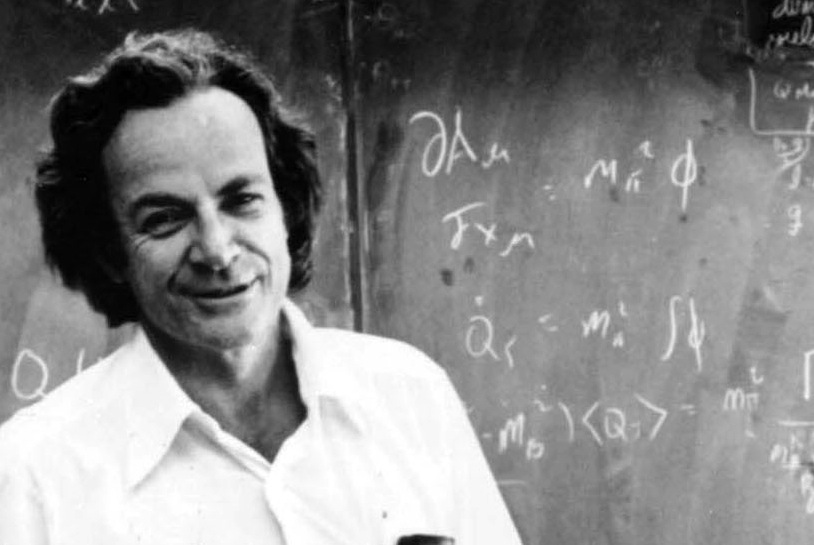
Richard-Feynman-cornellI began with Richard Feynman’s formula (the geezer in the above picture) for solving physics problems:

  1. Write down the problem.
  2. Think very hard.
  3. Write down the answer.

That may seem either arrogant or facetious, or just a bit of a joke, but that’s really just the middle bit. Feynman’s advice on points 1 and 3 is absolutely spot on and worth repeating many times to an audience of physics students.

I’m a throwback to an older style of school education when the approach to solving unseen mathematical or scientific problems was emphasized much more than it is now. Nowadays much more detailed instructions are given in School examinations than in my day, often to the extent that students  are only required to fill in blanks in a solution that has already been mapped out.

I find that many, particularly first-year, students struggle when confronted with a problem with nothing but a blank sheet of paper to write the solution on. The biggest problem we face in physics education, in my view, is not the lack of mathematical skill or background scientific knowledge needed to perform calculations, but a lack of experience of how to set the problem up in the first place and a consequent uncertainty about, or even fear of, how to start. I call this “blank paper syndrome”.

In this context, Feynman’s advice is the key to the first step of solving a problem. When I give tips to students I usually make the first step a bit more general, however. It’s important to read the question too. The key point is to write down the information given in the question and then try to think how it might be connected to the answer. To start with, define appropriate symbols and draw relevant diagrams. Also write down what you’re expected to prove or calculate and what physics might relate that to the information given.

The middle step is more difficult and often relies on flair or the ability to engage in lateral thinking, which some people do more easily than others, but that does not mean it can’t be nurtured.  The key part is to look at what you wrote down in the first step, and then apply your little grey cells to teasing out – with the aid of your physics knowledge – things that can lead you to the answer, perhaps via some intermediate quantities not given directly in the question. This is the part where some students get stuck and what one often finds is an impenetrable jumble of mathematical symbols  swirling around randomly on the page. The process of problem solving is not always linear. Sometimes it helps to work back a little from the answer you are expected to prove before you can return to the beginning and find a way forward.

Everyone gets stuck sometimes, but you can do yourself a big favour by at least putting some words in amongst the algebra to explain what it is you were attempting to do. That way, even if you get it wrong, you can be given some credit for having an idea of what direction you were thinking of travelling.

The last of Feynman’s steps  is also important. I lost count of the coursework attempts I marked this week in which the student got almost to the end, but didn’t finish with a clear statement of the answer to the question posed and just left a formula dangling.  Perhaps it’s because the students might have forgotten what they started out trying to do, but it seems very curious to me to get so far into a solution without making absolutely sure you score the points.  IHaving done all the hard work, you should learn to savour the finale in which you write “Therefore the answer is…” or “This proves the required result”. Scripts that don’t do this are like detective stories missing the last few pages in which the name of the murderer is finally revealed.

So, putting all these together, here are the three tips I gave to my undergraduate students this morning.

  1. Read the question! Some students give solutions to problems other than that which is posed. Make sure you read the question carefully. A good habit to get into is first to translate everything given in the question into mathematical form and define any variables you need right at the outset. Also drawing a diagram helps a lot in visualizing the situation, especially helping to elucidate any relevant symmetries.
  2. Remember to explain your reasoning when doing a mathematical solution. Sometimes it is very difficult to understand what students are trying to do from the maths alone, which makes it difficult to give partial credit if they are trying to the right thing but just make, e.g., a sign error.
  3.  Finish your solution appropriately by stating the answer clearly (and, where relevant, in correct units). Do not let your solution fizzle out – make sure the marker knows you have reached the end and that you have done what was requested. In other words, finish with a flourish!

There are other tips I might add – such as checking answers by doing the numerical parts at least twice on your calculator and thinking about whether the order-of-magnitude of the answer is physically reasonable – but these are minor compared to the overall strategy.

And another thing is not to be discouraged if you find physics problems difficult. Never give up without a fight. It’s only by trying difficult things that you can improve your ability by learning from your mistakes. It’s not the job of a physics lecturer to make physics seem easy but to encourage you to believe that you can do things that are difficult.

To illustrate the advice I’ve given I used this problem, which I leave as an exercise to the reader. It is a slightly amended version the first physics problem I was set as tutorial work when I began my undergraduate studies way back in 1982. I think it illustrates very well the points I have made above, and it doesn’t require any complicated mathematics – not even calculus! See how you get on…

problem

Quantum Madness

Posted in The Universe and Stuff with tags , , on September 18, 2015 by telescoper

A very busy day lies in store so I only have time for a quick morning visit to the blog. If you enjoyed the recent guest post on the “hidden variables” interpretation of Quantum Mechanics, then you will probably enjoy reading a paper that recently appeared on the arXiv with the abstract:

Motivated by some recent news, a journalist asks a group of physicists: “What’s the meaning of the violation of Bell’s inequality?” One physicist answers: “It means that non-locality is an established fact”. Another says: “There is no non-locality; the message is that measurement outcomes are irreducibly random”. A third one says: “It cannot be answered simply on purely physical grounds, the answer requires an act of metaphysical judgement”. Puzzled by the answers, the journalist keeps asking questions about quantum theory: “What is teleported in quantum teleportation?” “How does a quantum computer really work?” Shockingly, for each of these questions, the journalist obtains a variety of answers which, in many cases, are mutually exclusive. At the end of the day, the journalist asks: “How do you plan to make progress if, after 90 years of quantum theory, you still don’t know what it means? How can you possibly identify the physical principles of quantum theory or expand quantum theory into gravity if you don’t agree on what quantum theory is about?” Here we argue that it is becoming urgent to solve this too long lasting problem. For that, we point out that the interpretations of quantum theory are, essentially, of two types and that these two types are so radically different that there must be experiments that, when analyzed outside the framework of quantum theory, lead to different empirically testable predictions. Arguably, even if these experiments do not end the discussion, they will add new elements to the list of strange properties that some interpretations must have, therefore they will indirectly support those interpretations that do not need to have all these strange properties.

You can download a PDF of the full paper here. It’s a short piece, but with a very good list of references for further reading.

Widening Participation in Physics

Posted in Education with tags , , , , on September 9, 2015 by telescoper

Following on from a provocative post I wrote a couple of weeks ago on this blog (which was subsequently reblogged by the Times Higher), I was contacted by Paul Crowther who sent me a copy of the slides used by Peter Main of the Institute of Physics in a talk in May 2015 on the subject of Widening Participation in Physics. With Peter Main’s permission I’m sharing those slides here as a service to the Physics community. There’s a lot of interesting information in these slides, which I think many UK physicists would be interested in.

Have we reached Peak Physics?

Posted in Education, The Universe and Stuff with tags , , , , on August 17, 2015 by telescoper

One of the interesting bits of news I picked up concerning last week’s A-level results is a piece from the Institute of Physics about the number of students taking A-level physics. The opening paragraph reads:

Although there was an overall rise of 2% in the number of A-level entries, the number taking physics fell to 36,287 compared with 36,701 last year – the first time numbers have fallen since 2006. The number of girls taking physics rose by 0.5%, however.

The decline is slight, of course, and it’s obviously too early to decide whether we’ve reached Peak Physics or not. It remains the case however that Physics departments in UK universities are competing for a very small pool of students with A-levels in that discipline. With some universities, e.g. Newcastle, opening up physics programmes that they had previously closed, competition  is going to be intense to recruit students across the sector unless the pool of qualified applicants increases substantially.

The article goes on to speculate that students may be put off doing physics by the perception that it is harder than other subjects. It may even be that some schools – mindful of the dreaded league tables – are deliberately discouraging all but the brightest pupils from studying physics in case their precious league table position is affected.

That’s not a line I wish to pursue here, but I will take the opportunity to rehearse an argument that I have made on this blog before. The idea is one that joins two threads of discussion that have appeared on a number of occasions on this blog. The first is that, despite strenuous efforts by many parties, the fraction of female students taking A-level Physics has flat-lined at 20% for over a decade. This is the reason why the proportion of female physics students at university is the same, i.e. 20%. In short, the problem lies within our school system. This year’s modest increase doesn’t change the picture significantly.

The second line of argument is that A-level Physics is simply not a useful preparation for a Physics degree anyway because it does not develop the sort of problem-solving skills, or the ability to express physical concepts in mathematical language, on both of abilities which university physics depends. Most physics admissions tutors that I know care much more about the performance of students at A-level Mathematics than Physics when it comes to selecting “near misses” during clearing, for example.

Hitherto, most of the effort that has been expended on the first problem has been directed at persuading more girls to do Physics A-level. Since all universities require a Physics A-level for entry into a degree programme, this makes sense but it has not been successful.

I now believe that the only practical way to improve the gender balance on university physics course is to drop the requirement that applicants have A-level Physics entirely and only insist on Mathematics (which has a much more even gender mix at entry). I do not believe that this would require many changes to course content but I do believe it would circumvent the barriers that our current school system places in the way of aspiring female physicists. Not all UK universities seem very interested in widening participation, but those that are should seriously consider this approach.

I am grateful to fellow astronomer Jonathan Pritchard for pointing out to me that a similar point has been made to drop A-level Physics as an entry requirement to  Civil Engineering degrees, which have a similar problem with gender bias.

Physics Graduation, according to Private Eye

Posted in Education, The Universe and Stuff with tags , , on August 11, 2015 by telescoper

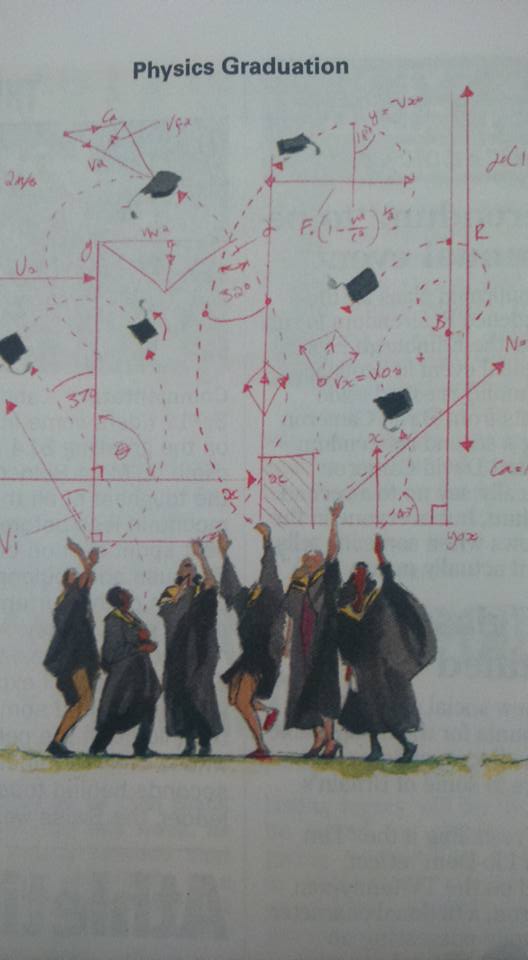
Very busy day today, what with one thing and another (and another, and another…) so in lieu of a proper post I thought I’d just post this rather excellent cartoon I saw in last week’s Private Eye

Physics Graduation

Physics is more than applied mathematics

Posted in Education, The Universe and Stuff with tags , , , on July 15, 2015 by telescoper

I thought rather hard before reblogging this, as I do not wish to cause any conflict between the different parts of my School – the Department of Mathematics and the Department of Physics and Astronomy!

I don’t think I really agree that Physics is “more” than Applied Mathematics, or at least I would put it rather differently. Physics and Mathematics intersect, but there are parts of mathematics that are not physical and parts of physics that are not mathematical.

Discuss.

Michael de Podesta's avatarProtons for Breakfast

A problem set for potential applicants in the foyer of the Cavendish Laboratory. Despite appearances - this is not physics! A problem set for potential applicants in the foyer of the Physics department of a premier UK university. It looks like physics, but it is in fact maths. The reason is that in the context of this problem, the string cannot pull a particle along at all unless it stretches slightly. Click the image for a larger diagram.

While accompanying my son on an Open Day in the Physics Department of a premier UK university, I was surprised and appalled to be told that Physics ‘was applied mathematics‘.

I would just like to state here for the record that Physics is notapplied mathematics.

So what’s the difference exactly?

I think there are two linked, but subtly distinct, differences.

1. Physics is a science and mathematics is not.

This means that physics has an experimental aspect. In physics, it is possible to disprove a hypothesis by experiment: this cannot be done in maths.

2. Physics is about…

View original post 256 more words

Through My Vision

Posted in Education with tags , , , , on May 31, 2015 by telescoper

I just saw this video and thought I would post it here. It features Daniel Hajas, one of our second-year Theoretical Physics students in the Department of Physics and Astronomy at the University of Sussex. In this short documentary he talks about his life and the challenges he faces as a blind person studying physics. Some of it was filmed inside the School of Mathematical and Physical Sciences, so you might see some people you recognise…

A Problems Class in Complex Analysis

Posted in Education, The Universe and Stuff with tags , , , , , on May 15, 2015 by telescoper

My theoretical physics examination is coming up on Monday and the students are hard at working revising for it (or at least they should be) so I thought I’d lend a hand by deploying some digital technology in the form of the following online interactive video-based learning resource on Complex Analysis:

R.I.P. Sir Sam Edwards

Posted in Biographical, Education, The Universe and Stuff with tags , , , , , , on May 12, 2015 by telescoper

I’ve only found out this morning that Professor Sir Sam Edwards passed away last week, on 7th May 2015 at the age of 87. Although I didn’t really know him at all on a personal level, I did come across him when I was an undergraduate student at the University of Cambridge in the 1980s, so I thought I would post a brief item to mark his passing and to pay my respects.

Sam Edwards taught a second-year course at Cambridge to Physics students,entitled Analytical Dynamics as a component of Part IB Advanced Physics. It would have been in 1984 that I took it. If memory serves, which is admittedly rather unlikely, this lecture course was optional and intended for those of us who intended to follow theoretical physics Part II, i.e. in the third year.
I have to admit that Sam Edwards was far from the best lecturer I’ve ever had, and I know I’m not alone in that opinion. In fact, not to put too fine a point on it, his lectures were largely incomprehensible and attendance at them fell sharply after the first few. They were, however, based on an excellent set of typewritten notes from which I learned a lot. It wasn’t at all usual for lecturers to hand out printed lecture notes in those days, but I am glad he did. In fact, I still have them now. Here is the first page:

Sam_Edwards

It’s quite heavy stuff, but enormously useful. I have drawn on a few of the examples contained in his handout for my own lectures on related concepts in theoretical physics, so in a sense my students are gaining some benefit from his legacy.

At the time I was an undergraduate student I didn’t know much about the research interests of the lecturers, but I was fascinated to read in his Guardian obituary how much he contributed to the theoretical development of the field of soft condensed matter, which includes the physics of polymers. In those days – I was at Cambridge from 1982 to 1985 – this was a relatively small part of the activity in the Cavendish laboratory but it has grown substantially over the years.

I feel a bit guilty that I didn’t appreciate more at the time what a distinguished physicist he was, but he undoubtedly played a significant part in the environment at Cambridge that gave me such a good start in my own scientific career and was held in enormously high regard by friends and colleagues at Cambridge and beyond.

Rest in peace, Sir Sam Edwards (1928-2015).

Examination Time Again

Posted in Biographical, Education with tags , , , , , on May 11, 2015 by telescoper

Once again it’s time for examinations at the University of Sussex, so here’s a lazy rehash of my previous offerings on the subject that I’ve posted around this time each year since I started blogging.

My feelings about examinations agree pretty much with those of  William Wordsworth, who studied at the same University as me, as expressed in this quotation from The Prelude:

Of College labours, of the Lecturer’s room
All studded round, as thick as chairs could stand,
With loyal students, faithful to their books,
Half-and-half idlers, hardy recusants,
And honest dunces–of important days,
Examinations, when the man was weighed
As in a balance! of excessive hopes,
Tremblings withal and commendable fears,
Small jealousies, and triumphs good or bad–
Let others that know more speak as they know.
Such glory was but little sought by me,
And little won.

It seems to me a great a pity that our system of education – both at School and University – places such a great emphasis on examination and assessment to the detriment of real learning. On previous occasions, before I moved to the University of Sussex, I’ve bemoaned the role that modularisation has played in this process, especially in my own discipline of physics.

Don’t get me wrong. I’m not opposed to modularisation in principle. I just think the way modules are used in many British universities fails to develop any understanding of the interconnection between different aspects of the subject. That’s an educational disaster because what is most exciting and compelling about physics is its essential unity. Splitting it into little boxes, taught on their own with no relationship to the other boxes, provides us with no scope to nurture the kind of lateral thinking that is key to the way physicists attempt to solve problems. The small size of many module makes the syllabus very “bitty” and fragmented. No sooner have you started to explore something at a proper level than the module is over. More advanced modules, following perhaps the following year, have to recap a large fraction of the earlier modules so there isn’t time to go as deep as one would like even over the whole curriculum.

In most UK universities (including Sussex), tudents take 120 “credits” in a year, split into two semesters. In many institutions, these are split into 10-credit modules with an examination at the end of each semester; there are two semesters per year. Laboratories, projects, and other continuously-assessed work do not involve a written examination, so the system means that a typical  student will have 5 written examination papers in January and another 5 in May. Each paper is usually of two hours’ duration.

Such an arrangement means a heavy ratio of assessment to education, one that has risen sharply over the last decades,  with the undeniable result that academic standards in physics have fallen across the sector. The system encourages students to think of modules as little bit-sized bits of education to be consumed and then forgotten. Instead of learning to rely on their brains to solve problems, students tend to approach learning by memorising chunks of their notes and regurgitating them in the exam. I find it very sad when students ask me what derivations they should memorize to prepare for examinations. A brain is so much more than a memory device. What we should be doing is giving students the confidence to think for themselves and use their intellect to its full potential rather than encouraging rote learning.

You can contrast this diet of examinations with the regime when I was an undergraduate. My entire degree result was based on six three-hour written examinations taken at the end of my final year, rather than something like 30 examinations taken over 3 years. Moreover, my finals were all in a three-day period. Morning and afternoon exams for three consecutive days is an ordeal I wouldn’t wish on anyone so I’m not saying the old days were better, but I do think we’ve gone far too far to the opposite extreme. The one good thing about the system I went through was that there was no possibility of passing examinations on memory alone. Since they were so close together there was no way of mugging up anything in between them. I only got through  by figuring things out in the exam room.

I think the system we have here at the University of Sussex is much better than I’ve experienced elsewhere. For a start the basic module size is 15 credits. This means that students are usually only doing four things in parallel, and they consequently have fewer examinations, especially since they also take laboratory classes and other modules which don’t have a set examination at the end. There’s also a sizeable continuously assessed component (30%) for most modules so it doesn’t all rest on one paper. Although in my view there’s still too much emphasis on assessment and too little on the joy of finding things out, it’s much less pronounced than elsewhere. Maybe that’s one of the reasons why the Department of Physics & Astronomy does so consistently well in the National Student Survey?

We also have modules called Skills in Physics which focus on developing the problem-solving skills I mentioned above; these are taught through a mixture of lectures and small-group tutorials. I don’t know what the students think of these sessions, but I always enjoy them because the problems set for each session are generally a bit wacky, some of them being very testing. In fact I’d say that I’m very impressed at the technical level of the modules in the Department of Physics & Astronomy generally. I’ve been teaching Green’s Functions, Conformal Transformations and the Calculus of Variations to second-year students this semester. Those topics weren’t on the syllabus at all in my previous institution!

Anyway, my Theoretical Physics paper is next week (on 18th May) so I’ll find out if the students managed to learn anything despite having such a lousy lecturer. Which reminds me, I must remember to post some worked examples online to help them with their revision.