Archive for Physics

Introduction to the PhD for Physics or Astronomy students

Posted in Education with tags , , , , , , on October 22, 2013 by telescoper

It’s the time of year when final-year students start to think about the possibility of doing a PhD after they have graduated, so I I thought I’d jot down here a few general remarks that might be useful to people who are thinking of taking the plunge. I’ve posted on such matters before, but this is something that comes around every year so I hope you’ll excuse the repeat. I’m aiming this primarily at UK students applying for places in the UK; special considerations apply for students wanting to do graduate research abroad.
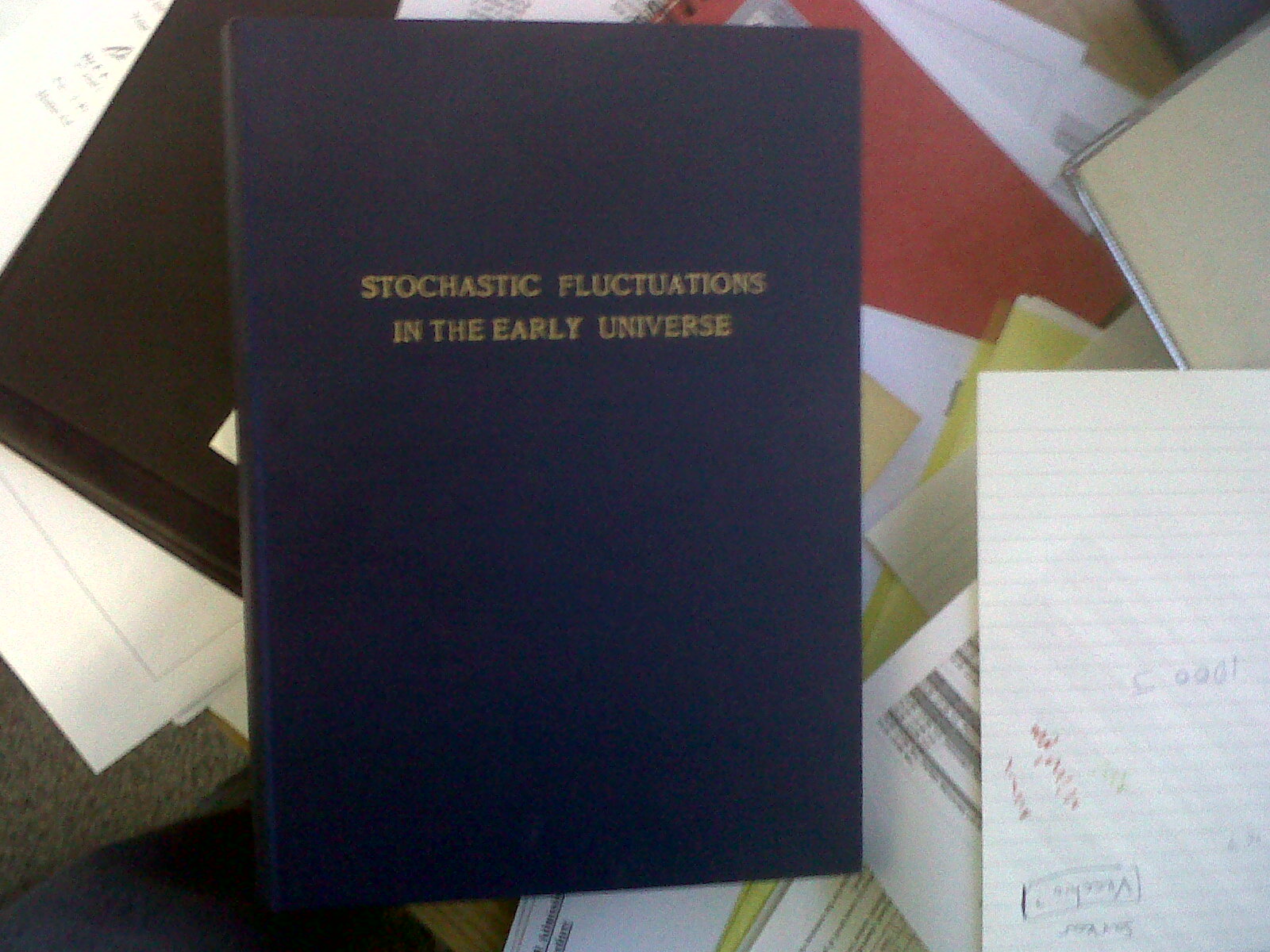
What is a PhD? The answer to that is relatively easy; it’s a postgraduate research degree. In order to obtain a PhD you have to present a thesis like that shown on the left (which happens to be mine, vintage 1988), typically in the range 100-250  pages long. A thesis has to satisfy two conditions for the award of the degree: it should contain original research, which is publishable in an academic journal; and it should present a coherent discussion of that original work within the context of ongoing work in the area of study. In Physics & Astronomy, the PhD is pretty much a prerequisite for any career in academic research, and it usually takes between 3 and 4 years to complete. After submission of the thesis you will have to undergo a viva voce examination conducted by two examiners, one internal and one external. This is quite a tough test, which  can last anywhere between about 2 and about 6 hours, during which you can be asked  detailed questions about your research and wide-ranging questions about the general area.

The Money Side. In the UK most PhDs are supported financially by the research councils, either EPSRC (most physics) or STFC (nuclear & particle physics, astronomy). These generally award quotas of studentships to departments who distribute them to students they admit. A studentship will cover your fees and pay a stipend, currently £13590 pa. That doesn’t sound like a lot, but you should at least remember that it is a stipend rather than a wage; it is therefore not taxed and there is no national insurance payable.

How do I choose a PhD? During the course of a postgraduate degree you are expected to become an expert in the area in which you specialize. In particular you should reach the point where you know more about that specific topic than your supervisor does. You will therefore have to work quite a lot on your own, which means you need determination, stamina and enthusiasm. In my view the most important criterion in your choice of PhD is not the institution where you might study but the project. You need to be genuinely excited by the topic in order to drive yourself to keep through the frustrations (of which there will be many). So, find an area that interests you and find the departments that do active research in that area by looking on the web. Check out the recent publications by staff in each department, to ensure that they are active and to have something to talk about at interview!

Qualifications. Most universities have a formal requirement that candidates for admission to the PhD should have a “good honours degree”, which basically means at least an Upper Second Class Honours degree. Some areas are more competitive than others, however, and in many disciplines you will find you are competing with a great many applicants with First Class degrees.

How to apply successfully. The application procedure at most universities is quite simple and can be done online. You will need to say something about the area in which you wish to do research (e.g. experiment/theory, and particular field, e.g. cosmology or star formation). You’ll also need a CV and a couple of references. Given the competition, it’s essential that you prepare. Give your curriculum vitae some attention, and get other people (e.g. your personal tutor) to help you improve it. It’s worth emphasizing particular skills (e.g. computing). If you get the chance, make use of your summer vacations by taking on an internship or other opportunity to get a taste of research; things like that will undoubtedly give your CV an edge.

The Interview. Good applicants will be invited for an interview, which is primarily to assess whether you have the necessary skills and determination, but also to match applicants to projects and supervisors. Prepare for your interview! You will almost certainly be asked to talk about your final-year project, so it will come across very badly if you’re not ready when they ask you. Most importantly, mug up about your chosen field. You will look really silly if you haven’t the vaguest idea of what’s going on in the area you claimed to be interested in when you wrote your  application!

Don’t be shy! There’s nothing at all wrong with being pro-active about this process. Contact academic staff at other universities by email and ask them about research, PhD opportunities. That will make a good impression. Also, don’t be afraid to ask for advice. Although we’re all keen to recruit good PhD students for our own departments, we academics are  conscious that it is also our job to give impartial advice. Ask your tutor’s opinion.

How many places should I apply for? Some research areas are more fashionable than others so the level of competition varies with field. As a general rule I would advise applying for about half-a-dozen places, chosen because they offer research in the right area. Apply to fewer than that and you might lose out to the competition. Apply to many more and you might not have time to attend the interviews.

What’s the timetable?  Most applications come in early in the new year for entry to the PhD in the following October. The Christmas break is therefore a pretty good time to get your applications sorted out. Interviews are normally held in February or March, and decisions made by late March. STFC runs a deadline system whereby departments can not force students to accept or decline offers before the end of March, so there should be ample time to visit all your prospective departments before having to make any decisions.

Here are some of the slides I used for a talk on such matters a year or so ago, which you might find useful.

That’s all I can think of for now. I hope at least some of these comments are useful to undergraduates anywhere in the UK thinking of applying for a PhD. If there are any further questions, please feel free to ask through the comments box. Likewise if I’ve missed anything important, please feel free to suggest additions in the same manner…

Old Emus for Physics

Posted in Education, The Universe and Stuff with tags , on September 3, 2013 by telescoper

It is time to reveal just a part of  the series of innovations I have been introducing to the curriculum here in the School of Mathematical and Physical Sciences at the University of Sussex, since I became head earlier this year.

In order to develop further the problem-solving skills of students in the Department of Physics & Astronomy, I have decided that  all modules OLD EMUS will henceforth be referred to by anagrams of their actual titles. For example, in the forthcoming Semester I will be teaching second-year students MONSTER DELICACY.

Among the other old emus to be taken by Year 2 students of SHY PICS are:

MANIAC MUNCH QUEST

UNFITTING COMIC SPICE

SPIN HISS SLICKLY

A TINSMITH’S DEPTH, SARCASTICALLY

ASTHMATIC MODE HALTED for SPICY SHITS

and for options there are

TRANSPLANTED ASS (compulsory for those into RACY SOPHISTS)

ATHEIST PSYCHIC LORE

This list does not include the compulsory A RICH SORT’S PLAYBOY.

I hope this clarifies the situation.

Quantum Information and Quantum Computing

Posted in The Universe and Stuff with tags , , , , , on August 23, 2013 by telescoper

Having a very late and very short lunch break today because I was involved in a series of meetings this morning all of which overran. That, together with the heat, has put me in a bit of a fluster. Anyway, while I drink my sandwich and eat a cup of tea, I thought I’d post this very cute video that I stumbled across via Twitter. It’s by Jorge Cham, the creator of Piled Higher and Deeper (known to the world as PhDcomics); you can find his blog post about these videos here.

Physics and Statistics

Posted in Bad Statistics, Education with tags , , , on August 16, 2013 by telescoper

Predictably, yesterday’s newspapers and other media  were full of feeble articles about the A-level results, and I don’t just mean the gratuitous pictures of pretty girls opening envelopes and/or jumping in the air.  I’ve never met a journalist who understood the concept of statistical significance, which seems to account for the way they feel able to write whatever they like about any numbers that happen to be newsworthy without feeling constrained by mathematical common-sense.  Sometimes it’s the ridiculous over-interpretation of opinion polls (which usually have a sampling uncertainty of ±3 %), sometimes its league tables. This time it’s the number of students getting the top grades at A-level.

The BBC, for example, made a lot of fuss about the fall in the % of A and A* A-level grades, to  26.3% this year from 26.6% last year. Anyone with a modicum of statistical knowledge would know, however, that whether this drop means anything at all depends on how many results were involved: the sampling uncertainty depends on size N approximately as √N. For a cohort of 300000 this turns into a percentage uncertainty of about 0.57%, which is about twice as large as the reported fall.  The result is therefore “in the noise” – in the sense that there’s no evidence that it was actually harder to get a high grade this year compared with last year – but that didn’t prove a barrier to those editors intent on filling their newspapers and websites with meaningless guff.

Almost hidden among the bilge was an interesting snippet about Physics. It seems that the number of students taking Physics A-level this year has exceeded 35,000 in 2013.  That was set as a government target for 2014, so it has been reached a year early.  The difference between the number that took Physics this year (35,569) and those who took it in 2006 (27,368) is certainly significant. Whether this is the so-called Brian Cox effect or something else, it’s very good news for the future health of the subject.

On the other hand, the proportion of female Physics students remains around 20%. Over the last three years the proportion has been 20.8%, 21.3% and 20.6% so numerically this year is down on last year, but the real message in these figures is that despite strenuous efforts to increase this fraction, there is no significant change.

As I write I’m formally still on Clearing business, sitting beside the telephone in case anyone needs to talk to me. However, at close of play yesterday the School of Mathematical and Physical Sciences had exceeded its recruitment target by quite a healthy margin.  We’re still open for Clearing, though, as our recent expansion means we can take a few more suitably qualified students. Physics and Astronomy did particularly well, and we’re set to welcome our biggest-ever intake into the first year in September 2013. I’m really looking forward to meeting them all.

While I’m on about statistics, here’s another thing. When I was poring over this year’s NSS results, I noticed that only 39 Physics departments appeared in the survey. When I last counted them there were 115 universities in the UK. This number doesn’t include about 50 colleges and other forms of higher education institutions which are also sometimes included in lists of universities. Anyway, my point is that at most about a third of British universities have a physics department.

Now that is a shocking statistic…

Advice for Students on Clearing

Posted in Education, The Universe and Stuff with tags , , , , on August 15, 2013 by telescoper

1-dont-panic

We still have places in the School of Mathematical & Physical Sciences at the University of Sussex. No other Physics & Astronomy department in the UK scored more highly in the latest NSS survey than ours, so whether you’re interested in Physics, Astrophysics, Astronomy or Mathematics (or even a combination of those subjects), why not just take a look at the University’s Clearing Page and give us a ring.?

As a matter of fact, I’ll be there myself from 8am this morning to talk to interested students.

11.30 UPDATE. I finished my first shift at 11am. I’ll be going back at 5pm for the last session, until the lines close at 7pm. During the last hour a minimum of 20 overs must be bowled. Or something.  The main call centre (which has fifty phone lines) is next door to where we were sitting and is operated by admissions experts and student helpers who are processing the queries and, if necessary, routing them through to academics (i.e. people like me) to provide further information or to answer specific questions. You can take a peep behind the scenes here. Some of the calls were from very anxious prospective students, and it’s a very nice feeling being able to help them sort out their course! Now back to other things until I start again this evening.


19.30 UPDATE. Phew. Finally been stood down, but I’ll be back on duty tomorrow afternoon. It’s been a very interesting day which has gone very well for us. Lines stay open until 8pm tonight and re-open at 8 in the morning and we’re still in business to see if we can give just a few more students the opportunity to study in the School next academic year. Now I’m off home to chill, probably over a glass or two of wine!

Duet for Violin and Subatomic Particles

Posted in Music, The Universe and Stuff with tags , , , on August 8, 2013 by telescoper

I received an email this morning about this video and thought I’d post the clip here. This short documentary is about the performance of the composition Cloud Chamber (“Duet for violin and subatomic particles”) in San Francisco at the California Academy of Sciences in Golden Gate Park. The video was produced by Patrick Haynes, Adam Behrmann and Chris Whitmore, and features commentaries from , e.g., Hitoshi Murayama, Professor of Physics at Berkeley and Director of the Institute of Physics and Mathematics of the Universe at the University of Tokyo (the commentaries start at 16:10). It is introduced by Professor JoAnne L. Hewitt, Head of Theoretical Physics at SLAC National Accelerator Laboratory, Stanford University. There’s a longer description on the Youtube page if you’re interested in learning more about this interesting project.

Physics Proverbs

Posted in The Universe and Stuff with tags , on July 2, 2013 by telescoper

I was a bit bored on the bus this morning, as it got stuck in a traffic jam, so decided to amuse myself (and probably nobody else) by thinking up physics-related versions of traditional proverbs and tweeting them (hashtag #physicsproverbs). I thought it might be fun to use them to indulge in a bit of audience participation, by asking the blogosphere to contribute their own through  the comments box below.

Here are some of my offerings:

  • Never mind the Q-factor, feel the FWHM
  • Don’t throw stones if there are periodic boundary conditions
  • A stitch in time may violate causality
  • A thing of beauty is now generally known as a bottom
  • No amplifier, no gain
  • Nothing is certain, except death and deterministic processes
  • Blood is thicker than dark matter
  • May the Devil take the Hindmarsh
  • Don’t change potentials in mid streamline
  • Angular momentum makes the world go round
  • Many a micro makes a mega
  • When the cat’s away the mice will annoy Dr Schrödinger
  • Ask a silly question, and you might well get a research grant
  • Discreteness is the greater part of granularity
  • There’s no time like t=0
  • The course of a random walk never did run smooth
  • Many hadrons make very few Higgs Bosons at CERN
  • Actions speak louder than differential equations
  • Radiation pressure makes light work
  • Don’t cast your PRLs before swine
  • Nature abhors most of the papers submitted there
  • Photons should be seen and not heard. As opposed to phonons.
  • Power corrupts. Absolute power has exactly the same effect because power is always positive.

You can see all the tweets resulting from the Twitter version of this game here.

Punch and Judy meet Quantum Technology

Posted in The Universe and Stuff with tags , , , , , , on June 28, 2013 by telescoper

It’s an Open Day here on campus, and there’s quite a crowd of potential students and parents gathering in the School of Mathematical and Physical Sciences here at the University of Sussex to find out a bit more about the School in advance of making decisions about where to apply next year.

I noticed the other day that quite a few of these have appeared on campus over the last few days:

IMG-20130627-00139

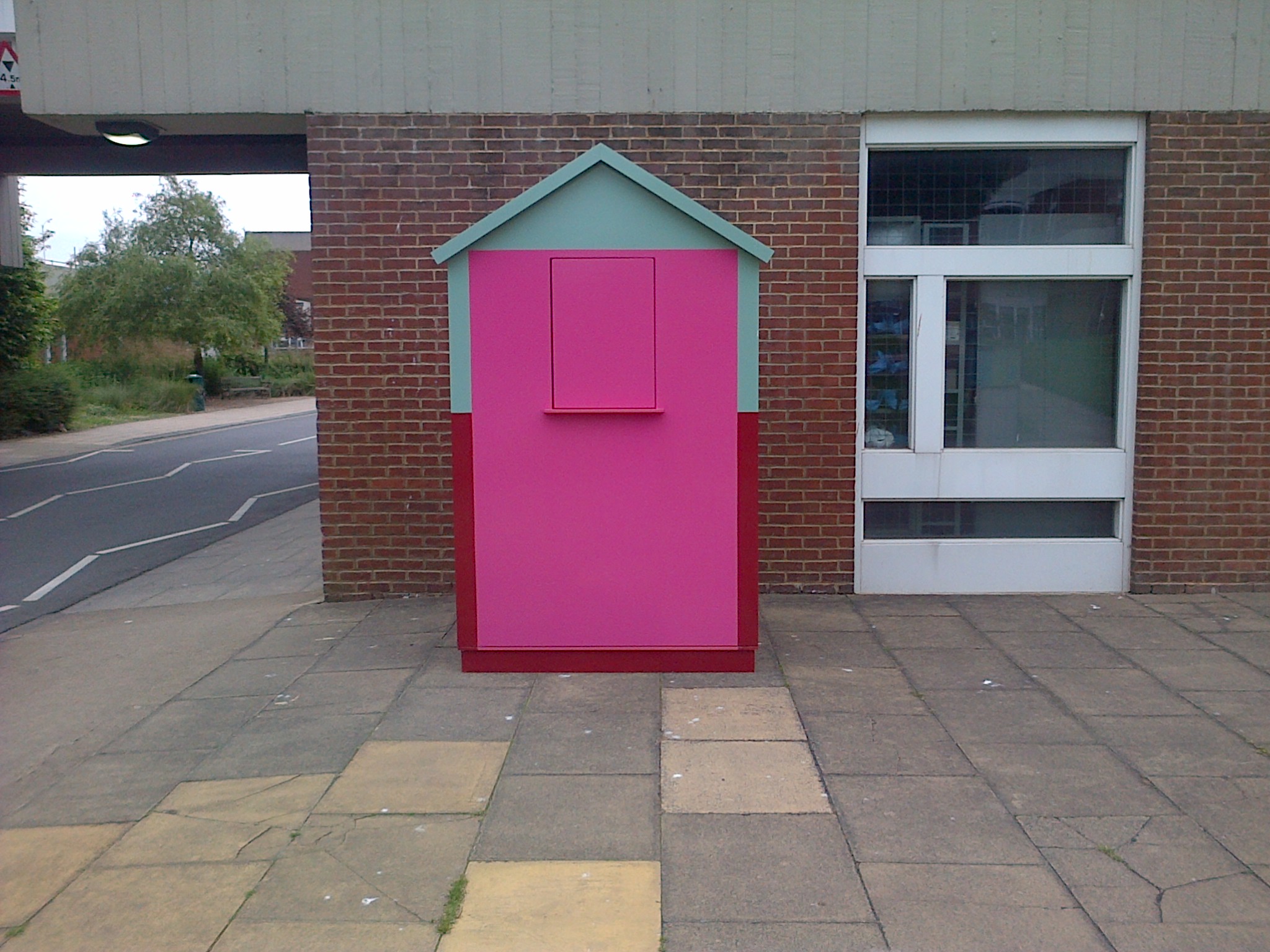
Apparently they’re information points manned by various helpers to help visitors find their way around the place. When I first saw this one, I thought it was a Punch and Judy box, so assumed that there was some sort of conference of Punch and Judy performers going on. That wouldn’t be inappropriate for a University campus, actually, because the traditional name for a Punch & Judy puppeteer is a “Professor”. Not a lot of people know that.

Anyway, none of that is really relevant to what I wanted to post today. I stumbled across this video featuring Winfried Hensinger (one of my colleagues from the Department of Physics & Astronomy within the School of Mathematical and Physical Sciences). I thought it would be fun to share it here, just to give an idea of some of the work that’s going on here outside my own speciality of astrophysics. I hope this will complement the real open day with a mini virtual open day on the blog.

Winfried is Reader in Quantum, Atomic and Optical Physics at the University of Sussex and he works in the group we generally call “AMO” (Atomic, Molecular and Optical). In this TEDX lecture he talks about the future of quantum computers and the role the team he is part of, at Sussex University, plays as they develop large scale quantum computers using ions cooled to extremely low temperatures using lasers. Enjoy!

The South-East Physics Network – The Sequel

Posted in Education, Science Politics with tags , , , , , , , , , , , , , on June 18, 2013 by telescoper

Every now and again I’m at a loss for something to blog about when a nice press release comes to the rescue. This announcement has just gone live, and I make no apology for repeating it here!


UPDATE: You can now read the University of Sussex take on this announcement here.

–0–

SEPnet_extratext_black

New Investment in Physics Teaching and Research in South East England

The South East Physics network (SEPnet) and HEFCE are delighted to announce their plans to invest £13.1 million pounds to sustain physics undergraduate and postgraduate teaching provision, and world class research facilities, staff and doctoral training over the 5 years up to 2018. HEFCE will provide £2.75 million to maintain and expand the network, to establish a dedicated regional graduate training programme for physics postgraduate students and address physics specific issues of student participation and diversity. On top of the HEFCE contribution, each SEPnet partner will support and fund programmes of Outreach, Employability and Research.

The South East Physics Network (SEPnet) was formed after receiving a £12.5 million grant from HEFCE in 2008 as a network of six Physics departments in South East England at the Universities of Kent, Queen Mary University of London, Royal Holloway University of London, Southampton, Surrey and Sussex. The Science and Technology Facilities Council and Rutherford Appleton Laboratory provided additional funds and resources for collaborations in particle physics and astrophysics. The University of Portsmouth joined in 2010. The Open University and the University of Hertfordshire will join the network effective the 1st August 2013.

SEPnet Phase One has been tremendously successful for the partners in SEPnet and for physics in the region. The Outreach programme, regarded as an exemplar for collaborative outreach, uses the combined knowledge and resources of each partner to provide greater impact and reach and demonstrates that the whole is greater than the sum of its parts. It has succeeded in effectively exploiting the growing national interest in physics through its wide range of public engagement and schools activities. There has been a substantial increase in applications and intake for physics undergraduate courses and undergraduate numbers are now 90% higher in the SEPnet physics departments compared with 2007 and applications up approximately 115% – well above national trends.

Announcing the investment, SEPnet’s Independent Chair Professor Sir William Wakeham said “This is a major success for physics both in the region and nationally. HEFCE’s contribution via SEPnet has enabled the partners in the consortium to grow and develop their physics departments for the long term. Before SEPnet, physics departments had falling student numbers and lacked research diversity. Now they are robust and sustainable and the SEPnet consortium is an exemplar of collaboration in Higher Education.”

David Sweeney, Director of Research, Innovation and Skills, HEFCE said: “We are delighted to see the fruits of a very successful intervention to support what was once a vulnerable subject. HEFCE are pleased to provide funding for a new phase, particularly to address new challenges in the field of postgraduate training and widening participation. The expansion to include new physics departments is a testament to the success of the network and can only act to strengthen and diversify the collaboration.”

Sir Peter Knight, President of the Institute of Physics, expressed strong support for the government’s continued investments in the sciences generally and in physics specifically. “SEPnet has been an undoubted success in sustaining physics in the South East region and has strongly participated in contributing to its beneficial effects nationally. It is an exemplar of collaborative best practice in outreach, employability and research and we now look forward to collaborating in the critical areas of graduate training, public engagement and diversity.”

The specific programmes already being developed by the network include:

  1. a regional Graduate Network built on the strength of current SEPnet research collaborations and graduate training whose  primary objectives  will be to:
  • develop and deliver an exemplar programme of PhD transferable and leadership skills training delivered flexibly to create employment-ready physics doctoral graduates for the economic benefit of the UK;
  • increase employer engagement with HEIs including PhD internships,  industrially-sponsored  studentships and Knowledge Transfer fellowships;
  • enhance the impact  of SEPnet’s research via a clear, collaborative impact strategy;
  • enhance research environment diversity through engagement with Athena SWAN and the IoP’s Project Juno.
  1. Expansion of its employer engagement and internship programmes, widening the range of work experiences available to enhance undergraduate (UG) and postgraduate (PG) employability and progress to research degrees.
  2. Enhancement of its Outreach Programme  to deliver and disseminate  best practice in schools and public engagement and  increase diversity in  physics education.

The inclusion of new partners The Open University and University of Hertfordshire broadens the range of teaching and postgraduate research in the network. The University of Reading, about to introduce an undergraduate programme in Environmental Physics (Department of Meteorology), will join as an associate partner.

A key part of the contributions from each partner is the provision of “SEPnet PhD Studentships”, a programme to attract the brightest and best physics graduates to engage in a programme of collaborative research within the network, of joint supervision and with a broad technical and professional graduate training programme within the SEPnet Graduate Network.

The network will be led by the University of Southampton. Its Vice-Chancellor, Professor Don Nutbeam: “I am delighted that the University of Southampton, in partnership with nine other universities in the region, is able to build on the success of the SEPnet initiative to reinvigorate the university physics teaching and research and take it to a new level in the turbulent period ahead for the higher education sector. The SEPnet training programme brings novelty, quality and diversity to the regions physics postgraduates that we expect to be a model for other regions and subjects.”

A Question of Bores

Posted in Cute Problems, The Universe and Stuff with tags , , , on June 7, 2013 by telescoper

I was at a lengthy meeting this morning so naturally there popped into my mind the subject of bores. The most prominent of these that will be familiar to British folk is the Severn Bore, but they happen in a variety of locations, including Morecambe Bay (which is in the Midlands):

Tidal_Bore_-_geograph.org.uk_-_324581

As you can see, a bore consists of a steep wavefront that travels a long distance without disruption, and is one manifestation of a more general phenomenon called a hydraulic jump; in a coordinate frame that moves with the wavefront, a bore is basically identical to a stationary hydraulic jump.

Anyway, I while ago I decided to set an examination question about this, which I reproduce here in severely edited form for your amusement and edification; you can click on it to make it larger if you have difficulty reading the question. With the examination season over I’m sure there are many people out there missing the opportunity to grapple with physics problems! Or perhaps not…

Bore

If you need hints, I suggest first working out how the pressure P varies with depth and then using the result to work out to work out the balance of forces either side of the discontinuity. Then deploy Bernoulli’s theorem and Bob’s your uncle!

P.S. For another hint, try the yellow pages:

Boring