Archive for Physics

Reffing Madness

Posted in Science Politics with tags , , , , , , , , , , on June 30, 2012 by telescoper

I’m motivated to make a quick post in order to direct you to a blog post by David Colquhoun that describes the horrendous behaviour of the management at Queen Mary, University of London in response to the Research Excellence Framework. It seems that wholesale sackings are in the pipeline there as a result of a management strategy to improve the institution’s standing in the league tables by “restructuring” some departments.

To call this strategy “flawed” would be the understatement of the year. Idiotic is a far better word.  The main problem being that the criteria being applied to retain or dismiss staff bear no obvious relation to those adopted by the REF panels. To make matters worse, Queen Mary has charged two of its own academics with “gross misconduct” for having the temerity to point out the stupidity of its management’s behaviour. Read on here for more details.

With the deadline for REF submissions fast approaching, it’s probably the case that many UK universities are going into panic mode, attempting to boost their REF score by shedding staff perceived to be insufficiently excellent in research and/or  luring  in research “stars” from elsewhere. Draconian though the QMUL approach may seem, I fear it will be repeated across the sector.  Clueless university managers are trying to guess what the REF panels will think of their submissions by staging mock assessments involving external experts. The problem is that nobody knows what the actual REF panels will do, except that if the last Research Assessment Exercise is anything to go by, what they do will be nothing like what they said they would do.

Nowhere is the situation more absurd than here in Wales. The purported aim of the REF is to allocated the so-called “QR” research funding to universities. However, it is an open secret that in Wales there simply isn’t going to be any QR money at all. Leighton Andrews has stripped the Higher Education budget bare in order to pay for his policy of encouraging Welsh students to study in England by paying their fees there.

So here we have to enter the game, do the mock assessments, write our meaningless “impact” cases, and jump through all manner of pointless hoops, with the inevitable result that even if we do well we’ll get absolutely no QR money at the end of it. The only strategy that makes sense for Welsh HEIs such as Cardiff University, where I work, is to submit only those researchers guaranteed to score highly. That way at least we’ll do better in the league tables. It won’t matter how many staff actually get submitted, as the multiplier is zero.

There’s no logical argument why Welsh universities should be in the REF at all, given that there’s no reward at the end. But we’re told we have to by the powers that be. Everyone’s playing games in which nobody knows the rules but in which the stakes are people’s careers. It’s madness.

I can’t put it better than this quote:

These managers worry me. Too many are modest achievers, retired from their own studies, intoxicated with jargon, delusional about corporate status and forever banging the metrics gong. Crucially, they don’t lead by example.

Any reader of this blog who works in a university will recognize the sentiments expressed there. But let’s not blame it all on the managers. They’re doing stupid things because the government has set up a stupid framework. There isn’t a single politician in either England or Wales with the courage to do the right thing, i.e. to admit the error and call the whole thing off.

R.I.P. Prof. John G. Taylor

Posted in The Universe and Stuff with tags , , , , , , , on June 27, 2012 by telescoper

I just received an email from Ian Ridpath pointing out that Professor John G. Taylor had died back in March 2012. The news had passed me by, and I’m quite surprised that there’s very little about this news on the internet with the exception of a brief announcement from the Department of Mathematics at King’s College London:

The Department is very sorry to announce the death of Professor John G. Taylor (JGT) on 10th March. John Taylor was appointed to the established Chair in Applied Mathematics at King’s College London in 1971. His research interests were wide, ranging over high energy physics, superstrings, quantum field theory and quantum gravity, neural computation, neural bases of behaviour and mathematical modelling in neurobiology. He was formidably energetic and remained actively engaged in research until his death.

His name came up on a post of mine a while ago of which the following is an excerpt.

In the 1970s, when Uri Geller was at the height of his popularity,  Professor Taylor took great interest in him and the things that he appeared to be able to do. Professor of applied mathematics at King’s College, London, Taylor was (and remains) a very distinguished scientist and was the first to take the paranormal phenomena displayed by Geller seriously. When Uri Geller visited Britain in 1974, Taylor conducted scientific tests of Geller’s feats of metal bending using all the paraphernalia of modern science, including a Geiger counter. Taylor also experimented with some of the children and adults who claimed to manifest psychic abilities after seeing Uri Geller’s appearances on British television programs. Taylor’s interest in such phenomena was not only in its scientific validation, but also in investigation of the way in which such phenomena take place and the nature of the forces involved. He suggested the phenomena may be some low-frequency electromagnetic effect generated by human beings.

Through the 1970s Taylor was regarded as fully endorsing the paranormal metal bending of Uri Geller, but gradually has made more guarded statements; then in 1980 he largely retracted his support for Geller’s paranormal talents. In 1974 he wrote

The Geller effect—of metal-bending—is clearly not brought about by fraud. It is so exceptional it presents a crucial challenge to modern science and could even destroy the latter if no explanation became available.

Taylor then spent three years of careful investigation of such phenomena as psychokinesis, metal bending, and dowsing, but could not discover any reasonable scientific explanation or validation that satisfied him. He was particularly concerned to establish whether there is an electromagnetic basis for such phenomena. After failing to find this he did not believe that there was any other explanation that would suffice. Most of his experiments under laboratory conditions were negative; this left him in a skeptical position regarding the validity of claimed phenomena.

In contrast to the endorsement in his first book, Superminds, he published a paper expressing his doubts in a paper in Nature (November 2, 1978) titled “Can Electromagnetism Account for Extra-sensory Phenomena?” He followed this with his book Science and the Supernatural (1980) in which he expressed complete skepticism about every aspect of the paranormal. In his final chapter he stated:

We have searched for the supernatural and not found it. In the main, only poor experimentation [including his own], shoddy theory, and human gullibility have been encountered.

Taylor’s investigation of the Geller effect is interesting because it shows that physics doesn’t have all the answers all the time, particularly not when the phenomena in question involve people. Physics research proceeds by assuming that Nature is not playing tricks, and that what can be measured must represent some sort of truth. This faith can be easily exploited by a charlatan. James Randi always argued that scientists aren’t the right people to detect tricks performed by people. This is best left to tricksters. There’s no reason to believe that a theoretical physicist – no matter how brilliant – can spot the way a clever deception is carried out. The best person to see that is a magician, someone like James Randi. Set a thief to catch a thief, and all that.

More Order-of-Magnitude Physics

Posted in Cute Problems, Education with tags , , , on June 27, 2012 by telescoper

A very busy day today so I thought I’d just do a quick post to give you a chance to test your brains with some more order-of-magnitude physics problems. I like using these in classes because they get people thinking about the physics behind problems without getting too bogged down in or turned off by complicated mathematics. If there’s any information missing that you need to solve the problem, make an order-of-magnitude estimate!

Give  order of magnitude answers to the following questions:

  1. What is the tension in a violin string?
  2. By how much would the temperature of the Earth increase if all its rotational energy were converted to heat?
  3. What fraction of the Earth’s water is in its atmosphere?
  4. How much brighter is sunlight than moonlight?
  5. What is the mass of water in a soap bubble?

There’s no prize involved, but feel free to post answers through the comments box. It would be helpful if you explained a  bit about how you arrived at your answer!

A Return to O-levels?

Posted in Education, The Universe and Stuff with tags , , , , , , , on June 21, 2012 by telescoper

I woke up this morning as usual to the 7am news on BBC Radio 3, which included an item about how Education Secretary Michael Gove is planning to scrap the current system of GCSE Examinations and replace them with something more like the old GCE O-levels, which oldies like me took way back in the mists of time.

There is a particular angle to this in Wales, because Michael Gove doesn’t have responsibility for education here. That falls to the devolved Welsh Government, and in particular to Leighton Andrews. He’s made it quite clear on Twitter that he has no intention to take  Wales  back to O-levels. Most UK media sources – predominantly based in London – seem to have forgotten that Gove speaks for England, not for the whole United Kingdom.

This is not the central issue, however. The question is whether GCSEs are, as Michael Gove claims, “so bad that they’re beyond repair”. Politicians, teachers and educationalists are basically saying that students are doing better; others are saying that the exams are easier. It’s a shouting match that has been going for years and which achieves very little. I can’t add much to it either, because I’m too old to have done GCSEs – they hadn’t been invented then. I did O-levels.

It does, however, give me the excuse to show you  the O-level physics paper I took way back in 1979. I’ve actually posted this before, but it seems topical to put it up again:

You might want to compare this with a recent example of an Edexcel GCSE (Multiple-choice) Physics paper, about which I have also posted previously.

I think most of the questions in the GCSE paper are much easier than the O-level paper above. Worse, there are many that are so sloppily put together that they  don’t make any sense at all. Take Question 1:

I suppose the answer is meant to be C, but since it doesn’t say that A is the orbit of a planet, as far as I’m concerned it might just as well be D. Are we meant to eliminate D simply because it doesn’t have another orbit going through it?

On the other hand, the orbit of a moon around the Sun is in fact similar to the orbit of its planet around the Sun, since the orbital speed and radius of the moon around its planet are smaller than those of the planet around the Sun. At a push, therefore you could argue that A is the closest choice to a moon’s orbit around the Sun. The real thing would be something close to a circle with a 4-week wobble variation superposed.

You might say I’m being pedantic, but the whole point of exam questions is that they shouldn’t be open to ambiguities like this, at least if they’re science exams. I can imagine bright and knowledgeable students getting thoroughly confused by this question, and many of the others on the paper.

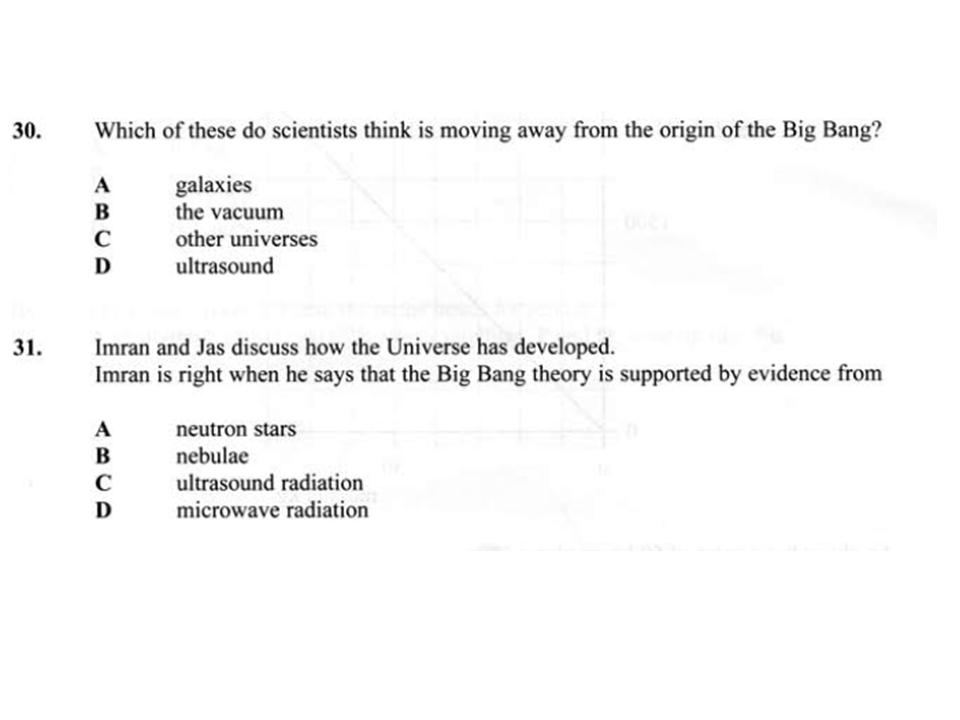
Here’s a couple more, from the “Advanced” section:

The answer to Q30 is, presumably, A. But do any scientists really think that galaxies are “moving away from the origin of the Big Bang”?  I’m worried that this implies that the Big Bang was located at a specific point. Is that what they’re teaching?

Bearing in mind that only one answer is supposed to be right, the answer to Q31 is presumably D. But is there really no evidence from “nebulae” that supports the Big Bang theory? The expansion of the Universe was discovered by observing things Hubble called “nebulae”..

I’m all in favour of school students being introduced to fundamental things such as cosmology and particle physics, but my deep worry is that this is being done at the expense of learning any real physics at all and is in any case done in a garbled and nonsensical way.

Lest I be accused of an astronomy-related bias, anyone care to try finding a correct answer to this question?

The more of this kind of stuff I see, the more admiration I have for the students coming to study physics and astronomy at University. How they managed to learn anything at all given the dire state of science education represented by this paper is really quite remarkable.

Ultimately, however, the issue is not whether we have GCSEs or O-level examinations. There’s already far too much emphasis in the education system on assessment instead of   learning. That runs all the way through schools and into the university system. The excessive time we spend examining students reduces what we can teach them and turns the students’ learning experience into something resembling a treadmill. I agree that we need better examinations than we have now, but we also need   fewer. And we need to stop being obsessed by them.

The End of the Viva

Posted in Biographical, Education with tags , , , , , on June 13, 2012 by telescoper

I’m stuck at home today, waiting for UPS to come and collect a defective printer. Any time between 9am and 7pm, they said. Very helpful. Anyway, I’ve got plenty to do while I’m here, catching up on STFC Astronomy Grant Panel business that I’ve been too busy to attend to. Also, this week’s Private Eye has just arrived in the post, so I’ll take a break at some point to do the crossword by Cyclops. It’s a lovely day. Pity I can’t sit in the garden. I’d miss the doorbell when the carrier arrives.

Anyway, the past two days have been largely given over to the business of examinations in the School of Physics & Astronomy at Cardiff University. The External Examiners spent a big slice of Monday doing viva voce examinations of selected candidates; not just those on borderlines, but also some others for “calibration”. I wasn’t involved in them this year, but have taken part in the past as External in various places. Obviously these examinations are very stressful for the students, and also quite difficult to conduct fairly, but sometimes provide useful insights in the cases where a student’s marks put them on a knife-edge between two degree classifications (or even between pass and fail).

Anyway, in its infinite wisdom Cardiff University has decided to scrap the viva voce examination after next year. From 2014 onwards we’ll just have to apply a formula to deal with borderline cases; the algorithm involves counting how many modules were passed at the higher level, etc. Actually, I probably agree with this for the purposes of classifying degrees. Twenty minutes’ questioning under stress can hardly be expected to yield much objective  information about a candidate’s knowledge of the subject that dozens of written papers and other assessments. Often, in my experience, students (especially the shy ones) are so nervous that the shutters come down almost straight away.  I would  prefer a system which is algorithmic as possible, so everyone knows what the rules are, rather than relying on subjective judgements.

As external, I always found the viva examinations a useful way of getting feedback from the students on their course which can be fed back – either usefully or not – to the department. In losing the viva  for drawing up the classification lists, I hope that we can find another way for the externals to talk to students in some other context to get some feedback about the course. Perhaps they could attend for project talks, or something like that?

Yesterday, the entire Board of Examiners (including Externals) gathered to go through all the individual cases and draw up the Honours List. I was delighted when I saw all the consolidated marks in advance of the meeting, to see how well how many of our students had done. There were one or two difficult cases, but in the end we produce the lists. As I went back to my office, students were already gathering in the corridor by the noticeboard where it is always placed as soon as the definitive final version has been prepared, shortly after the meeting closed.

Soon I heard whoops of joy and laughter and had a quick look to see the students congratulating one another. As always on such occasions, I was tempted to go along and chat to a few of them but, as always, I resisted doing so. It’s a time for them, the students, not us, the staff.

Anyway, congratulations to all those who had good news yesterday!

I hope your hangovers aren’t too bad…

Teaching (about) Physics

Posted in Education with tags , , , on June 10, 2012 by telescoper

So the academic year nears its end. This week we have the dreaded meetings of the Examination Boards, complete with External Examiners, ordeal by viva voce for selected students, and finally the lists go up announcing success (or otherwise) for this year’s finalists. It’s all a lot of work – and I’m sure also extremely stressful for the students waiting for their results.

If it’s any consolation for any students reading this post, I can assure you that there’s no lack of stress on this side of the fence either. I always feel a sense of dread opening the packets of examination scripts, and this year was no different. Have I set the exam too hard? Will the marks be a fair reflection of the students’ ability? Have they learned anything at all from the hours I spent droning on? These questions are all the more apt for a third-year class, since these are the papers that really count in determining the final outcome of their course. When the lists go up later this week, one’s delight at the sight of happy (or relieved) faces is always tempered by sadness when things have obviously gone wrong.

Coincidentally, I noticed the other day that a former student from the School of Physics and Astronomy at Cardiff University posted an item on her blog giving her view of her degree. It’s a very frank assessment of her own opinion of the course she took, including a list of her  three favourite courses. None of the ones I lectured are amongst them, by the way, in case you think I’m mentioning it for egocentric reasons. Indeed, I’m pretty confident that I’m one of the lecturers she didn’t like at all!

The main thing is that, for better or worse, our course involves an enormous amount of contact time with academic staff.  In the new fee regime students will pay the same £9K for a science course as they would for the Arts and Humanities:

See, doing a Physics and Astronomy degree, I had about 20 contact hours. With lab time. so in one month I had out stripped the BA people for an entire academic year. So in the 12 weeks of one semester, I have had more contact time than they will get in their entire degree. Worth it?

As for whether we make the best use of the time we devote to teaching, that’s a different matter. We have in fact recently overhauled the entire curriculum so we’ll see whether that has the desired effect. One can’t please all of the people all of the time, so we’ve tried to introduce new teaching methods – e.g. fewer lectures, more problems classes – to try to engage better with more students. Only time will tell whether it works.

Anyway, although it’s not one of the topics of her post, Harriet’s blog brought something from the back of my mind where it usually lurks ready to trouble me when I start to think about teaching physics. The point is that most of us involved in teaching physics at University level think that what we should be doing is training people to be professional physicists. That means teaching them to do physics the way it is actually done by people who do research. That means that, especially in Astronomy, students have to grapple with strange unit systems, peculiar terminology and quite a lot of maths. Those aren’t put into our courses in order to torment students – they’re there in the curriculum because they’re there in the world of (astro)physics research. It would be dishonest for us to pretend we were training physicists if we made out that it was all easier than it actually is.

What I mean to say is that I don’t think it should be our job to present physics in a way that’s different from (specifically easier than) the way it is  done at the coalface, in the world of scientific research.  What we should be doing is giving students the skills and confidence to solve the difficult problems a scientist can expect to confront in that situation. To be honest I don’t think we do that particularly well either, but that’s the aim. And that’s why our courses are mainly taught by people who actually do physics and why we claim our teaching is research-led.

That’s an oversimplification, of course. Especially in earlier years, much of the undergraduate curriculum – Newtonian Mechanics, Electromagnetism, Quantum Mechanics, etc  – is not “frontier” stuff so probably doesn’t require an active researcher to teach it. On the other hand, none of that is exactly easy so anyone who is going to teach it competently needs to have mastered it themselves. And in later years, the more specialist material and projects certainly require an active research environment.

Anyway, the point is that  in the new fee regime science courses will attract the same level of funding as courses in, e.g. English Literature. But a course in Physics requires physicists to teach it, while a course in literature does not require a team of successful novelists. Given the fact that the way we teach physics is more expensive by a very large margin, should we be rethinking our approach to the basic physics degree, and leave all the fancy research-led stuff to Masters courses?

Should we really be trying to teach all our students how to do physics? Or should we just be teaching them about physics?

The Transparent Dishonesty of the Research Excellence Framework

Posted in Open Access, Science Politics with tags , , , , , , on May 30, 2012 by telescoper

Some of my colleagues in the School of Physics & Astronomy recently attended a briefing session about the  forthcoming Research Excellence Framework. This, together with the post I reblogged earlier this morning, suggested that I should re-hash an article I wrote some time ago about the arithmetic of the REF, and how it will clearly not do what it says on the tin.

The first thing is the scale of the task facing members of the panel undertaking the assessment. Every research active member of staff in every University in the UK is requested to submit four research publications (“outputs”) to the panel, and we are told that each of these will be read by at least two panel members. The Physics panel comprises 20 members.

As a rough guess I’d say that the UK has about 40 Physics departments, and the average number of research-active staff in each is probably about 40. That gives about 1600 individuals for the REF. Actually the number of category A staff submitted to the 2008 RAE was 1,685.57 FTE (Full-Time Equivalent), pretty close to this figure. At 4 outputs per person that gives 6400 papers to be read. We’re told that each will be read by at least two members of the panel, so that gives an overall job size of 12800 paper-readings. There are 20 members of the panel, so that means that between 29th November 2013 (the deadline for submissions) and the announcement of the results in December 2014 each member of the panel will have to have read 640 research papers. That’s an average of about two a day. Every day. Weekends included.

Now we are told the panel will use their expert judgment to decide which outputs belong to the following categories:

  • 4*  World Leading
  • 3* Internationally Excellent
  • 2* Internationally Recognized
  • 1* Nationally Recognized
  • U   Unclassified

There is an expectation that the so-called QR  funding allocated as a result of the 2013 REF will be heavily weighted towards 4*, with perhaps a small allocation to 3* and probably nothing at all for lower grades. In other words “Internationally recognized” research will probably be deemed completely worthless by HEFCE. Will the papers belonging to the category “Not really understood by the panel member” suffer the same fate?

The panel members will apparently know enough about every single one of the papers they are going to read in order to place them  into one of the above categories, especially the crucial ones “world-leading” or “internationally excellent”, both of which are obviously defined in a completely transparent and objective manner. Not.

We are told that after forming this judgement based on their expertise the panel members will “check” the citation information for the papers. This will be done using the SCOPUS service provided (no doubt at considerable cost) by   Elsevier, which by sheer coincidence also happens to be a purveyor of ridiculously overpriced academic journals. No doubt Elsevier are  on a nice little earner peddling meaningless data for the HECFE bean-counters, but I haven’t any confidence that it will add much value to the assessment process.

There have been high-profile statements to the effect that the REF will take no account of where the relevant “outputs”  are published, including a recent pronouncement by David Willetts. On the face of it, that would suggest that a paper published in the spirit of Open Access in a free archive would not be disadvantaged. However, I very much doubt that will be the case.

I think if you look at the volume of work facing the REF panel members it’s pretty clear that citation statistics will be much more important for the Physics panel than we’ve been led to believe. The panel simply won’t have the time or the breadth of understanding to do an in-depth assessment of every paper, so will inevitably in many cases be led by bibliometric information. The fact that SCOPUS doesn’t cover the arXiv means that citation information will be entirely missing from papers just published there.

The involvement of  a company like Elsevier in this system just demonstrates the extent to which the machinery of research assessment is driven by the academic publishing industry. The REF is now pretty much the only reason why we have to use traditional journals. It would be better for research, better for public accountability and better economically if we all published our research free of charge in open archives. It wouldn’t be good for academic publishing houses, however, so they’re naturally very keen to keep things just the way they are. The saddest thing is that we’re all so cowed by the system that we see no alternative but to participate in this scam.

Incidentally we were told before the 2008 Research Assessment Exercise that citation data would emphatically not be used;  we were also told afterwards that citation data had been used by the Physics panel. That’s just one of the reasons why I’m very sceptical about the veracity of some of the pronouncements coming out from the REF establishment. Who knows what they actually do behind closed doors?  All the documentation is shredded after the results are published. Who can trust such a system?

To put it bluntly, the apparatus of research assessment has done what most bureaucracies eventually do; it has become  entirely self-serving. It is imposing increasingly  ridiculous administrative burdens on researchers, inventing increasingly  arbitrary assessment criteria and wasting increasing amounts of money on red tape which should actually be going to fund research.

EPSRC Blues

Posted in Science Politics with tags , , , , , on May 15, 2012 by telescoper

I woke up this morning to find via Twitter an interesting blog post about a demonstration in London against the policies of the Engineering and Physical Sciences Research Council (EPSRC).

For those of you not up with the ins and outs of the UK science funding regime, EPSRC is the agency that funds the more mainstream areas of physics (as well as chemistry, engineering and some mathematics) while the more exotic bits (particle physics, nuclear physics and astronomy) are the responsibility of the Science and Technology Facilities Council (STFC). The current protest seems to be lead by a number of eminent chemists, including Prof. Sir Harry Kroto, Prof. Sir John Cadogan and Prof. Anthony Barrett.

Almost five years ago – was it really so long? – owing to a mixture of funding cuts and incompetent management, STFC was born into a financial crisis that made many of us doing astronomy and particle physics wish that we also were protected by the friendly hands of EPSRC rather than left out in the cold as we felt we were at STFC. Things have slowly improved at STFC, which now has an executive team that actually seems to listen to its community as well as speaking the language that Whitehall wants to hear. Funding is still tight, but STFC is a noticeably happier ship now than it was it first launched.

In the meantime, any envy we might have had about our colleagues in, e.g., condensed matter physics being safer in the EPSRC stable has now well and truly evaporated. Their strategy, “Shaping Capability“, expressed in dreadful management-speak, involves the imposition of arbitrary priorities such as the restriction of fellowship applications to certain areas chosen by The Management. Worse, its new funding rules attempt to target funding at commercially-driven research. Dark clouds are gathering in the “blue skies” under which UK science has hitherto flourished.

The unresponsive top-down character of EPSRC has strengthened under the leadership of David Delpy who must have been made in the same factory as Keith Mason, former Chief Executive of STFC, whose diplomatic skills were similarly remarkable by their absence.

For some reason, this reminds me of the following quote from Smiley’s People

In my time, Peter Guillam, I’ve seen Whitehall skirts go up and come down again. I’ve listened to all the excellent argument for doing nothing, and reaped the consequent frightful harvest. I’ve watched people hop up and down and call it progress. I’ve seen good men go to the wall and the idiots get promoted with a dazzling regularity.

I’ve argued before that I think EPSRC’s approach is fundamentally wrong. When taxpayers’ money used is used to generate immediate commercial returns, it ends up in the pockets of entrepreneurs when the research succeeds and, if it doesn’t, the grant has effectively been wasted. Commercial Impact should not be a factor in awarding public funding, because it is perfectly suited as a criterion for attracting private funding. This is why we have a national fiscal policy: the only justification for levying taxation is to fund projects which will not yield short-term economic returns. There is no reason to spend public money on commercial projects: we need to justify pure research by a non-economic valuation.

This morning EPSRC have issued a press release calling upon scientists to work together ahead of the forthcoming comprehensive spending review. It doesn’t mention the demonstration, or other manifestations of unrest within the EPSRC community, but instead re-asserts the need for its so-called strategy, with a clear message not to rock the boat ahead of the next Comprehensive Spending Review.

I’ve heard that argument many times in the context of STFC during its crisis period. I firmly believe that rocking the boat in that case helped it get off the rocks. It remains to be seen whether the EPSRC protest, which is currently rather small, will gather enough momentum to make a difference. It all depends on what fraction of EPSRC scientists have actually signed up to the Delpy Agenda. Is the new campaign representative of the views of the EPSRC community? No doubt many research groups will be prospering under the new regime, at least in the short term. Time alone will tell what the long-term impact of short-termism will be.

Rigid Body Sings

Posted in Poetry, The Universe and Stuff with tags , , , , on May 14, 2012 by telescoper

Gin a body meet a body
Flyin’ thro the air,
Gin a body hit a body,
Will it fly? And where?

Ilka impact has its measure
Ne’er a’ ane hae I
Yet a’ the lads they measure me,
Or, at least, they try.

Gin a body meet a body
Altogether free,
How they travel afterwards
We do not always see.

Ilka problem has its method
By analytics high;
For me, I ken na ane o’ them,
But what the waur am I?

by James Clerk Maxwell (1831-1879)

P.S. This poet is of course much better known as a physicist, but this is a nice little parody of Robert Burns’ Comin’ through the Rye in authentic Scots.

Dielectric Breakdown

Posted in The Universe and Stuff with tags , , on May 9, 2012 by telescoper

This is the season when our  second-year students are picking the projects they want to do in their third year, as are those third-year students intending to carry on for Year 4 of the MPhys programme. I’ve been chatting to quite a few students about this particular project so thought I’d do a quick post here.


One of the third-year projects I’ve got in the current catalogue for next year concerns a computer model of dielectric breakdown based on the idea of diffusion-limited aggregation. This is  a neat model that allows the students to simulate pretty patterns like the one shown on the left.

The mathematics of it was first presented in Niemeyer, L., Pietronero, L., Wiesmann, H., “Fractal dimension of dielectric breakdown,” Physical Review Letters 52 (1984), 1033-1036.

Dielectric breakdown happens when a sufficiently large voltage is applied across a material that doesn’t normally conduct electricity, the classic example being a lightning strike. Here’s another example, which I find particularly electrifying…

Classical physics can be fun, you know!