Archive for Physics

B2FH

Posted in The Universe and Stuff with tags , , , , , , , , on March 22, 2012 by telescoper

I spent a pleasant evening yesterday at a public lecture arranged by Cardiff Scientific Society and given by Professor Mike Edmunds, former Head of the School of Physics & Astronomy at Cardiff University and now Emeritus Professor here. The subject of his talk was Origin of the Chemical Elements, a subject Mike has worked on for many years. Here’s the abstract of his talk:

When the Universe was 300,000 years old, the only chemical elements with significant abundance were hydrogen, helium and a small amount of lithium. All the atoms of all the other elements in the Periodic Table have been synthesised during the 13.7 billion years since that time. Research in physics and astronomy over the last 64 years has allowed us to identify the nuclear processes involved, including the importance of the humble neutron in the manufacture of the heavier elements. We now have a good picture of the astronomical sites where elements such as the carbon, nitrogen, oxygen and iron in our bodies were made, including violent supernova explosions. It is a picture that appears almost, but not quite, complete.

That last sentence is tempting fate a bit, but it’s fair comment! The lecture, which I had the pleasure of chairing, was both entertaining and informative, and very warmly received by the large audience in the Reardon Smith Lecture Theatre (in the National Museum of Wales).

Inevitably in a talk on this subject, the subject came up of the classic work of Burbidge, Burbidge, Fowler and Hoyle in 1957 (a paper usually referred to as B2FH after the initials of its authors). It’s such an important contribution, in fact, that it has its own wikipedia page

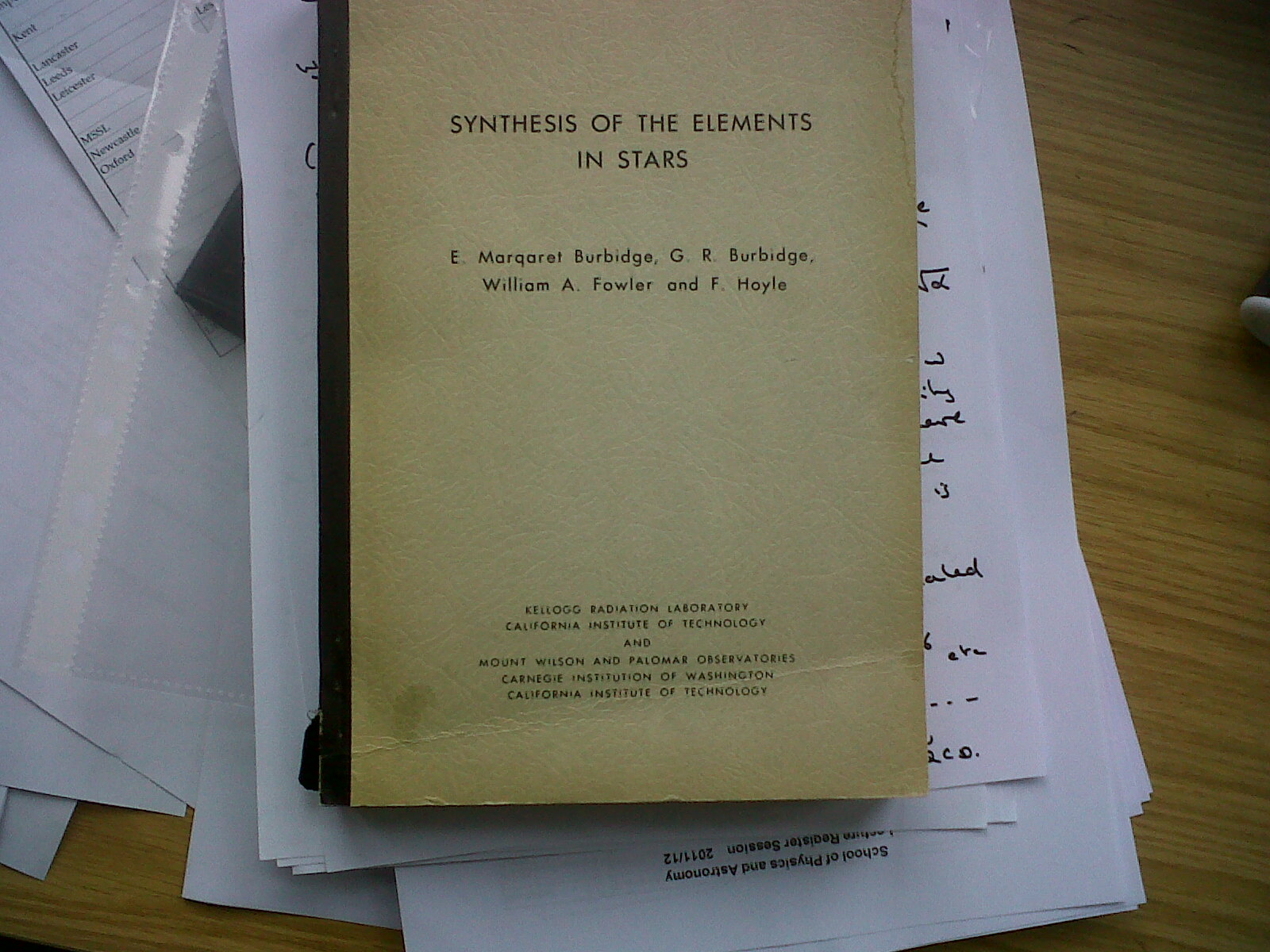
This reminded me that one of the interesting astronomical things I’ve acquired over the years is a preprint of the B2FH paper. Younger readers will probably not be aware of preprints – we all used to post them in large numbers to (potentially) interested colleagues before publication to get comments – because in the age of the internet people don’t really bother to make them any more.

Anyway, here’s a snap of it.

It’s a hefty piece of work, and an important piece of astronomical history. In years to come perhaps it may even acquire some financial value. Who knows?

Teaching Physics

Posted in Education, The Universe and Stuff with tags , , on March 22, 2012 by telescoper

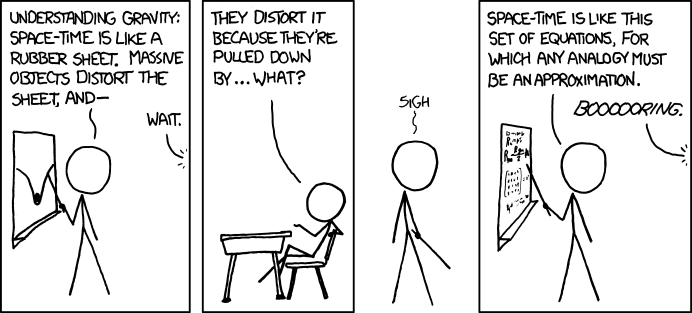
More on this weeks’ theme, from the inestimable xkcd

Failed Physics Teaching Analogies

Posted in Education, The Universe and Stuff with tags , , , , , , , on March 18, 2012 by telescoper

Last week I deputized for a colleague who was skiving off away at an important meeting so, for the first time ever in my current job, I actually got to give a proper lecture on cosmology. As the only out-and-out specialist in cosmology research in the School of Physics and Astronomy at Cardiff, I’ve always thought it a bit strange that I’ve never been asked to teach this subject to undergraduates, but there you are. Ours not to reason why, etc. Anyway, the lecture I gave was about the cosmic microwave background, and since I have taught cosmology elsewhere in the past it was quite easy to cobble something together.

As a lecturer you find, over the years, that various analogies come to mind that you think will help students understand the physical concepts underpinning what’s going on, and that you hope will complement the way they are developed in a more mathematical language. Sometimes these seem to work well during the lecture, but only afterwards do you find out they didn’t really serve their intended purpose. Sadly it also  sometimes turns out that they can also confuse rather than enlighten…

For instance, the two key ideas behind the production of the cosmic microwave background are recombination and the consequent decoupling of matter and radiation. In the early stages of the Big Bang there was a hot plasma consisting mainly of protons and electrons in an intense radiation field. Since it  was extremely hot back then  the plasma was more-or-less  fully ionized, which is to say that the equilibrium for the formation of neutral hydrogen atoms via

p+e^{-} \rightarrow H+ \gamma

lay firmly to the left hand side. The free electrons scatter radiation very efficiently via Compton  scattering

\gamma +e^{-} \rightarrow \gamma + e^{-}

thus establishing thermal equilibrium between the matter and the radiation field. In effect, the plasma is opaque so that the radiation field acquires an accurate black-body spectrum (as observed). As long as the rate of collisions between electrons and photons remains large the radiation temperature adjusts to that of the matter and equilibrium is preserved because matter and radiation are in good thermal contact.

Eventually, however, the temperature falls to a point at which electrons begin to bind with protons to form hydrogen atoms. When this happens the efficiency of scattering falls dramatically and as a consequence the matter and radiation temperatures are no longer coupled together, i.e. decoupling occurs; collisions can longer keep everything in thermal equilibrium. The matter in the Universe then becomes transparent, and the radiation field propagates freely as a kind of relic of the time that it was last in thermal equilibrium. We see that radiation now, heavily redshifted, as the cosmic microwave background.

So far, so good, but I’ve always thought that everyday analogies are useful to explain physics like this so I thought of the following. When people are young and energetic, they interact very effectively with everyone around them and that process allows them to keep in touch with all the latest trends in clothing, music, books, and so on. As you get older you don’t get about so much , and may even get married (which is just like recombination, in that it dramatically  reduces your cross-section for interaction with the outside world). Changing trends begin to pass you buy and eventually you become a relic, surrounded by records and books you acquired in the past when you were less introverted, and wearing clothes that went out of fashion years ago.

I’ve used this analogy in the past and students generally find it quite amusing even if it has modest explanatory value. I wasn’t best pleased, however, when a few years ago I set an examination question which asked the students to explain the processes of recombination and decoupling. One answer said “Decoupling explains Prof. Coles’ terrible fashion sense”. Grrr.

An even worse example happened when I was teaching particle physics some time ago. I had to explain neutrino oscillations, a process in which neutrinos (which have three distinct flavour states, associated with the electron, mu and tau leptons) can change flavour as they propagate. It’s quite a weird thing to spring on students who previously thought that lepton number was always conserved so I decided to start with an analogy based on more familiar physics.

A charged fermion such as an electron (or in fact anything that has a magnetic moment, which would include, e.g. the neutron)  has spin and, according to standard quantum mechanics, the component of this in any direction can  can be described in terms of two basis states, say |\uparrow> and |\downarrow> for spin in the z direction. In general, however, the spin state will be a superposition of these, e.g.

\frac{1}{\sqrt{2}} \left( |\uparrow> + |\downarrow>\right)

In this example, as long as the particle is travelling through empty space, the probability of finding it with spin “up” is  50%, as is the probability of finding it in the spin “down” state. Once a measurement is made, the state collapses into a definite “up” or “down” wherein it remains until something else is done to it.

If, on the other hand, the particle  is travelling through a region where there is a  magnetic field the “spin-up” and “spin-down” states can acquire different energies owing to the interaction between the spin and the magnetic field. This is important because it means the bits of the wave function describing the up and down states evolve at different rates, and this  has measurable consequences: measurements made at different positions yield different probabilities of finding the spin pointing in different directions. In effect, the spin vector of the  particle performs  a sort of oscillation, similar to the classical phenomenon called  precession.

The mathematical description of neutrino oscillations is very similar to this, except it’s not the spin part of the wavefunction being affected by an external field that breaks the symmetry between “up” and “down”. Instead the flavour part of the wavefunction is “precessing” because the flavour states don’t coincide with the eigenstates of the Hamiltonian that describes the neutrinos’ evolution. However, it does require that different neutrino types have intrinsically different energies  (which, in turn, means that the neutrinos must have different masses), in quite  a similar way similar to the spin-precession example.

Although this isn’t a perfect analogy I thought it was a good way of getting across the basic idea. Unfortunately, however, when I subsequently asked an examination question about neutrino oscillations I got a significant number of answers that said “neutrino oscillations happen when a neutrino travels through a magnetic field….”. Sigh. Neutrinos don’t interact with  magnetic fields, you see…

Anyhow, I’m sure there’s more than one reader out there who has had a similar experience with an analogy that wasn’t perhaps as instructive as hoped. Feel free to share through the comments box…

Big Bang Acoustics

Posted in The Universe and Stuff with tags , , , , , , on March 12, 2012 by telescoper

It’s National Science and Engineering Week this week and as part of the programme of events in Cardiff we have an open evening at the School of Physics & Astronomy tonight. This will comprise a series of public talks followed by an observing session using the School’s Observatory. I’m actually giving a (short) talk myself, which means it will be a long day, so I’m going to save time by recycling the following from an old blog post on the subject of my talk.

As you probably know the Big Bang theory involves the assumption that the entire Universe – not only the matter and energy but also space-time itself – had its origins in a single event a finite time in the past and it has been expanding ever since. The earliest mathematical models of what we now call the  Big Bang were derived independently by Alexander Friedman and George Lemaître in the 1920s. The term “Big Bang” was later coined by Fred Hoyle as a derogatory description of an idea he couldn’t stomach, but the phrase caught on. Strictly speaking, though, the Big Bang was a misnomer.

Friedman and Lemaître had made mathematical models of universes that obeyed the Cosmological Principle, i.e. in which the matter was distributed in a completely uniform manner throughout space. Sound consists of oscillating fluctuations in the pressure and density of the medium through which it travels. These are longitudinal “acoustic” waves that involve successive compressions and rarefactions of matter, in other words departures from the purely homogeneous state required by the Cosmological Principle. The Friedman-Lemaitre models contained no sound waves so they did not really describe a Big Bang at all, let alone how loud it was.

However, as I have blogged about before, newer versions of the Big Bang theory do contain a mechanism for generating sound waves in the early Universe and, even more importantly, these waves have now been detected and their properties measured.

The above image shows the variations in temperature of the cosmic microwave background as charted by the Wilkinson Microwave Anisotropy Probe about a decade years ago. The average temperature of the sky is about 2.73 K but there are variations across the sky that have an rms value of about 0.08 milliKelvin. This corresponds to a fractional variation of a few parts in a hundred thousand relative to the mean temperature. It doesn’t sound like much, but this is evidence for the existence of primordial acoustic waves and therefore of a Big Bang with a genuine “Bang” to it.

A full description of what causes these temperature fluctuations would be very complicated but, roughly speaking, the variation in temperature you see in the CMB corresponds directly to variations in density and pressure arising from sound waves.

So how loud was it?

The waves we are dealing with have wavelengths up to about 200,000 light years and the human ear can only actually hear sound waves with wavelengths up to about 17 metres. In any case the Universe was far too hot and dense for there to have been anyone around listening to the cacophony at the time. In some sense, therefore, it wouldn’t have been loud at all because our ears can’t have heard anything.

Setting aside these rather pedantic objections – I’m never one to allow dull realism to get in the way of a good story- we can get a reasonable value for the loudness in terms of the familiar language of decibels. This defines the level of sound (L) logarithmically in terms of the rms pressure level of the sound wave Prms relative to some reference pressure level Pref

L=20 log10[Prms/Pref]

(the 20 appears because of the fact that the energy carried goes as the square of the amplitude of the wave; in terms of energy there would be a factor 10).

There is no absolute scale for loudness because this expression involves the specification of the reference pressure. We have to set this level by analogy with everyday experience. For sound waves in air this is taken to be about 20 microPascals, or about 2×10⁻¹⁰ times the ambient atmospheric air pressure which is about 100,000 Pa.  This reference is chosen because the limit of audibility for most people corresponds to pressure variations of this order and these consequently have L=0 dB. It seems reasonable to set the reference pressure of the early Universe to be about the same fraction of the ambient pressure then, i.e.

Pref~2×10⁻¹⁰ Pamb

The physics of how primordial variations in pressure translate into observed fluctuations in the CMB temperature is quite complicated, and the actual sound of the Big Bang contains a mixture of wavelengths with slightly different amplitudes so it all gets a bit messy if you want to do it exactly, but it’s quite easy to get a rough estimate. We simply take the rms pressure variation to be the same fraction of ambient pressure as the averaged temperature variation are compared to the average CMB temperature,  i.e.

Prms~ a few ×10-5Pamb

If we do this, scaling both pressures in logarithm in the equation in proportion to the ambient pressure, the ambient pressure cancels out in the ratio, which turns out to be a few times 10-5

With our definition of the decibel level we find that waves corresponding to variations of one part in a hundred thousand of the reference level  give roughly L=100dB while part in ten thousand gives about L=120dB. The sound of the Big Bang therefore peaks at levels just a bit less than  120 dB. As you can see in the Figure to the left, this is close to the threshold of pain,  but it’s perhaps not as loud as you might have guessed in response to the initial question. Many rock concerts are actually louder than the Big Bang, so I suspect any metalheads in the audience will be distinctly unimpressed.

A useful yardstick is the amplitude  at which the fluctuations in pressure are comparable to the mean pressure. This would give a factor of about 1010 in the logarithm and is pretty much the limit that sound waves can propagate without distortion. These would have L≈190 dB. It is estimated that the 1883 Krakatoa eruption produced a sound level of about 180 dB at a range of 100 miles. By comparison the Big Bang was little more than a whimper.

PS. If you would like to read more about the actual sound of the Big Bang, have a look at John Cramer’s webpages. You can also download simulations of the actual sound. If you listen to them you will hear that it’s more of  a “Roar” than a “Bang” because the sound waves don’t actually originate at a single well-defined event but are excited incoherently all over the Universe.

PPS. If you would like to hear a series of increasingly sophisticated computer simulations showing how our idea of the sounds accompanying the start of the Universe has evolved over the past few years, please take a look at the following video. It’s amazing how crude the 1995 version seems, compared with that describing the new era of precision cosmology.

Cambridge Entrance Examination – Physics (1981)

Posted in Biographical, Education with tags , , , on February 27, 2012 by telescoper

In response to a request to a while ago when I posted the Mathematics paper, here is the Physics paper I took as part of the Cambridge Entrance  Examinations way back in 1981.

I’ve decided to try out Qu. 13 on my third-year students doing Nuclear and Particle Physics this year just for fun. Other comments on the content and/or difficulty are welcome through the box below!

What’s the Difference between a Masters and a Masters?

Posted in Education with tags , , , , , , on February 25, 2012 by telescoper

After a day in London away from the department for the “Kick-off” meeting of this year’s Astronomy Grants Panel I find myself back in lovely sunny Cardiff with a mountain of things to catch up on: exams to set, forms to fill in, postgraduate interviews to arrange, forms to fill in, references to write, forms to fill in, lectures to prepare, oh and some forms to fill in. I’ll therefore keep this brief before grabbing a bite to eat and heading off to the department for an afternoon in the office.

Quite a few times recently, current and prospective students (or parents thereof) have asked me what the difference is between an MSc and an MSci or equivalent (which, at least in Cardiff, exists in various flavours according to the specialism, i.e. MPhys, MChem, etc). I have to admit that it’s all very confusing so here’s my attempt to explain.

The main distinction is that the MSc “Master of Science” is a (taught) postgraduate (PG) degree, usually of one year’s duration, whereas the MPhys etc are undergraduate (UG) degrees usually lasting 4 years. This means that students wanting to do an MSc must already have completed a degree programme (and usually have been awarded at least Second Class Honours)  before starting an MSc.

Undergraduate students wanting to do Physics in the School of Physics & Astronomy at Cardiff University, for example, can opt for either the 3-year BSc or the 4-year MPhys programmes. However, choosing the 4-year option does not lead to the award of a BSc degree and then a subsequent Masters qualification;  graduating students get a single qualification.

It is possible for a student to take a BSc and then do a taught MSc programme afterwards, perhaps at a different university, but there are relatively few MSC programmes for Physics  in the UK because the vast majority of students who are interested in postgraduate study will already have registered for 4-year undergraduate programmes. That’s not to say there are none, however. There are notable MSc programmes dotted around, but they tend to be rather specialist; examples related to my own area include Astronomy and Cosmology at Sussex and Astrophysics at Queen Mary. The only MSc programme we have in my department is in Biophotonics. To a large extent these courses survive by recruiting students from outside the UK because the market from home students is so small. No department can afford to put on an entire MSc programme for the benefit of just one or two students.

So why does it matter whether one Masters is PG while the other is UG? One difference is that the MSc lasts a calendar year (rather than an academic year). In terms of material covered, this means it contains 180 credits compared to the 120 credits of an undergraduate programme. Typically the MSc will have 120 credits of courses, examined in June as with UG programmes, followed by 60 credits worth of project work over the summer, handed in in September.

The reason why this question comes up so frequently nowadays is that the current generation of applicants to university (and their parents) are facing up to fees of £9K per annum. The cost of doing a 3-year BSc is then about £27K compared to £36K for an MPhys. When rushing through the legislation to allow universities to charge this amount, the Powers That Be completely forgot about PG programmes, which have accordingly maintained their fees at a similar level. For example, the MSc Astronomy at Sussex attracts a fee of about £5K for home students and about £15K for overseas students. These levels are roughly consistent with the UG fees paid by existing home students (approx £3.5K per annum, bearing in mind that you get 1.5 times as much teaching on an MSc compared to a year of an MPhys).

Being intelligent people, prospective physicists look at the extra £9K they have to pay for the 4th year of an MPhys and compare it with the current rate for an entire MSc and come to the conclusion that they should just do a BSc then switch. This seems to be not an unreasonable calculation to make.

However, there are some important things to bear in mind. Firstly, unlike UG programmes, the fee for PG programmes is basically unregulated. Universities can charge whatever they like and can increase them in the future if they decide to. See, for example, the list at Cardiff University which shows that MSc fees already vary by more than a factorof four from one school to another. Incidentally, that in itself shows the absurdity of charging the same fee for UG degrees regardless of subject…

Now the point is that if one academic year of UG teaching is going cost £9K for future students, there is no way any department can justify putting on an entire calendar of advanced courses (i.e. 50% more teaching at an extremely specialist level) for half tthe  income per student. The logical fee level for MSc programmes must rise to a mininum of about 1.5 times the UG fee, which is a whopping £13.5K (similar to the current whopping amount already paid by overseas students). It’s therefore clear that you cannot take the current MSc fee levels as a guide to what they will be in three years’ time, when you will qualify to enter a taught PG programme. Prices will certainly have risen by then.

Moreover, it’s much harder to get financial support for postgraduate than undergraduate study.  MSc students do not qualify for student loans as undergraduates do, for example. Also the MSc fee usually has to be paid in full, up front, not collected later when your income exceeds some level. Some PG courses do run their own bursary schemes, but generally speaking students on taught PG programmes have to find their own funding.

In summary I’d say that, contrary to what many people seem to think,  if you take into the full up-front fee and the lack of student loans etc, the cost of a BSc + MSc is  already significantly greater than doing an MPhys, and in future the cost of the former route will inevitably increase. I therefore don’t think this is a sensible path for most Physics undergraduates to take, assuming that they want their MSc to qualify them for a career in Physics research, either in a university or a commercial organization, perhaps via the PhD degree, and they’re not so immensely rich that money is no consideration.

The exception to this conclusion is for the student who wishes to switch to another field at Masters level,  to do a specialist MSc in a more applied discipline such as medical physics or engineering. Then it might make sense, as long as you can find a way to deal with the increased cost.

In conclusion, though, I have to say that, like many other aspects of Higher Education in the Disunited Kingdom, this system is a mess. I’d prefer to see the unified system of 3 year UG Bachelor degrees, 2-year Masters, and 3-year PhD that pertains throughout most of contintental Europe. To colleagues there our two types of Masters degree and the funding anomalies arising from them look like a complete mess. Which is what they are.

P.S. In the interest of full disclosure, I should point out an even worse anomaly. I did a 3-year Honours degree in Natural Science at Cambridge University for which I was awarded not a BSc but a BA (Bachelor of Arts). A year or so later this – miraculously and with no effort on my part – turned into an MA. Work that one out if you can.
The Quality of Physics

Posted in Science Politics with tags , , , on February 21, 2012 by telescoper

Just time for a quick post this lunchtime,  in between meetings and exercise classes. My eye was drawn this morning to an article about a lengthy report from the Institute of Physics that gives an international comparison of citation impact in physics and related fields.

According to the IOP website..

Although the UK is ranked seventh in a list of key competitor countries for the quantity of its physics research output – measured by the number of papers published – the UK is second only to Canada, and now higher than the US, when ranked on the average quality of the UK’s physics research output – measured by the average number of times research papers are cited around world.

The piece also goes on to note that the UK’s share of the total number of research papers written has decreased

For the UK, however, its proportionate decrease in output – from 7.1% of the world’s physics research in 2001 to 6.4% in 2010 – has been accompanied by a celebratory increase in overall, average quality – with the average number of citations of UK research papers rising from 1.24 in 2001 to 1.72 in 2010.

This, of course, assumes that citations measure “quality” but I’ve got no time to argue that point today. What I will do is put up a couple of interesting figures from the report.  This one shows that Space Science in the UK (including Astronomy and Astrophysics) holds a much bigger share of the total world output of papers than other disciplines (by a factor of about three):

While this one shows that the “citation impact” for Physics and Space Science roughly track each other…

..apart from the downturn right at the end of the window for space sciences, which, one imagines, might be a result of decisions taken by the management of the Science and Technology Facilities Council  over that period.

Our political leaders will be tempted to portray the steady increase of citation impact across fields as a sign of improved quality arising from the various research assessment exercises.  But I don’t think it’s as simple as that. It seems that many developing countries – especially China – are producing more and more scientific papers. This inevitably drives the UK’s share of world productivity down, because our capacity is not increasing. If anything it’s going down, in fact, owing to recent funding cuts. However, the more papers there are, the more reference lists there are, and the more citations there will be. The increase in citation rates may therefore just be a form of inflation.

Anyway, you can download the entire report here (PDF). I’m sure there will be other reactions to it so, as usual, please feel free to comment via the box below…

Out, Mad Colleague!

Posted in Uncategorized with tags , on January 30, 2012 by telescoper

In order to develop further the problem-solving skills of students in the School of Physics & Astronomy at Cardiff University, it has been decided to list the entries in the Spring Semester module catalogue in the form of anagrams.

For example, here is the list for third year students doing basic courses in physics SHY PICS

PX3206      A CHEMIST’S TACTICAL SIN

PX3211       VASTLY DIMMED CAPACITANCE HASH

PX3226      MEDIC’S CROUTONS

PX3233      CRISPY HASSLE

PX3235      AN ANARCHY, SO MINDLESS NOTES

PX3237      ACCIDENTAL RAUNCHY SLIPPERS

while those taking courses involving ROMAN TOYS also have

PX3231       POSY ALCOHOLIC’S GYM

PX3212       SLITHERY SCALPS

Students doing  SCUM I also get to do

PX3214       SHUTS NOISY DENS

and DECIMAL students have

PX3234        A RUNT CALLED SODIUM

Students also have to do their JET CROP, of course…

Oh, and  I forgot that 3rd year students can also take

PX4215      PITY CHERISHES SAGGY HORN

I hope this clarifies the situation.

Hungry Philosophers

Posted in The Universe and Stuff with tags , , on January 17, 2012 by telescoper

Away to Swansea

Posted in The Universe and Stuff with tags , , , , on January 11, 2012 by telescoper

Just time for a quick post this evening, primarily to make a note of an enjoyable event that took place this afternoon. I long since gave up keeping a proper journal so the old blog will have to play that role.

Today a small group of cosmologists from the School of Physics & Astronomy at Cardiff University made the short trip to Swansea to meet with members of the Physics department there. The idea of the meeting was to explore the possibilites of future research collaboration. For historical reasons there is a pretty strong separation in Wales between research in Particle Physics and Astronomy/Astrophysics; Swansea does the former and Cardiff does the latter. However, cosmology is an area in which there are possible overlaps between some of the – primarily theoretical – research going on at Swansea into, e.g., Quantum Gravity and what we do in Cardiff, e.g. inflationary cosmology.

Anyway we decided to get together for an afternoon of talks by members of both departments to see if anything emerged as potential research topics. In fact, a couple of interesting ideas were discussed and although the main focus of research differs substantially in the two institutions we’re definitely going to get together again to follow up these ideas.

Although I’ve been in Cardiff since 2007, I’d never visited Swansea University before which, considering that it’s only an hour away by train, is admittedly a bit pathetic. In fact I think it’s quite weird the two departments don’t collaborate more in other areas too. I’m certainly very keen to see more joint activities than we have now, so hopefully this is a move in that direction.

Anyway, I’d like to thank Graham Shore at Swansea for hosting us this afternoon and I very much look forward to the planned return leg which will be held in Cardiff in a couple of months.
