Archive for Physics

In a Physicist’s Mailbag…

Posted in Biographical, The Universe and Stuff with tags , , on January 10, 2012 by telescoper

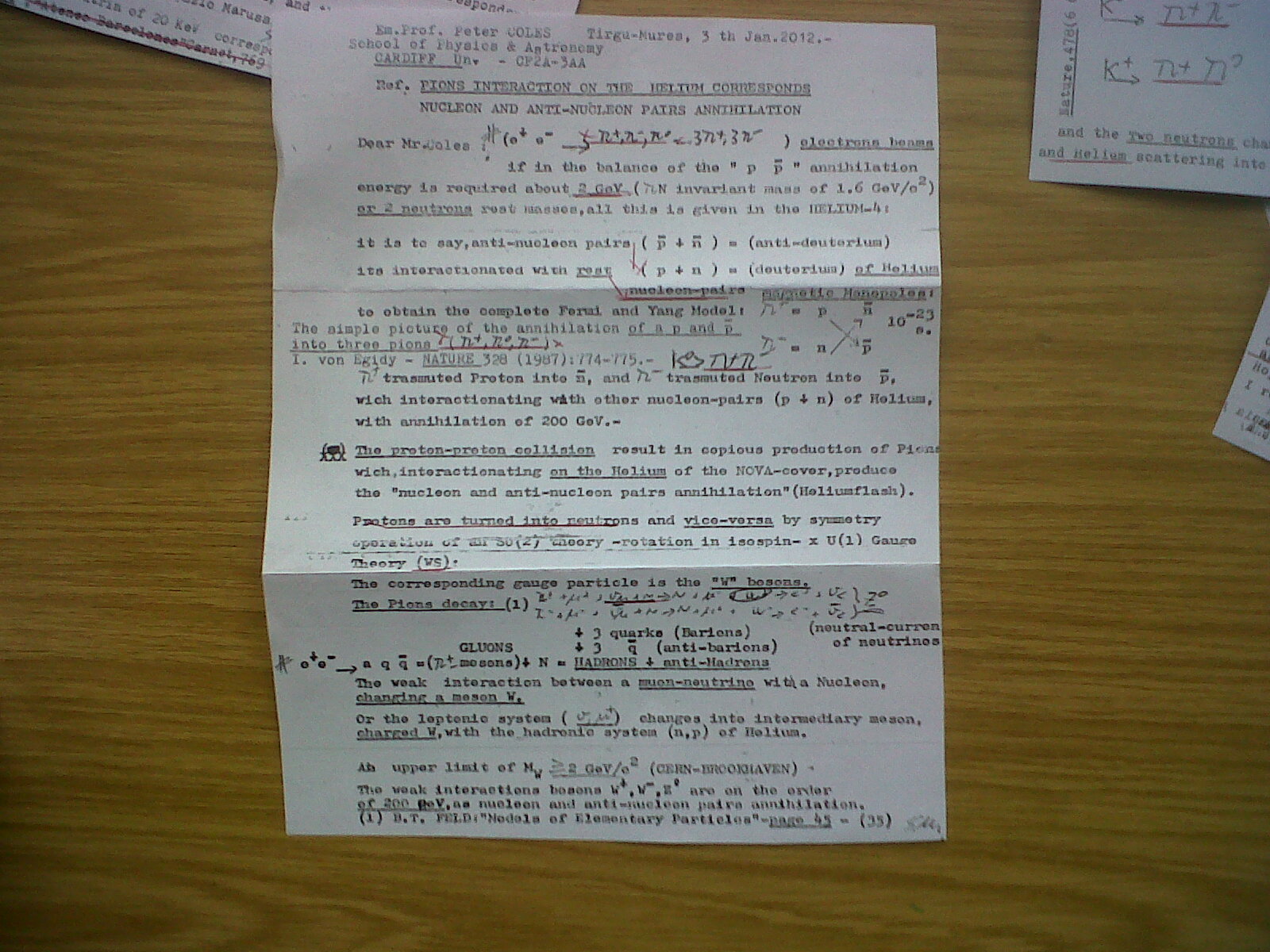
Among the delights (?) of being a scientist are those priceless pieces of unsolicited mail from members of the public. When I went to collect my mail this morning I found a prime example waiting in my pigeonhole. I knew what it was going to be like before I even opened it because the envelope was addressed (rather inaccurately) using an old-fashioned typewriter. Only a certain kind of person uses a typewriter these days.

I particularly enjoyed the “Emeritus Prof. ” bit. And Cardiff isn’t in “Engand”, by the way. Or even “England”.

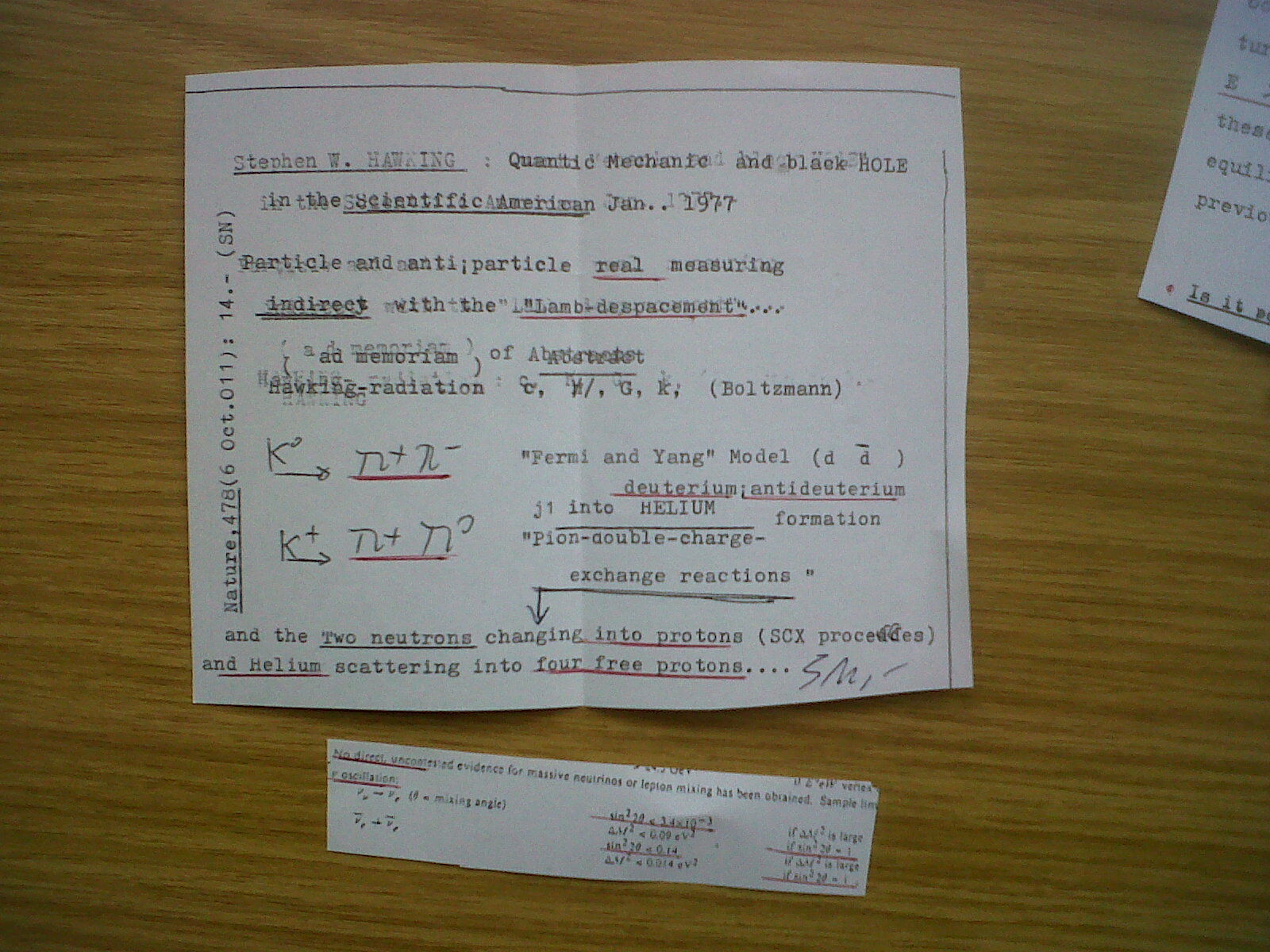
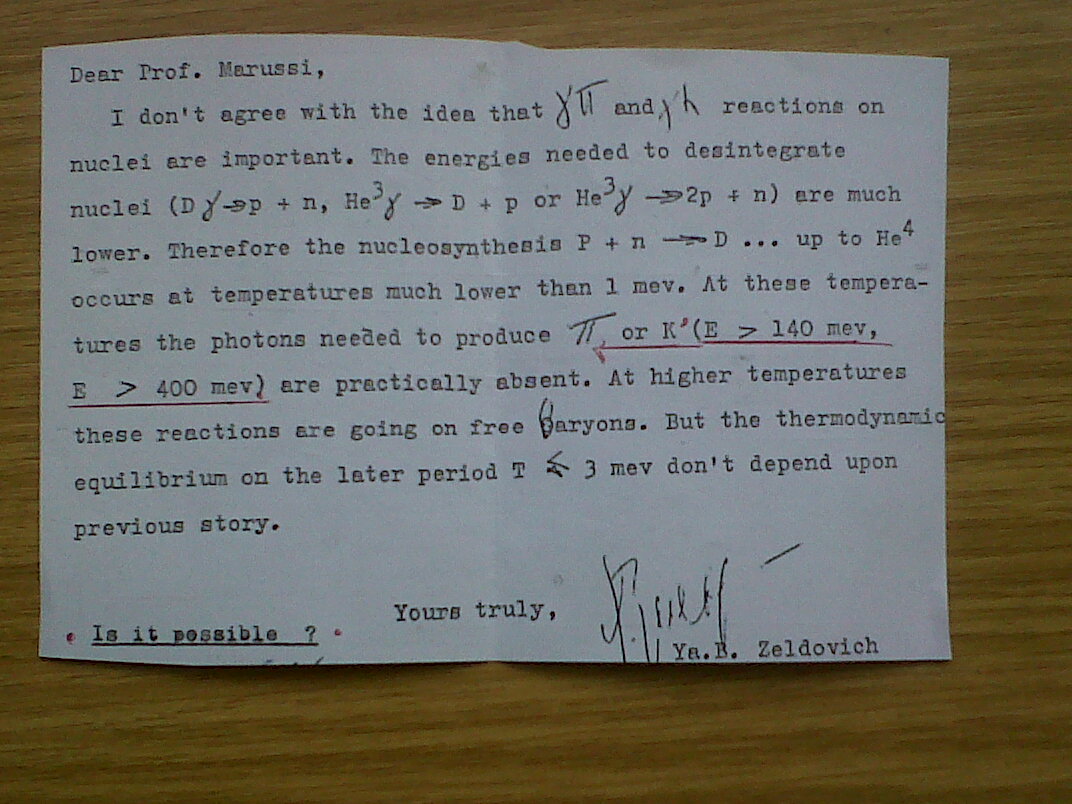
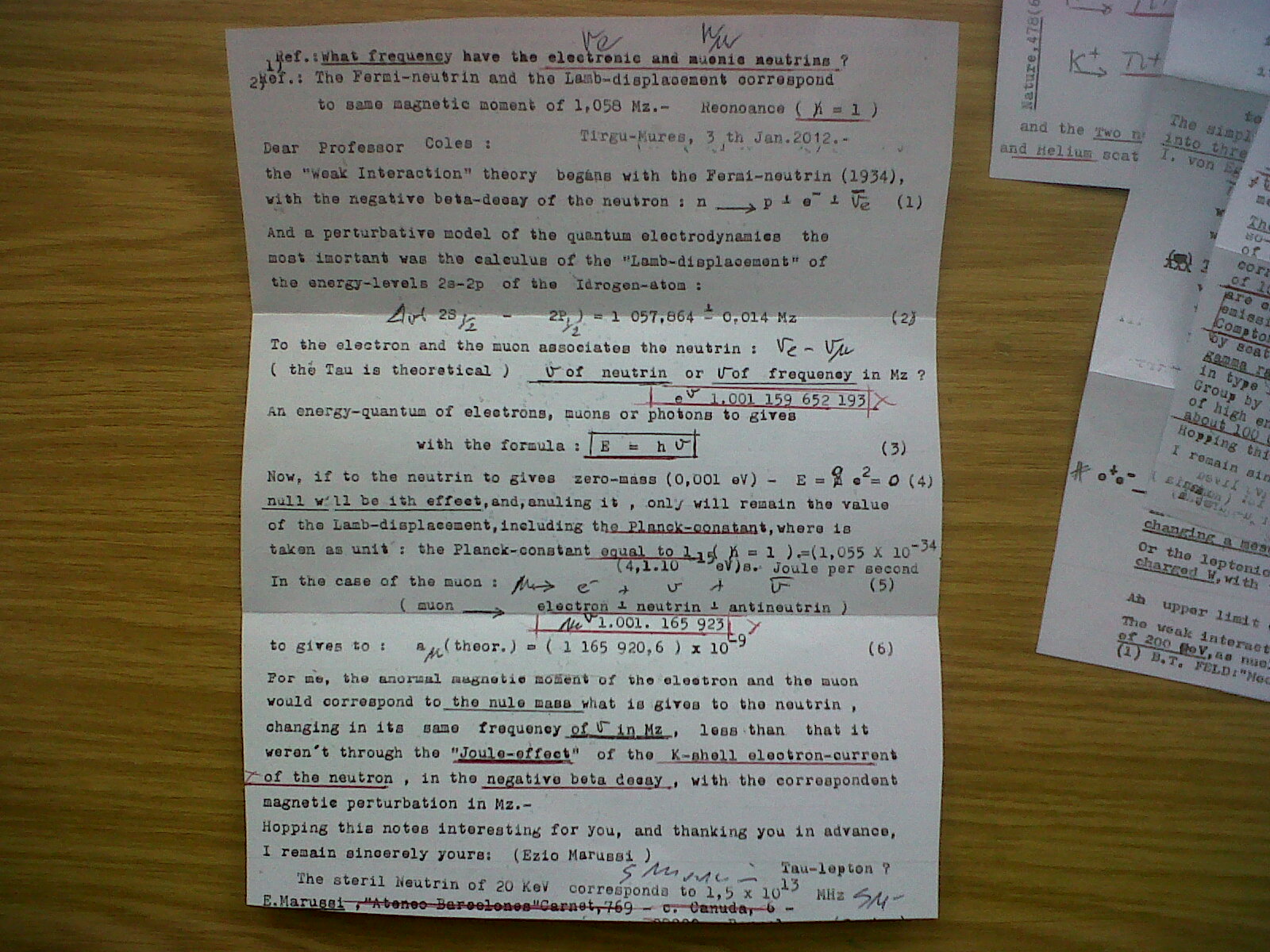
Inside were six pieces of paper – all of different sizes – on which fascinating things had been typed and later highlighted with red and black pens in order to enhance both their scientific and artistic impact.

I’m in the middle of a load  of project vivas today so haven’t had time to scan this masterpiece neatly, but it’s such a wonderful piece of correspondence that I couldn’t resist taking a few pictures of various elements for the edification of my vast readership. I think if you click on the images you might be able to read them more clearly but, if you do, I will not accept liability for the consequences.

Unfortunately I’m not sure whether I have them in the right order, as the logic that connects them together escapes me.

I have  a large collection of similar missives but, despite some obvious deficiencie, such as a lack of drawings,  this letter is one of the best and will now take pride of place in the bottom drawer of my filing cabinet. Perhaps one day I’ll write a book about them…

Hawking at 70

Posted in Books, Talks and Reviews, The Universe and Stuff with tags , , , , on January 8, 2012 by telescoper

Today is the 70th Birthday of renowned British theoretical physicist Stephen Hawking. His  immense contributions to physics, including but not restricted to cosmology, are remarkable in their own right, but  made even more emarkable that has done so much after having been stricken by such a debilitating disease when he was only in his twenties. Hawking’s is undoubtedly a brilliant and inspirational mind, but his courage and physical endurance in the face of difficulties that  others might have found unbearable provide inspiration far behond physics. I’d therefore like to add a genuine Many Happy Returns to Professor Stephen Hawking, and I hope he’s enjoying the celebratory conference and other events that have been laid on to mark this special occasion.

I have in the past gone on record, both on television and in print, as being not entirely positive about the “cult” that surrounds Stephen Hawking. I think a number of my colleagues find things I have said disrespectful and/or churlish. I do, however, stand by everything I’ve said. I do have enormous respect for Hawking the physicist, as well as deep admiration for his tenacity and fortitude, and have never said otherwise. I don’t, however, agree that Hawking is in the same category of revolutionary thinkers as Newton or Einstein, which is how he is often portrayed.

In fact  a poll of 100 theoretical physicists in 1999 came to exactly the same conclusion. The top ten in that list were:

  1.  Albert Einstein
  2. Isaac Newton
  3. James Clerk Maxwell
  4. Niels Bohr
  5. Werner Heisenberg
  6. Galileo Galilei
  7. Richard Feynman
  8. Paul Dirac
  9. Erwin Schrödinger
  10. Ernest Rutherford

The idea of a league table like this is of course a bit silly, but it does at least give some insight into the way physicists regard prominent figures in their subject. Hawking came way down the list, in fact, in 300th (equal) place. I don’t think it is disrespectful to Hawking to point this out. I’m not saying he isn’t a brilliant physicist. I’m just saying that there are a great many other brilliant physicists that no one outside physics has ever heard of.

It is interesting to speculate what would have happened if the list had been restricted to living physicists. I’d guess Hawking would be in the top ten, but I’m not at all sure where…

And before I get accused of jealousy about Stephen Hawking’s fame, let me make it absolutely clear that if Hawking is like a top Premiership footballer (which I think is an appropriate analogy), then I am definitely like someone kicking a ball around for a pub team on a Sunday morning (with a hangover). This gulf does not make me envious; it just makes me admire his ability all the more, just as trying to play football makes one realise exactly how good the top players really are.

Anyway, I had better wind this up because that sporting metaphor has just reminded me that there are some FA Cup ties on the TV this afternoon. I’ll therefore switch to a slightly different kind of hawking, i.e. trying to peddle a few copies of my book  Hawking and the Mind of God, which was published in 2000. Excuse the blatant self-promotion, but these are hard times!

Here is the jacket blurb:

Stephen Hawking has achieved a unique position in contemporary culture, combining eminence in the rarefied world of theoretical physics with the popular fame usually reserved for film stars and rock musicians. Yet Hawking’s technical work is so challenging, both in its conceptual scope and in its mathematical detail, that proper understanding of its significance lies beyond the grasp of all but a few specialists. How, then, did Hawking-the-scientist become Hawking-the-icon? Hawking’s theories often take him into the intellectual territory that has traditionally been the province of religion rather than science. He acknowledges this explicitly in the closing sentence of his bestseller, “A Brief History of Time”, where he says that his ultimate aim is the “know the Mind of God”. “Hawking and the Mind of God” examines the pseudo-religious connotations of some of the key themes in Hawking’s work, and how these shed light not only on the Hawking cult itself, but also on the wider issue of how scientists represent themselves in the media.

And you can take a peek at the inside here:

Lecture less, teach more…

Posted in Education with tags , , , , , on January 2, 2012 by telescoper

I was just about to go to the shops just now, but the weather is so extreme – dark apocalyptic skies and violent hailstorms – that I thought I’d have a quick go on the blog in the hope that  things quieten down a little. I was going to write something a bit earlier, as I was up at 7am, but all that came into my head were dark imaginings about the future and I didn’t want to depress myself and everyone else going on about that. The e-astronomer has already done something along those lines anyway.

Fortunately I saw something on Twitter that is a more appropriate theme for a blog post, namely a very interesting article about the role of lectures in university physics education. This is a topic I feel very strongly about, and I agree with most of what the article says, which is basically that the traditional lecture format is a very ineffective way of teaching physics. I wouldn’t go as far as to say that lectures are inherently useless, but I think they should be used in a very different way from the way they are used now.

When I was an undergraduate, in the dim and distant past, I attended lectures assiduously because that was expected of students. To put it bluntly, though, I don’t think I ever learned anything much from doing so. My real learning was done back in my room, with books and problem sheets as well as my lecture notes, trying to figure out how the physics all went together with other things I had learned, and how to apply it in interesting situations. Sometimes the lecture notes were useful, sometimes not, but I never felt that I had learned anything until I was confident that I knew how to apply the new concepts in solving problems.

But I did find some lectures very enjoyable and worthwhile, because some lecturers were good at making students feel interested in the subject.  The enthusiasm and depth of understanding conveyed by someone who has devoted their life to the study of a subject can be  infectious, and a very enjoyable form of entertainment in its own right. That’s why public lectures remain popular; their intrinsic educational value is limited, but they serve to stimulate the audience to find out more. That’s if they’re good, of course. They can have the opposite effect also.

At Cardiff – like other universities – we hand out questionnaires to students to get feedback on lecturers. Usually the thing that stands out as making one lecturer more popular than others is their enthusiasm. Quite rightly so. If someone who has made a career out of the subject can’t be enthusiastic, why on Earth should the students?

For other comments on what makes a good lecture, see here.

What makes a lecture useless is when it is used simply to transfer material from the lecturer to the student, without passing through the mind of either participant. Slavishly copying detailed notes seems to me a remarkably pointless activity, although taking notes of the key points in a lecture devoted primarily to concepts and demonstrations is far from that. Far better to learn to use resources such as textbooks and internet sites effectively than to endure an hour’s dictation. We don’t want our students to learn physics by rote; we want them to learn to think like physicists!

While I’m on about lectures, I’ll also add that I think the increasing use of Powerpoint in lectures has its downside too. I started using it when I moved to Cardiff, but never felt comfortable with it as a medium for teaching physics. This year I’m going to scrap it. I would revert to “chalk-and-talk” if we had any blackboards, so I’ll have to make do with those hideous whiteboard things. Not all progress is good progress.

Anyway, what we’ve recently done with our new courses in the School of Physics & Astronomy at Cardiff University is to start to move away from an over-reliance on lectures. One way we’ve done this is to merge some of our smaller modules. Whereas a 10-credit module used to have two lectures a week, the new 20 credit modules now have the same number of lectures, complemented by two hours of problems classes in which the students work through exercise with staff members lending assistance. Initial reaction from the students is positive, though there have been some teething troubles. We’ll just  have to wait for the examination results to see how well it has worked.

I dare say other departments around the country are making similar changes in teaching methods in response to the availability of new technologies and changes to the school curriculum. But of course its a path that other trod before. It’s good to have the chance to end by congratulating Derek Raine of the University of Leicester for his MBE in the New Years Honours List for his contributions to science education. He was arguing for a different approach to physics teaching when many of us were still in short pants. It’s just a pity we’ve taken such a long time to realise he was right.

Now the sky’s blue so I can go and do my shopping. Toodle-pip!

Yet another cute physics problem

Posted in Cute Problems, The Universe and Stuff with tags , , on November 22, 2011 by telescoper

I’ve spent all day either teaching or writing draft grant applications and am consequently a bit knackered, so in lieu of one of my usual rambling dissertations here is another example from the file marked Cute Physics Problems, this time from thermodynamics. It’s quite straightforward. Or is it? Most people I’ve asked this question in private have got it wrong, so let’s see if the blogosphere is smarter:

Three identical bodies of constant  heat capacity are at temperatures of 300, 300 and 100 K. If no work is done on the system and no heat transferred to it from outside, what is the highest temperature to which any one of the bodies can be raised by the operation of heat engine(s)?

Thinking of Applying for a PhD in Physics or Astronomy?

Posted in Education with tags , , , , , , on November 21, 2011 by telescoper

This afternoon I gave a short talk to our final-year students about postgraduate research in which I passed on some, hopefully useful,  information about how to go about applying for PhDs  in Physics  and Astronomy. I am, for my sins, the Director of Postgraduate Studies within the School of Physics & Astronomy here at Cardiff University.

Although quite a lot of what I talked about was about our own arrangements in Cardiff, I thought I’d jot down here a few general remarks that might be useful to people elsewhere who are thinking of taking the plunge when they graduate. I’m aiming this primarily at UK students applying for places in the UK; special considerations apply for students wanting to do graduate research abroad.

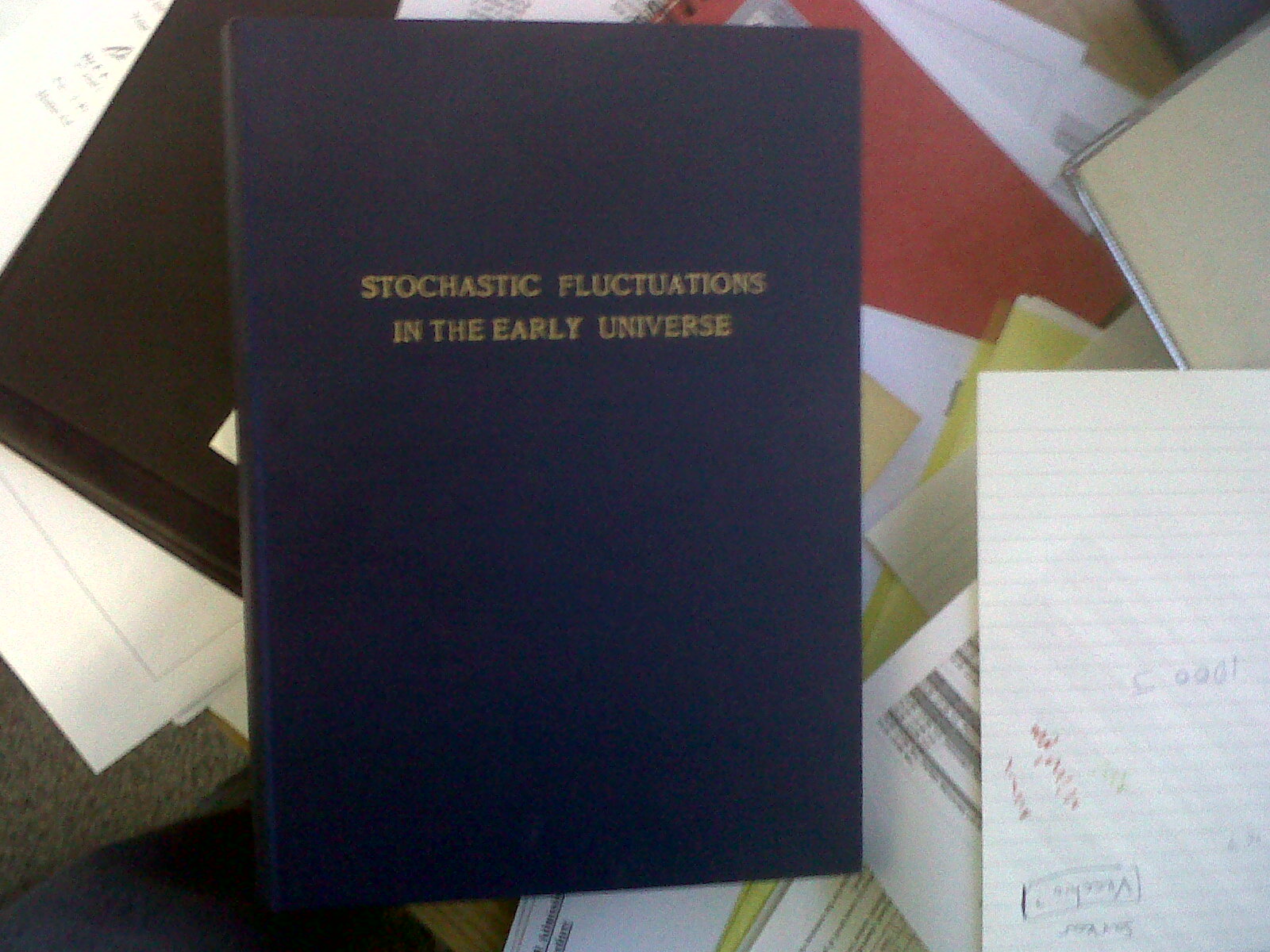
What is a PhD? The answer to that is relatively easy; it’s a postgraduate research degree. In order to obtain a PhD you have to present a thesis like that shown on the left (which happens to be mine, vintage 1988), typically in the range 100-250  pages long. A thesis has to satisfy two conditions for the award of the degree: it should contain original research, which is publishable in an academic journal; and it should present a coherent discussion of that original work within the context of ongoing work in the area of study. In Physics & Astronomy, the PhD is pretty much a prerequisite for any career in academic research, and it usually takes between 3 and 4 years to complete. After submission of the thesis you will have to undergo a viva voce examination conducted by two examiners, one internal and one external. This is quite a tough test, which  can last anywhere between about 2 and about 6 hours, during which you can be asked  detailed questions about your research and wide-ranging questions about the general area.

The Money Side. In the UK most PhDs are supported financially by the research councils, either EPSRC (most physics) or STFC (nuclear & particle physics, astronomy). These generally award quotas of studentships to departments who distribute them to students they admit. A studentship will cover your fees and pay a stipend, currently £13590 pa. That doesn’t sound like a lot, but you should at least remember that it is a stipend rather than a wage; it is therefore not taxed and there is no national insurance payable.

How do I choose a PhD? During the course of a postgraduate degree you are expected to become an expert in the area in which you specialize. In particular you should reach the point where you know more about that specific topic than your supervisor does. You will therefore have to work quite a lot on your own, which means you need determination, stamina and enthusiasm. In my view the most important criterion in your choice of PhD is not the institution where you might study but the project. You need to be genuinely excited by the topic in order to drive yourself to keep through the frustrations (of which there will be many). So, find an area that interests you and find the departments that do active research in that area by looking on the web. Check out the recent publications by staff in each department, to ensure that they are active and to have something to talk about at interview!

Qualifications. Most universities have a formal requirement that candidates for admission to the PhD should have a “good honours degree”, which basically means at least an Upper Second Class Honours degree. Some areas are more competitive than others, however, and in many disciplines you will find you are competing with a great many applicants with First Class degrees.

How to apply successfully. The application procedure at most universities is quite simple and can be done online. You will need to say something about the area in which you wish to do research (e.g. experiment/theory, and particular field, e.g. cosmology or star formation). You’ll also need a CV and a couple of references. Given the competition, it’s essential that you prepare. Give your curriculum vitae some attention, and get other people (e.g. your personal tutor) to help you improve it. It’s worth emphasizing particular skills (e.g. computing). If you get the chance, make use of your summer vacations by taking on an internship or other opportunity to get a taste of research; things like that will undoubtedly give your CV an edge.

The Interview. Good applicants will be invited for an interview, which is primarily to assess whether you have the necessary skills and determination, but also to match applicants to projects and supervisors. Prepare for your interview! You will almost certainly be asked to talk about your final-year project, so it will come across very badly if you’re not ready when they ask you. Most importantly, mug up about your chosen field. You will look really silly if you haven’t the vaguest idea of what’s going on in the area you claimed to be interested in when you wrote your  application!

Don’t be shy! There’s nothing at all wrong with being pro-active about this process. Contact academic staff at other universities by email and ask them about research, PhD opportunities. That will make a good impression. Also, don’t be afraid to ask for advice. Although we’re all keen to recruit good PhD students for our own departments, we academics are  conscious that it is also our job to give impartial advice. Ask your tutor’s opinion.

How many places should I apply for? Some research areas are more fashionable than others so the level of competition varies with field. As a general rule I would advise applying for about half-a-dozen places, chosen because they offer research in the right area. Apply to fewer than that and you might lose out to the competition. Apply to many more and you might not have time to attend the interviews.

What’s the timetable?  Most applications come in early in the new year for entry to the PhD in the following October. The Christmas break is therefore a pretty good time to get your applications sorted out. Interviews are normally held in February or March, and decisions made by late March. STFC runs a deadline system whereby departments can not force students to accept or decline offers before the end of March, so there should be ample time to visit all your prospective departments before having to make any decisions.

That’s all I can think of for now. I hope at least some of these comments are useful to undergraduates anywhere in the UK thinking of applying for a PhD. If there are any further questions, please feel free to ask through the comments box. Likewise if I’ve missed anything important, please feel free to suggest additions in the same manner…

Order-of-magnitude Physics

Posted in Cute Problems, Education with tags , , , on November 14, 2011 by telescoper

A very busy day today so I thought I’d wind down by giving you a chance to test your brains with some order-of-magnitude physics problems. I like using these in classes because they get people thinking about the physics behind problems without getting too bogged down in or turned off by complicated mathematics. I’ve also kept some of these in archaic units just to annoy people who can only do things in the SI system. I think it’s good to practice swapping between systems, especially for us astro-types who use all kinds of bizarre units, so if you don’t know the units, look them up! And if there’s any information missing that you need to solve the problem, make an order-of-magnitude estimate!

Give  order of magnitude answers to the following questions:

  1. What is the mass of a body whose weight is equivalent to the total force exerted by a 40 mph gale on the side of a house 40 ft long and 20 ft high? Express your answer in tons.
  2. What is the power required to keep in the air a helicopter of mass 500 kg whose blades are 3m long? Express your answer in kilowatts.
  3. The base of the Great Pyramid  is 750 ft square and its  height is 500ft. How much work was done building it?  Express your answer in Joules.
  4. How high would the jet of a fountain reach if it were aimed vertically up and supplied by a water main in which the pressure is 3 atmospheres? Express your answer in feet.

There’s no prize involved, but feel free to post answers through the comments box. It would be helpful if you explained a  bit about how you arrived at your answer!


To Edinburgh and Back

Posted in Biographical, Education with tags , , , on November 10, 2011 by telescoper

I’m back home now after a trip to and from the fine city of Edinburgh which, in case you weren’t aware, is known to the locals as Auld Reekie. I wonder if there’s a local internet guide called Reekipedia?

The excuse for this trip was an invitation to take part in an exercise called a Teaching Programme Review in the School of Physics & Astronomy at the University of Edinburgh. The TPR is an exercise that looks at the courses on offer in the department, how they are taught, as well as the technical and administrative arrangements to back it all up. The Panel involved people from other departments inside the University and a couple of external advisers (both physicists), of which I was one. The Panel will be writing a detailed report on our findings which I hope will turn out to be useful, but it definitely wouldn’t be appropriate to comment on the details here.

What I will say here is that, although it was a very intense and busy few days, including face-to-face meetings with all kinds of academic and support staff, as well as current students, it was extremely interesting. As well as hopefully providing some input and suggestions to the TPR, it was also a chance for me to see the inner workings of another department and pick up a few ideas for the way we teach Physics courses in Cardiff.

One of the striking things about this visit was how similar are many of the problems facing Edinburgh to those we encounter in Cardiff. Another is how easy it is to recognize kindred spirits. It may not always be obvious to the students, but physicists are passionate about their subject, not only in terms of their research but also in terms of nurturing the talents of the students in their care. In the Brave New World of Higher Education we’re all supposed to see universities as businesses, competing ruthlessly in an unforgiving marketplace. In fact, most of us at the real business end of the university system (i.e. teaching and research as opposed to PR and marketing) see our competitors more as colleagues than as rivals. Long may that continue, in my opinion.

During the visit I was taken on a tour of the excellent facilities available at Edinburgh, including some really snazzy and impressive “teaching studios” the like of which I’d never seen before. I’d really love to have a go at teaching in one of those some day, as they offer a different style of education which I’m sure complements the more traditional lecture format. The students seem to like them a lot, which is the most important thing.

However, I have to say that the thing that I was most jealous about was the fact that most of their teaching rooms still have blackboards. Ours have all been replaced with horrible whiteboards that require expensive markers and are far less visible to a big audience. “Chalk and talk” is a tried and tested method and when it’s done well I still think it’s a very effective one. I’m all for innovation in teaching, but some traditional methods are actually pretty good!

Anyway, I’d like to thank everyone from Auld Reekie University for hosting this visit. It was hard work, but thoroughly enjoyable. If anyone from Edinburgh reads this I hope they will pass on my thanks to all the staff and students there for making it such a rewarding occasion! I’m just sorry I didn’t have the chance to see a bit more of the city, but the schedule was just too hectic.

What I did enjoy was staying in a nice hotel for 3 days that offered a truly splendid cooked breakfast in the mornings. I hadn’t started the day with kippers for a very long time! Might need to go on a diet for a few days though….

Advice for the REF Panels

Posted in Finance, Science Politics with tags , , , , , on October 30, 2011 by telescoper

I thought I’d post a quick follow-up to last week’s item about the Research Excellence Framework (REF). You will recall that in that post I expressed serious doubts about the ability of the REF panel members to carry out a reliable assessment of the “ouputs” being submitted to this exercise, primarily because of the scale of the task in front of them. Each will have to read hundreds of papers, many of them far outside their own area of expertise. In the hope that it’s not too late to influence their approach, I thought I’d offer a few concrete suggestions as to how things might be improved. Most of my comments refer specifically to the Physics panel, but I have a feeling the themes I’ve addressed may apply in other disciplines.

The first area of  concern relates to citations, which we are told will be used during the assesment, although we’re not told precisely how this will be done. I’ve spent a few hours over the last few days looking at the accuracy and reliability various bibliometric databases and have come to the firm conclusion that Google Scholar is by far the best, certainly better than SCOPUS or Web of Knowledge. It’s also completely free. NASA/ADS is also free, and good for astronomy, but probably less complete for the rest of physics. I therefore urge the panel to ditch its commitment to use SCOPUS and adopt Google Scholar instead.

But choosing a sensible database is only part of the solution. Can citations be used sensibly at all for recently published papers? REF submissions must have been published no earlier than 2008 and the deadline is in 2013, so the longest time any paper can have had to garner citations will be five years. I think that’s OK for papers published early in the REF window, but obviously citations for those published in 2012 or 2013 won’t be as numerous.

However, the good thing about Google Scholar (and ADS) is that they include citations from the arXiv as well as from papers already published. Important papers get cited pretty much as soon as they appear on the arXiv, so including these citations will improve the process. That’s another strong argument for using Google Scholar.

The big problem with citation information is that citation rates vary significantly from field to field sit will be very difficult to use bibliometric data in a formulaic sense, but frankly it’s the only way the panel has to assess papers that lie far from their own expertise. Unless anyone else has a suggestion?

I suspect that what some panel members will do is to look beyond the four publications to guide their assessment. They might, for example, be tempted to look up the H-index of the author if they don’t know the area very well. “I don’t really understand the paper by Professor Poindexter but he has an H-index of 95 so is obviously a good chap and his work is probably therefore world-leading”. That sort of thing.

I think this approach would be very wrong indeed. For a start, it seriously disadvantages early career researchers who haven’t had time to build up a back catalogue of high-impact papers. Secondly, and more fundamentally still, it is contrary to the stated aim of the REF, which is to assess only the research carried out in the assessment period, i.e. 2008 to 2013. The H-index would include papers going back far further than 2008.

But as I pointed out in my previous post, it’s going to be impossible for the panel to perform accurate assessments of all the papers they are given: there will just be far too many and too diverse in content. They will obviously therefore have to do something other than what the rest of the community has been told they will do. It’s a sorry state of affairs that dishonesty is built into the system, but there you go. Given that the panel will be forced to cheat, let me suggest that they at least do so fairly. Better than using the H-index of each individual, use the H-index calculated over the REF period only. That will at least ensure that only research done in the REF period will count towards the REF assessment.

Another bone of contention is the assessment of the level of contribution authors have made to each paper, in other words the question of attribution. In astronomy and particle physics, many important papers have very long author lists and may be submitted to the REF by many different authors in different institutions. We are told that what the panel will do is judge whether a given individual has made a “significant” contribution to the paper. If so, that author will be accredited with the score given to the paper. If not, the grade assigned will be the lowest and that author will get no credit at all. Under this scheme one could be an author on a 4* paper but be graded “U”.

This is fair enough, in that it will penalise the “lurkers” who have made a career by attaching their names to papers on which they have made negligible contributions. We know that such people exist. But how will the panel decide what contribution is significant and what isn’t? What is the criterion?

Take the following example. Suppose the Higgs Boson is discovered at the LHC duringthe REF period. Just about every particle physics group in the UK will have authors on the ensuing paper, but the list is likely to be immensely long and include people who performed many different roles. Who decides where to draw the line on “significance”. I really don’t know the answer to this one, but a possibility might be to found in the use of the textual commentary that accompanies the submission of a research output. At present we are told that this should be used to explain what the author’s contribution to the paper was, but as far as I’m aware there is no mechanism to stop individuals hyping up their involvement.What I mean is I don’t think the panel will check for consistency between commentaries submitted by different people for the same institution.

I’d suggest that consortia  should be required to produce a standard form of words for the textual commentary, which will be used by every individual submitting the given paper and which lists all the other individuals in the UK submitting that paper as one of their four outputs. This will require co-authors to come to an agreement about their relative contributions in advance, which will no doubt lead to a lot of argument, but it seems to me the fairest way to do it. If the collaboration does not produce such an agreement then I suggest that paper be graded “U” throughout the exercise. This idea doesn’t answer the question “what does significant mean?”, but will at least put a stop to the worst of the game-playing that plagued the previous Research Assessment Exercise.

Another aspect of this relates to a question I asked several members of the Physics panel for the 2008 Research Assessment Exercise. Suppose Professor A at Oxbridge University and Dr B from The University of Neasden are co-authors on a paper and both choose to submit it as part of the REF return. Is there a mechanism to check that the grade given to the same piece of work is the same for both institutions? I never got a satisfactory answer in advance of the RAE but afterwards it became clear that the answer was “no”. I think that’s indefensible. I’d advise the panel to identify cases where the same paper is submitted by more than one institution and ensure that the grades they give are consistent.

Finally there’s the biggest problem. What on Earth does a grade like “4* (World Leading)” mean in the first place? This is clearly crucial because almost all the QR funding (in England at any rate) will be allocated to this grade. The percentage of outputs placed in this category varied enormously from field to field in the 2008 RAE and there is very strong evidence that the Physics panel judged much more harshly than the others. I don’t know what went on behind closed doors last time but whatever it was, it turned out to be very detrimental to the health of Physics as a discipline and the low fraction of 4* grades certainly did not present a fair reflection of the UK’s international standing in this area.

Ideally the REF panel could look at papers that were awarded 4* grades last time to see how the scoring went. Unfortunately, however, the previous panel shredded all this information, in order, one suspects, to avoid legal challenges. This more than any other individual act has led to deep suspicions amongs the Physics and Astronomy community about how the exercise was run. If I were in a position of influence I would urge the panel not to destroy the evidence. Most of us are mature enough to take disappointments in good grace as long as we trust the system.  After all, we’re used to unsuccessful grant applications nowadays.

That’s about twice as much as I was planning to write so I’ll end on that, but if anyone else has concrete suggestions on how to repair the REF  please file them through the comments box. They’ll probably be ignored, but you never know. Some members of the panel might take them on board.

Come off it, REF!

Posted in Science Politics with tags , , , , , , on October 27, 2011 by telescoper

Yesterday we all trooped off to the Millennium Stadium in Cardiff for a Staff Away Day. We didn’t actually get to play on the pitch of course, which wasn’t even there, as it had been removed to reveal a vast expanse of soil. Instead we were installed in the “Dragon Suite” for a discussion about our preparation for the forthcoming Research Excellence Framework.

Obviously I can’t post anything about our internal deliberations, but I’m sure departments up and down the United Kingdom are doing similar things so I thought I’d mention a few things which are already in the public domain and my personal reactions to them. I should also say that the opinions I express below are my own and not necessarily those of anyone else at Cardiff.

The first thing is the scale of the task facing members of the panel undertaking this assessment. Each research active member of staff is requested to submit four research publications (“outputs”) to the panel, and we are told that each of these will be read by at least two panel members. The panel comprises 20 members.

As a rough guess I’d say that the UK has about 40 Physics departments, and the average number of research-active staff in each is probably about 40. That gives about 1600 individuals for the REF. Actually the number of category A staff submitted to the 2008 RAE was 1,685.57 FTE (Full-Time Equivalent), pretty  close to this figure. At 4 outputs per person that gives 6400 papers to be read. We’re told that each will be read by at least two members of the panel, so that gives an overall job size of 12800 paper-readings. There are 20 members of the panel, so that means that between 29th November 2013 (the deadline for submissions) and the announcement of the results in December 2014 each member of the panel will have to have read 640 research papers. That’s an average of about two a day…

Incidentally, as I’ve mentioned before, the Physics REF panel includes representatives from institutions in England, Scotland and Northern Ireland, but not Wales. The decision to exclude representation from Welsh physics departments was a disgrace, in my view.

Now we are told the panel will use their expert judgment to decide which outputs belong to the following categories:

  • 4*  World Leading
  • 3* Internationally Excellent
  • 2* Internationally Recognized
  • 1* Nationally Recognized
  • U   Unclassified

There is an expectation that the so-called QR  funding allocated as a result of the 2013 REF will be heavily weighted towards 4*, with perhaps a small allocation to 3* and probably nothing at all for lower grades. “Internationally recognized” research is probably worthless in the view of HEFCE, in other words. Will the papers belonging to the category “Not really understood by the panel member” suffer the same fate?

The panel members will apparently know enough about every single one of the papers they are going to read in order to place them  into one of the above categories, especially the crucial ones “world-leading” or “internationally excellent”, both of which are obviously defined in a completely transparent and objective manner. Not.

We are told that after forming this judgement based on their expertise the panel members will “check” the citation information for the papers. This will be done using the SCOPUS service provided (no doubt at considerable cost) by   Elsevier, which by sheer coincidence also happens to be a purveyor of ridiculously overpriced academic journals. I’ve just checked the citation information for some of my papers on SCOPUS, and found an alarming number of errors. No doubt Elsevier are  on a nice little earner peddling meaningless data for the HECFE bean-counters, but I haven’t any confidence that it will add much value to the assessment process.

There have been high-profile statements to the effect that the REF will take no account of where the relevant “outputs”  are published, including a recent pronouncement by David Willetts. On the face of it, that would suggest that a paper published in the spirit of Open Access in a free archive would not be disadvantaged. However, I very much doubt that will be the case.

I think if you look at the volume of work facing the REF panel members it’s pretty clear that citation statistics will be much more important for the Physics panel than we’ve been led to believe. The panel simply won’t have the time or the breadth of understanding to do an in-depth assessment of every paper, so will inevitably in many cases be led by bibliometric information. The fact that SCOPUS doesn’t cover the arXiv means that citation information will be entirely missing from papers just published there.

The involvement of  a company like Elsevier in this system just demonstrates the extent to which the machinery of research assessment is driven by the academic publishing industry. The REF is now pretty much the only reason why we have to use traditional journals. It would be better for research, better for public accountability and better economically if we all published our research free of charge in open archives. It wouldn’t be good for academic publishing houses, however, so they’re naturally very keen to keep things just the way they are. The saddest thing is that we’re all so cowed by the system that we see no alternative but to participate in this scam.

Incidentally we were told before the 2008 Research Assessment Exercise that citation data would emphatically not be used;  we were also told afterwards that citation data had been used by the Physics panel. That’s just one of the reasons why I’m very sceptical about the veracity of some of the pronouncements coming out from the REF establishment. Who knows what they actually do behind closed doors?  All the documentation is shredded after the results are published. Who can trust such a system?

To put it bluntly, the apparatus of research assessment has done what most bureaucracies eventually do; it has become  entirely self-serving. It is imposing increasingly  ridiculous administrative burdens on researchers, inventing increasingly  arbitrary assessment criteria and wasting increasing amounts of money on red tape which should actually be going to fund research.

And that’s all just about “outputs”. I haven’t even started on “impact”….

The Physics of the Pole Vault

Posted in Education, The Universe and Stuff with tags , , , , , on October 17, 2011 by telescoper

At the RAS Club Dinner last Friday I chatted for a while with my former DPhil supervisor, John Barrow. I’m not sure how, but the topic came up about how helpful it is to use sports to teach physics. By coincidence he chose the same example as I have used in the past during first-year tutorials,  the pole vault.

Years ago I went to watch an athletics meeting at Gateshead Stadium and sat right next to the pole vault area. I can tell you that the height the vaulters reach is truly spectacular, especially when you’re close to the action. The current world record for the pole vault is 6.14m, in fact, set by the legendary Sergey Bubka in 1994, so the record hasn’t been broken for 17 years. Here’s a clip of him a few years earlier clearing a mere 6.10 metres (pretty comfortably, by the look of it)…

One might infer, from the fact that the record has not been broken for such a long time, that pole vaulters are working pretty much at the limit of what the human body can achieve. And a bit of physics will convince you of the same.

Basically, the pole is a device that converts the horizontal kinetic energy of the vaulter \frac{1}{2} m v^2,  as he/she runs in, to the gravitational potential energy m g h acquired at the apex of his/her  vertical motion, i.e. at the top of the vault.

Now assume that the approach is at the speed of a sprinter, i.e. about 10 ms^{-1}, and work out the height h = v^2/2g that the vaulter can gain if the kinetic energy is converted with 100% efficiency. Since g = 9.8 ms^{-2} the answer turns out to be about 5 metres.

This suggests that  6.15 metres should not just be at, but beyond, the limit of a human vaulter,  unless the pole were super-elastic. However, there are two things that help. The first is that the centre of mass of the combined vaulter-plus-pole does not start at ground level; it is at a height of a bit less than 1m for an an average-sized person.  Nor does the centre of mass of the vaulter-pole combination reach 6.15 metres. The pole does not go over the bar, but it’s pretty light so that probably doesn’t make much difference. However, it’s not  obvious that the centre of mass of the vaulter actually passes over the bar.  That certainly doesn’t happen in the high jump – owing to the flexibility of the jumper’s back the arc is such that the centre of mass remains under the bar while the different parts of the jumper’s body go over it.

Moreover, it’s not just the kinetic energy of the vaulter that’s involved. A human can in fact jump vertically from a standing position, using elastic energy stored in muscles. One can’t jump very high like that, but it seems likely to me that this accounts for a few tens of centimetres.

Anyway, it is clear that pole vaulters are remarkably efficient athletes. And not a little brave either – as someone who is scared of heights I can tell you that I’d be absolutely terrifed being shot up to 6.15 metres on the end of  a bendy stick, even with something soft to land on!