Oh what fun it is to derive the Bohr radius. At least the camera on my Blackberry works!
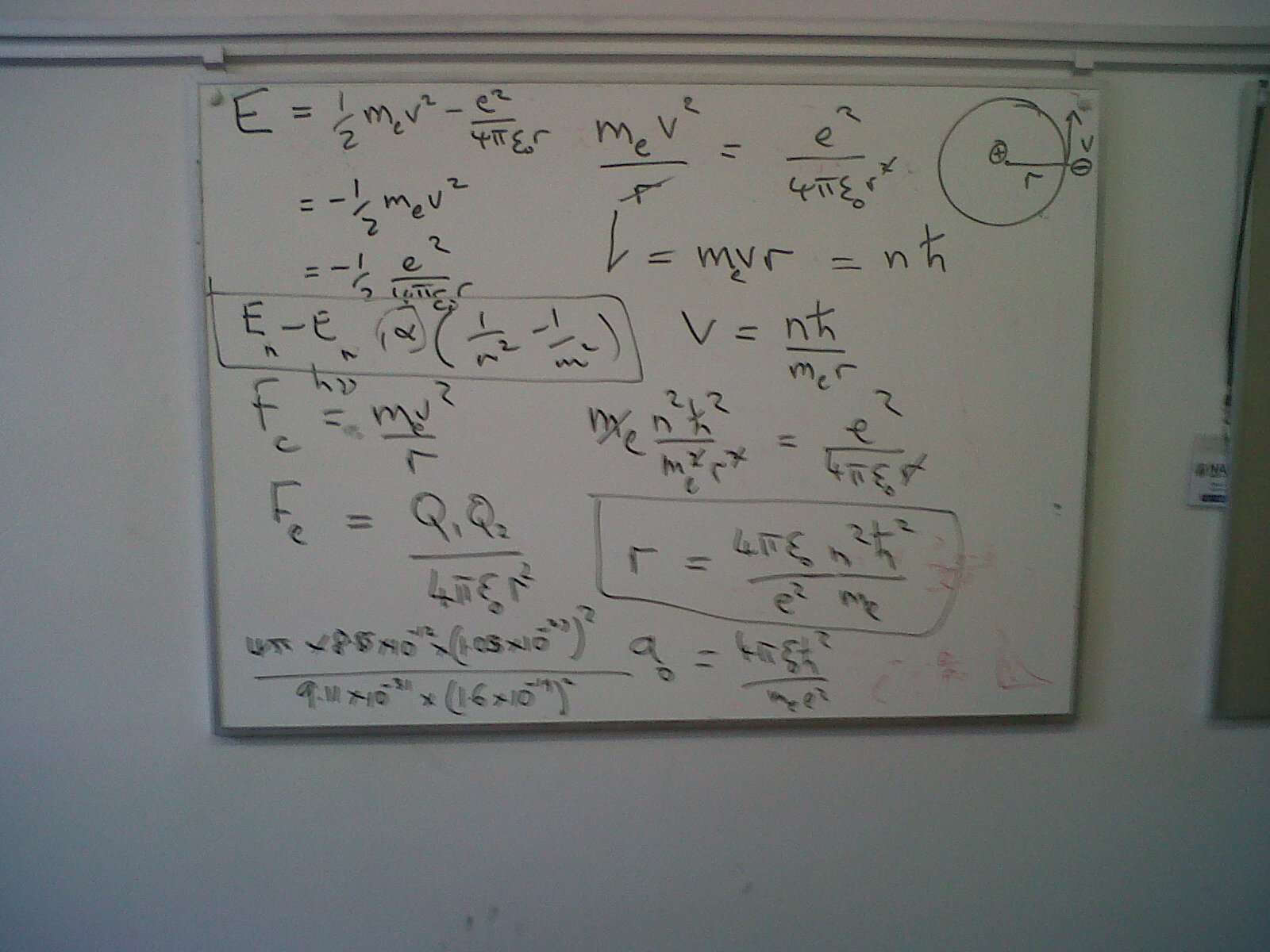
Oh what fun it is to derive the Bohr radius. At least the camera on my Blackberry works!
Yet another very busy day looms in front of me. I’m off to the smoky bigness of London for an examiners’ meeting at Queen Mary this afternoon, but before that I have to squeeze in my first tutorial of the year, with a group of fresh-faced freshers. Actually I don’t know if they’re fresh faced or not because I haven’t met them yet. I had my first teaching encounter with the first years yesterday morning during an exercise class on mechanics, which I enjoyed despite some teething troubles with the facilities in the room we were using. I was very happy with the way the students chipped freely in with answers whenever I asked questions, which is a good sign.
A while ago I attended a session on teaching for our new lecturers. Actually I didn’t attend most of it, I just dropped in at the end to deliver a few tips I’ve picked up from observing other lecturers. Here in Cardiff we have “peer observation” of lectures in which one member of teaching staff sits in on a lecture by another, followed by a feedback and discussion session. While I was at Nottingham it was a different system; two nominated staff members (myself and another Professor) sat in on lectures by each of the other staff. It was a lot of work, but gave me the chance to see quite a lot of different approaches to teaching and was consequently very interesting.
Anyway, over the years it became obvious that there are some obvious basics which lecturers need to do in order to teach competently, including being prepared, talking sufficiently loudly, writing clearly (if relevant), and so on. And of course turning up at the right theatre at the right time. But there are also those things that turn mere competence into excellence. Of course there are many ways to lecture, and you have to put your own personality into what you do, but the main tips I’d pass on to make your lecturers really popular can be boiled down into the Three Es. I add that these are things that struck me while watching others lecture, rather than me claiming to be brilliant myself (which I know I’m not). Anyway, here we go:
Enthusiasm. The single most obvious response on student questionnaires about lecturing refers to enthusiasm. My take on this is that we’re all professional physicists, earning our keep by doing physics. If we can’t be enthusiastic about it then it’s clearly unreasonable to expect the students to get fired up. So convey the excitement of the subject! I don’t mean by descending into vacuous gee-whizz stuff, but by explaining how interesting things are when you look at them properly as a physicist, mathematics and all.
Engagement. This one cuts both ways. First it is essential to look at your audience, ask questions, and make them feel that they are part of a shared experience not just listening to a monologue. The latter might be fine for a public lecture, but if a teaching session is to be successful as a pedagogical exercise it can’t be passive. And if you ask a question of the audience, make your body language tell them that it’s not just rhetorical; if you don’t look like you want an answer, you won’t get one. More importantly, try to cultivate an atmosphere wherein the students feel they can contribute. You know you’ve succeeded in this when students point out mistakes you have made. On the other hand, you can’t take this too far. The lecturer is the person who is supposed to know the stuff so fundamentally there’s no symmetry between you and the audience. You have to be authoritative, though that doesn’t mean you have to behave like a schoolmaster. Know your subject, explain it well and you’ll earn respect without needing to bluster.
Entertainment. To be absolutely honest, I think lectures are a fairly useless as a way of teaching physics. That is not to say that they don’t have a role, which I think is to highlight key concepts and demonstrate their applicability; the rest, the details, the nuts and bolts are best done by problem-based learning. I therefore think it does no harm at all if you make your lectures enjoyable as pieces of entertainment. By all means introduce the odd joke, refer to surprising examples, amusing analogies, and so on. As long as you don’t overdo it, you’ll find that a bit of light relief will keep the attention levels up. A key element of this is spontaneity. A lecture should appear as if it develops naturally, in an almost improvised fashion. Of course your spontaneity will probably have to be very carefully rehearsed, but the sense of a live performance always adds value. A lecture should be a happening, not just a presentation. Lecture demonstrations also play this role, although they seem to be deployed less frequently nowadays than in the past. Being a showman doesn’t come naturally to everyone, and the audience will know if you’re forcing it so don’t act unnaturally, but at the very least try to move about. Believe me, watching a lecturer drone on for an hour while rooted to the spot is a very tedious experience. You’d be surprised how much difference it makes if you can convey at least the impression of being alive.
On this last point, I’ll offer a few quotes from a physicist who definitely knew a thing or two about lecturing, Michael Faraday. First his opinion was that the lecturer should not be
…glued to the table or screwed to the floor. He must by all means appear as a body distinct and separate from the things around, and must have some motion apart from that which they possess.
Conventional wisdom nowadays suggests that one should take breaks in lectures to stop students losing concentration. I’m not sure I agree with this, actually. It’s certainly the case that attention will flag if you persist with a dreary monotone for an hour, but I think a lecture can have a natural dynamic to it which keeps the students interested by variation rather than interruption. Faraday also thought this.
A flame should be lighted at the commencement and kept alive with unremitting splendour to the end…I very much disapprove of breaks in the lecture.
Finally, here is one of my all-time favourite physics quotes, Faraday’s take on the need for lectures to be entertaining:
..for though to all true philosophers science and nature will have charms innumerable in every dress, yet I am sorry to say that the generality of mankind cannot accompany us one short hour unless the path is strewn with flowers.
Well, that’s all I have time for, but please offer your own tips through the comments box if you feel so motivated!
Follow @telescoperThe argument about academic publishing has been bubbling away nicely in the mainstream media and elsewhere in the blogosphere; see my recent post for links to some of the discussion elsewhere.
I’m not going to pretend that there’s a consensus amongst all scientists about this, but everything I’ve read has confirmed my rather hardline view, which is that in my field, astrophysics, academic journals are both unnecessary and unhealthy. I can certainly accept that in days gone by, perhaps up to around 1990, scientific journals provided the only means of disseminating research to the wider world. With the rise of the internet, that is no longer the case. Year after year we have been told that digital technologies would make scientific publishing cheaper. That has not happened. Journal subscriptions have risen faster than inflation for over a decade. Why is this happening? The answer is that we’re being ripped off. What began by providing a useful service has now become simply a parasite and, like most parasites, it is endangering the health of its subject.
The scale of the racket is revealed in an article I came across in Research Fortnight. Before I give you the figures let me explain that the UK Higher Education funding councils, such as HEFCE in England and HEFCW in Wales, award funding in a manner determined by the the quality of research going on in each department as judged by various research assessment exercises; this funding is called QR funding. Now listen to this. It is estimated that around 10 per cent of all QR funding in the UK goes into journal subscriptions. There is little enough money in science research these days for us to be paying a tithe of such proportions. This has to stop.
You might ask why such an obviously unsustainable situation carries on. I think there are two answers to this. One is the rise of the machinery of research assessment, which plays into the hands of the publishing industry. For submitted work to count in the Research Assessment Exercise (or its new incarnation, the Research Excellence Framework) it must be published in a refereed journal. Scientists who want to break the mould by publishing their papers some other way will be stamped on by our lords and masters who hold the purse strings. The whole system is invidious.
The second answer is even more discomforting. It is that many scientists actually like the current system. Each paper in a “prestigious” journal is another feather in your cap, another source of pride. It doesn’t matter if nobody reads any of them, ones published output is a measure of status. For far too many researchers gathering esteem by publishing in academic journals has become an end in itself. The system corrupts and has become corrupted. You can find similar comments in a piece in last week’s Guardian.
So what can be done? Well, I think that physics and astronomy can show the way forward. There is already a rudimentary yet highly effective prototype in place, called the arXiv. In many fields, including astronomy, all new papers are put on the arXiv, and these can be downloaded by anyone for free. Particle physics led the way towards the World Wide Web, an invention that has revolutionised so many things. It’s no coincidence that physicists are also ahead of the game on academic publishing too.
Of course it takes money to run the arXiv and that money is at the moment paid by contributions from universities that use it extensively. You might then argue that means the arXiv is just another journal, just one where the subscription cost is less obvious.
Perhaps that’s true, but then just take a look at the figures. The total running costs of the arXiv amount to just $400,000 per annum. That’s not just for astronomy but for a whole range of other branches of physics too, and not only new papers but a back catalogue going back at least 15 years.
There are about 40 UK universities doing physics research. If UK Physics had to sustain the costs of the arXiv on its own the cost would be an average of just $10,000 per department per annum. Spread the cost around the rest of the world, especially the USA, and the cost would be peanuts. Even $10,000 is less than most single physics journal subscriptions; indeed it’s not even 10 per cent of my departments annual budget for physics journals!
Whenever I’ve mentioned the arXiv to publishers they’ve generally dismissed it, arguing that it doesn’t have a “sustainable business plan”. Maybe not. But it is not the job of scientific researchers to support pointless commercial enterprises. We do the research. We write the papers. We assess their quality. Now we can publish them ourselves. Our research is funded by the taxpayer, so it should not be used to line the pockets of third parties.
I’m not saying the arXiv is perfect but, unlike traditional journals, it is, in my field anyway, indispensable. A little more investment, adding a comment facilities or a rating system along the lines of, e.g. reddit, and it would be better than anything we get academic publishers at a fraction of the cost. Reddit, in case you don’t know the site, allows readers to vote articles up or down according to their reaction to it. Restrict voting to registered users only and you have the core of a peer review system that involves en entire community rather than relying on the whim of one or two referees. Citations provide another measure in the longer term. Nowadays astronomical papers attract citations on the arXiv even before they appear in journals, but it still takes time for new research to incorporate older ideas.
Apparently, Research Libraries UK, a network of libraries of the Russell Group universities and national libraries, has already warned journal publishers Wiley and Elsevier that they will not renew subscriptions at current prices. If it were up to me I wouldn’t bother with a warning…
Follow @telescoper
I’ve just taken a short break from reading grant applications and filling in forms to read through the stack of teaching questionnaires that arrived yesterday, along with a complicated statistical analysis which I won’t even try to explain – because I don’t understand it.
These questionnaires are handed out during a lecture, filled in by the students (anonymously), and then sent off to be analysed by a team of elves. Doing this during a lecture ensures a reasonable rate of return; in my case about 2/3 of the students returned completed questionnaires. The results are condensed into a “Figure of Merit” (FOM) using a mystic formula of some sort. If my FOM turned out badly I would probably try to work out what it means, but since it’s quite good I’ll just assume the algorithm is excellent.
Questions on the questionnaire are divided into questions about the module (we don’t have courses, we have modules), e.g. is it easy, hard, interesting etc, and questions about the lecturer(s), e.g. was he/she audible, legible. Generally speaking, students seemed to enjoy this particular first-year module, Astrophysical Concepts, but also thought it was difficult. In fact it’s a generic outcome of this sort of analysis that modules that are considered to be easy don’t get the best student feedback – they don’t seem to mind so much if the material is difficult, as long as it is interesting. I think that’s where astrophysics is a lot easier to score well than, say, solid state physics.
The only thing I was disappointed with was the score for the responses to the prompt “The lecturer wrote helpful comments on the marked homework“. In fact, I didn’t write anything at all on the marked homework because I didn’t mark it – that’s usually done by PhD students, according to a mark scheme I provide. Nevertheless, I do post full worked solutions (on a system called Learning Central) along with the mark scheme after the scripts have been returned to students so they can easily find out where they went wrong and how they lost marks. I though that, supplemented by the comments written by the markers on the scripts, would be sufficient feedback. Obviously not. Heigh-ho.
More interesting than the statistical analysis (to me) are the individual comments written on the reverse of the questionnaire. Most don’t write anything at all here, but there’s an opportunity to massage one’s ego by reading things like “Best lecturer this term by a long, long way”. Actually, come to think of it, that was the only one that said that.
Occasionally, however, one comes across a disgruntled response. An example was
I think the homeworks should be on Blackboard. They never are. If you misplace a homework you can never get another!
Sigh. Actually, all the homeworks were put on Blackboard (the older name for Learning Central) at the same time that I handed them out. As a matter of fact, they’re all still there…along with the solutions in a folder marked Assignments.
Anyway, Astrophysical Concepts was fun to teach and popular with the students, so obviously it had to go. It’s now been discontinued and replaced in the first year by a module about Planets. But I think some of it will make a return in a new problem-solving class for 2nd year students…
PS. In case you’re not up with the jargon, “reflective practice” is “the capacity to reflect on action so as to engage in a process of continuous learning” and is “one of the defining characteristics of professional practice” that involves “paying critical attention to the practical values and theories which inform everyday actions, by examining practice reflectively and reflexively. This leads to developmental insight.”
In other words, thinking about the stuff you do in order to do it better.
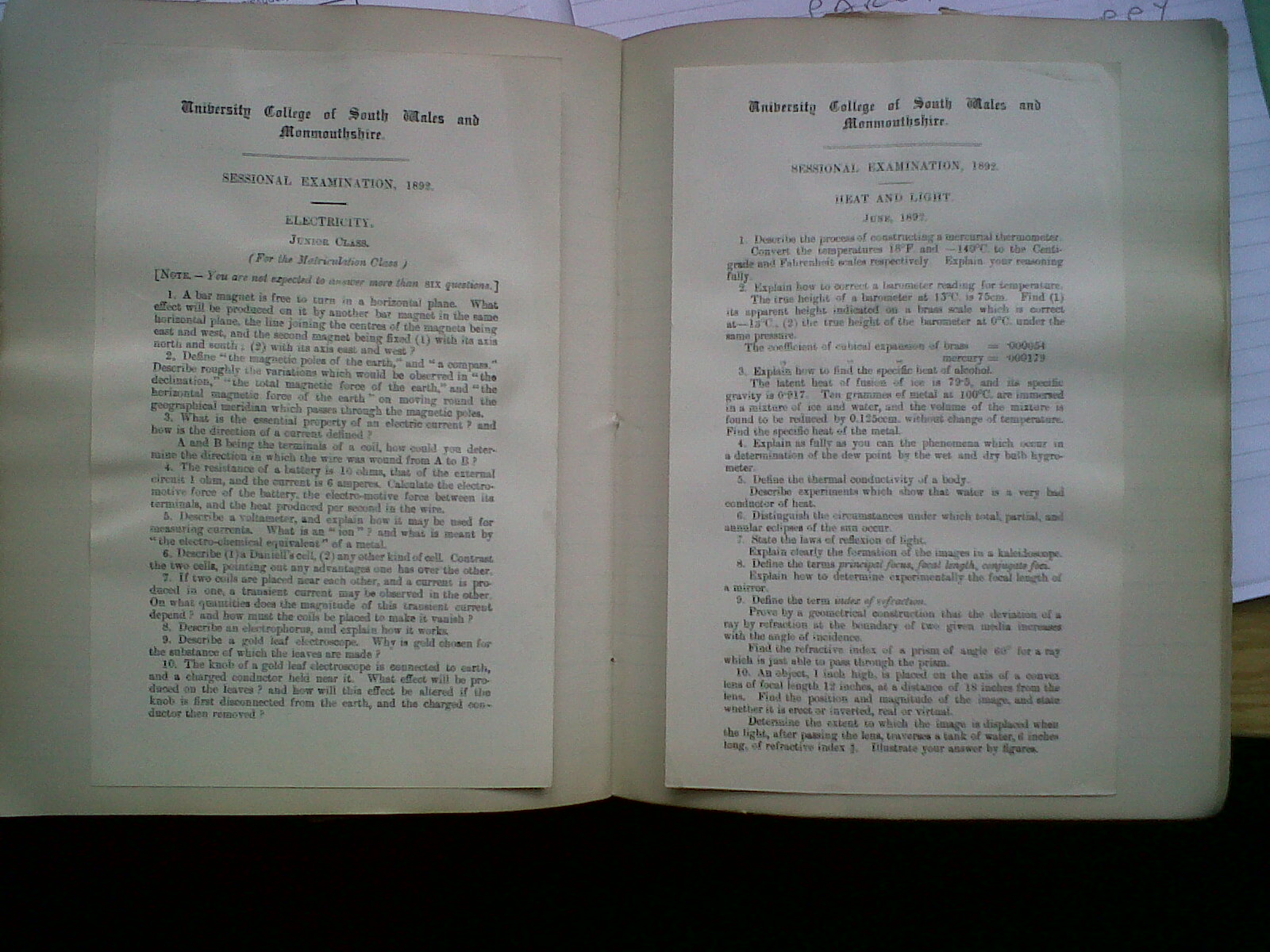
Follow @telescoperThere recently came into my possession a book of very old school and university physics examinations, which are of interest because I’ve been posting slightly less ancient examples in recent weeks. These examinations were set by the University College of South Wales and Monmouthshire, which was founded in 1883, an institution which eventually became Cardiff University. I find them absolutely fascinating.
The papers are rather fragile, as is the book containing them, so I daren’t risk trying to scan them systematically in case flattening them out causes damage. Here instead are a few random examples that I photographed on my desk, in the manner of an old-fashioned secret agent. Sorry they’re not all that clear, but you can see them blown up if you click on them.
The collection is fairly complete, covering most of classical physics, at all examination levels from university entry to final honours. For some reason, however, the papers on relativity and quantum physics appear to be missing….


At the risk of becoming one of the Great Bores of the Day on the subject of past examinations I thought I’d follow up my old O-level Physics paper with a Physics A-level examination paper to see what people think about it. It might add to the discussion over on another blog I read too.
I took this particular examination myself in 1981. Can it really be 30 years ago? Agh. Paper 1 comprised a collection of short questions of multiple-choice type from which I’ve already posted one example on this blog. This one is Paper 2 and, as you’ll see, it consists of longer questions with a freer format.
One comment I’ll make is that Question 5 is remarkably similar to a coursework questions we have been using here in the School of Physics & Astronomy at Cardiff University in our First year Physics module on Electricity and Magnetism.
Any other comments from people who’ve done A-levels more recently would be very welcome through the Comments Box, e.g. is there anything in this paper that you wouldn’t expect to see nowadays? Is it easier, harder, or about the same as current A-level physics papers?
Follow @telescoperMy recent post about the O-level Mathematics examination I took way back in 1979 seems to have generated quite a lot of comment, both here and elsewhere, so I thought I’d follow it up with a Physics examination paper to see what people think about that.
One complication with this is that I didn’t actually take Physics O-level; the School I went to preferred to offer Combined Science instead. This examination covered a general syllabus including Physics, Chemistry and Biology but was worth two O-levels rather than three. More or less, therefore, I did 2/3 of a Physics O-level.
I think the reason for choosing Combined Science rather than three separate subjects was to allow us kids the chance to take as broad a range of subjects as possible. In fact I did ten O-levels: Combined Science (2); Mathematics; Additional Mathematics; History; Geography; English Literature; English Language; French; and Latin. My best mark at O-level was in neither mathematics nor science subjects, actually, but in Latin…
Anyway, the examination for Combined Science consisted of four papers. Paper 1 was a general paper with a range of short questions in a booklet into which candidates had to write their answers in the space provided. Obviously I don’t have this paper because I handed it in. The three other papers were each on one of the main subjects and Paper 2, shown below, was the Physics paper.
This also gives me the opportunity to try out slideshare as a better way of displaying the paper than the clumsy method of photographing it on my desk I used for the Mathematics paper. Unfortunately our temperamental scanner – which is rapidly becoming my arch enemy – seems to have missed some of the question numbers, so I put them in by hand.
The first thing that struck me about Question 5 is “During an experiment a boy obtained…”. Girls don’t do physics, obviously.
Any other comments or comparison with GCSE Physics papers should be written in the space provided. Write clearly and legibly, and show clearly the reasoning by which you arrive at your conclusions. You may begin.
Follow @telescoperIn view of my current rather hectic schedule – why else would I be up at this ungodly hour? – I thought I’d combine another bit of recycling with some audience participation. I’ve updated below the list of Haiku I posted some time ago with some new ones I’ve jotted down at random intervals over the intervening months.
How about a few Haiku of your own on themes connected to astronomy, cosmology or physics?
Don’t be worried about making the style of your contributions too authentic, just make sure they are 17 syllables in total, and split into three lines of 5, 7 and 5 syllables respectively.
Here are some of my own to get you started:
Quantum Gravity:
The troublesome double-act
Of Little and Large
Gravity’s waves are
Traceless; which does not mean they
Can never be found
The Big Bang wasn’t
So big, at least not when you
Think in decibels.
Cosmological
Constant and Dark Energy
Are vacuous names
Microwave Background
Photons remember a time
When they were hotter
Isotropic and
Homogeneous metric?
Robertson-Walker
Galaxies evolve
In a complicated way
We don’t understand
Acceleration:
Type Ia Supernovae
Gave us the first clue
Cosmic Inflation
Could have stretched the Universe
And made it flatter
Astrophysicist
Is what I’m told is my Job
Title. Whatever.
“Clusters look cool,” said
Sunyaev and Zel’dovich,
“because they are hot”.
Gaussianity
is produced by inflation,
normally speaking.
Gravity waves are
a kind of perturbation;
they make you tensor
Bubble collisions
Leave marks in the C-M-B
To please A. Linde
This Haiku contains
“Baryon Oscillations”
in its middle line.
What should we build next:
S-K-A or E-L-T?
Or maybe neither…?
J W* S T,
(the James Webb Space Telescope);
long name, big budget
* “W” has to be pronounced “dubya” for this one to work!
Contributions welcome via the comments box. The best one gets a chance to win Bully’s star prize.
Follow @telescoperNow that I’m back from my trip to Copenhagen, it’s going to be back to work with a vengeance. To those of you who think academics have massively long summer breaks, I can tell you that mine ends on Monday when I will be doing a stint as Acting Head of School. That’s not usually a particularly onerous task during the summer months, but next week happens to be the week that A-level results come out and it promises to be a hectic and critical period. It’s obviously a sheer coincidence that all the other senior professors have decided to take their leave at this time…
There are several reasons for this being a particularly stressful time. First the number of potential students applying to study Physics (and related subjects) this forthcoming academic year (2011/12) in the School of Physics & Astronomy at Cardiff University was up by a whopping 53% on last year. I blogged about this a few months ago when it became obvious that we were having a bumper year.
The second reason is that Cardiff’s School of Physics & Astronomy has been given a big increase in funded student numbers from HEFCW. In fact we’ve been given an extra 60 funded places (over two years), which is a significant uplift in our quota and a much-needed financial boost for the School. This has happened basically because of HECFW‘s desire to bolster STEM subjects as part of a range of measures related to the Welsh Assembly Government’s plans for the regions. Preparations have been made to accommodate the extra students in tutorial groups and we’re even modifying one of our larger lecture rooms to increase capacity.
Unfortunately the extra places were announced after the normal applications cycle was more-or-less completed, so the admissions team had been proceeding on the basis that demand would exceed supply for this year so has set our undergraduate offers rather high. In order to fill the extra places that have been given to us late in the day, even with our vastly increased application numbers, we will almost certainly have to go into the clearing system to recruit some of the extra students.
In case you didn’t realise, universities actually get a sneak preview of the A-level results a couple of days before the applicants receive them. This helps us plan our strategy, whether to accept “near-misses”, whether to go into clearing, etc.
On top of these local factors there is the sweeping change in tuition fees coming in next year (2012-13). Anxious to avoid the vastly increased cost of future university education many fewer students will be opting to defer entry than in previous years. Moreover, some English universities have had cuts in funded student places making entry highly competitive. As an article in today’s Observer makes clear, this all means that clearing is likely to be extremely frantic this year.
And once that’s out of the way I’ll be working more-or-less full time until late September on business connected with the STFC Astronomy Grants Panel, a task likely to be just as stressful as UCAS admissions for both panel members and applicants.
Ho hum.
Follow @telescoperSome of you might think this is just ridiculous hype, but I couldn’t possibly comment…
via viXra log


 In the Dark