Archive for Planck

BICEP2: Watch this Space!

Posted in The Universe and Stuff with tags , , , on August 21, 2014 by telescoper

One of the advantages of informal workshops like this one I’m attending in Copenhagen right now is that there’s a lot of time for discussions and picking up various bits of gossip. Some of the intelligence gathered in this way is unreliable but often it represents knowledge that’s widely known in the cosmological community but which I’ve missed because I don’t spend as much time on the conference circuit these days.

Anyway, those of you with more than a passing interest in cosmology will remember the results from the BICEP2 experiment announced with a great fanfare of publicity in March this year. A significant number of eminent cosmologists immediately seized on the detection of B-mode correlations in the polarized cosmic microwave background as definitive proof of the existence of primordial gravitational waves. Some went even further, in fact, and claimed that the BICEP2 results prove all kinds of other things too.

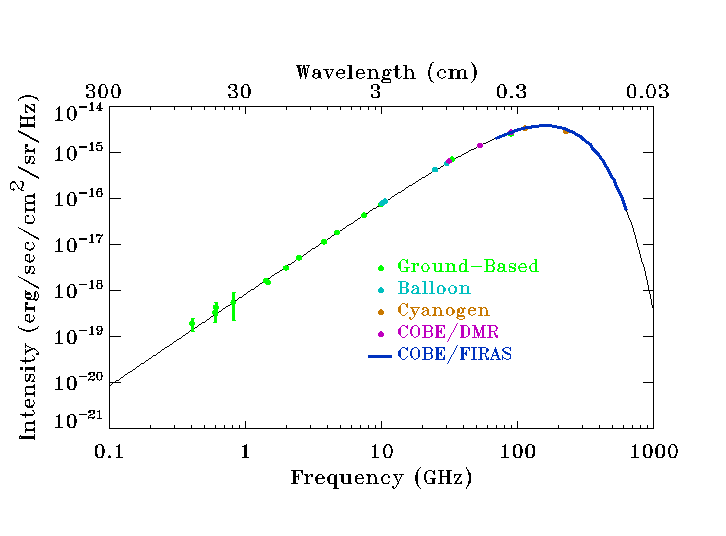
As time passed, however, and folks had time to digest some of the details presented by the BICEP2 team, there has been a growing unease about the possibility that the measurements may have been misinterpreted. The problem – the Achilles Heel of BICEP, so to speak – is that it operates at a single frequency, 150 GHz. That means that it is not possible for this experiment on its own to determine the spectrum of the detected signal. This is important because it is not only the cosmic microwave background that is capable of producing polarized radiation at a frequency of 150 GHz, foreground dust inside our own Galaxy being the prime suspect as an alternative source. It should be possible to distinguish between dust and CMB using measurements at different frequencies because the microwave background has a black-body spectrum  whereas dust does not. However, BICEP2 maps only a small part of the sky and at the time of the announcement there were no other measurements covering the same region, so a convincing test has not so far been possible.


cmbspectrum

The measured spectrum of the cosmic microwave background. It’s indistinguishable from the theoretical black-body curve shown as a solid line

The initial BICEP2 announcement included a discussion of foregrounds that concluded that these were expected to be much lower than their detected signal in the area mapped, but serious doubts have emerged about the accuracy of this claim. Have a look at my BICEP2 folder to see more discussion.

More recently, in July, it was announced that the BICEP2 team would collaborate with the large consortium working on the analysis of data from the Planck experiment to try to resolve these difficulties. Planck not only covers the whole sky but also has detectors making measurements over a wide range of frequencies (all the way up to 857 GHz). This should provide a definitive measurement of the contribution of Galactic dust to the BICEP2 field and at last give us a strong experimental basis on which to decided whether the BICEP2 signal is primordial or not. The result of my informal poll on BICEP2 was a clear majority (~62%) in favour of the statement that it was “too early to say” what the BICEP2 signal actually represents.

Anyway, I have it on very good authority that Planck’s analysis of the Galactic foregrounds in the BICEP2 region will be published (on the arXiv) on or around September 1st 2014. That’s just about 10 days from now. Maybe then this tantalizing wait will be over. I’ll try my best to post about the results when it comes out. In the meantime, I thought I’d do something completely unscientific and try to gauge what how current opinion stands on this issue by means of a poll of the total unrepresentative readership of this blog. Suppose you had to bet on whether the BICEP2 result is due to (a) primordial gravitational waves or (b) Galactic foregrounds, which would you go for?

Of course, those working on this project probably know the answer already so they’ll have to decide for themselves whether they wish to vote!

Has BICEP2 bitten the dust?

Posted in The Universe and Stuff with tags , , , , , , , , , , on June 5, 2014 by telescoper

Time for yet another update on twists and turns of the ongoing saga of  BICEP2 and in particular the growing suspicion that the measurements could be accounted for by Galactic dust rather than primordial gravitational waves; see various posts on this blog.

First there is a Nature News and Views article by Paul Steinhardt with the title Big Bang blunder bursts the multiverse bubble. As the title suggests, this piece is pretty scathing about the whole affair, for two main reasons. The first is to do with the manner of the release of the result via a press conference before the results had been subjected to peer review. Steinhardt argues that future announcements of “discoveries” in this area

should be made after submission to journals and vetting by expert referees. If there must be a press conference, hopefully the scientific community and the media will demand that it is accompanied by a complete set of documents, including details of the systematic analysis and sufficient data to enable objective verification.

I also have reservations about the way the communication of this result was handled but I wouldn’t go as far as Steinhardt did. I think it’s quite clear that the BICEP2 team have detected something and that they published their findings in good faith. The fact that the media pushed the result as being a definitive detection of primordial gravitational waves wasn’t entirely their fault; most of the hype was probably down to other cosmologists (especially theorists) who got a bit over-excited.

It is true that if it turns out that the BICEP2 signal is due to dust rather than primordial gravitational waves then the cosmology community will have a certain amount of egg on its face. On the other hand, this is actually what happens in science all the time. If we scientists want the general public to understand better how science actually works we should not pretend that it is about absolute certainties but that it is a process, and because it is a process operated by human beings it is sometimes rather messy. The lesson to be learned is not about hiding the mess from the public but about communicating the uncertainties more accurately and more honestly.

Steinhardt’s other main point is one with which I disagree very strongly. Here is the core of his argument about inflation:

The common view is that it is a highly predictive theory. If that was the case and the detection of gravitational waves was the ‘smoking gun’ proof of inflation, one would think that non-detection means that the theory fails. Such is the nature of normal science. Yet some proponents of inflation who celebrated the BICEP2 announcement already insist that the theory is equally valid whether or not gravitational waves are detected. How is this possible?

The answer given by proponents is alarming: the inflationary paradigm is so flexible that it is immune to experimental and observational tests.

This is extremely disingenuous. There’s a real difference between a theory that is “immune to experimental and observational tests” and one which is just very difficult to test in that way. For a start, the failure of a given experiment to detect gravitational waves  does not prove that gravitational waves don’t exist at some level; a more sensitive experiment might be needed. More generally, the inflationary paradigm is not completely specified as a theory; it is a complex entity which contains a number of free parameters that can be adjusted in the light of empirical data. The same is also true, for example, of the standard model of particle physics. The presence of these adjustable degrees of freedom makes it much harder to test the hypothesis than would be the case if there were no such wiggle room. Normal science often proceeds via the progressive tightening of the theoretical slack until there is no more room for manoeuvre. This process can take some time.

Inflation will probably be very difficult to test, but then there’s no reason why we should expect a definitive theoretical understanding of the very early Universe to come easily to us. Indeed, there is almost certainly a limit to the extent that we can understand the Universe with “normal science” but I don’t think we’ve reached it yet. We need to be more patient. So what if we can’t test inflation with our current technology? That doesn’t mean that the idea is unscientific. It just means that the Universe is playing hard to get.

Steinhardt continues with an argument about the multiverse. He states that inflation

almost inevitably leads to a multiverse with an infinite number of bubbles, in which the cosmic and physical properties vary from bubble to bubble. The part of the multiverse that we observe corresponds to a piece of just one such bubble. Scanning over all possible bubbles in the multi­verse, every­thing that can physically happen does happen an infinite number of times. No experiment can rule out a theory that allows for all possible outcomes. Hence, the paradigm of inflation is unfalsifiable.

This may seem confusing given the hundreds of theoretical papers on the predictions of this or that inflationary model. What these papers typically fail to acknowledge is that they ignore the multiverse and that, even with this unjustified choice, there exists a spectrum of other models which produce all manner of diverse cosmological outcomes. Taking this into account, it is clear that the inflationary paradigm is fundamentally untestable, and hence scientifically meaningless.

I don’t accept the argument that “inflation almost inevitably leads to a multiverse” but even if you do the rest of the argument is false. Infinitely many outcomes may be possible, but are they equally probable? There is a well-defined Bayesian framework within which one could answer this question, with sufficient understanding of the underlying physics. I don’t think we know how to do this yet but that doesn’t mean that it can’t be done in principle.

For similar discussion of this issue see Ted Bunn’s Blog.

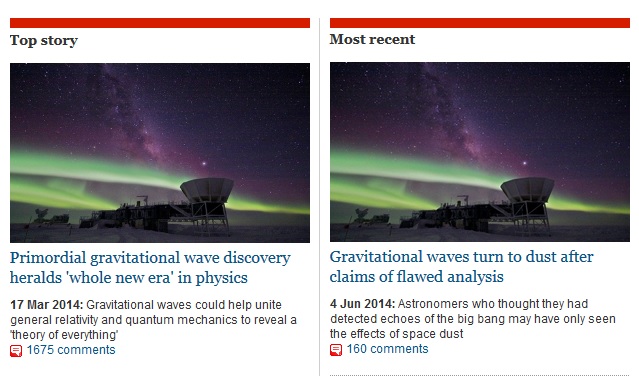
Steinhardt’s diatribe was accompanied  yesterday by a sceptical news piece in the Grauniad entitled Gravitational waves turn to dust after claims of flawed analysis. This piece is basically a rehash of the argument that the BICEP2 results may be accounted for by dust rather than primordial gravitational waves, which definitely a possibility, and that the BICEP2 analysis involved a fairly dubious analysis of the foregrounds. In my opinion it’s an unnecessarily aggressive piece, but mentioning it here gives me the excuse to post the following screen grab from the science section of today’s Guardian website:

BICEP_thenandnow

Aficionados of Private Eye will probably think of the Just Fancy That section!

Where do I stand? I can hear you all asking that question so I’ll make it clear that my view hasn’t really changed at all since March. I wouldn’t offer any more than even money on a bet that BICEP2 has detected primordial gravitational waves at all and I’d offer good odds that, if the detection does stand, the value of the tensor-to-scalar ratio is significantly lower than the value of 0.2 claimed by BICEP2.  In other words, I don’t know. Sometimes that’s the only really accurate statement a scientist can make.

BICEP2: The Dust Thickens…

Posted in The Universe and Stuff with tags , , , , , , on May 29, 2014 by telescoper

Off to a day-long staff training event today so just time to post a quick update on the BICEP2 saga (see various posts on this blog). There’s a new paper on the arXiv today by Flauger, Hill and Spergel. The first part of its rather lengthy abstract reads:

BICEP2 has reported the detection of a degree-scale B-mode polarization pattern in the Cosmic Microwave Background (CMB) and has interpreted the measurement as evidence for primordial gravitational waves. Motivated by the profound importance of the discovery of gravitational waves from the early Universe, we examine to what extent a combination of Galactic foregrounds and lensed E-modes could be responsible for the signal. We reanalyze the BICEP2 results and show that the 100×150 GHz and 150×150 GHz data are consistent with a cosmology with r=0.2 and negligible foregrounds, but also with a cosmology with r=0 and a significant dust polarization signal. We give independent estimates of the dust polarization signal in the BICEP2 region using four different approaches. While these approaches are consistent with each other, the expected amplitude of the dust polarization power spectrum remains uncertain by about a factor of three. The lower end of the prediction leaves room for a primordial contribution, but at the higher end the dust in combination with the standard CMB lensing signal could account for the BICEP2 observations, without requiring the existence of primordial gravitational waves. By measuring the cross-correlations between the pre-Planck templates used in the BICEP2 analysis and between different versions of a data-based template, we emphasize that cross-correlations between models are very sensitive to noise in the polarization angles and that measured cross-correlations are likely underestimates of the contribution of foregrounds to the map. These results suggest that BICEP1 and BICEP2 data alone cannot distinguish between foregrounds and a primordial gravitational wave signal, and that future Keck Array observations at 100 GHz and Planck observations at higher frequencies will be crucial to determine whether the signal is of primordial origin. (abridged)

The foreground analysis done in this paper seems to me to be much more convincing that that presented in the original BICEP2 paper and it confirms that the data as presented can not discriminate between B-modes arising from a polarized foreground component and from the presence of primordial gravitational waves. As I’ve said before (several times now), the press hype surrounding this discovery was a bit premature and we have to wait for observations at other frequencies before a clearer picture emerges through the dust.

UPDATE: A new Nature News and Views Article contains a strong statement by David Spergel to the effect that BICEP2 provides no evidence either for or against the existence of primordial gravitational waves.

Sakharov Oscillations in Cosmology

Posted in The Universe and Stuff with tags , , , , on May 21, 2014 by telescoper

No time for much of a post today, but I couldn’t resist commenting on something I picked up from Twitter just now. Today is the 93rd anniversary of the birth of the nuclear physicist and dissident Andrei Dmitrievich Sakharov who died in 1989. Sakharov is probably more famous for his political campaigning and the award of the Nobel Peace Prize in 1975 than for his work in physics, but I couldn’t resist mentioning a classic paper by him which was first published in Russian in 1965.

Here is the abstract:

Sakharov

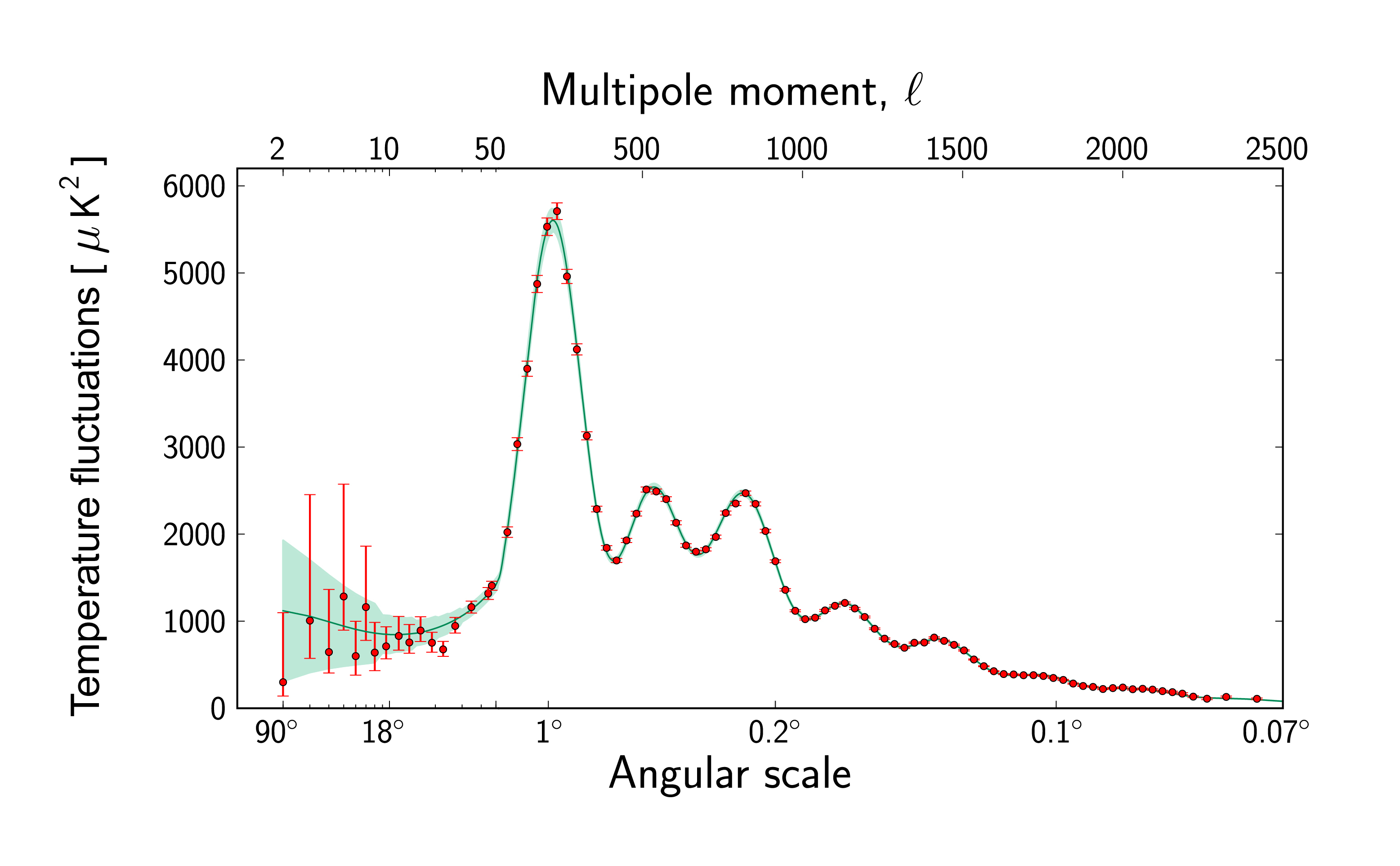
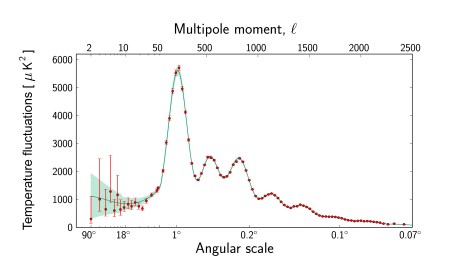
The importance of this remarkable paper for modern cosmology can’t be overstated, although many modern cosmologists have either forgotten it or were never aware of it in the first place. The details are a bit out of date, but the idea that density perturbations that grew by a process of gravitational instability to form galaxies and the large-scale structure of the Universe has survived almost fifty years, and plays a central role in the standard cosmological model. Moreover, the Sakharov Oscillations predicted in this paper manifest themselves in the temperature fluctuations of the cosmic microwave background as measured by, e.g., the Planck experiment:

Planck_power_spectrum_orig

The wiggles in the power spectrum plotted above appear because these fluctuations, generated in the modern theory during an episode of cosmic inflation, are set up in phase and thus reach the epoch of scattering at different phases of their oscillation and hence with different amplitudes. The detailed behaviour of the spectrum displayed above tells us a huge amount about the composition and evolution of the Universe.

When Francesco Lucchin and I were writing the first edition of our cosmology textbook (second edition here) we were careful to acknowledge Sakharov’s role in the development of cosmological theory, which wasn’t generally reflected in texts written outside Russia. I particularly recall the late Leonid Grischuk banging on about Sakharov’s work at many conferences in order to ensure he got proper credit and some books, e.g. Zel’dovich and Novikov’s two-volume Relativistic Astrophysics, do acknowledge him correctly. Somehow, however, the CMB wiggles never acquired the name of Sakharov; the peaks in the spectrum are often still called Doppler Peaks or Acoustic Peaks, when surely they should be Sakharov Peaks. It’s probably too late to change the nomenclature now, but there you go.

Anyway, I’ve now realized that I was working on the First Edition of Coles & Lucchin in 1994 which is now twenty years ago so before I get too depressed about the passage of time I’ll stop writing and get on with something else!

Anyway, I’ve now realized that

Planck versus BICEP2: Round One!

Posted in The Universe and Stuff with tags , , , , , , , on May 6, 2014 by telescoper

You may recall my scepticism about the recent announcement from the BICEP2 experiment about evidence from polarized microwave emission for the existence of primordial gravitational waves generated during a period of cosmic inflation.

Well, in between a couple of meetings this morning, I realised that there’s a paper just out onto the arXiv from the Planck Collaboration. Here’s the abstract:

This paper presents the large-scale polarized sky as seen by Planck HFI at 353 GHz, which is the most sensitive Planck channel for dust polarization. We construct and analyse large-scale maps of dust polarization fraction and polarization direction, while taking account of noise bias and possible systematic effects. We find that the maximum observed dust polarization fraction is high (pmax > 18%), in particular in some of the intermediate dust column density (AV < 1mag) regions. There is a systematic decrease in the dust polarization fraction with increasing dust column density, and we interpret the features of this correlation in light of both radiative grain alignment predictions and fluctuations in the magnetic field orientation. We also characterize the spatial structure of the polarization angle using the angle dispersion function and find that, in nearby fields at intermediate latitudes, the polarization angle is ordered over extended areas that are separated by filamentary structures, which appear as interfaces where the magnetic field sky projection rotates abruptly without apparent variations in the dust column density. The polarization fraction is found to be anti-correlated with the dispersion of the polarization angle, implying that the variations are likely due to fluctuations in the 3D magnetic field orientation along the line of sight sampling the diffuse interstellar medium. We also compare the dust emission with the polarized synchrotron emission measured with the Planck LFI, with low-frequency radio data, and with Faraday rotation measurements of extragalactic sources. The two polarized components are globally similar in structure along the plane and notably in the Fan and North Polar Spur regions. A detailed comparison of these three tracers shows, however, that dust and cosmic rays generally sample different parts of the line of sight and confirms that much of the variation observed in the Planck data is due to the 3D structure of the magnetic field.

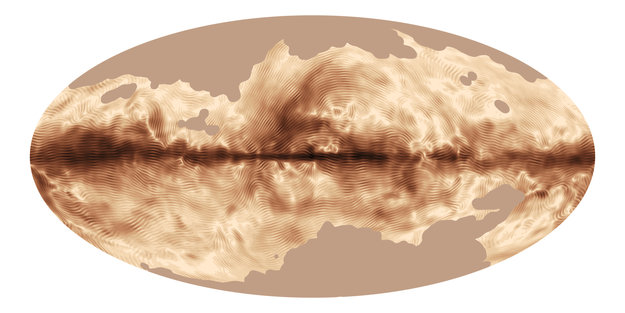
There’s also a press release from the European Space Agency which includes this nice picture:

Milky_Way_s_magnetic_fingerprint_large

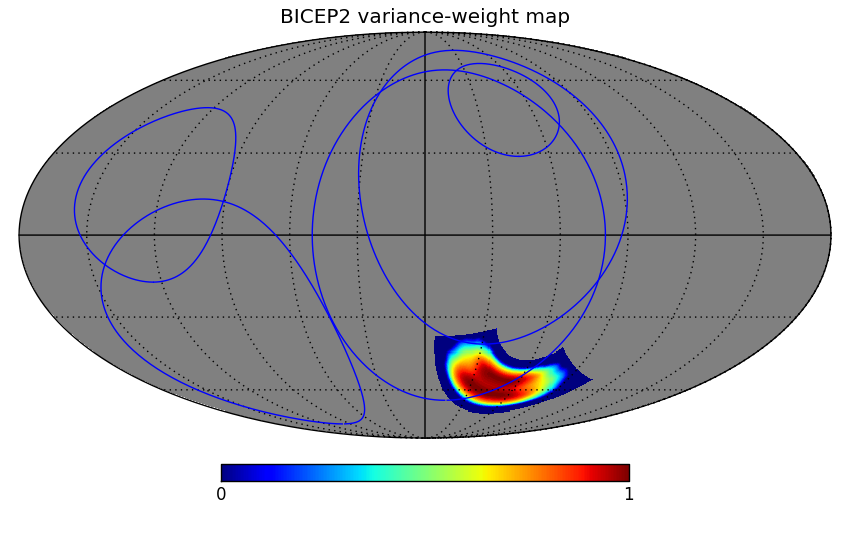
This study is at 353 GHz, compared to the 150 GHz of the BICEP2 measurements. Galactic dust emission increases with frequency so one would expect more of an effect in this Planck map than in BICEP2, but the fact that polarized foreground emission is so strong at these frequencies does give one pause for thought. The Planck data actually cover the whole sky, so the above map has clearly been censored; below you can see the actual region of the sky covered by BICEP2, so there is little or no direct overlap with what’s been released by Planck:

bicep2_loops

We’ll have to wait until later this year to see what’s going on in the masked regions (i.e. far above and below the Galactic Plane, where the dust emission is presumably weaker) and indeed at the 7 other frequencies measured by Planck. It’s all a bit of a tease so far!

Here’s what the press release says about BICEP2

In March 2014, scientists from the BICEP2 collaboration claimed the first detection of such a signal in data collected using a ground-based telescope observing a patch of the sky at a single microwave frequency. Critically, the claim relies on the assumption that foreground polarised emissions are almost negligible in this region.

Later this year, scientists from the Planck collaboration will release data based on Planck’s observations of polarised light covering the entire sky at seven different frequencies. The multiple frequency data should allow astronomers to separate with great confidence any possible foreground contamination from the tenuous primordial polarised signal.

P.S.  It’s gratifying to see the Planck Collaboration have used extragalactic Faraday Rotation measures to probe the Galactic Magnetic field as I suggested on this blog not long ago. The article that first advocated doing this with CMB maps can be found here.


Is Inflation Testable?

Posted in The Universe and Stuff with tags , , , , , , , , on March 4, 2014 by telescoper

It seems the little poll about cosmic inflation I posted last week with humorous intent has ruffled a few feathers, but at least it gives me the excuse to wheel out an updated and edited version of an old piece I wrote on the subject.

Just over thirty  years ago a young physicist came up with what seemed at first to be an absurd idea: that, for a brief moment in the very distant past, just after the Big Bang, something weird happened to gravity that made it push rather than pull.  During this time the Universe went through an ultra-short episode of ultra-fast expansion. The physicist in question, Alan Guth, couldn’t prove that this “inflation” had happened nor could he suggest a compelling physical reason why it should, but the idea seemed nevertheless to solve several major problems in cosmology.

Three decades later, Guth is a professor at MIT and inflation is now well established as an essential component of the standard model of cosmology. But should it be? After all, we still don’t know what caused it and there is little direct evidence that it actually took place. Data from probes of the cosmic microwave background seem to be consistent with the idea that inflation happened, but how confident can we be that it is really a part of the Universe’s history?

According to the Big Bang theory, the Universe was born in a dense fireball which has been expanding and cooling for about 14 billion years. The basic elements of this theory have been in place for over eighty years, but it is only in the last decade or so that a detailed model has been constructed which fits most of the available observations with reasonable precision. The problem is that the Big Bang model is seriously incomplete. The fact that we do not understand the nature of the dark matter and dark energy that appears to fill the Universe is a serious shortcoming. Even worse, we have no way at all of describing the very beginning of the Universe, which appears in the equations used by cosmologists as a “singularity”- a point of infinite density that defies any sensible theoretical calculation. We have no way to define a priori the initial conditions that determine the subsequent evolution of the Big Bang, so we have to try to infer from observations, rather than deduce by theory, the parameters that govern it.

The establishment of the new standard model (known in the trade as the “concordance” cosmology) is now allowing astrophysicists to turn back the clock in order to understand the very early stages of the Universe’s history and hopefully to understand the answer to the ultimate question of what happened at the Big Bang itself and thus answer the question “How did the Universe Begin?”

Paradoxically, it is observations on the largest scales accessible to technology that provide the best clues about the earliest stages of cosmic evolution. In effect, the Universe acts like a microscope: primordial structures smaller than atoms are blown up to astronomical scales by the expansion of the Universe. This also allows particle physicists to use cosmological observations to probe structures too small to be resolved in laboratory experiments.

Our ability to reconstruct the history of our Universe, or at least to attempt this feat, depends on the fact that light travels with a finite speed. The further away we see a light source, the further back in time its light was emitted. We can now observe light from stars in distant galaxies emitted when the Universe was less than one-sixth of its current size. In fact we can see even further back than this using microwave radiation rather than optical light. Our Universe is bathed in a faint glow of microwaves produced when it was about one-thousandth of its current size and had a temperature of thousands of degrees, rather than the chilly three degrees above absolute zero that characterizes the present-day Universe. The existence of this cosmic background radiation is one of the key pieces of evidence in favour of the Big Bang model; it was first detected in 1964 by Arno Penzias and Robert Wilson who subsequently won the Nobel Prize for their discovery.

The process by which the standard cosmological model was assembled has been a gradual one, but the latest step was taken by the European Space Agency’s Planck mission . I’ve blogged about the implications of the Planck results for cosmic inflation in more technical detail here. In a nutshell, for several years this satellite mapped  the properties of the cosmic microwave background and how it varies across the sky. Small variations in the temperature of the sky result from sound waves excited in the hot plasma of the primordial fireball. These have characteristic properties that allow us to probe the early Universe in much the same way that solar astronomers use observations of the surface of the Sun to understand its inner structure,  a technique known as helioseismology. The detection of the primaeval sound waves is one of the triumphs of modern cosmology, not least because their amplitude tells us precisely how loud the Big Bang really was.

The pattern of fluctuations in the cosmic radiation also allows us to probe one of the exciting predictions of Einstein’s general theory of relativity: that space should be curved by the presence of matter or energy. Measurements from Planck and its predecessor WMAP reveal that our Universe is very special: it has very little curvature, and so has a very finely balanced energy budget: the positive energy of the expansion almost exactly cancels the negative energy relating of gravitational attraction. The Universe is (very nearly) flat.

The observed geometry of the Universe provides a strong piece of evidence that there is an mysterious and overwhelming preponderance of dark stuff in our Universe. We can’t see this dark matter and dark energy directly, but we know it must be there because we know the overall budget is balanced. If only economics were as simple as physics.

Computer Simulation of the Cosmic Web

The concordance cosmology has been constructed not only from observations of the cosmic microwave background, but also using hints supplied by observations of distant supernovae and by the so-called “cosmic web” – the pattern seen in the large-scale distribution of galaxies which appears to match the properties calculated from computer simulations like the one shown above, courtesy of Volker Springel. The picture that has emerged to account for these disparate clues is consistent with the idea that the Universe is dominated by a blend of dark energy and dark matter, and in which the early stages of cosmic evolution involved an episode of accelerated expansion called inflation.

A quarter of a century ago, our understanding of the state of the Universe was much less precise than today’s concordance cosmology. In those days it was a domain in which theoretical speculation dominated over measurement and observation. Available technology simply wasn’t up to the task of performing large-scale galaxy surveys or detecting slight ripples in the cosmic microwave background. The lack of stringent experimental constraints made cosmology a theorists’ paradise in which many imaginative and esoteric ideas blossomed. Not all of these survived to be included in the concordance model, but inflation proved to be one of the hardiest (and indeed most beautiful) flowers in the cosmological garden.

Although some of the concepts involved had been formulated in the 1970s by Alexei Starobinsky, it was Alan Guth who in 1981 produced the paper in which the inflationary Universe picture first crystallized. At this time cosmologists didn’t know that the Universe was as flat as we now think it to be, but it was still a puzzle to understand why it was even anywhere near flat. There was no particular reason why the Universe should not be extremely curved. After all, the great theoretical breakthrough of Einstein’s general theory of relativity was the realization that space could be curved. Wasn’t it a bit strange that after all the effort needed to establish the connection between energy and curvature, our Universe decided to be flat? Of all the possible initial conditions for the Universe, isn’t this very improbable? As well as being nearly flat, our Universe is also astonishingly smooth. Although it contains galaxies that cluster into immense chains over a hundred million light years long, on scales of billions of light years it is almost featureless. This also seems surprising. Why is the celestial tablecloth so immaculately ironed?

Guth grappled with these questions and realized that they could be resolved rather elegantly if only the force of gravity could be persuaded to change its sign for a very short time just after the Big Bang. If gravity could push rather than pull, then the expansion of the Universe could speed up rather than slow down. Then the Universe could inflate by an enormous factor (1060 or more) in next to no time and, even if it were initially curved and wrinkled, all memory of this messy starting configuration would be lost. Our present-day Universe would be very flat and very smooth no matter how it had started out.

But how could this bizarre period of anti-gravity be realized? Guth hit upon a simple physical mechanism by which inflation might just work in practice. It relied on the fact that in the extreme conditions pertaining just after the Big Bang, matter does not behave according to the classical laws describing gases and liquids but instead must be described by quantum field theory. The simplest type of quantum field is called a scalar field; such objects are associated with particles that have no spin. Modern particle theory involves many scalar fields which are not observed in low-energy interactions, but which may well dominate affairs at the extreme energies of the primordial fireball.

Classical fluids can undergo what is called a phase transition if they are heated or cooled. Water for example, exists in the form of steam at high temperature but it condenses into a liquid as it cools. A similar thing happens with scalar fields: their configuration is expected to change as the Universe expands and cools. Phase transitions do not happen instantaneously, however, and sometimes the substance involved gets trapped in an uncomfortable state in between where it was and where it wants to be. Guth realized that if a scalar field got stuck in such a “false” state, energy – in a form known as vacuum energy – could become available to drive the Universe into accelerated expansion.We don’t know which scalar field of the many that may exist theoretically is responsible for generating inflation, but whatever it is, it is now dubbed the inflaton.

This mechanism is an echo of a much earlier idea introduced to the world of cosmology by Albert Einstein in 1916. He didn’t use the term vacuum energy; he called it a cosmological constant. He also didn’t imagine that it arose from quantum fields but considered it to be a modification of the law of gravity. Nevertheless, Einstein’s cosmological constant idea was incorporated by Willem de Sitter into a theoretical model of an accelerating Universe. This is essentially the same mathematics that is used in modern inflationary cosmology.  The connection between scalar fields and the cosmological constant may also eventually explain why our Universe seems to be accelerating now, but that would require a scalar field with a much lower effective energy scale than that required to drive inflation. Perhaps dark energy is some kind of shadow of the inflaton

Guth wasn’t the sole creator of inflation. Andy Albrecht and Paul Steinhardt, Andrei Linde, Alexei Starobinsky, and many others, produced different and, in some cases, more compelling variations on the basic theme. It was almost as if it was an idea whose time had come. Suddenly inflation was an indispensable part of cosmological theory. Literally hundreds of versions of it appeared in the leading scientific journals: old inflation, new inflation, chaotic inflation, extended inflation, and so on. Out of this activity came the realization that a phase transition as such wasn’t really necessary, all that mattered was that the field should find itself in a configuration where the vacuum energy dominated. It was also realized that other theories not involving scalar fields could behave as if they did. Modified gravity theories or theories with extra space-time dimensions provide ways of mimicking scalar fields with rather different physics. And if inflation could work with one scalar field, why not have inflation with two or more? The only problem was that there wasn’t a shred of evidence that inflation had actually happened.

This episode provides a fascinating glimpse into the historical and sociological development of cosmology in the eighties and nineties. Inflation is undoubtedly a beautiful idea. But the problems it solves were theoretical problems, not observational ones. For example, the apparent fine-tuning of the flatness of the Universe can be traced back to the absence of a theory of initial conditions for the Universe. Inflation turns an initially curved universe into a flat one, but the fact that the Universe appears to be flat doesn’t prove that inflation happened. There are initial conditions that lead to present-day flatness even without the intervention of an inflationary epoch. One might argue that these are special and therefore “improbable”, and consequently that it is more probable that inflation happened than that it didn’t. But on the other hand, without a proper theory of the initial conditions, how can we say which are more probable? Based on this kind of argument alone, we would probably never really know whether we live in an inflationary Universe or not.

But there is another thread in the story of inflation that makes it much more compelling as a scientific theory because it makes direct contact with observations. Although it was not the original motivation for the idea, Guth and others realized very early on that if a scalar field were responsible for inflation then it should be governed by the usual rules governing quantum fields. One of the things that quantum physics tells us is that nothing evolves entirely smoothly. Heisenberg’s famous Uncertainty Principle imposes a degree of unpredictability of the behaviour of the inflaton. The most important ramification of this is that although inflation smooths away any primordial wrinkles in the fabric of space-time, in the process it lays down others of its own. The inflationary wrinkles are really ripples, and are caused by wave-like fluctuations in the density of matter travelling through the Universe like sound waves travelling through air. Without these fluctuations the cosmos would be smooth and featureless, containing no variations in density or pressure and therefore no sound waves. Even if it began in a fireball, such a Universe would be silent. Inflation puts the Bang in Big Bang.

The acoustic oscillations generated by inflation have a broad spectrum (they comprise oscillations with a wide range of wavelengths), they are of small amplitude (about one hundred thousandth of the background); they are spatially random and have Gaussian statistics (like waves on the surface of the sea; this is the most disordered state); they are adiabatic (matter and radiation fluctuate together) and they are formed coherently.  This last point is perhaps the most important. Because inflation happens so rapidly all of the acoustic “modes” are excited at the same time. Hitting a metal pipe with a hammer generates a wide range of sound frequencies, but all the different modes of the start their oscillations at the same time. The result is not just random noise but something moderately tuneful. The Big Bang wasn’t exactly melodic, but there is a discernible relic of the coherent nature of the sound waves in the pattern of cosmic microwave temperature fluctuations seen in the Cosmic Microwave Background. The acoustic peaks seen in the  Planck  angular spectrum  provide compelling evidence that whatever generated the pattern did so coherently.
Planck_power_spectrum_orig
There are very few alternative theories on the table that are capable of reproducing these results, but does this mean that inflation really happened? Do they “prove” inflation is correct? More generally, is the idea of inflation even testable?

So did inflation really happen? Does Planck prove it? Will we ever know?

It is difficult to talk sensibly about scientific proof of phenomena that are so far removed from everyday experience. At what level can we prove anything in astronomy, even on the relatively small scale of the Solar System? We all accept that the Earth goes around the Sun, but do we really even know for sure that the Universe is expanding? I would say that the latter hypothesis has survived so many tests and is consistent with so many other aspects of cosmology that it has become, for pragmatic reasons, an indispensable part our world view. I would hesitate, though, to say that it was proven beyond all reasonable doubt. The same goes for inflation. It is a beautiful idea that fits snugly within the standard cosmological and binds many parts of it together. But that doesn’t necessarily make it true. Many theories are beautiful, but that is not sufficient to prove them right.

When generating theoretical ideas scientists should be fearlessly radical, but when it comes to interpreting evidence we should all be unflinchingly conservative. The Planck measurements have also provided a tantalizing glimpse into the future of cosmology, and yet more stringent tests of the standard framework that currently underpins it. Primordial fluctuations produce not only a pattern of temperature variations over the sky, but also a corresponding pattern of polarization. This is fiendishly difficult to measure, partly because it is such a weak signal (only a few percent of the temperature signal) and partly because the primordial microwaves are heavily polluted by polarized radiation from our own Galaxy. Polarization data from Planck are yet to be released; the fiendish data analysis challenge involved is the reason for the delay.  But there is a crucial target that justifies these endeavours. Inflation does not just produce acoustic waves, it also generates different modes of fluctuation, called gravitational waves, that involve twisting deformations of space-time. Inflationary models connect the properties of acoustic and gravitational fluctuations so if the latter can be detected the implications for the theory are profound. Gravitational waves produce very particular form of polarization pattern (called the B-mode) which can’t be generated by acoustic waves so this seems a promising way to test inflation. Unfortunately the B-mode signal is expected to be very weak and the experience of WMAP suggests it might be swamped by foregrounds. But it is definitely worth a go, because it would add considerably to the evidence in favour of inflation as an element of physical reality.

But would even detection of primordial gravitational waves really test inflation? Not really. The problem with inflation is that it is a name given to a very general idea, and there are many (perhaps infinitely many) different ways of implementing the details, so one can devise versions of the inflationary scenario that produce a wide range of outcomes. It is therefore unlikely that there will be a magic bullet that will kill inflation dead. What is more likely is a gradual process of reducing the theoretical slack as much as possible with observational data, such as is happening in particle physics. For example, we have not yet identified the inflaton field (nor indeed any reasonable candidate for it) but we are gradually improving constraints on the allowed parameter space. Progress in this mode of science is evolutionary not revolutionary.

Many critics of inflation argue that it is not a scientific theory because it is not falsifiable. I don’t think falsifiability is a useful concept in this context; see my many posts relating to Karl Popper. Testability is a more appropriate criterion. What matters is that we have a systematic way of deciding which of a set of competing models is the best when it comes to confrontation with data. In the case of inflation we simply don’t have a compelling model to test it against. For the time being therefore, like it or not, cosmic inflation is clearly the best model we have. Maybe someday a worthy challenger will enter the arena, but this has not happened yet.

Most working cosmologists are as aware of the difficulty of testing inflation as they are of its elegance. There are also those  who talk as if inflation were an absolute truth, and those who assert that it is not a proper scientific theory (because it isn’t falsifiable). I can’t agree with either of these factions. The truth is that we don’t know how the Universe really began; we just work on the best ideas available and try to reduce our level of ignorance in any way we can. We can hardly expect  the secrets of the Universe to be so easily accessible to our little monkey brains.
Physics World Plug

Posted in Books, Talks and Reviews, The Universe and Stuff with tags , , , on January 7, 2014 by telescoper

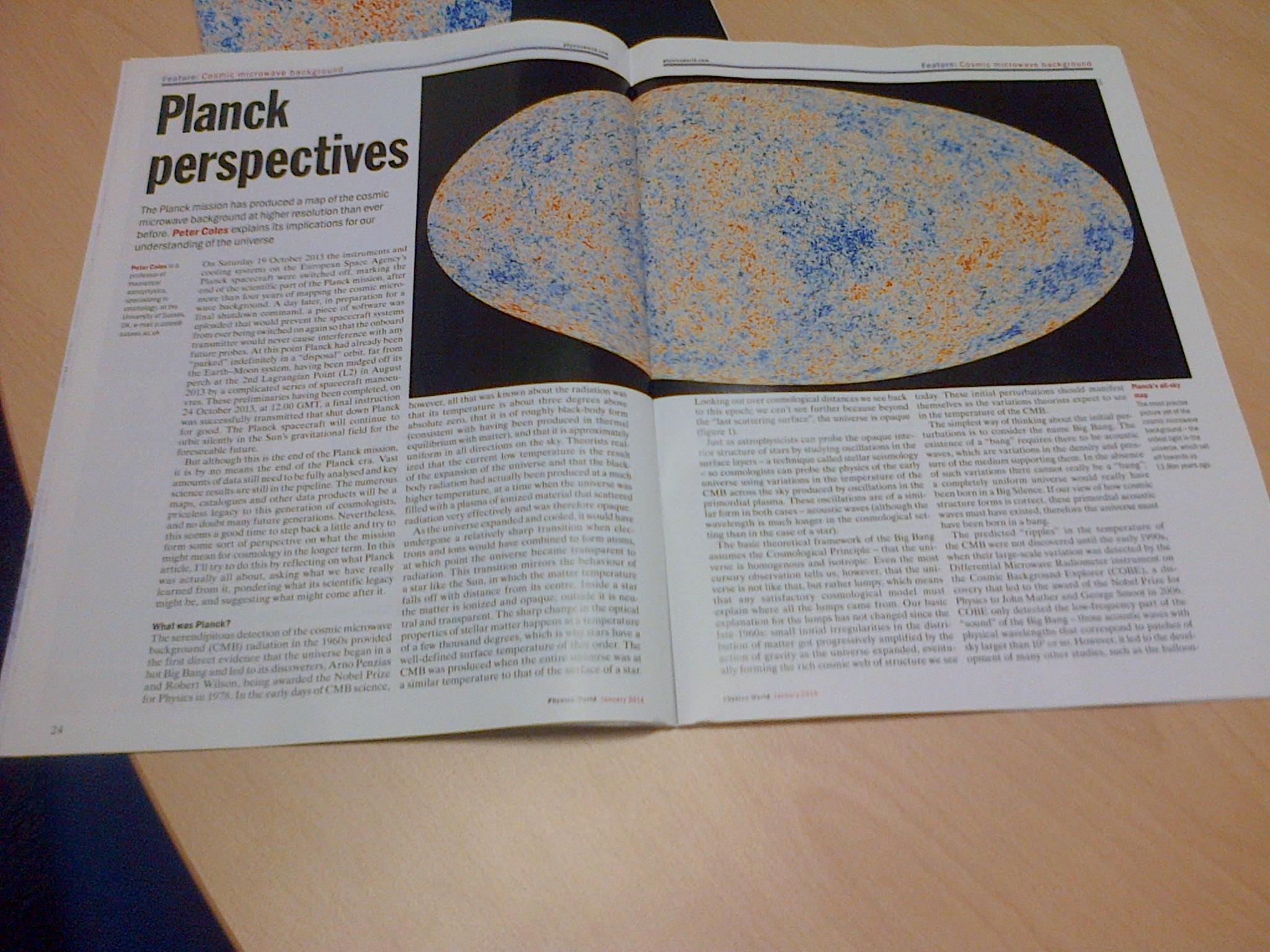
Just time for a quick bit of shameless self-promotion. This month’s Edition of Physics World has an article by me as cover feature. Here’s a sneak preview, but to read the whole thing you’ll have to rush out and buy a copy! Alternatively, you can find it online here.

IMG-20140107-00256

Has Planck closed the window on the Early Universe?

Posted in The Universe and Stuff with tags , , , , , , , , on April 7, 2013 by telescoper

A combination of circumstances – including being a bit poorly – has made me rather late in getting around to reading the papers released by the Planck consortium a couple of weeks ago. I’ve had a bit of time this Sunday so I decided to have a look. Naturally I went straight for, er, paper No. 24, which you can find on the arXiv, here.

I picked this one to start with because it’s about primordial non-Gaussianity. This is an important topic because the simplest theories of cosmological inflation predict the generation of small-amplitude irregularities in the early Universe that form a statistically homogeneous and isotropic Gaussian random field. This means that the perturbations (usually defined in terms of departures of the metric from a pure Robertson-Walker form) are defined by probability distributions which are invariant under translations and rotations in 3D space.

In a nutshell, such perturbations arise quite simply in inflationary cosmology as zero-point oscillations of a scalar quantum field, in a very similar way the Gaussian distributions that arise from the quantized harmonic oscillator. Assuming the fluctuations are small in amplitude the scalar field evolves according to

\ddot{\Phi} +3H\dot{\Phi} + V^{\prime}(\Phi),

which is similar to that describing a ball rolling down a potential V, under the action of a force given by the derivative V^{\prime}, opposed by a “frictional” force depending on the ball’s speed; in the inflationary context the frictional force depends on the expansion rate H(\Phi, \dot{\Phi}). If the slope of the potential is relatively shallow then there is a slow-rolling regime during which the kinetic energy of the field is negligible compared to its potential energy; the term in \ddot{\phi} then becomes negligible in the above equation. The universe then enters a near-exponential phase of expansion, during which the small Gaussian quantum fluctuations in \Phi become Gaussian classical metric perturbations.

On the one hand, Gaussian fluctuations are great for a theorist because so many of their statistical properties can be calculated analytically: I played around a lot with them in my PhD thesis many moons ago, long before Planck, in fact long before any fluctuations in the cosmic microwave background were measured at all! The problem is that if we keep finding that everything is consistent with the Gaussian hypothesis then we have problems.

The point about this slow-rolling regime is that it is an attractor solution that resembles the physical description of a body falling through the air: eventually such a body reaches a terminal velocity defined by the balance between gravity and air resistance, but independent of how high and how fast it started. The problem is that if you want to know where a body moving at terminal velocity started falling from, you’re stumped (unless you have other evidence). All dynamical memory of the initial conditions is lost when you reach the attractor solution. The problem for early Universe cosmologists is similar. If everything we measure is consistent with having been generated during a simple slow-rolling inflationary regime, then there is no way of recovering any information about what happened beforehand because nothing we can observe remembers it. The early Universe will remain a closed book forever.

So what does all this have to do with Planck? Well, one of the most important things that the Planck collaboration has been looking for is evidence of non-Gaussianity that could be indicative of primordial physics more complicated than that included in the simplest inflationary models (e.g.  multiple scalar fields, more complicated dynamics, etc).  Departures from the standard model might just keep the window on the early Universe open.

A simple way of defining a parameter that describes the level of non-Gaussianity is as follows:

\phi = \phi_{G} + f_{NL} \left( \phi_{G}^2 -< \phi_{G}^2 > \right)

the parameter f_{NL} describes a quadratic contribution to the overall metric perturbation \phi: you can think of this as being like a power series expansion of the total fluctuation in terms of a Gaussian component \phi_{G}; the term in angle brackets is just there to ensure the whole thing averages to zero. This definition of non-Gaussianity is not the only one possible, but it’s the simplest and it’s the one for which Planck has produced the most dramatic result:

f_{NL}=2.7 \pm 5.8,

which is clearly consistent with zero. If this doesn’t look impressive, bear in mind that the typical fluctuation in the metric inferred from cosmological measurements is of order 10^{-5}. The quadratic terms are therefore of order 10^{-10}, so the upper limit on the level of non-Gaussianity allowed by Planck really is minuscule. This is one of the reasons why some people have described the best-fitting model emerging from Planck as the Maximally Boring Universe

So it looks like only very unwise investors will be buying shares in cosmological non-Gaussianity at least in the short-term. More fundamentally we may be approaching the limit of what we can learn about inflation in particular, or even the early Universe in general, using the traditional techniques of observational cosmology. But there remain very intriguing questions that may yet shed light on the pre-inflationary epoch. Among these are the large-scale anomalies seen in the very same Planck data that have put such stringent limits on non-Gaussianity. But that question, described in Planck Paper 23, will have to wait for another day…

The Universe through a lens, darkly…

Posted in The Universe and Stuff with tags , , on March 27, 2013 by telescoper

Just time to post this neat picture I found on the BBC Website this morning:

lens

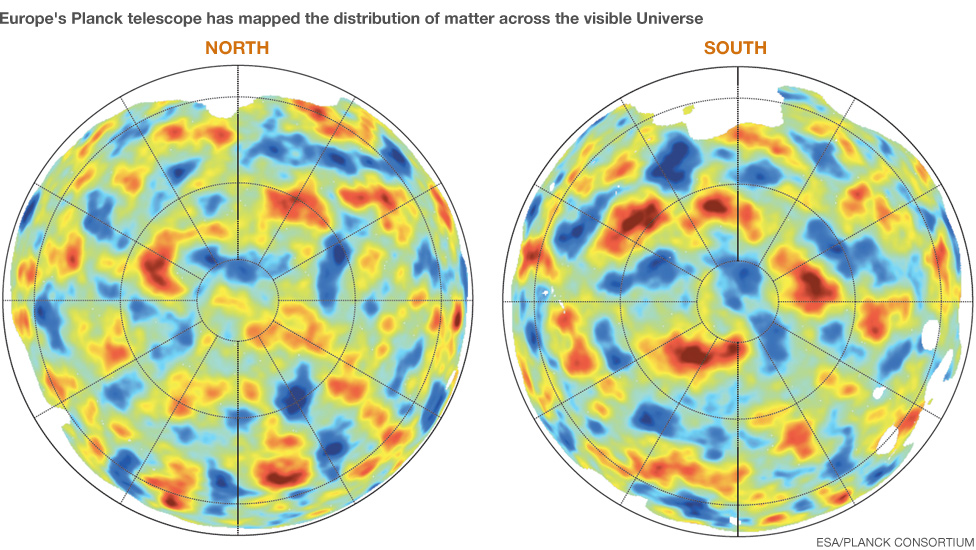
Although these images were obtained using measurements of the cosmic microwave background made by Planck, they are not themselves maps of the radiation field itself. As photons produced in the early Universe travel through the Universe towards the observer, they are deflected by the gravitational field of intervening clumps of matter; this is called gravitational lensing. With a bit of effort this effect can be “inverted” to reveal the distribution of matter traversed by CMB photons, or at least a projection of that distribution along the line of sight. The good thing about this is that the maps show all the matter (through its gravitational effects) not just the luminous part that might be seen in a galaxy surveys, so they might provide more direct ways of testing cosmological theories.

Planck, Pointillism and the Axle of Elvis

Posted in Art, Biographical, Cosmic Anomalies, Open Access, The Universe and Stuff with tags , , , , , , on March 21, 2013 by telescoper

The reason I was out of the office yesterday was that I was in Cambridge, doing a PhD oral in the Cavendish Laboratory so the first thing to say is congratulations Dr Johnston! It was one of those viva voce examinations that turned out to be less of an examination than an interesting chat about physics. In fact the internal examiner, Prof. Steve Gull, seemed to spend more time asking me questions rather than the candidate!

Afterwards I met up with Anthony Lasenby, the candidate’s supervisor. Not surprisingly the main topic of our brief discussion was today’s impending announcement of results from Planck. Anthony is one of the folks who have been involved with Planck for about twenty years, since it began as a twinkle in the eye of COBRAS/SAMBA. I was looking forward to getting in bright and early this morning to watch the live streaming of the Planck press conference from Paris.

Unfortunately however, I could feel a bit of a lurgy coming on as I travelled to Cambridge yesterday. It got decidedly worse on the way home – it must have been the Cambridge air – and I even ended up passing out on the train from Victoria to Brighton. Fortunately, Brighton was the terminus so someone woke me up when we got there and I got home, coughing and spluttering. I suspect many cosmologists didn’t sleep well last night because of excitement about the Planck results, but in my case it was something else that kept me awake. Anyway, I didn’t make it in this morning so had to follow the announcements via Twitter. Fortunately there’s a lot of press coverage too; see the ESA site and a nice piece by the BBC’s redoubtable Jonathan Amos.

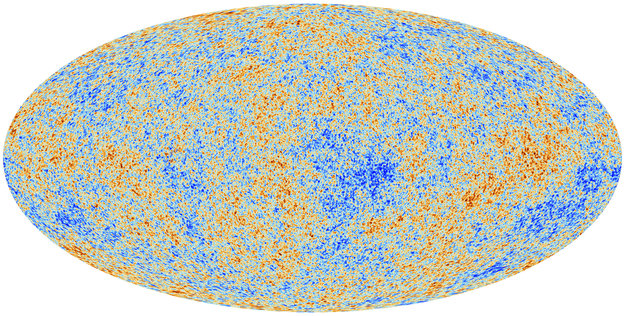
Anyway, without further ado, here’s Planck’s map of the cosmic microwave background:

Planck_CMB_large

It’s rather beautiful, in a pointillist kind of way, I think…

It will take me a while in my weakened state to complete a detailed study of the results – and I’m sure to return to them many times in the future, but I will make a couple of points now.

The first is that the papers and data products are all immediately available online. The papers will all appear on the arXiv. Open Access sceptics please take note!

The second is that the most interesting result (as far as I’m concerned) is that at least some of the cosmic anomalies I’ve blogged about in the past, such as the Axle of Elvis Axis of Evil and the famous colder-than-it-should-be cold spot, are still present in the Planck data:

_66524456_66524455

The other results excite me less because, at a quick reading, they all seem to be consistent with the standard cosmological model. Of course, the north-south asymmetry is a small effect on could turn out to be a foreground (e.g. zodiacal emission) or an artefact of the scanning strategy. But if it isn’t a systematic it could be very important. I suspect there’ll be a rush of papers about this before long!

I’m sure to p0st much more about the Planck results in due course, but I think I’ll leave it there for now. Please feel free to post comments and reactions through the box below.