Archive for Poetry

At a Lecture

Posted in Education, Poetry with tags , , , on November 27, 2014 by telescoper

Since mistakes are inevitable, I can easily be taken
for a man standing before you in this room filled
with yourselves. Yet in about an hour
this will be corrected, at your and at my expense,
and the place will be reclaimed by elemental particles
free from the rigidity of a particular human shape
or type of assembly. Some particles are still free. It’s not all dust.

So my unwillingness to admit it’s I
facing you now, or the other way around,
has less to do with my modesty or solipsism
than with my respect for the premises’ instant future,
for those afore-mentioned free-floating particles
settling upon the shining surface
of my brain. Inaccessible to a wet cloth eager to wipe them off.

The most interesting thing about emptiness
is that it is preceded by fullness.
The first to understand this were, I believe, the Greek
gods, whose forte indeed was absence.
Regard, then, yourselves as rehearsing perhaps for the divine encore,
with me playing obviously to the gallery.
We all act out of vanity. But I am in a hurry.

Once you know the future, you can make it come
earlier. The way it’s done by statues or by one’s furniture.
Self-effacement is not a virtue
but a necessity, recognised most often
toward evening. Though numerically it is easier
not to be me than not to be you. As the swan confessed
to the lake: I don’t like myself. But you are welcome to my reflection.

by Joseph Brodsky (1940-1996)


The New Mariner

Posted in Poetry, The Universe and Stuff, Uncategorized with tags , , , , on November 16, 2014 by telescoper

In the silence
that is his chosen medium
of communication and telling
others about it
in words. Is there no way
not to be the sport
of reason? For me now
there is only the God-space
into which I send out
my probes. I had looked forward
to old age as a time
of quietness, a time to draw
my horizons about me,
to watch memories ripening
in the sunlight of a walled garden.
But there is the void
over my head and the distance
within that the tireless signals
come from. An astronaut
on impossible journeys
to the far side of the self
I return with the messages
I cannot decipher, garrulous
about them, worrying the ear
of the passer-by, hot on his way
to the marriage of plain fact with plain fact.

by Ronald Stuart Thomas (1913-2000)


Science, Poetry and Romanticism

Posted in Poetry, The Universe and Stuff with tags , , , , , , on November 4, 2014 by telescoper

I listened to a very interesting programme on BBC Radio 3 on Sunday evening, part of which was a documentary about science and poetry presented by Gregory Tate. Given that both these subjects feature heavily on this blog I couldn’t resist a quick post about it.

The feature explored why so many scientists have been inspired to write poetry, and the nature of the relationship between their artistic work and their science.

Among the famous scientists included in the programme was chemist and inventor Humphry Davy who, inspired by his friendship with the poets Wordsworth and Coleridge, wrote poems throughout his life. Others to do likewise were: physician Eramus Darwin; mathematician William Rowan Hamilton; astronomer William Herschel (who was also a noted musician and composer); J. Robert Oppenheimer; and Erwin Schrödinger.

Doing a quick google about after the programme I came across this example by Hamilton, which I searched for because he is the scientist from the list above with whose mathematical work I am most familiar because of its huge influence on physics, and because he seems to have been a very colourful character as well as a superb mathematician. Interestingly, he too was a very close friend of Wordsworth, to whom he often sent poems with requests for comments and feedback. In the subsequent correspondence, Wordsworth was usually not very complimentary even to the extent of telling Hamilton to stick to his day job (or words to that effect). What I didn’t know was that Hamilton regarded himself as a poet first and a mathematician second. That just goes to show you shouldn’t necessarily trust a man’s judgement when he applies it to himself.

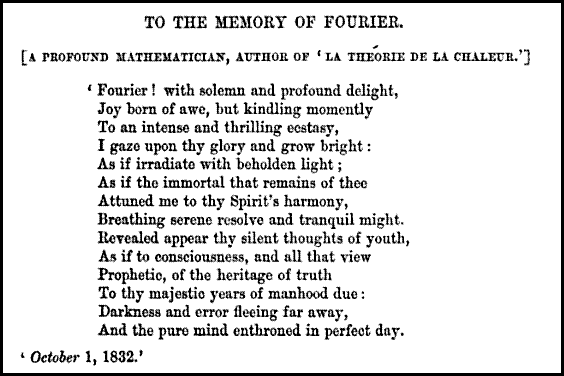
Here’s an example of Hamilton’s verse – a poem written to honour Joseph Fourier:

Hamilton-for Fourier

If that’s one of his better poems, then I think Wordsworth may have had a point!

The serious thing that struck me about this programme though was how many scientists of the 19th Century, Hamilton included, saw their scientific interrogation of Nature as a manifestation of the human condition just as the romantic poets saw their artistic contemplation. It is often argued that romanticism is responsible for the rise of antiscience. I’m not really qualified to comment on that but I don’t see any conflict at all between science and romanticism. I certainly don’t see Wordsworth’s poetry as antiscientific. I just find it inspirational:

I HAVE seen
A curious child, who dwelt upon a tract
Of inland ground, applying to his ear
The convolutions of a smooth-lipped shell;
To which, in silence hushed, his very soul
Listened intensely; and his countenance soon
Brightened with joy; for from within were heard
Murmurings, whereby the monitor expressed
Mysterious union with its native sea.
Even such a shell the universe itself
Is to the ear of Faith; and there are times,
I doubt not, when to you it doth impart
Authentic tidings of invisible things;
Of ebb and flow, and ever-during power;
And central peace, subsisting at the heart
Of endless agitation.

A Dirge

Posted in Poetry with tags , , on October 21, 2014 by telescoper

Rough Wind, that moanest loud
Grief too sad for song;
Wild wind, when sullen cloud
Knells all the night long;
Sad storm, whose tears are vain,
Bare woods, whose branches strain,
Deep caves and dreary main, _
Wail, for the world’s wrong!

by Percy Bysshe Shelley


Poetic Words: Dannie Abse

Posted in Poetry with tags , , on September 30, 2014 by telescoper

I don’t usually post about poetry two days running, but circumstances seem to justify reblog of the poem Three Street Musicians by wonderful Welsh poet Dannie Abse, who died on Sunday.

House on a Cliff

Posted in Poetry with tags , , , on September 29, 2014 by telescoper

Indoors the tang of a tiny oil lamp. Outdoors
The winking signal on the waste of sea.
Indoors the sound of the wind. Outdoors the wind.
Indoors the locked heart and the lost key.

Outdoors the chill, the void, the siren. Indoors
The strong man pained to find his red blood cools,
While the blind clock grows louder, faster. Outdoors
The silent moon, the garrulous tides she rules.

Indoors ancestral curse-cum-blessing. Outdoors
The empty bowl of heaven, the empty deep.
Indoors a purposeful man who talks at cross
Purposes, to himself, in a broken sleep.

by Louis MacNeice (1907-1963).

Beloved Dust

Posted in Poetry with tags , , , on September 24, 2014 by telescoper

And you as well must die, beloved dust,
And all your beauty stand you in no stead,
This flawless, vital hand, this perfect head,
This body of flame and steel, before the gust
Of Death, or under his autumnal frost,
Shall be as any leaf, be no less dead
Than the first leaf that fall, —this wonder fled.
Altered, estranged, disintegrated, lost.
Nor shall my love avail you in your hour.
In spite of all my love, you will arise
Upon that day and wander down the air
Obscurely as the unattended flower,
It mattering not how beautiful you were,
Or how beloved above all else that dies.

by Edna St. Vincent Millay (1892-1950)

Scotland Small?

Posted in Poetry with tags , , , on September 18, 2014 by telescoper

Scotland small? Our multiform, our infinite Scotland _small_?
Only as a patch of hillside may be a cliche corner
To a fool who cries “Nothing but heather!” Where in September another
Sitting there and resting and gazing around
Sees not only heather but blaeberries
With bright green leaves and leaves already turned scarlet,
Hiding ripe blue berries; and amongst the sage-green leaves
Of the bog-myrtle the golden flowers of the tormentil shining;
And on the small bare places, where the little Blackface sheep
Found grazing, milkworts blue as summer skies;
And down in neglected peat-hags, not worked
In living memory, sphagnum moss in pastel shades
Of yellow, green and pink; sundew and butterwort
And nodding harebells vying in their colour
With the blue butterflies that poise themselves delicately upon them,
And stunted rowans with harsh dry leaves of glorious colour
“Nothing but heather!” — How marvellously descriptive! And incomplete!


by Hugh McDiarmid (1892-1978)

As Summer into Autumn slips

Posted in Poetry with tags , , , on September 10, 2014 by telescoper

As Summer into Autumn slips
And yet we sooner say
“The Summer” than “the Autumn,” lest
We turn the sun away,

And almost count it an Affront
The presence to concede
Of one however lovely, not
The one that we have loved —

So we evade the charge of Years
On one attempting shy
The Circumvention of the Shaft
Of Life’s Declivity.

by Emily Dickinson (1830-1886)

After Bank Holiday

Posted in Poetry with tags , , on August 26, 2014 by telescoper

Now deserted are the roads
Where awhile the lovers went;
Vacant are the field-abodes
Where a vivid hour they spent:
Solemn dark
Broods again in lane and park.

‘Tis no matter where are gone
Those warm lives—to halls, maybe,
Festive, or to lodgings lone:
Of the land their tenancy
Now is o’er;
Earth to earth belongs once more.

Gone are they as hourly goes
From the sombre fields of space
Our world, with its little glows—
Passion’s ship that has no place,
Leaves no track,
On time’s endless ocean black.

by Elizabeth Daryush (1887-1977)