Archive for Poetry

There’s a certain slant of light

Posted in Poetry with tags , on January 18, 2010 by telescoper

Once again I haven’t had time to put together anything of much significance for the old blog today so, as usual when this happens, I’ll cheat by posting a poem. I picked this one for its wintry and appropriately melancholic theme; it is by the great American poet Emily Dickinson. I bought a collection of her poems in a very cheap edition in a bookshop in the States many years ago, but have never really managed to figure many of them out. I gather she features much more regularly in Eng. Lit. classes on the other side of the Atlantic than over here in Britain, and its probably my foreigner status that makes me find her poems so difficult.

This a very famous example of her work. At one level it expresses the unsettling effect that changes in light can have on the human psyche, but that’s just the start. The deeper meanings elude me, except that it is probably to do with the poet’s uncomfortable relationship with organized religion.  At least when she was young,  Emily Dickinson was a devotee of the Transcendentalist movement, which saw human experience, Nature and God as aspects of a transcendent unity. The  view expressed in this poem is certainly nothing like that. This is a fractured, lonely world where Nature and God are both alien and oppressive influences.

The strange use of punctuation and capitalization is also very typical.

There’s a certain Slant of light,
Winter Afternoons —
That oppresses, like the Heft
Of Cathedral Tunes —

Heavenly Hurt, it gives us —
We can find no scar,
But internal difference,
Where the Meanings, are —

None may teach it — Any —
‘Tis the Seal Despair —
An imperial affliction
Sent us of the Air —

When it comes, the Landscape listens —
Shadows — hold their breath —
When it goes, ’tis like the Distance
On the look of Death —

From Sunset to Star Rise

Posted in Poetry with tags , , on January 11, 2010 by telescoper

It was just a last-minute thought to borrow the title for a recent post from a poem by Christina Rossetti, but since doing that I’ve been thinking I should perhaps post something a bit more appropriate to the greatest female poet in England before the 20th Century. Christina Rossetti was both prolific and popular, but suffered long periods of depression and ill-health and cultivated a reclusive image until she died in 1894. Her reputation suffered after her death, and the arrival of modernism, as she was considered old-fashioned and sentimental but more recently her work has become much more widely appreciated. Much of her poetry is devotional – she was a committed and pious Anglican – and some was written especially for children. However, her love poems are often  highly erotic and somtimes express desire for women as well as men. She made a virtue of ambiguity in many aspects of her work, in fact. Other recurring themes are loneliness, loss and unattainable hope.

I bought an edition of her Selected Poems for £1 in the closing down sale at Borders bookshop just before Christmas, thinking I wouldn’t really like them, but I was taken aback by their range and complexity. I especially recommend Goblin Market, one of her best-known poems and also one of her strangest. I thought it was a bit long to put on here, however, so here’s a less well-known one, not so much because it has a vaguely astronomical title, but because its wintry theme beautifully expresses a sense of love of solitude tinged with regret.

Go from me, summer friends, and tarry not:
I am no summer friend, but wintry cold,
A silly sheep benighted from the fold,
A sluggard with a thorn-choked garden plot.
Take counsel, sever from my lot your lot,
Dwell in your pleasant places, hoard your gold;
Lest you with me should shiver on the wold,
Athirst and hungering on a barren spot.
For I have hedged me with a thorny hedge,
I live alone, I look to die alone:
Yet sometimes, when a wind sighs through the sedge,
Ghosts of my buried years, and friends come back,
My heart goes sighing after swallows flown
On sometime summer’s unreturning track.

A Compression of Distances

Posted in Biographical, Poetry, The Universe and Stuff with tags , , , on December 28, 2009 by telescoper

I’m back in Cardiff after a few days of yuletide indulgence in my home town of Newcastle upon Tyne in the North East of England. And very nice it was too, although my mass has increased as a consequence. We didn’t do much except eat and drink, although we did manage a scenic drive on Boxing Day through the beautiful Northumberland countryside, even more beautiful than usual because of the covering of snow that fell heavily before Christmas and never got round to melting.

Last year I did the round trip from Cardiff to Newcastle by train, which is quite a lengthy ordeal, but this year the powers that be have decided to close the main railway line from South Wales into England (via Bristol) because of engineering work. Route B, via Cheltenham and Birmingham, was also closed, so the only way to do the journey by train would have been via Manchester, a trip of around 8 hours each way. It wasn’t a very difficult decision therefore to abandon the railways this year and fly, which turned out to be remarkably painless. Although we landed in snow at Newcastle the planes both ways were on time and, with a flying time of less than an hour, I had much more time for sloth and gluttony.

Just before I left for my short break a book sent from Cinnamon Press popped through my letterbox. I occasionally post bits of poetry on here, and if there’s any doubt about copyright I always check with the publisher before putting them online. I had a nice exchange of emails with this particular publisher as a result of which they sent me a collection of poems they thought I might like to feature. This one is called A Compression of Distances and it’s by a poet quite new to me, Daphne Gloag.

Poetry books are ideal for reading on short trips on train or plane. They’re usually slim so they are easy to carry and you can read them one poem at a time in between pesky interruptions, such as take-off and landing. I didn’t have time to read this one before leaving so I put it in my pocket and took it with me. Given the changed mode of travel this year, the title seemed quite appropriate for this journey!

Anyway, it’s a very interesting collection altogether but there are a few poems at the end, taken from a  much longer collection called Beginnings, which seem to me to be the most appropriate to put on here. I agree wholeheartedly with the comments  on the jacket by John Latham

Her poems are remarkable, especially in the way she has successfully taken complex concepts in modern science – particularly cosmology – and integrated them successfully and seamlessly into poems which speak of the human condition in an effective and moving manner.

I have to say that it is a difficult task to combine modern physics with poetry. Often, attempts to do this either completely trivialise the scientific content or become tiresomely didactic. I think these poems get it just right. What Daphne Gloag does is to juxtapose  ideas from comtemporary cosmology (inflation, dark matter, etc) with diverse aspects of human experience. The parallels are often very moving as well as ingeneous. The poems are also preceded by brief explanations of the physics. Here is one of the best examples.

The children’s charity concert:
matter and antimatter

Particles and antiparticles are interchangeable, but just after the big bang the process whereby they kept annihilating each other ended by producing very slightly more matter than antimatter, making the universe possible.

Arriving at the church for the children’s charity concert
we remembered the words of Richard Feynman:
Created and annihilated,
created and annihilated –
what a waste of time.

He was speaking of those particles and antiparticles
at the beginning of time
annihilated in explosions of light.

In the church the children were playing
for the refugees of Kosovo;
our granddaughter’s long hair shone
like the sheen of her violin.
She did not know
she was a child of that hair’s breadth victory
of particles over antiparticles
in the early universe: annihilation
for all but a few, a final imbalance
just enough for making galaxies and worlds
and at that end of time
those children and the making of their years.

They played Bach and Twinkle twinkle little star,
not knowing what a star is
or the violence of stars,
not knowing they were perfected children
of the violent universe,
not knowing the years piled up on the scrap heaps
of that country they’d raised money for…
the man with his ear sawn off slowly
and fed to a dog like offal, the girl
with her legs torn off, her family machine gunned,
blown into darkness.

So many annihilations of perfected years.
But also those children in their panache of light.

You can order a copy of A Compression of Distances by Daphne Gloag directly from the publisher.

Science and Poetry

Posted in Poetry, The Universe and Stuff with tags , , , on December 6, 2009 by telescoper

In amongst all the doom and gloom about job cuts and the oncoming onslaught that goes by the name of impact, I found in this week’s Times Higher a thought-provoking article about the demise of poetry. The author, Neil McBride, is principal lecturer in Informatics at De Montfort University and the piece is made all the more interesting by the fact that it includes some of his own verse. In fact, with his permission, I’ve included one of the poems below.

I agree with some of what McBride says in his article and disagree with some too. I don’t intend to dissect the piece here, and suggest instead that you read it yourself and form your own opinion. Since I wanted to include one of the poems here, however, I thought I should at least address its context in the article. The opening paragraph states

Dame Jocelyn Bell Burnell, the renowned astrophysicist, hid her love for poetry from the world until she retired, out of fear for what people would think.

In fact, I posted an item about an anthology of astronomy-inspired poems edited by Jocelyn on this blog many moons ago. McBride goes on to describe an anthology of poetry written by scientists that was published in 2001 wherein all the writers remained anonymous, the reason being

Good intelligent men and women, clothed in cold rationality, considered it professional suicide to admit to any literary emotions.

The following poem, McBride’s own, develops this image to the point of caricature:

Science and Poetry

In his lab he’s hid “Whitsun Weddings” behind the sink,
The latest volume of Fuller sandwiched between reagent catalogues.
Shakespeare’s sonnets encoded in the lab book
Rossetti pasted to the wall behind the periodic table.

Amongst the chaotic dishes and tubes, there cannot be anything poetic at all
Rhythm and language must be neutralised, the third person
Is the wash of objectivity, the veneer of scientific discipline:
Verse is hidden at the back of a draw covered with Millipore.

The poets of science have no names, clothed in the shame
Of irrationality, the atrocity of the literary mind is unspoken
Words must be disguised, sanitised. Any evidence of life
Outside the rational, the objective, must be denied.

The observatory is cold, dark, starless. Pulsars blip
The steady drip, drip of numbers stripped of spirit
The poetry of the stars must be denied
Planets are mathematical objects swimming in an emotional vacuum.

Do not suggest that patterns, laws, and the aesthetics of structure
Hold anything of the spirit. Don’t speak poetry to me:
We silence our critics, mute emotions, declare ourselves ‘observers’.
There is no soul, nothing but a rotting body of clockwork chemicals.

It’s certainly a finely crafted piece of satire, but as a scientist myself I have to stand up for my brothers and sisters and say that it is very far from my experience of their view of literature. Perhaps astronomy attracts more romantic types more likely to wear their hearts (and literary sensibilities) on their sleeves than computer scientists or chemists. The many scientists I know who do read and write poetry do not hide- and, as far as I know, never have hid – this from their peers or anyone else. And I doubt if it ever occurred to any of them that confession to a love of poetry would damage their careers. I don’t think there ever was a reason for Dame Jocelyn to have hidden it away for all those years, or perhaps she was just using poetic license?

McBride goes on to discuss a number of possible reasons for poetry’s falling popularity. Modern poetry is too difficult , too obscure, too “academic” , for the reader-in-the-street to understand. That’s not helped by the fact that, in this digital age people, the immediate availability of easier visual forms of entertainment is making people less receptive to literature that requires prolonged reflection. I think there’s truth in both of these arguments, but I think there’s another possibility: that the internet revolution may just be changing the way literature is conceived and delivered, just as technological and sociological change has done many times in the past.

In the course of his very interesting piece, McBride also touches on another theme I’ve posted about a number of times. To quote:

Perhaps the power of poetry is its downfall. It addresses uncertainty. It questions, it leaves frayed edges and loose wires. We reject poetry because we shun its emotional engagement.

This reminds me of the stereotypical image of a scientist as an arrogant god of certainty, one that I don’t recognize at all. Scientists are constantly addressing uncertainty. That’s their job. I’m sure we’re all too aware of frayed edges and loose wires too. The conflict and indeterminacy we face in our work is not the same as people find in their emotional lives, of course, but the need to engage with it causes similar levels of stress!

Most people don’t care much for either science or poetry. Both are considered too hard, but probably in different ways. The digital age hasn’t turned everyone into unthinking zombies, but I think it has probably led to more people opting out of difficult ways of earning a living and finding easier ways of spending their leisure time. But there are still some who find pleasure in what’s difficult. Perhaps the reason why so many scientists love poetry is that they know how hard it is.

You can find more of Neil McBride’s poetical work here.

Black Hole

Posted in Poetry, The Universe and Stuff with tags , , , on November 24, 2009 by telescoper

After an exceptionally trying day, I’ve been relaxing by dipping into a collection of poems called Dangerous Driving by Chris Woods. He’s an interesting character who works part-time as a GP in Lancashire and tries to balance medicine, family and writing. His poetry has appeared in numerous magazines and newspapers and has also been broadcast on BBC Radio and Channel Four Television (including a series called Six Experiments that Changed the World, to which I was also a contributor).

Anyway I’ve developed  a bit of a habit of putting up poems with vaguely astronomical themes so when I found this one, I decided to put it up here not least because it made me think of the person who has been causing me so much hassle over the past few days….

Black Hole

You turn all the lights off
but never sleep,
pace round the edge of yourself,
never communicate.
A million dark years distant,
you suck in light like spaghetti.

You got too big for yourself
and collapsed,
but ferocious energy remained
and now you’re back, muscling in
carving out your own space
and time.

You smash up your neighbourhood,
pull the light off stars.
Masked,
you are far outside our laws,
giving nothing away,
stealing everything from everything.

(reproduced with the kind permission of Comma Press).

You can also see a video based on the poem Black Hole from Ghost Code on Vimeo although I have to admit I could make neither head nor tail of it.

Three Poems by R. S. Thomas

Posted in Poetry with tags , on October 7, 2009 by telescoper

They

The new explorers don’t go
anywhere and what they discover
we can’t see. But they change our lives.

They interpret absence
as presence, measuring it by the movement
of its neighbours. Their world is

an immense place: deep down is as distant
as far out, but is arrived at
in no time. These are the new

linguists, exchanging acrosss closed
borders the currency of their symbols.
Have I been too long on my knees

worrying over the obscurity
of a message? These have their way, too,
other than a prayer of breaking that abstruse code.

Night Sky

What they are saying is
that there is life there, too:
that the universe is the size it is
to enable us to catch up.

They have gone on from the human:
that shining is a reflection
of their intelligence. Godhead
is the colonisation by mind

of untenanted space. It is its own
light, a statement beyond language
of conceptual truth. Every night
is a rinsing myself of the darkness

that is in my veins. I let the stars inject me
with fire, silent as it is far,
but certain in its cauterising
of my despair. I am a slow

traveller, but there is more than time
to arrive. Resting in the intervals
of my breathing, I pick up the signals
relayed to me from a periphery I comprehend.

The New Mariner

In the silence
that is his chosen medium
of communication and telling
others about it
in words. Is there no way
not to be the sport
of reason? For me now
there is only the God-space
into which I send out
my probes. I had looked forward
to old age as a time
of quietness, a time to draw
my horizons about me,
to watch memories ripening
in the sunlight of a walled garden.
But there is the void
over my head and the distance
within that the tireless signals
come from. An astronaut
on impossible journeys
to the far side of the self
I return with the messages
I cannot decipher, garrulous
about them, worrying the ear
of the passer-by, hot on his way
to the marriage of plain fact with plain fact.

(by Ronald Stuart Thomas)

The Normal Heart

Posted in Poetry with tags , , on September 1, 2009 by telescoper

It’s now exactly 70 years since the start of World War Two, as it was on this date in 1939 that Germany invaded Poland. On hearing the news, WH Auden composed this poem. Although the poet himself grew to dislike it, it became one of his most famous poems and has many resonances still in today’s world.

September 1st, 1939

I sit in one of the dives
On Fifty-second Street
Uncertain and afraid
As the clever hopes expire
Of a low dishonest decade:
Waves of anger and fear
Circulate over the bright
And darkened lands of the earth,
Obsessing our private lives;
The unmentionable odour of death
Offends the September night.

Accurate scholarship can
Unearth the whole offence
From Luther until now
That has driven a culture mad,
Find what occurred at Linz,
What huge imago made
A psychopathic god:
I and the public know
What all schoolchildren learn,
Those to whom evil is done
Do evil in return.

Exiled Thucydides knew
All that a speech can say
About Democracy,
And what dictators do,
The elderly rubbish they talk
To an apathetic grave;
Analysed all in his book,
The enlightenment driven away,
The habit-forming pain,
Mismanagement and grief:
We must suffer them all again.

Into this neutral air
Where blind skyscrapers use
Their full height to proclaim
The strength of Collective Man,
Each language pours its vain
Competitive excuse:
But who can live for long
In an euphoric dream;
Out of the mirror they stare,
Imperialism’s face
And the international wrong.

Faces along the bar
Cling to their average day:
The lights must never go out,
The music must always play,
All the conventions conspire
To make this fort assume
The furniture of home;
Lest we should see where we are,
Lost in a haunted wood,
Children afraid of the night
Who have never been happy or good.

The windiest militant trash
Important Persons shout
Is not so crude as our wish:
What mad Nijinsky wrote
About Diaghilev
Is true of the normal heart;
For the error bred in the bone
Of each woman and each man
Craves what it cannot have,
Not universal love
But to be loved alone.

From the conservative dark
Into the ethical life
The dense commuters come,
Repeating their morning vow;
‘I will be true to the wife,
I’ll concentrate more on my work,’
And helpless governors wake
To resume their compulsory game:
Who can release them now,
Who can reach the dead,
Who can speak for the dumb?

All I have is a voice
To undo the folded lie,
The romantic lie in the brain
Of the sensual man-in-the-street
And the lie of Authority
Whose buildings grope the sky:
There is no such thing as the State
And no one exists alone;
Hunger allows no choice
To the citizen or the police;
We must love one another or die.

Defenseless under the night
Our world in stupor lies;
Yet, dotted everywhere,
Ironic points of light
Flash out wherever the Just
Exchange their messages:
May I, composed like them
Of Eros and of dust,
Beleaguered by the same
Negation and despair,
Show an affirming flame.

Beautiful Cosmos

Posted in Poetry with tags , on July 26, 2009 by telescoper

I’m currently in transit to a conference in Ascona (Switzerland) so I thought I’d leave you for a while with something from the wacky and whimsical, weird and wonderful world of Ivor Cutler:

Professorial Misconduct

Posted in Poetry with tags , , on May 26, 2009 by telescoper

The British political establishment is currently mired in scandal owing to revelations about the widespread abuse of  so-called “second home” expenses allowance by greedy and unscrupulous Members of Parliament.  Combined with the country’s ongoing economic difficulties, this will undoubtedly lead to equally widespread disillusionment with the way our country is being run which will probably also lead to increased support of extremist parties in the forthcoming Local and European elections on 4th June.

You might have hoped that the ivory towers of academe might be immune from this epidemic of sleaze but, alas, that’s not so. Take the recent election to the Oxford Professorship of Poetry, which is claimed to be the most prestigious academic post in the country (apart from mine, of course). The Nobel laureate Derek Walcott – whom I’ve blogged about before – withdrew from the race after an anonymous source circulated a dossier containing allegations of sexual harassment committed by him during the course of employment at Harvard. It contained pages from a book  entitled “The Lecherous Professor”  detailing Walcott’s attempts to persuade a female student to have sex with him; Walcott had received an official reprimand over this episode and had been forced to make  a written apology for his actions. A later case involving a sexual harassment claim against him (from 1996) also came to light, but that was apparently settled out of court.

I find it difficult to be too sympathetic to Derek Walcott, and  I do think he probably did the right thing by withdrawing. While it is true that students are adults (in reality and in the law), a Professor is obviously in a position of responsiblity for, and power over, his or her students. For a male Professor to ask a female student if she wants to have sex with him does not in itself constitute harassment but to do so repeatedly after refusals clearly does, and so does any attempt to influence events by suggesting changes to grades. To abuse an academic position in order to secure sexual favours is clearly wrong and the disciplinary action taken against Walcott  seems to me to have  been justified. Even if there is no actual coercion, I think it is still very unprofessional behaviour for an academic to pursue a sexual relationship with one of their students as it could lead them into dangerous territory. I know of quite a few successful relationships that have started out that way, though, and  I don’t want to be  sound censorious about behaviour between consenting adults. In general  I don’t think a person’s sexual life is at all relevant to their suitability for a job.  What I mean is that Walcott’s prior inapproriate acts do cast doubt on his suitability for this particular position.

Despite the revelations about his past, I still admire Walcott’s poetry enormously. Beautiful literature, just like beautiful music and art, is not made by saints but by people. We all have our flaws.

Anyway, Walcott’s withdrawal from the election left the way open for Ruth Padel (distant relative of Charles Darwin), who was duly elected to the Chair last week. She had distanced herself from the circulation of the anti-Walcott dossier and stated her regret that Walcott had withdrawn, but it subsequently transpired that she had actually drawn his past behaviour to the attention of some journalists via email. This news caused further uproar, with the result that she yesterday resigned the post only a week or so after having been elected to it.

Oxford University will now hold another election, but this fiasco has already put a stain on the Chair and makes Oxford’s academic world look petty and vindictive, at least to people who didn’t realise how petty and vindictive academics are anyway.

Even if Ruth Padel did not have anything to do with the circulation of the dirty dossier, I think it still was a mistake for her to send emails drawing attention to it. Having allowed herself to be drawn into the affair I think she made the right decision to resign in order to bring the sorry business to an end. It’s all a bit sad, though, and I hope there aren’t any more skeletons in relevant cupboards next time the election is run.

And the issue still remains of who it was that dished the dirt on Derek in the first place? If it was someone or some people wanting to help Ruth Padel win the Oxford position then it seriously backfired. Handwriting experts have been looking at the evidence to try and identify the culprit. Inspector Morse would have been in his element.

The Darling Buds of May

Posted in Poetry with tags , on May 20, 2009 by telescoper

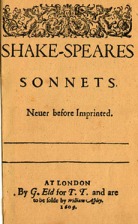
Four hundred years ago today, on the 20th May 1609, William Shakespeare published a collection of 154 Sonnets which arguably represent just as high a  level of literary achievement as his plays.  At any rate they’ve survived in popularity just as well and also furnished a huge number of memorable phrases including, appropriately enough for the time of year, the title of this post. This was, in fact, the only edition of the Sonnets published in Shakespeare’s lifetime and the circumstances of its publication remain uncertain.

Most of the poems concern Shakespeare’s love for a young man,  “Mr WH, the Onlie Begetter of the Sonnets”. However, there is a also group of sonnets addressed to his mistress, an anonymous “dark lady”,  which are far much more sexual in content than those addressed to the “Fair Youth”. The usual interpretation of this is that Shakespeare’s love for the boy was purely Platonic rather than sexual in nature.  Anyway, it was certainly a physical attraction.  Verse after verse speaks of the young man’s beauty. The first group of sonnets even encourage him to get married and have children so his beauty can continue and not die with his death. Sonnet 20 laments that the youth is not a woman, suggesting that this ruled out any sexual contact.  These early poems seem to suggest a slightly distant relationship between the two as if they didn’t really know each other well. However, as the collection goes on the poems become more and more intimate and it’s hard for me to accept that there wasn’t some sort of involvement between the two.  Although homosexual relationships were not officially tolerated in 17th Century England, they were not all that rare especially in the theatrical circles in which Shakespeare worked.

We’ll probably never know who Mr WH was – not Smith presumably – or indeed what was the real nature of his relationship to Shakespeare but we still have the poems. I do think it’s worth remembering, though, that these deep and moving expressions of romantic love were not written from a man to a woman, but from one man to another.  Here is perhaps the most famous one of all, Sonnet 18

Shall I compare thee to a summer’s day?
Thou art more lovely and more temperate:
Rough winds do shake the darling buds of May,
And summer’s lease hath all too short a date;
Sometime too hot the eye of heaven shines,
And often is his gold complexion dimm’d;
And every fair from fair sometime declines,
By chance or nature’s changing course untrimm’d;
But thy eternal summer shall not fade,
Nor lose possession of that fair thou ow’st;
Nor shall Death brag thou wander’st in his shade,
When in eternal lines to time thou grow’st:
So long as men can breathe or eyes can see,
So long lives this, and this gives life to thee.