So Operation Epstein Furore is in full swing, and already US and Israeli forces have scored some notable successes in the indiscriminate slaughter of civilians – the attack on a school in southern Iran that killed over 150 people, many of them children, stands out so far although it is certain that many more Iranian citizens will be similarly “liberated” (i.e. blown to bits). Trump’s plan is obviously to set the Middle East on fire in order to distract attention from his problems at home.
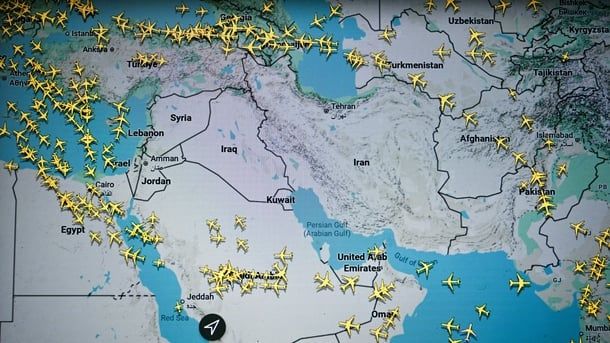
Anyway, I suddenly realized that it is just about two years to the day since I flew back to Dublin from Sydney where I spent a month during my sabbatical. It was actually 3rd March, not 2nd March, that I boarded the plan bound for Abu Dhabi, but one day is neither here not there (especially when you’re jetlagged). It seems that Iran has been firing drones and missiles at airports around the Gulf so there are no flights in the airspace right now:
Screengrab from FlightRadar24
I flew via Etihad, which has suspended commercial flights entirely. Abu Dhabi airport was struck by drones over the weekend, but I don’t think anyone was hurt. I suppose anyone wanting to fly from Sydney to Dublin these days will have to go via Singapore or just stay put. I’ve heard there are around 20,000 Irish people in the Gulf States right now. I hope they stay safe, and the same goes for all civilians caught up in the conflict.
Catherine Connolly (left) and Heather Humphreys (right)
Now that all the excitement about the Nobel Prize for Physics has died down I thought I would do a quick post to follow up my previous one about the election for the next President of Ireland (Uachtarán na hÉireann). Only three people gathered enough support by the deadline to be named on the ballot paper, namely: Catherine Connolly (an independent TD standing as a unified leftist who has the support of Sinn Féin, Labour, the Social Democrats and People Before Profit); Jim Gavin a former GAA player and football manager for Dublin, Civil Aviation Authority bigwig, and flying instructor in the Air Corps who was picked up by Fianna Fáil as their candidate; and Fine Gael candidate Heather Humphreys.
Sunday 5th October saw the withdrawal of Jim Gavin. It has to be said that he looked and sounded completely out of his depth in the TV debates, performing so badly that the bookies had put him at 16-1 by Sunday morning, but the final straw was a scandal over rent overpaid by a tenant to Gavin 16 years ago and never returned. I thought Gavin always looked like a potential banana skin for Fianna Fáil leader and Taoiseach Micheál Martin but in the event he turned into a hot potato that left Martin with egg on his face. In retrospect it seems a very serious error of judgement to back such a weak candidate.
Apparently Martin had pushed FF members very hard to select Gavin as their candidate, even though he wasn’t a member until recently, but now they are wondering why they had been asked to endorse a dodgy landlord from outside the party when there were so many of those already in it.
So now there are only two candidates, except that the relevant electoral law does not allow a candidate to withdraw after the deadline for nominations (which was 24th September) so Jim Gavin’s name will still be on the ballot paper. It will be interesting to see how many people vote for him despite his withdrawal, as a kind of protest. They might make a difference, as might those who transfer their first choice to Heather Humphreys. I suspect many ardent FF-ers will just not vote, though. In that case it will simply be down to who wins the most first preferences.
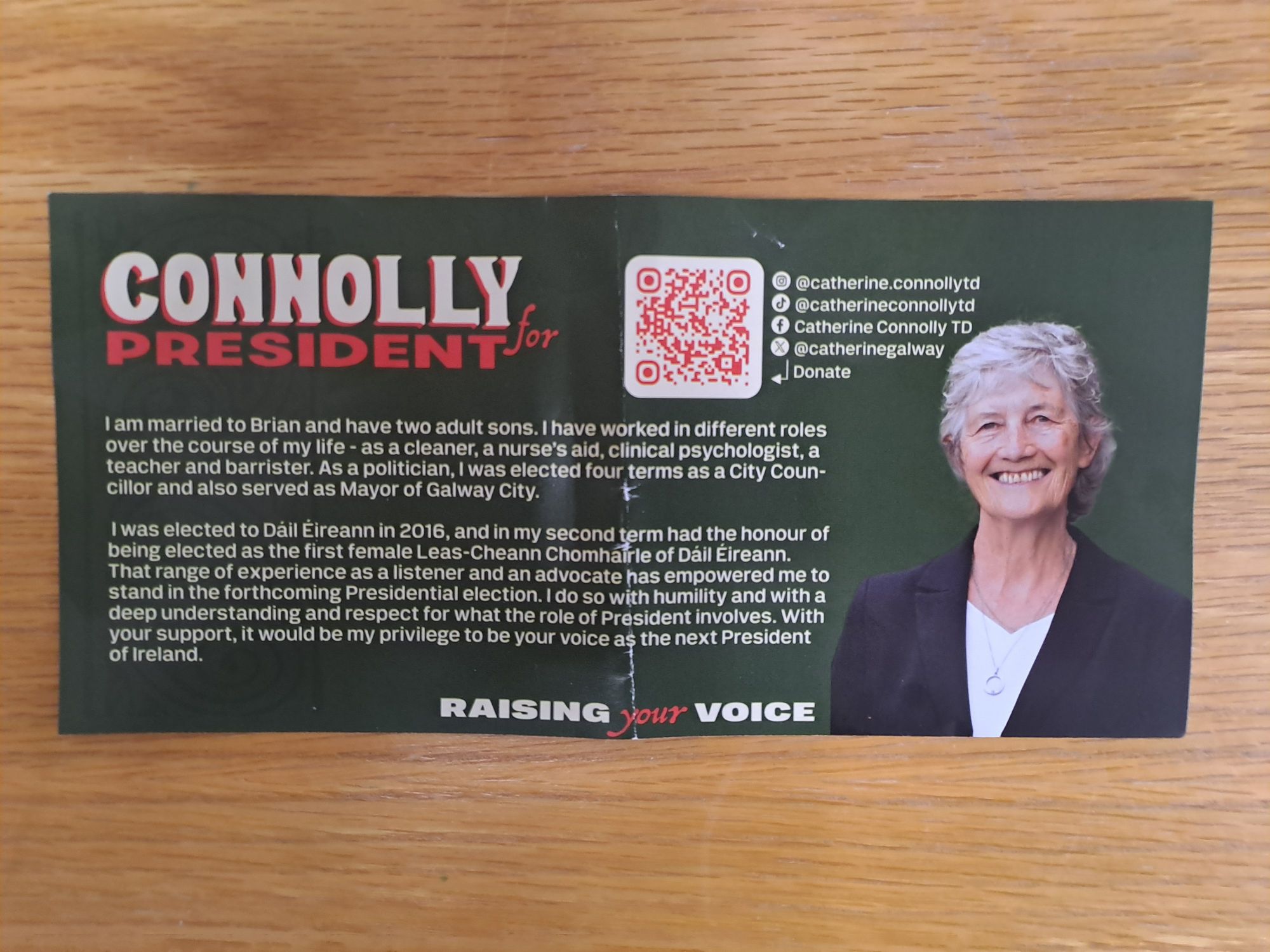
It wasn’t – and still isn’t – obvious to me which of the two remaining candidates is favoured by these shenanigans, but it is clear what the Bookies think: odds are currently Connnolly 1/3 favourite and Humphreys 11/4. At the start of the campaign Catherine Connolly was the outsider, but she’s now odds-on favourite. She’s the only candidate whose team has canvassed me (so far)
Election Day is Friday October 24th.
And as if all that excitement weren’t enough, today was Budget Day. The reaction to that might well influence the vote for President: if it is unpopular, the anti-establishment vote might increase.
Update: it is clear from here that Gavin’s votes will be treated as valid and if he finishes third on first preferences, his transfers will be counted in the usual way.
Nominations of candidates for the next President of Ireland (Uachtarán na hÉireann) closed at 12 noon, and only three gathered enough support to be named on the ballot paper. These are Catherine Connolly (left), Jim Gavin (centre) and Heather Humphreys (right). The last time there were as few as three candidates was 1990, when Mary Robinson was elected. The last Presidential Election had six candidates.
A number of names were touted ahead of today’s deadline for nominations, some plausible and some bizarre, but most dropped out without ever getting started. That list includes Bob Geldof, Michael Flatley of Riverdance fame, Conor McGregor (a famous rapist), a man who runs a doggy-day-care business, and a lady, whose name escapes me, who used to read the weather forecast on the telly.
Last week businessperson Gareth Sheridan also dropped out, having failed to convince enought local authorities to nominate him. The threshold for this route to nomination is very low, just 4 out of 31 – 26 County Councils, three City Councils (Dublin, Galway and Cork) and two hybrids (Limerick and Waterford). Sheridan only secured two so dropped out. I never really understood why he was standing as his company is facing litigation in the USA for fraud and breach of contract, and that would have undergone relentless scrutiny during the election campaign, so I find it strange he was willing to risk that. Anyway, it doesn’t matter now; he’s a non-runner.
The last one to drop out was ultra-conservative Catholic anti-everything campaigner Maria Steen. She went for the route of nominations from members of the Oireachtas (TDs and Senators). After frantically scraping the bottom of the barrel she came up two short of the 20 needed and dropped out just before the deadline. My worry with this reactionary person was not that Ireland would end up with her as President, but that the election campaign (which will last a month) would be dominated by her airing her bigoted views.
The three remaining candidates are: Catherine Connolly (an independent TD standing as a unified leftist) who has the support of Sinn Féin, Labour, the Social Democrats and People Before Profit. Jim Gavin is a former GAA player and football manager for Dublin and flying instructor in the Air Corps who was picked up by Fianna Fáil as their candidate (although I don’t think he was a member before the campaign started); and last;y we have the Fine Gael candidate Heather Humphreys. I normally react with an instant “no” to FG drones, but she is a Presbyterian, whose father was a member of an Orange Order, which would be interesting for North-South politics on the island.
Maria Steen would probably have fragmented the right-wing vote and thus favoured Connolly on first preferences, but now it’s basically a choice between one left and two right. Since FF and FG are basically equivalent, they will probably mainly transfer to each other, so if Connolly is going to win she will have to do it on first preferences.
Election day (24th October) is exactly a month away. Deciding who to vote for will be as easy as one-two-three.
PS. The bookies’ odds via Oddschecker are: Humphreys 11/10 fav; Gavin 15/8; Connolly 5/2.
The dust is now settling on the 2024 General Election which took place on Friday. Counting didn’t start anywhere until the following morning, so in the absence of any actual results the Saturday newspapers were full of articles by Phil Space, most of them based on an exit poll that turned out not to be very accurate. It soon become clear what was going to happen. The Single Transferable Vote system does mean that counting takes a while – one constituency (Cavan-Monaghan) is yet to declare as I write this – but it is much fairer than the system used in the UK and the process is fascinating to follow. Since moving to Ireland 7 years ago, I think my two favourite spectator sports are hurling and election counts, though the former happens at a considerably faster pace than the latter!
I’ll begin with my own constituency, Kildare North, which returned 5 TDs. The chosen five are James Lawless (FF), Réada Cronin (SF), Aidan Farrelly (SD), Naoise Ó Cearúil (FF) and Joe Neville (FG). The big surprise was that Fine Gael grandee Bernard Durkan lost his seat to a younger colleague, the strategy of fielding three candidates backfired on him. At one stage it even looked like all three might be eliminated, which would have been very amusing, but it was not to be.
A surprise at least to me, though a lesser one than the defeat of Bernard Durkan, is that Aidan Farrelly won for the Social Democrats. Catherine Murphy (SD) was top of the poll last time but has now retired. There was no guarantee that Aidan Farrrelly would hold onto Catherine Murphy’s personal following, especially since a former Social Democrat turned Independent stood against him. In the end, however, Farrelly was elected quite comfortably, although with a smaller share of the vote than Catherine Murphy had achieved.
Of the two FF candidates elected, James Lawless and Naoise Ó Cearúil, the fomer is more familiar; the latter was elected to the County Council this summer and will be a new arrival in the Dáil. The Kildare North constituency has one extra TD this time because of population growth, and it went to FF who ended up with the most TDs nationally.
The successful Sinn Féin candidate was the incumbent Réada Cronin.
The wooden spoon for Kildare North went to Sean Gill of the Centre Party of Ireland, an ironic name for what is far-right splinter group of FG previously known as Renua. He received a majestic 67 votes and was eliminated on the first round. In fact, far-right candidates did very poorly not only in Kildare North but nationally. That’s a relief.
One of the fascinating things about the coverage of the election has been to see how people use their preferences. Voting is a much more nuanced thing here that it has ever been allowed to be in the UK by the electoral system there. Some of the transfers are very hard to fathom. I noticed in Kildare North, for example, that some voters put the left-wing People Before Profit first then Fine Gael second, skipping over the whole spectrum in between. I don’t understand that choice, but then I don’t have to. Folk are perfectly entitled to use their vote whichever way they wish. That’s how it works. It’s called democracy.
The big three parties look set to finish on FF 48, SF 39 and FG 38. This means that FG+FF add up to 86, which is two short of a majority. The overall outcome of the election will therefore be the Same Old Same Old government, a coalition of the two right wings of the Property Party, possibly with a smaller party to make up the numbers and to be contemptuously discarded at the next election. That fate befell the Green Party, part of the outgoing coalition, which lost 11 of its 12 TDs this time round. Labour and the Social Democrats are both on 11 TDs. Will one of them walk into the trap, or will some Independents be enough?
Incidentally, the only prediction I made in my earlier post about this election, turned out to be incorrect. I was confident that there would be more Independent TDs than last time. In fact there are fewer (16 versus 20). Though the predominantly rural, right-wing Independent Ireland won 4 seats, it is a party so its TDs are not Independent, if you see what I mean.
The State of Irish Politics (detail from Impossible Stairs by M.C. Escher)
Sinn Féin once again failed to break the deadlock of FFG government. They have done reasonably well in terms of seats, but their share of the vote fell by about 5% since the 2020 Election but in between then and now had risen to over 30%. only to fall back recently. I suspect the party leaders will be privately relieved at where they ended up, given that a few weeks ago things looked likely to be much worse for them.
Whatever the complexion of the final coalition, it seems clear to me that we’re in for five more years of housing crisis, crumbling infrastructure, under-investment in education and public services. I don’t know what it will take for a change of government to take place. Perhaps the next (inevitable) financial crash? Or perhaps not even that. Ireland is very set in its ways, politically speaking.
It has been remarked that this election has bucked two global trends. One is the rise of the far-right, whose failure is something I am very happy about. The other is anti-incumbent feeling. I’m much more ambivalent about that because in my opinion change is long overdue. Apparently the electorate were unconvinced that change of government would really make things better here.
P.S. The turnout – just under 60% – was the lowest it has been in a General Election in Ireland since 1923. I find it saddening that 40% of those eligible did not even bother to vote.
This morning I noticed that the Google Doodle was reminding me to vote, so I took a detour on the way to work and exercised my franchise. I don’t have much optimism about the outcome, as I think we’re likely to end up with the same old same old, but at least I’ve had my little say.
Regardless of the likely outcome, I do enjoy voting in person. I don’t understand people who can’t be bothered, especially when there is an electoral system such as Ireland’s that allows a spread of political opinions to be represented. In my constituency there is a spectrum from far left to far right, though those most likely to win are the place everyone now calls Centre, but which to me is on the right. The two main parties in Ireland are really just one party, the Property Party, and it has two right wings (called FF and FG).
The polling station at the Presentation Girls School wasn’t busy when I voted, and the staff there were very friendly and helpful. The ballot paper was quite big – it had to be to accommodate sixteen names and photographs. Fortunately the weather has turned mild again so turnout should be reasonable. Polls stay open until 10pm and counting doesn’t start until tomorrow. I’ve plenty of other things with which to occupy myself for the rest of the day, including some coursework to be graded, a lecture to give, and later this evening, a concert to attend.
The arrival of my polling card yesterday indicates that the general election in Ireland on Friday 29th November is approaching rapidly, so I thought I’d give a rundown of the 16 candidates who will appear on the ballot paper for my constituency, Kildare North.
Kildare North will return 5 TDs (Teachta Dála, or Deputies), one more than last time because of the population growth in the area. The current TDs are Réada Cronin (SF; Sinn Féin), Bernard Durkan (FG; Fine Gael), James Lawless (FF; Fianna Fáil) and Catherine Murphy (SD; Social Democrats). The latter is retiring so will not be standing at this election. The current government is a coalition of FG, FF and Green Party TDs.
The Single Transferable Vote system is used, meaning that voters have a single ballot paper on which they rank the candidates in order of preference. The candidate with the lowest number of first-preference votes is eliminated and their second preference votes redistributed. Candidates are thus progressively eliminated until the requisite number of TDs is selected.
There are three FG candidates: Bernard Durkan, Joe Neville and Evie Sammon). They are based in Maynooth, Leixlip and Celbridge respectively so are presumably hoping that local voting will work out in their favour. The idea presumably is that Bernard Durkan would be first choice in Maynooth, etc. However, I’ve already had canvassers arguing that I should put Joe Neville first. I won’t be voting for any of the candidates anyway, but I would be very amused if their decision to put three candidates forward backfired. Incidentally, Bernard Durkan is 79 and has been a TD since 1982. The leaflet I got from him promised “New Energy” for Kildare North. Yeah, right…
There are two FF candidates, James Lawless and Naoise Ó Cearúil; the latter was elected to the County Council this summer. I find FF indistinguishable from FG. Together or separately these two parties have governed the Republic since its creation and a change is long overdue.
The two Sinn Féin candidates are the incumbent Réada Cronin and Caroline Hogan. I haven’t seen any posters for Réada Cronin up in Maynooth, so I assume the campaign team is saving their resources for elsewhere. Maynooth is not traditionally an SF stronghold.
With Catherine Murphy not standing, the Social Democrats ran a process to select a replacement candidate, which was won by Aidan Farrelly (who actually works at Maynooth University) who is the official SD candidate. That doesn’t end the story, however. Former SD member Bill Clear is standing as an Independent because he didn’t get selected. Adding to the fact that Catherine Murphy had a considerable personal following, this looks like a bit of a mess for the Social Democrats whose vote will probaboly be reduced and split. It may be in order to capitalize on this that SF added a candidate; they only fielded one last time round.
Now we’re into the (probable) also-rans. Angela Feeney is standing for Labour. She is an active member of the Council, representing Maynooth, but it’s not clear whether she has reach over the rest of the constituency. Vincent Martin represents the Greens who haven’t previously been strong here. The Green Party in Ireland is nowhere near as left-wing as corresponding parties in the UK and elsewere. It often seems like the bicycle division of Fine Gael. Leah Whelan is standing for People Before Profit – Solidarity, the only really left-wing party standing in Kildare North.
Then we have we have a number of generally disagreeable (to me) fringe party candidates: Una O’Connor is standing for Aontú, a reactionary splinter group of people previously in Sinn Féin and Sean Gill for the Centre Party of Ireland, an ironic name for what is far-right splinter group of FG previously known as Renua. Gerry Waters is standing from the Irish Freedom Party. He was struck off the medical register for refusing to administer vaccines and has unsupportable far-right opinions on other issues. Last and by all means least is Avril Corcoran who is candidate for The Irish People, a far-right nationalist party which is part of the National Alliance of like-minded bigots.
It’s probably obvious which 11 candidates I’m not going to be voting for, but I’ll leave you to guess in what order I will rank the other 5!
On Friday 8th November Taoiseach Simon Harris (left) inspired Ireland’s rugby team to a very disappointing home defeat by New Zealand. Earlier on that day he had visited the President to request a dissolution of the 33rd Dáil and to call a General Election on November 29th 2024.
The Saturday newspapers were full of nonsense about how the “General Election campaign starts now” when in fact I’ve had canvassers knocking at my door for at least a fortnight already. Two of them were for Fine GaeI – far scarier than trick-or-treat! I made it abundantly clear that I wouldn’t be voting for their party and hoped that they wouldn’t bother me again.
Fine Gael’s opening gambit was to announce that if elected they would reduce VAT on the hospitality sector to 11%. There was a budget just a few weeks ago in which they could have announced such a reduction had they really wanted it to happen. If re-elected no doubt they will find an excuse for not doing it. If you believe what they say I have a 340k bike shed to sell you.
Talking about the budget, Ireland’s government is in a very different position from the UK, with a large fiscal surplus thanks to buoyant tax receipts. This year presented a great opportunity to use that cash for much-needed investment in public housing, transport, education, the health service, etc. Instead the Government decided to tinker here and there with allowances and bung some cash to middle-income families in order to buy votes. Simon Harris has the air of a man who would sell his Grandmother if he could buy votes with the proceeds. The FG approach may well work but, if it does, we’re in for many years more of decaying public services, homelessness and high rents. As the Landlord Party in all but name, this will suit Fine Gael very well.
My constituency is Kildare North which in 2020 elected four TDs: 1 Social Democrat, 1 Fianna Fáil, 1 Fine Gael, and 1 Sinn Féin. This time, owing to population growth in the area, the seat will return five TDs. Fine Gael is standing three. I won’t say anything about Fianna Fáil. To all intents and purposes they are indistinguishable from Fine Gael and I won’t be voting for either of them. For me “more of the same” is not an option. I hope it goes without saying that I won’t be voting for any neofascists who get onto the ballot paper either.
Catherine Murphy (SD) is not standing and since she had a strong personal following the SDs will struggle to keep that seat. Angela Feeney, who is very active on the Local Council, is standing for Labour and Réada Cronin for Sinn Féin will be trying to hold onto her seat. Nominations of candidates continue for another week, so I don’t know the final list of candidates. I’ll wait until then before deciding on my order of preferences.
Not that long ago Sinn Féin were riding high in the polls, but a series of missteps have left them trailing Fine Gael. They also did poorly in the local and European elections earlier this year, seeming to have lost supporters of the more extreme nationalist type to overtly right-wing candidates.
The only prediction I am willing to make at this stage is that, owing to disaffection with the mainstream political parties, the number of independent TDs is likely to increase considerably from the 20 last time. This will make the task of forming a government even more complicated than before.
It has been quite an eventful week for voters either side of the English channel. In the United Kingdom, Keir Starmer’s Labour Party were victorious in the General Election, turfing out the Tories after 14 years of misrule, while in France a left-wing coalition managed against the odds to beat Marine Le Pen’s fascist National Rally into third place in their runoff election. In both elections tactical voting clear played a big role. In France many third-placed candidates of the centre or left stood aside to help defeat the Far Right. What happens now with regard to forming a government is anyone’s guess, even for people who know far more about French politics than me.
In the runup up to the UK general election, opinion polls had Labour much further ahead in terms of popular vote. As it turned out, however, Labour won 411 seats on a share of the vote of just 33.7% compared to the Conservatives 23.7% and a smaller number of votes than in 2019 when they won just 202 seats. The UK system is not proportional – and doesn’t pretend to be – so this kind of outcome is not surprising. Pundits have rightly pointed to the fact that the far-right Reform party got 14.3% of the vote which undoubtedly took seats from the Tories, but only managed 5 seats and that Labour profited greatly from the collapse of the SNP vote in Scotland.
There are other factors, however. One is that the turnout was 59.9%, well down on 2019 (67.35). That may well be partly due to voters generally not being enthused. But there may be more to it than that. The last time the turnout was below 60% in a UK general election was in 2001. In that year, Labour were miles ahead in the opinion polls so I suppose many Labour voters thought the result was a foregone conclusion and didn’t bother to turn out. It seems likely to me that there was a similar effect on the Labour vote this time. Rather than merely predicting the final result, opinion polls often influence it.
Another factor is that there may have been higher levels of tactical voting, especially with Labour voters switching to the Liberal Democrats to remove the Tory. That might account for why the LibDems did so well. Opinion polls play a role in this too. Yet another is that Labour lost several seats to Independents, standing against the stance on Gaza, and former Labour leader Jeremy Corbyn won his seat standing as an Independent.
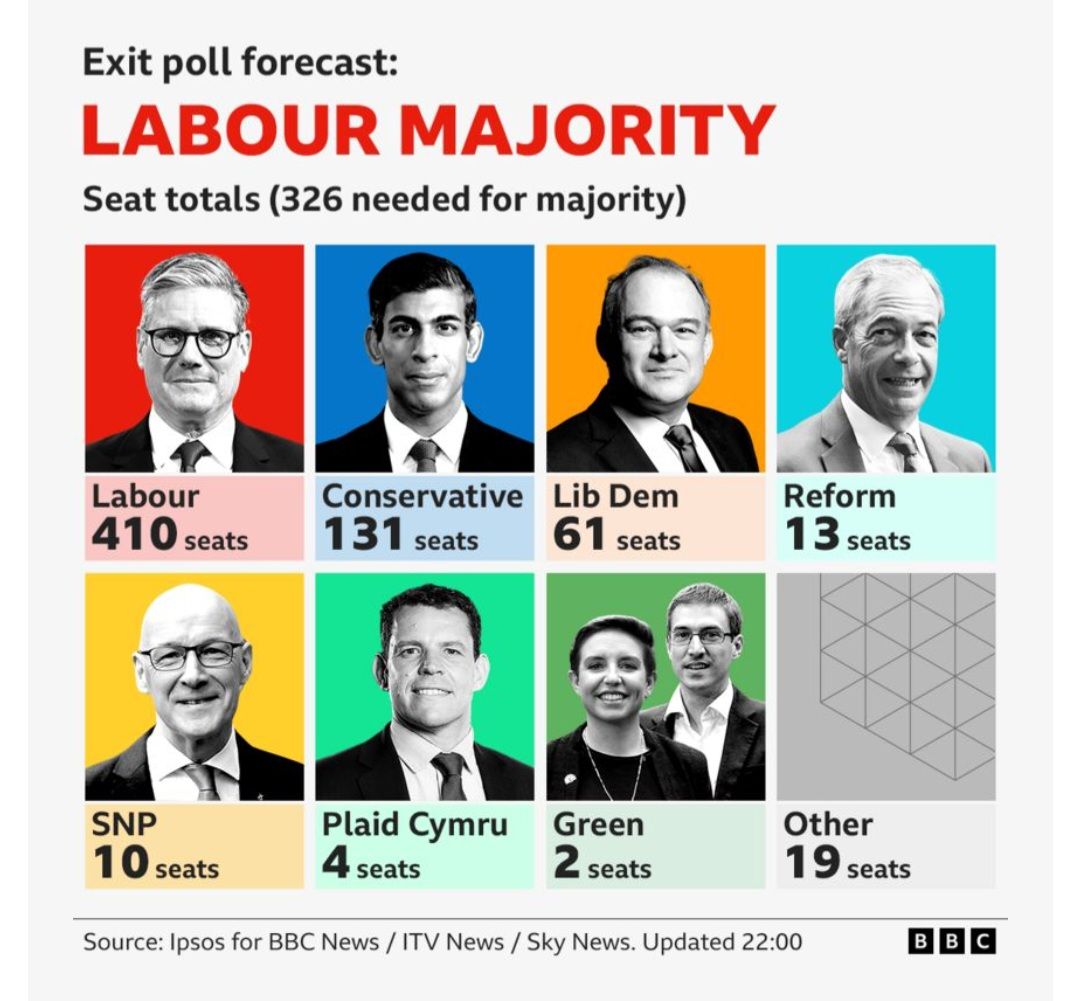
That brings me to the exit polls in the UK and France. Here the projections, the first released at 10pm on Thursday and the second at 9pm on Sunday:
Both are pretty accurate, but I’ve always been annoyed by the way the UK exit poll projection (left) is presented as a point estimate without any indication of the uncertainty (which must be considerable, especially for the smaller parties). The final results were Labour 411, Conservative 121, Lib Dem 72, Reform 5, SNP 9, Plaid Cymru 4, Green 4.
The French method of presenting the results (right) is much better in my opinion. In this case the results were 182, 168 and 143 respectively – all within the range presented.
I have to say that I greatly prefer the voting system used here in Ireland to those deployed in either France or the United Kingdom. Elections here are held under Proportional Representation (Single Transferable Vote) which seems to me a very sensible system. One ranks the candidates in order of preference; you can rank all the candidates or just some. In the system employed here in Ireland, votes are progressively reallocated in various rounds until one ends up with the top n candidates to fill the n available seats. The STV system involves a quota for automatic election which is N/(m+1) + 1 votes, where N is the number of valid ballots cast and m is the number of seats in the constituency. To see why this is the case consider a four-seat constituency, where the quota would be 20% of the votes cast plus one. No more than four candidates can reach this level so anyone managing to get that many votes is automatically elected. Surplus votes from candidates exceeding quota, as well as those of eliminated candidates, are reallocated to lower-preference candidates in this process. This system returns representatives with a local constituency connection but is also (approximately) proportional.
One problem with the First Past The Post system deployed in the UK is that if a Reactionary party (Reform) gets 5 seats while a Progressive party (Green) gets only 4, the former gets all the press coverage and the latter gets none..
P.S. I didn’t vote in the UK general election, but the four constituencies in which I lived before moving to Ireland (Cardiff West, Brighton Kemptown, Broxtowe, and Bethnal Green & Stepney) all voted in Labour MPs.
Following Friday’s vote, counting in Ireland’s local elections began Saturday morning. As it happened, Maynooth was one of the first LEAs to start counting and, the electorate being fairly small, was completed last night.
In the system employed in these elections, votes are progressively reallocated in various rounds until one ends up with the top n candidates to fill the n available seats. The STV system involves a quota for automatic election which is N/(m+1) + 1 votes, where N is the number of valid ballots cast and m is the number of seats in the constituency. To see why this is the case consider a four-seat constituency, where the quota would be 20% of the votes cast plus one. No more than four candidates can reach this level so anyone managing to get that many vote is automatically elected. Surplus votes from candidates exceeding quota, as well as those of eliminated candidates, are reallocated to lower-preference candidates in this process.
I thought it might be interesting to show how it went. Here is the state of the poll after the initial count of first preference votes:
Incumbent Councillor Naoise Ó Cearúil (Fianna Fáil) led the first preference votes, exceeding the quota of 1566, and was therefore immediately elected. When his surplus votes were reallocated to second-preference candidates they did not result in anyone else exceeding quota, so Peter Hamilton (who finished last) was eliminated and his votes reallocated, etc. And so it came to pass that Tim Durkan (Fine Gael) was elected on the third count, Angela Feeney (Lab) and Peter Melrose (Social Democrats) on the 6th Count, and Paul Ward (FF) on the 7th Count. Durkan, by the way, is the son of sitting Fine Gael TD Bernard Durkan. For those outside Ireland I should mention that the Irish Social Democrats are quite progressive – in contrast to some parties with the same name in other countries – and they have a TD in the form of Caroline Murphy who has strong local support.
The turnout in Maynooth, by the way, was 45.3%. That’s quite high by the standards of local elections in the UK, but I always find it disappointing when people can’t be bothered to vote.
Anyway, of the five councillors elected (2 FF, 1 FG, 1 Lab & 1 SD) four are incumbent. The only change was sitting Green candidate Hamilton was replaced by newbie Peter Melrose for the Social Democrats. It was a disappointing result for Sinn Féin, similar to what happened five years ago in this LEA. The losing candidate then, however, Réada Cronin, went on to win a seat as TD for North Kildare in the General Election of 2020.
As I write, under a quarter of LEAs have completed their counts but it is fairly clear that it has been a disappointing election for Sinn Féin who, despite riding high in the opinion polls a few months ago, have not really recovered significantly from their poor showing in the 2019 Local Elections. Of course the question asked in opinion polls is about a General Election, which is quite a different kettle of fish compared to a Local election. Lots of pundits are trying to interpret these local results as a kind of opinion poll on the General Election which must happen before next year. They do this in the UK too. I don’t think that is wise. I think most people vote in the Local Elections on the local and rather mundane issues which are actually what the County Councils can actually deal with. Councils have very little power in Ireland and candidates who have grandiose plans far beyond the scope of what a councillor can actually achieve are not likely to do well. There is also a definite advantage on being an incumbent who has done a good job for the past five years. A problem for Sinn Féin is that it had to put up new faces in many LEAs to replace those lost five years ago, and few have been successful.
Anyway, it seems the status quo parties have done better than expected, and a variety of Independents have done well. Fianna Fáil and Fine Gael – to me, indistinguishable conservative neoliberal parties – are currently governing Ireland in coalition with the Greens. It surprises me that there is so much support for establishment parties that have presided over a housing shortage, ever-increasing homelessness and steadily deteriorating public services, but there you go.
We’ll have to wait a considerable time for the European Election count to finish, as it hasn’t even started yet, but it seems likely that Sinn Fein will struggle and that Independent will do well.
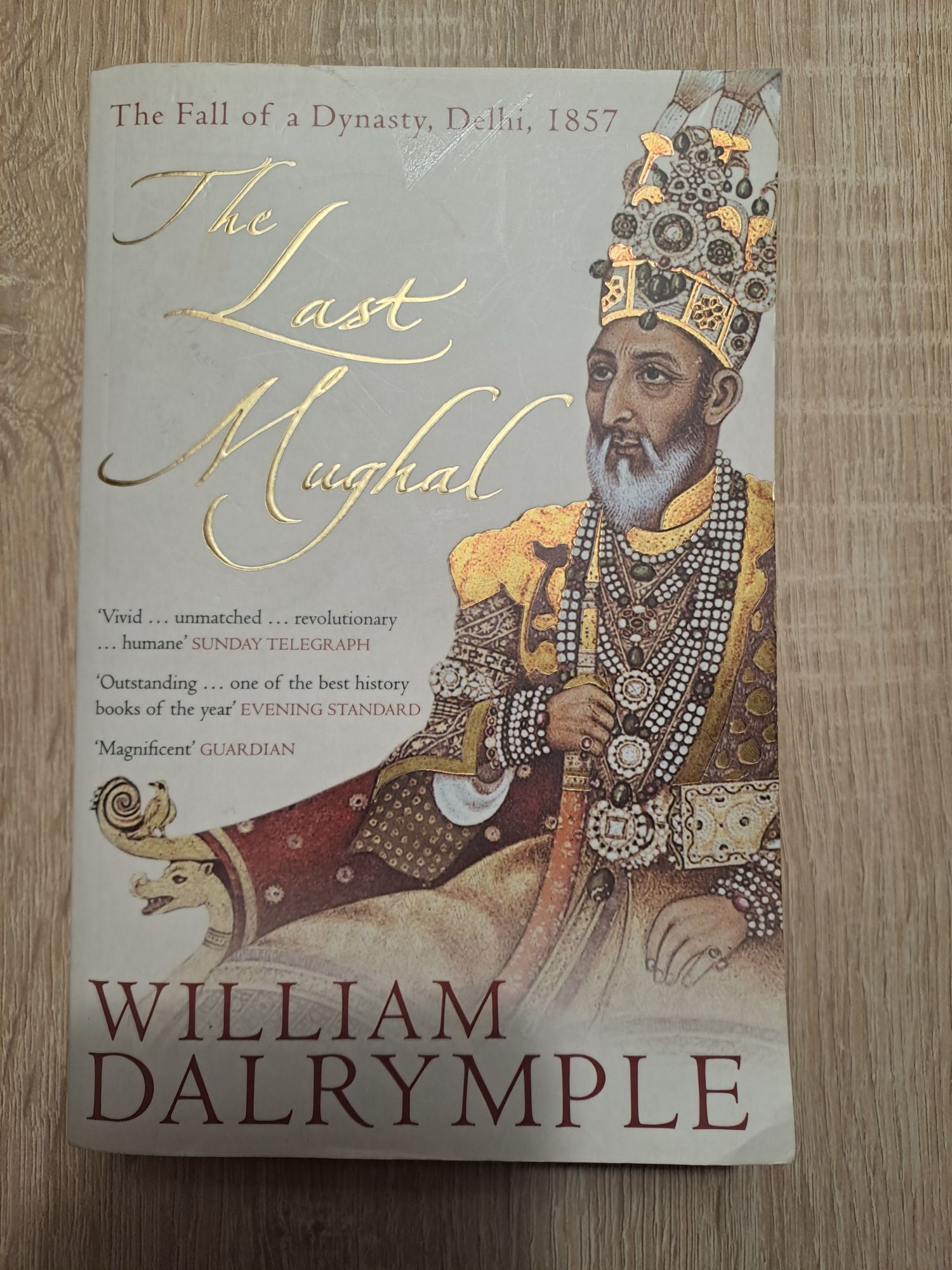
The latest item on my sabbatical reading list is The Last Mughal by William Dalrymple. This is about Bahadur Shah Zafur, the last King of the Mughal Dynasty that ruled Hindustan from its capital Delhi for 350 years, but it’s really about the last years of his life, focusing on the Indian Rebellion (Uprising) of 1857, when Mughal rule was already in a state of decline, to his death in exile in Rangoon five years afterwards. His narrative makes much use of the Mutiny Papers, an enormous collection of correspondence from the time of the rebellion collected in India’s National Archive, and there is extensive use of quoted material. There is also an extensive glossary and some excellent illustrations.
I remember learning about the “Indian Mutiny” (as it was called then) when I was doing my O-level History (in 1979) but that was more-or-less entirely from a British perspective. The immediate trigger for the rebellion of the sepoys in the British Army, we were told with some amusement by our teacher, was that a rumour had spread that the grease used to lubricate cartridges for the newly-issued Enfield rifles contained a mixture of beef fat and lard, offensive to both Hindus and Muslims. The implication was that this was a silly and trivial matter. There was, of course, a lot more to it than that…
Dalrymple explains how the British, Hindus and Muslims in Delhi co-existed reasonably peacefully until the middle of the 19th Century; there were many mixed marriages and it was by no means unknown for British representatives of the East India Company to wear Indian dress. This began to change with the arrival of a new British colonial class who disrespected any religion other than their own form of Christianity; the same attitudes were held by this class towards Irish Catholics. Resentment had been building up among both Hindus and Muslims, who felt their beliefs were under threat. The Enfield rifles were just the spark that lit the fire.
Let me quote from the book:
But while Zafar was certainly never cut out to be a heroic or revolutionary leader, he remains, like his ancestor the Emperor Akbar, an attractive symbol of Islamic civilisation at its most tolerant and pluralistic. he himself was a notable poet and calligrapher; his court contained some of the talented and artistic and literary figures in modern South Asian history; and the Delhi he presided over was undergoing one of its great periods of learning, communal amity and prosperity. He is certainly a strikingly liberal and sensitive figure when compared to the Victorian Evangelicals whose insensitivity, arrogance and blindness did so much to bring the Uprising of 1857 down upon their own heads, and those of the people and court of Delhi, engulfing all of northern India in a religious war of terrible violence
The Last Mughal, pp. 483-4
The Indian Rebellion (which took place between May and September 1857) was on a huge scale and involved terrible atrocities: women and children were not spared, many of the executed in sadistic fashion. The rebels (“mutineers” to the British) flocked to Delhi drawn to the idea that the Mughal King would lead them to victory. Unfortunately Zafar was already an old man of 82 and he was in no fit state, either mentally or physically, to be a military leader. By then he had very little power as King anyway; he certainly had only modest financial resources. He was really more of a mascot than anything else.
The lack of military leadership at Delhi was a serious problem for the rebels. In the British army a sepoy was unable to rise to a rank that involved commanding more than about 100 men. There was no-one at Delhi capable of organizing and coordinating the huge rebel army, with the result that they were unable to dislodge a much smaller British force that had assembled on a ridge outside the city. Eventually a much larger British column arrived and Delhi’s fate was sealed. Not without themselves suffering heavy casualties, the British eventually stormed the Kashmiri Gate, entered the city, looted what they could find and massacred the remnants of the rebel army in revenge for the atrocities committed by the sepoys. The famous Red Fort was largely destroyed. A plan to flatten Delhi completely was seriously considered, but eventually rejected. What remained however was a City of the Dead – that’s the title of Chapter 11.
Zafar was eventually captured but in contrast to most of the rest of his family and members of his court, was not summarily executed but exiled to Rangoon where he died in obscurity just five years later.
This book is vividly written with a extraordinary eye for detail as well as a sense of the grand sweep of the history. It must be difficult to combine the large and small scale like that. Although it’s well written it’s not always easy to read. The graphic descriptions of indiscriminate slaughter by both sides made me very uncomfortable, as did the obvious racism of many British officials and army officers revealed by the Mutiny Papers. But these are part of history, and we have to be made aware of them.
Zafar was of course Muslim, but a significant majority – almost two-thirds – of the sepoys who took part in the rebellion were Hindus. It’s interesting that both factions seem to have been content to rally around the Mughal banner. At his “trial” the British authorities in the form of prosecutor Major Harriott tried to argue that Zafar was the leader of a global Muslim conspiracy.
Here’s another quote:
The Uprising in fact showed every sign of being initiated by upper-caste Hindu sepoys reacting against specifically grievances perceived as a threat to their faith and dharma.; it then spread rapidly through the country, attracting a fractured and diffuse collection of other groups alienated by aggressively insensitive and brutal British policies. Among these were the Mughal court and the many Muslim individuals who made their way to Delhi and fought as civilian jihadis united against the kafir enemy. Yet Harriott’s bigoted and Islamophobic argument oversimplified this complex picture down to an easily comprehensible, if quite fictional, global Muslim conspiracy with an appealingly visible and captive hate figure at its centre, towards whom righteous vengeance could now be directed.
The Last Mughal, pp. 439-40
I won’t dwell on the obvious and important lesson about how bigotry and intolerance feed extremism, as the one lesson one can learn from studying history is that nobody ever learns the most obvious and important lesson.
The views presented here are personal and not necessarily those of my employer (or anyone else for that matter).
Feel free to comment on any of the posts on this blog but comments may be moderated; anonymous comments and any considered by me to be vexatious and/or abusive and/or defamatory will not be accepted. I do not necessarily endorse, support, sanction, encourage, verify or agree with the opinions or statements of any information or other content in the comments on this site and do not in any way guarantee their accuracy or reliability.








 In the Dark