
Archive for Radio astronomy

R.I.P. Jasper Wall

Posted in R.I.P., The Universe and Stuff with tags , , , , on June 1, 2024 by telescoper

I have been asked to use the medium of this blog to pass on the sad news of the passing of Jasper Wall (left) who died on 28th March at White Rock, British Columbia, Canada.

Jasper Wall (who was Canadian by birth) began his career in Radio Astronomy in Toronto with Alan Yen. This included building a 320-MHz receiver, and carrying out absolute background measurements using a pyramidal horn. He subsequently chose Australia to continue his research, working on a receiver for Parkes Radio Telescope at CSIRO where he and John Bolton began a sky survey at hitherto unprecedented high frequency of 2.7 GHz. Wall’s survey discovered the extensive ‘flat-spectrum’ quasar population, the key to the relativistic beaming model of radio sources. His research at Parkes lasted over eight years and the statistical results of this work strongly favoured a “Big Bang” universe rather than the “Steady State” preferred by John Bolton, Fred Hoyle and Tommy Gold.

Wall was also part of the team which in 1969 brought the Apollo 11 moon landing via the Parkes Radio Telescope to an estimated 650 million TV viewers world wide. In 1974-1978 he was a member of Martin Ryle’s group at the MRAO Cambridge UK, continuing his research in active galaxy systems at both radio and optical wavelengths, plus submm and X-ray observations. He taught statistics to astronomy students at Cambridge, leading to his 2003 book with co-author Charles Jenkins, Practical Statistics for Astronomers.

Later on in his career, he became more involved in science administration. Joining the Royal Greenwich Observatory in 1979 as Head of Astrophysics and Astrometry Division, he continued research in optical and radio astronomy. In 1986 he became Director of the Isaac Newton Group of Telescopes on La Palma for four years, and then Director of the Royal Greenwich Observatory from 1995 until its closure in 1998. He was a Professor at Oxford University from 1998 to 2002, after which he retired, returned to Canada and took up an emeritus position at the University of British Columbia, where he continued to teach and supervise students.

The Radio and Microwave Sky from Juno

Posted in The Universe and Stuff with tags , , , , , , , on May 16, 2024 by telescoper

I found out about an interesting paper by Anderson et al. at a discussion group this morning. The abstract reads:

We present six nearly full-sky maps made from data taken by radiometers on the Juno satellite during its 5-year flight to Jupiter. The maps represent integrated emission over ∼4% passbands spaced approximately in octaves between 600 MHz and 21.9 GHz. Long time-scale offset drifts are removed in all bands, and, for the two lowest frequency bands, gain drifts are also removed from the maps via a self-calibration algorithm similar to the NPIPE pipeline used by the Planck collaboration. We show that, after this solution is applied, residual noise in the maps is consistent with thermal radiometer noise. We verify our map solutions with several consistency tests and end-to-end simulations. We also estimate the level of pixelization noise and polarization leakage via simulations.

arXiv:2405.08388

For those of you unaware about Juno, it is a NASA space mission (launched in 2011) intended to study the planet Jupiter (which it is still doing). On the way there, however, this spacecraft made continuous measurements of the radiation field around it, at radio and microwave frequencies. The work described by Anderson et al. involved turning these observations into maps at a range of frequency; they also studied the polarization properties of the radiation.

The full maps and other relevant data can be downloaded here. Here are some pretty pictures (the grey bits represent the parts of the sky that were not covered; radio emission from our own Galaxy is the most obvious component at low frequencies, but it looks more complicated at higher frequencies).

It’s always fun when data sets are used for something so different from the purpose originally intended, and what has come out of this analysis are rather nice maps of the emission from the Milky Way. These might turn out to be useful for many things, such as foreground removal for extragalactic surveys or studies of our own Galaxy.

The Complex Heart of the Milky Way

Posted in Art, The Universe and Stuff with tags , , , on January 26, 2022 by telescoper

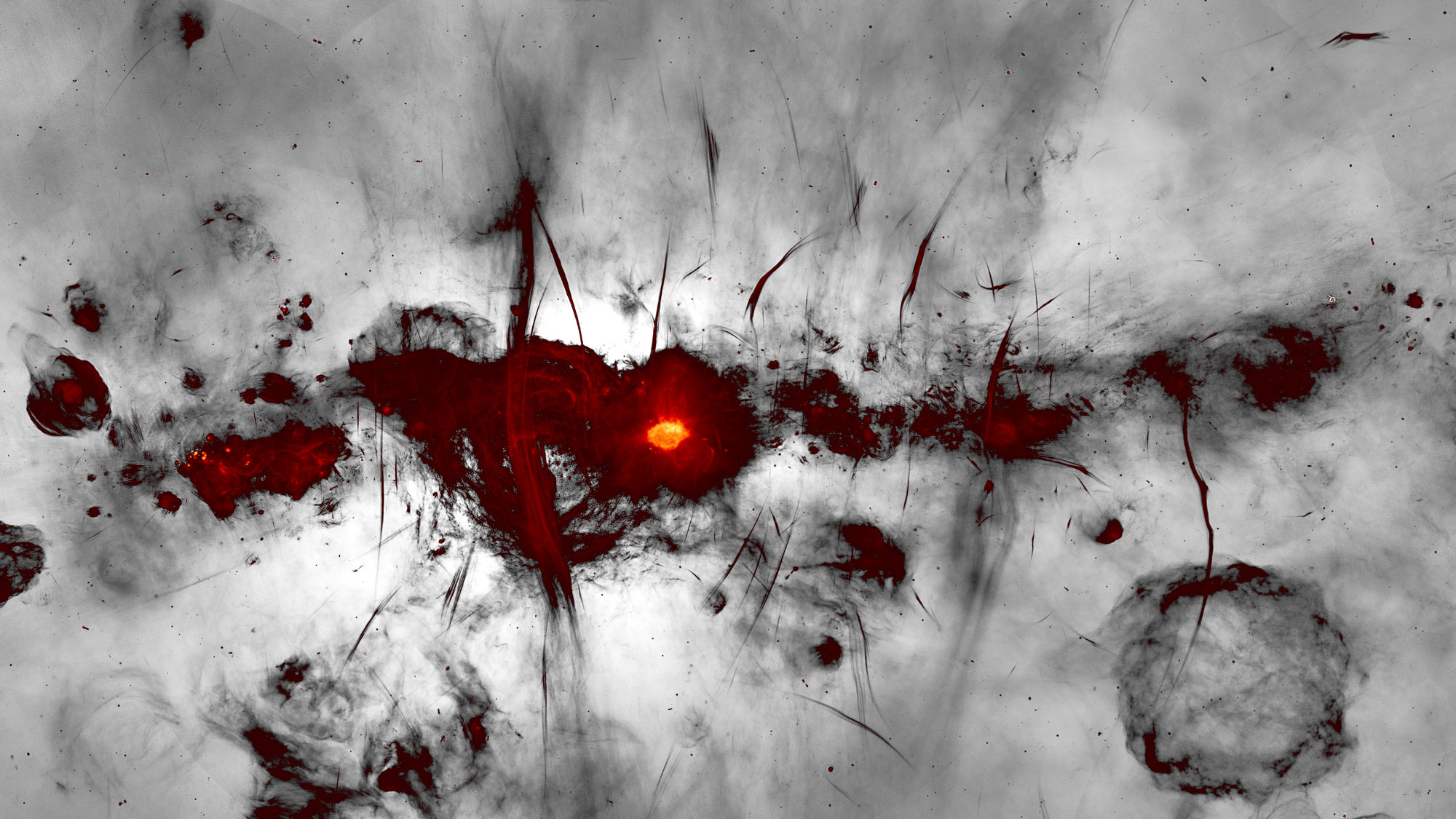
I couldn’t resist sharing this amazing radio image of the Galactic Centre made using the South African MeerKAT radio telescope:

Radio frequency electromagnetic radiation is able to penetrate the dust that permeates this region so can reveal what optical light can not. In particular you can see the very active region around the black hole at the centre of the Milky Way, bubbles caused by exploding stars and – most interesting of all – a number of magnetized filamentary structures.

It’s an extraordinarily beautiful picture made from a mosaic of 20 separate observations. In fact I like it so much I’ve cross-filed it in my “Art” folder. Those of us who work in astronomy or astrophysics are wont to say that there’s much more to it than pretty pictures, but when one like this comes along we’re all sure to geek out over it!

For more information about this image at the science behind it, see here.