After spending a big chunk of yesterday afternoon chatting the cosmic microwave background, yesterday evening I remembered a time when I was trying to explain some of the related concepts to an audience of undergraduate students. As a lecturer you find from time to time that various analogies come to mind that you think will help students understand the physical concepts underpinning what’s going on, and that you hope will complement the way they are developed in a more mathematical language. Sometimes these seem to work well during the lecture, but only afterwards do you find out they didn’t really serve their intended purpose. Sadly it also sometimes turns out that they can also confuse rather than enlighten…
For instance, the two key ideas behind the production of the cosmic microwave background are recombination and the consequent decoupling of matter and radiation. In the early stages of the Big Bang there was a hot plasma consisting mainly of protons and electrons in an intense radiation field. Since it was extremely hot back then the plasma was more-or-less fully ionized, which is to say that the equilibrium for the formation of neutral hydrogen atoms via

lay firmly to the left hand side. The free electrons scatter radiation very efficiently via Compton scattering

thus establishing thermal equilibrium between the matter and the radiation field. In effect, the plasma is opaque so that the radiation field acquires an accurate black-body spectrum (as observed). As long as the rate of collisions between electrons and photons remains large the radiation temperature adjusts to that of the matter and equilibrium is preserved because matter and radiation are in good thermal contact.
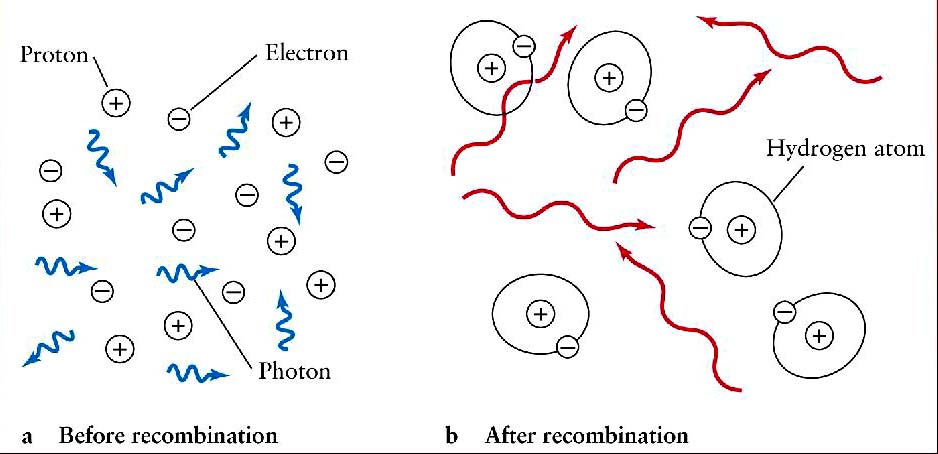
Image credit: James N. Imamura of University of Oregon.
Eventually, however, the temperature falls to a point at which electrons begin to bind with protons to form hydrogen atoms. When this happens the efficiency of scattering falls dramatically and as a consequence the matter and radiation temperatures are no longer coupled together, i.e. decoupling occurs; collisions can longer keep everything in thermal equilibrium. The matter in the Universe then becomes transparent, and the radiation field propagates freely as a kind of relic of the time that it was last in thermal equilibrium. We see that radiation now, heavily redshifted, as the cosmic microwave background.
So far, so good, but I’ve always thought that everyday analogies are useful to explain physics like this so I thought of the following.
When people are young and energetic, they interact very extensively with everyone around them and that process allows them to keep in touch with all the latest trends in clothing, music, books, and so on. As you get older you don’t get about so much , and may even get married (which is just like recombination, not only that it involves the joining together of previously independent entities, but also in the sense that it dramatically reduces their cross-section for interaction with the outside world). As time goes on changing trends begin to pass you buy and eventually you become a relic, surrounded by records and books you acquired in the past when you were less introverted, and wearing clothes that went out of fashion years ago.
I’ve used this analogy in the past and students generally find it quite amusing even if it has modest explanatory value. I wasn’t best pleased, however, when a few years ago I set an examination question which asked the students to explain the processes of recombination and decoupling. One answer said
Decoupling explains the state of Prof. Coles’s clothes.
Anyhow, I’m sure there’s more than one reader out there who has had a similar experience with an analogy that wasn’t perhaps as instructive as hoped or which came back to bite you. Feel free to share through the comments box…
Follow @telescoper and
and  for spin in the
  direction. In general, however, the spin state will be a superposition of these, e.g.

 In the Dark