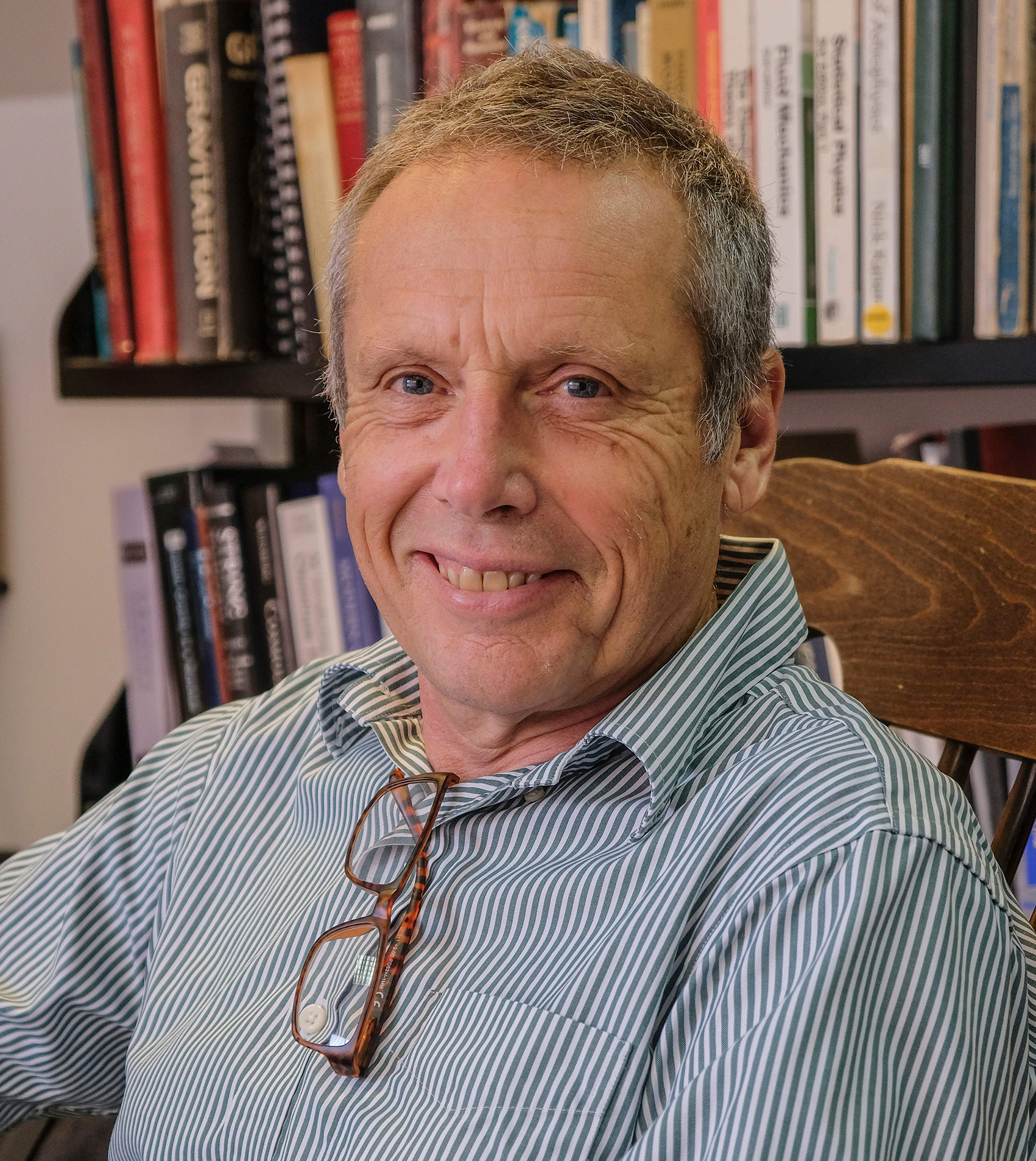
It was with a sense of shock that I heard this afternoon of the death of the age of 68 of cosmologist Nick Kaiser. It seems like only yesterday that we were celebrating the award of the Gruber Prize to Nick, but that was back in 2019. In a field filled with very clever people, Nick was one of the cleverest and also one of the nicest.
I have never worked directly with Nick Kaiser but he had an enormous influence on me, especially early on in my career. When I was doing my PhD, Nick was based in Cambridge and if I remember correctly he was the first person ever to ask me a question during a conference talk when I gave one there in 1987. Nick was never shy about making such interventions, sometimes somewhat mischievously. At first he terrified me because I didn’t know him except by scientific reputation, and didn’t realize what a nice guy he was. His question was actually very helpful, as it allowed me explain something that I’d skipped because I was under time pressure. His response to my explanation was very complimentary and supportive, which encouraged me a lot, and we chatted for quite a while after the session (in a pub). He was very friendly and approachable, and very far from the intimidating character I’d expected. Anyway, his 1984 paper on cluster correlations was the direct motivation for my very first publication (in 1986).
I mentioned yesterday that many of the papers published by the Open Journal of Astrophysics over the last few years have been in the field of weak gravitational lensing. It is safe to say that is a field that was basically created by Nick; see the paper by Kaiser & Squires (1993) that kicked it all off. You could also say the same about the use of redshift-space distortions, concerning which he wrote a seminal paper in 1987. These are two techniques that will be applied in the analysis of data from the Euclid spacecraft, to be launched next month.
These are just a few of things that Nick did. He did many others, always original and always interesting. In recognition of his achievements he was made a Fellow of the Royal Society in 2008, won the Gold Medal of the Royal Astronomical Society in 2017, the Daniel Chalonge and Hector de Vega Medals in 2018, and the Gruber Prize for Astronomy in 2019.
It’s hard to characterize someone of such intellectual breadth, but it always seemed to me that his approach was driven by a very deep physical insight. He was often able to identify what were the fundamental aspects of apparently complicated phenomena and build simple models that captured most of the physics. Using this approach he could penetrate the thickets in which others might get lost. He was perfectly capable of undertaking more complicated calculations to elaborate the details, but he always started by focussing on the basics.
I met Nick many times here and there, usually at conferences. He was always enthusiastic and energetic and entertaining, and was great company to talk to over a drink or several. You always had a good laugh talking to Nick, but you always learnt something too. His son studied in Cardiff some years ago, while I was working there, and Nick sometimes came to visit on the pretext of giving a seminar. I remember once he almost missed his own talk because we were sitting in a pub chatting.
Nick spent recent years in Paris; I remember his presence when I did an online colloquium for the Daniel Chalonge – Hector de Vega School in 2021. He certainly seemed in fine health and good spirits then. Indeed, he gave a talk in the same series that year which you can download here.
Nick’s untimely death is particularly shocking because he was ultra-fit. I think he got hooked on ultra-endurance events while living in Hawaii, as the first Ironman events were held there. Mere marathons were not enough for him. I think I last saw him in person in 2016 during a meeting in Italy. While most of us laboured on the “easy” hiking trails, Nick found them uninteresting and went running off looking for greater challenges.
It still hasn’t really sunk in that Nick has gone. I know I’m not the only one who feels that way. I think the sense of loss will pervade the cosmological community for a considerable time. I send deepest condolences to his family, friends, colleagues and co-workers. He’ll be hugely missed by a huge number of people.
Rest in peace, Nick.

 is the recession velocity,
  is the redshift,
  is Hubble’s constant and
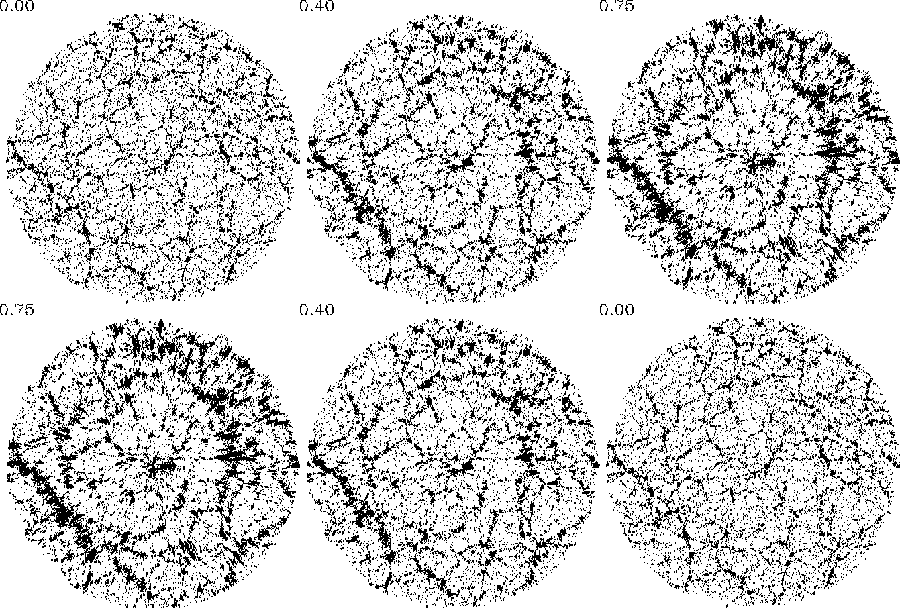
  is the radial distance of the galaxy. However, this only applies exactly in a completely homogeneous Universe. In reality the various inhomogeneities (galaxies, clusters and superclusters) introduce distortions into the Hubble Law by generating peculiar velocities

 . The higher this number is, the more matter there is to generate peculiar motions so the more pronounced the alteration; in a low density universe, real and redshift space look rather similar.

 In the Dark