Archive for Roy Kerr

Roger Penrose: Discoverer of Black Holes?

Posted in History, The Universe and Stuff with tags , , , , , , , , , on February 27, 2025 by telescoper

I got home from a busy day on campus to find the 21st February issue of the Times Literary Supplement had landed on my doormat having arrived today, 27th February. It used to take a couple of weeks for my subscription copy to reach Ireland but recently the service has improved. Intriguingly, the envelope it comes in is postmarked Bratislava…

But I digress. This is the cover:
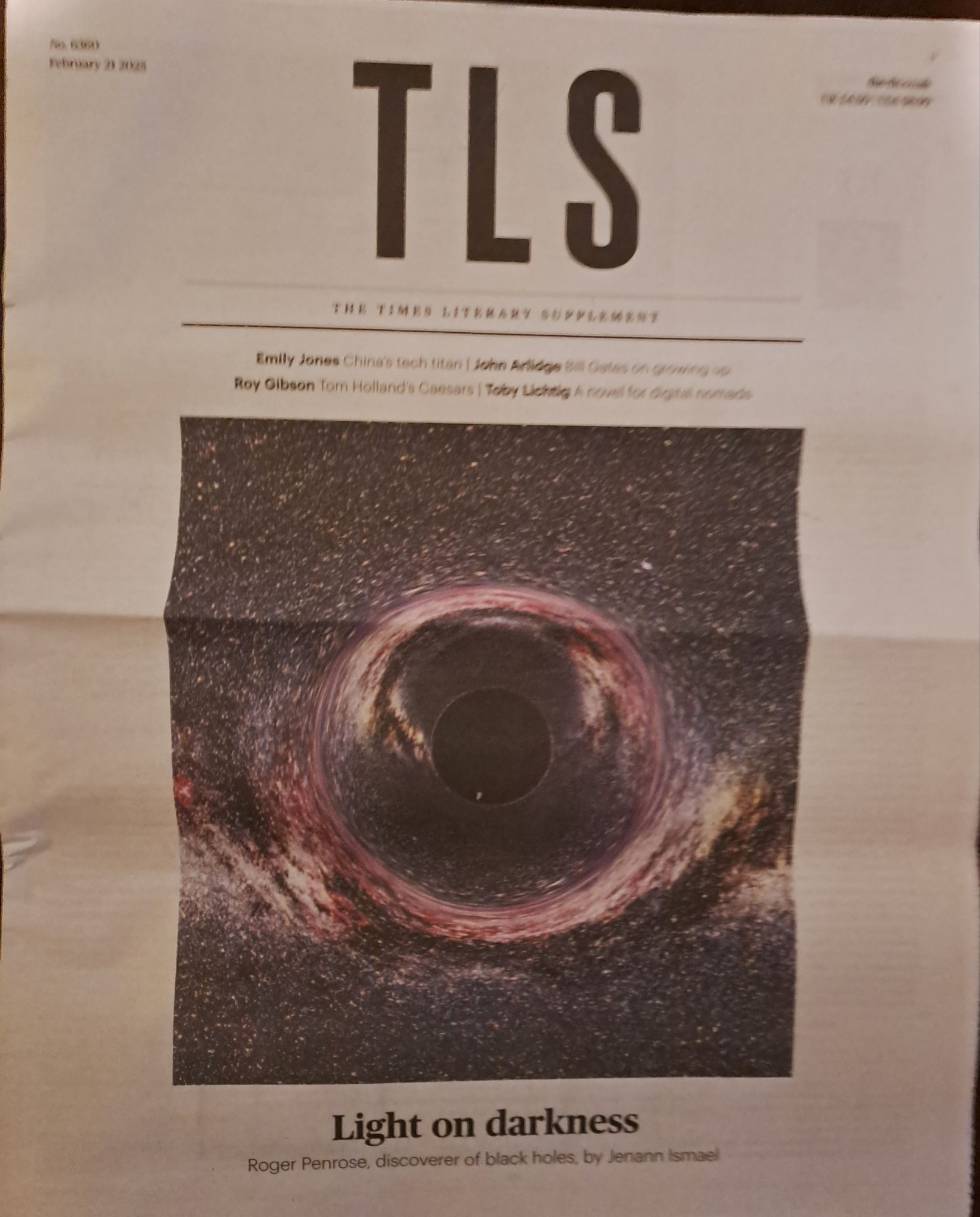
The text below the title “Light on darkness” under the graphic reads “Roger Penrose, discoverer of black holes, by Jennan Ismael”. Nice though it is to see science featured in the Times Literary Supplement for a change and much as I admire Roger Penrose, it is unreasonable to describe him as “the discoverer of black holes”.

A black hole represents a region of space-time where the action of gravity is sufficiently strong that light cannot escape. The idea that such a phenomenon might exist dates back to John Michell, an English clergyman, in 1783, and later by Pierre-Simon Laplace but black holes are most commonly associated with Einstein’s theory of general relativity.  Indeed, one of the first exact solutions of Einstein’s equations to be found describes such an object. The famous Schwarzschild solution was obtained in 1915 by Karl Schwarzschild, who died soon after on the Eastern front in the First World War. The solution corresponds to a spherically-symmetric distribution of matter, and it was originally intended that it could form the basis of a mathematical model for a star. It was soon realised, however that for an object of any mass M there is a critical radius (Rs, the Schwarzschild radius) such that if all the mass is squashed inside Rs then no light can escape.  In terms of the mass M, velocity of light c, and Newton’s constant G, the critical radius is given by Rs = 2GM/c2 . For the mass of the Earth, the critical radius is only 1cm, whereas for the Sun it is about 3km.

Since the pioneering work of Schwarzschild, research on black holes has been intense and other kinds of mathematical solutions have been obtained. For example, the Kerr solution describes a rotating black hole and  the Reissner -Nordstrom solution corresponds to  a black hole with an electric charge.  Various theorems have also been demonstrated relating to the so-called `no-hair’ conjecture: that black holes give very little outward sign of what is inside.

Some people felt that the Schwarzschild solution was physically unrealistic as it required a completely spherical object, but Roger Penrose showed mathematically that the existence of a trapped surface was a generic consequence of gravitational collapse, the result that won him the Nobel Prize in 2020. His work did much to convince scientists of the physical reality of black holes, and he deserved his Nobel Prize, but I don’t think it is fair to say he “discovered” them.

I would say that, as is the case for discoveries in many branches of science, there isn’t just one “discoverer” of black holes: there were important contributions by many people along the way.

P.S. If you want to limit the application of the word “discovery” to observations then I think that the discovery of black holes is down to Paul Murdin and Louise Webster who identified the first really plausible candidate for a black hole in Cygnus X-1, way back in 1971…

P.P.S. The term “Black Hole” was, as far as I know, coined by John Wheeler in 1967.

Roger Penrose is 93.

Do Black Holes have Singularities?

Posted in mathematics, The Universe and Stuff with tags , , , on December 7, 2023 by telescoper

A paper appeared on arXiv this week that has ruffled a few feathers. It’s by Roy Kerr (yes, him) and it has the abstract:

There is no proof that black holes contain singularities when they are generated by real physical bodies. Roger Penrose claimed sixty years ago that trapped surfaces inevitably lead to light rays of finite affine length (FALL’s). Penrose and Stephen Hawking then asserted that these must end in actual singularities. When they could not prove this they decreed it to be self evident. It is shown that there are counterexamples through every point in the Kerr metric. These are asymptotic to at least one event horizon and do not end in singularities.

arXiv:2312.00841

I don’t think this paper is as controversial as some people seem to find it. I think most of us have doubts that singularities – specifically curvature singularities – are physically real rather than manifestations of gaps in our understanding. On the other hand, this paper focusses on an interesting technical question and provides a concrete counterexample. The point is that the famous Penrose-Hawking singularity theorems don’t actually prove the existence of singularities; they prove geodesic incompleteness, i.e. that there are geodesics that can only be extended for a finite time as measured by an observer travelling along one. Geodesic incompleteness does imply the existence of some sort of boundary, often termed a trapped surface, but not necessarily that anything physical diverges there at that boundary. Though a singularity will result in geodesic incompleteness, the assertion that geodesic incompleteness necessarily implies the existence of a singularity is really just a conjecture.

For more details, read the paper. It’s technical, of course, but well written and actually not all difficult to understand.

On the Fellowship of Roy Kerr

Posted in The Universe and Stuff with tags , , , , , , , on April 18, 2019 by telescoper

Among the new Fellows of the Royal Society announced this week, I was astonished to see the name of Roy Kerr, the man who gave his name to the Kerr Metric an exact solution of Einstein’s equations of general relativity which describes the geometry of space-time around a rotating black hole.

When I say “astonished” I don’t mean that Kerr does not deserve this recognition. Far from it. I’m astonished because it has taken so long:the Kerr solution was published way back in 1963.

Anyway, better late than never, and heartiest congratulations to him!

While I’m on about Roy Kerr I’ll also say that I now think there is a very strong case for him to be awarded a Nobel Prize. The reasons are twofold.

One is that all the black hole binary systems whose coalescences produced gravitational waves detected by LIGO have involved Kerr black holes. Without Kerr’s work it would not have been possible to construct the template waveforms needed to extract signals from the LIGO data.

Second, and even more topically, the black hole in M87 recently imaged (above) by the Event Horizon Telescope is also described by the Kerr geometry. Without Kerr’s work the modelling of light paths around this object would not have been possible either.