Archive for Rugby Union

Six Nations Summary

Posted in Rugby with tags , , , , , , , , , on March 17, 2024 by telescoper

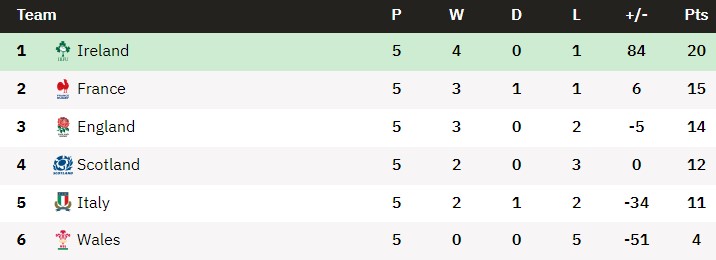
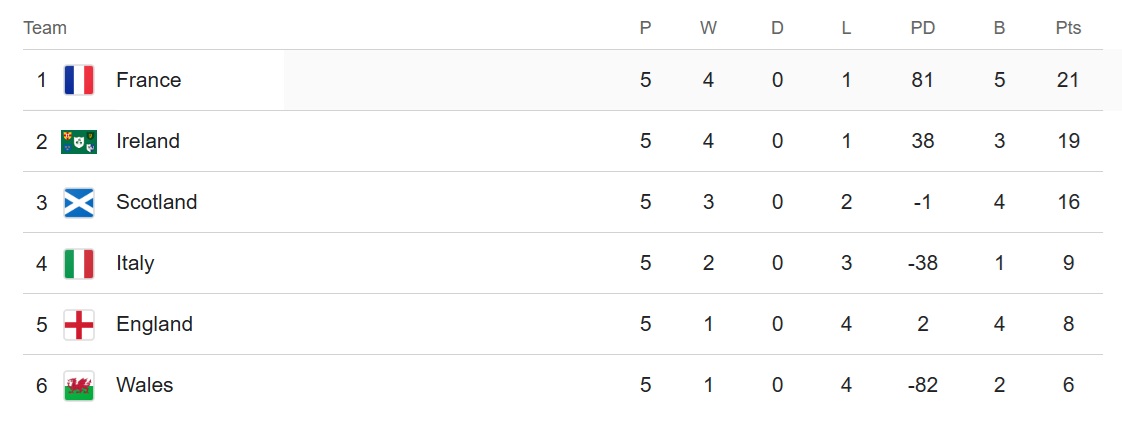
I didn’t see many of the games in this year’s Six Nations Rugby because I was abroad for most of it, but yesterday I saw the last round of matches. The last one, between France and England in Lyon, was probably the best game I’ve seen in this year’s tournament. After a fascinating ebb and flow, England thought they had snatched it with a converted try to make it 31-30 with just a couple of minutes to go, but then immediately conceded a penalty on the halfway line. Up stepped Thomas Ramos, who had scored from a similar distance earlier in the game, stepped up and scored. France won 33-31 in a game that could have gone either way. It was effectively a playoff for 2nd place.

Earlier in the day, Ireland held off a spirited challenge from Scotland in a tense and scrappy match to win 17-13 which guaranteed they would be Six Nations Champions. for the sixth time. I don’t think the team reached the heights of last year’s Grand Slam but it was a deserved victory. It was all a bit more comfortable than the scoreline suggests, though Scotland did score a try late on when Ireland lost concentration which made for a nervy few minutes. A defeat would have meant metaphorical rain on the St Patrick’s Day parades going on today, but in the end there was no rain, either metaphorical or literal.

Given the result in Lyon, Ireland would have been Champions by virtue of their bonus points, even if they had lost to Scotland. England (who beat Ireland last week in a game I didn’t see) had to win with a bonus point to catch them; they managed the bonus point for four tries, but lost the match. Some pundits have commented on whether it was fair for a team to have won having lost more games than the second place team. Of course all the teams know the rules before the competition starts, so there’s no point complaining after the fact. Ireland played attacking rugby knowing that the try count might be important. However, I do think there is a point. In the old Five Nations, and indeed in the World Cup Pools, each team played four games. A bonus point from each of those matches would add 4 to a team’s total, the same as a win. In the Six Nations each team places five matches, so the bonus points could add up to more than a win. A way to remedy this might be to award more points for a win: six for a win and three for a draw is my suggestion.

The first game of the last round yesterday was between Wales and Italy, a game which Italy won to finish 5th. They were unlucky not to beat France earlier in the competition and have played some excellent rugby this year. If they can deal with a marked tendency to fade in the last twenty minutes – as they did yesterday, but managed to hold on – then they will be genuine contenders. Wales had a terrible competition, losing all their games and finishing last. I am reliably informed that “wooden spoon” in Welsh is “llwy bren”. But nil desperandum: the last time Wales got the wooden spoon was in 2003; two years later they did the Grand Slam!

R.I.P. Barry John (1945-2024)

Posted in R.I.P., Rugby with tags , , , on February 6, 2024 by telescoper

I just read the terrible news of the death at the age of 79 of yet another icon of Welsh Rugby Union, the legendary standoff Barry John.

Five years ago I posted an item about Barry John inspired by this clip

The opening part of this clip had caught my attention because it was filmed near the bus stop just outside The Halfway, a pub on Cathedral Road just a few yards from the house in Cardiff in which I lived for many years; in the background you can see Llandaff Fields.

I had often wondered what became of Barry John. He was 74 when I wrote about him and no longer the slim young prodigy who was undoubtedly the best rugby player I ever saw. Since he played in a great era for Welsh rugby that included Gareth Edwards, J.P.R. Williams, Gerald Davies et al, that really says something. As the Guardian obituary aptly puts it, he “played Rugby from another world”.

As a sort of rugby equivalent of George Best, Barry John was incredibly famous during his career. Budding rugby players – even those not born in Wales – all wanted to play like Barry John. But suddenly, at the age of just 27, after playing just 25 internationals, he turned his back on all the publicity and adulation and retired from rugby. He found the pressure of being such a star in the amateur era too difficult to cope with.

So was Barry John really that good? Absolutely yes, he was. Slight of build but with superb balance, he had an extraordinary, almost magical, ability to find his way through a crowd of potential tacklers as if they weren’t there at all. In the memorable words of that great commentator Bill McLaren “he flits like a little phantom”. But you don’t need to take my word for it. Just look at him – and some other giants of the time – in these highlights of the classic Scotland-Wales tie in the Five Nations of 1971. Watch about 30 seconds in, where he wrong-foots half the Scottish three-quarter line before ghosting through three more and releasing the ball to his forwards. Will there ever be another Barry John? I doubt it..

I’m sure there are many of us who remember the excitement of watching Barry John play and feel enriched by what he gave us.

Rest in Peace, Barry John (1945-2024).

R.I.P. John Peter Rhys (“JPR”) Williams (1949-2024)

Posted in Biographical, Cardiff, R.I.P., Rugby with tags , , , , , , on January 9, 2024 by telescoper

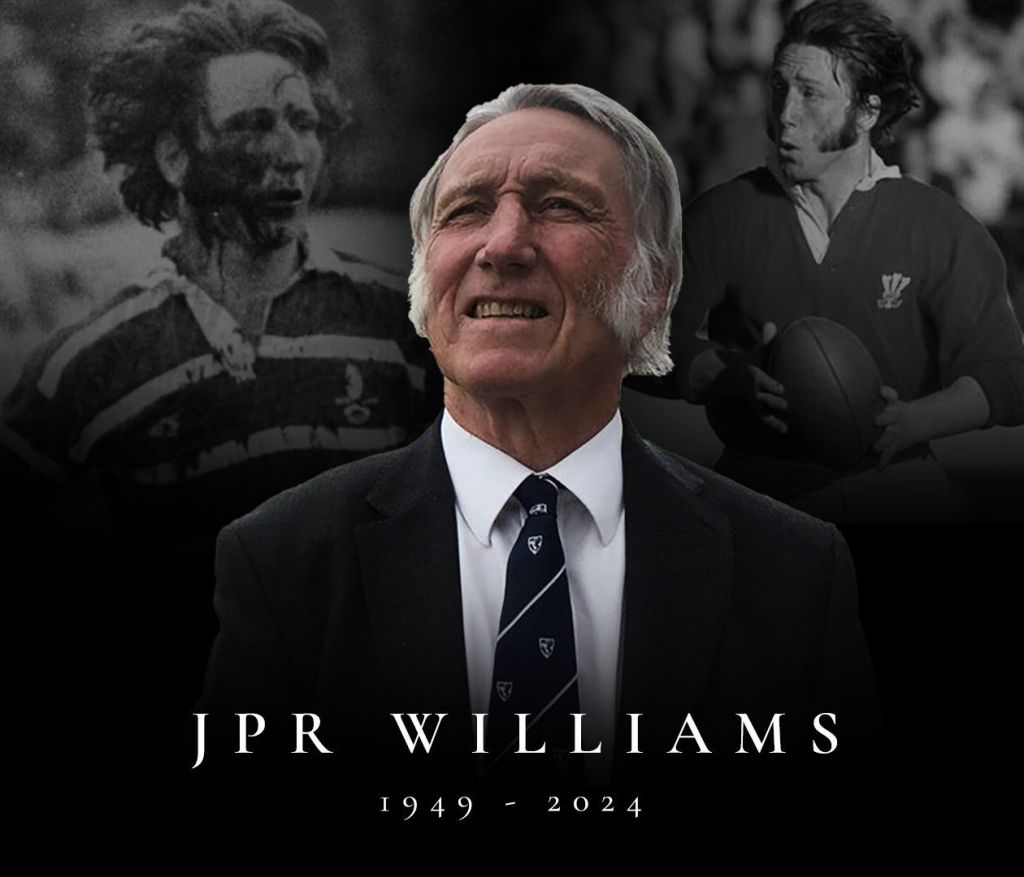
A cold and miserable day in Cardiff yesterday got even sadder when news came out of the death of Welsh rugby legend John Peter Rhys Williams known universally as “JPR” after the winger John James Williams (another great player), joined the national team and became “JJ”. JPR was one of the superb players who dominated Welsh rugby in the 1970s; he stood out even in such exalted company. In my opinion JPR is was the greatest full-back ever.

JPR was instantly recognizable on the field: tall and craggy, with characteristic long hair, prominent sideburns, socks always rolled down around his ankles, he was an imposing figure whether patrolling the defensive lines or stepping up to join the attack. In the famous 1973 match in Cardiff between The Barbarians and New Zealand he was described by commentator Cliff Morgan as “a man who never shirks his responsibility”. Just watch the memorable opening try where you’ll see JPR in the thick of the action, twice shrugging off dangerous tackles around his neck, the second time receiving the ball from Phil Bennett to start the passing move from deep inside his own half.

Many people forget that the man himself scored a great try in that game too:

(Note the involvement of David Duckham in that move; he passed away just a year ago.)

As a full-back, JPR was often the last line of defence. Sometimes, tidying up after a kick from the opposition, he would clear his lines by kicking. More often, though, he would spot a weakness and go charging forward, ball in hand, not afraid to run straight at the opposition. He was quick to spot gaps in his own defence too, rushing to provide cover, often with last-ditch try-saving tackles.

As good as he was at turning defence into attack, he was even better when his side were already in control. Here are two tries he scored for Wales against England in 1976 that demonstrate his superb positional sense in attack as well as his sheer physical strength.

(Wales achieved a Grand Slam in 1976; England got the Wooden Spoon.)

JPR was a tough, aggressive and uncompromising man on the field – players certainly knew when he’d tackled them! – but a gentleman off it, and held in a very high regard throughout the rugby world and beyond. His loss is immeasurable. One by one the legends are leaving us. The world is poorer without them.

Rest in peace, J.P.R. Williams (1949-2024)

P.S. When living in Cardiff years ago I had the pleasure of meeting and talking with two Welsh rugby legends, Gerald Davies and Phil Bennett (the former at a function, the latter at a book-signing). Both were charmingly modest men. I never really met JPR properly but I remember vividly stepping out of my house in Pontcanna on a Six Nations match day and finding myself face-to-face with him in the street. He must have been around 60 then and was still the same imposing figure he was in the 1970s. I recognized him immediately. I wanted to say something and perhaps even shake his hand, but I was too star-struck.

P.P.S. JPR was a fully-qualified orthopaedic surgeon and a Fellow of the Royal College of Surgeons. This is a reminder that back in the 1970s, Rugby Union was still an amateur game.

R.I.P. Phil Bennett (1948-2022)

Posted in Biographical, Rugby with tags , , , on June 13, 2022 by telescoper

With the passing of Phil Bennett at the age of 73, one of the true greats of Rugby Union has left us. Known to many as “Benny”, Phil Bennett was one of the best players ever to play at fly half for any team at any time. While the role of outside half in the modern game involves a much greater emphasis on kicking ability, Bennett just loved to run with the ball and had an amazing box of tricks with which to bamboozle the opposition, including but not limited to his famous sidestep.

Watch him here in the classic Barbarians versus New Zealand match in Cardiff 1973. The coach of a mere mortal would tear his hair out seeing a player what Bennett did under the shadow of his own posts, but he didn’t just get away with it – he started the move that created a part of Rugby history.

Phil Bennett took over as outside half for Wales from Barry John, who retired early from Rugby, and soon established himself as a permanent member of the phenomenal Welsh team of the early 1970s, joining the ranks of such legends as JPR Williams, Gerald Davies, and Gareth Edwards.

I was born in England but had family connections to Scotland, Wales and Ireland too. Partly because the English team of that period was not strong we always cheered for Wales when we watched the Five Nations games at home. Years later I managed to meet a few of the players of that time. I was flabbergasted to bump into JPR Williams once just outside my house; met Gerald Davies at an event in Cardiff Bay; and encountered Phil Bennett in a bookshop in Cardiff city centre. On all occasions I was completely tongue-tied, struck by the awe of being in the company of such people. All of them were modest and gracious. Remember that Rugby Union in those days was an amateur sport and none of these extraordinary men became rich like modern players do.

Anyway, here is another sensational try featuring Phil Bennett who both starts and finishes the move – with a fantastic contribution from Gerald Davies in between. In the words of the great Bill McLaren “That was absolute magic, and the whole crowd here knows it”.

Rest in Peace, Phil Bennett (1948-2022)