Archive for Schrodinger Equation

New Publication at the Open Journal of Astrophysics

Posted in OJAp Papers, Open Access, The Universe and Stuff with tags , , , , on November 10, 2022 by telescoper

I’m delighted to be able to announce the 10000th paper this year, and 1000000th publication overall, at the Open Journal of Astrophysics!

That is counting in binary, of course. In base ten the  new paper at the 16th paper in Volume 5 (2022) as well as the 64th in all.

The latest publication is entitled “Evolution of Cosmic Voids in the Schrödinger-Poisson Formalism” and the authors are Aoibhinn Gallagher and Peter Coles (Who he? Ed) both of the Department of Theoretical Physics at Maynooth University. Obviously as author I played no role in the selection of referees or any other aspect of the editorial process.

Aoibhinn Gallagher – bonus marks for pronouncing both names correctly – is my first Maynooth PhD student and this is her first paper, of many I hope (and expect)! We’re already working on extensions of this approach to other aspects of large-scale structure. You can find some discussion of this general approach here.

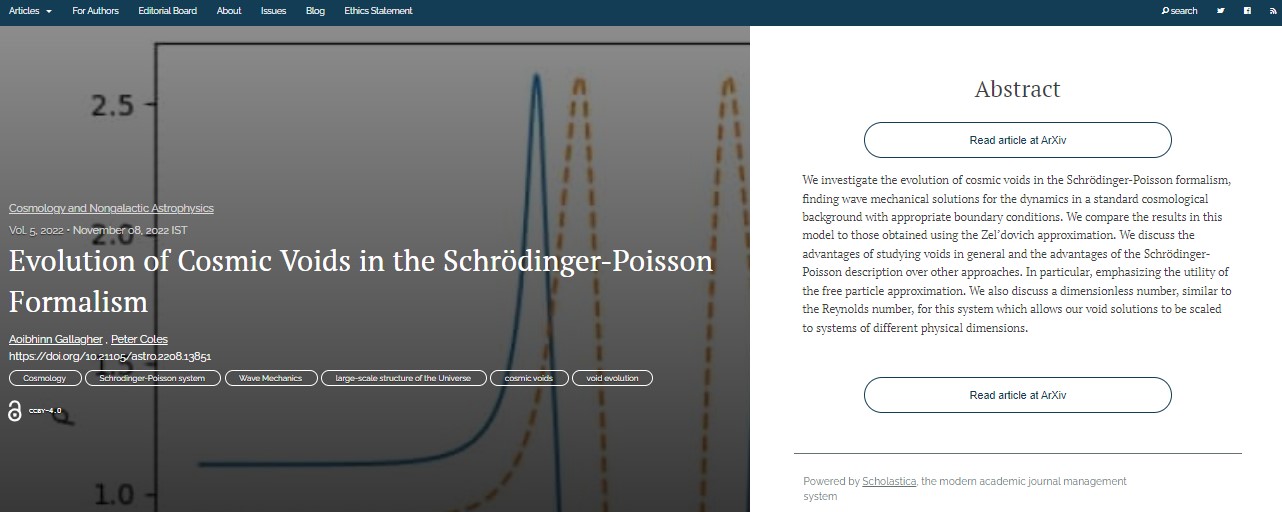
Anyway, here is a screen grab of the overlay which includes the  abstract:


You can click on the image to make it larger should you wish to do so. You can find the officially accepted version of the paper on the arXiv here.

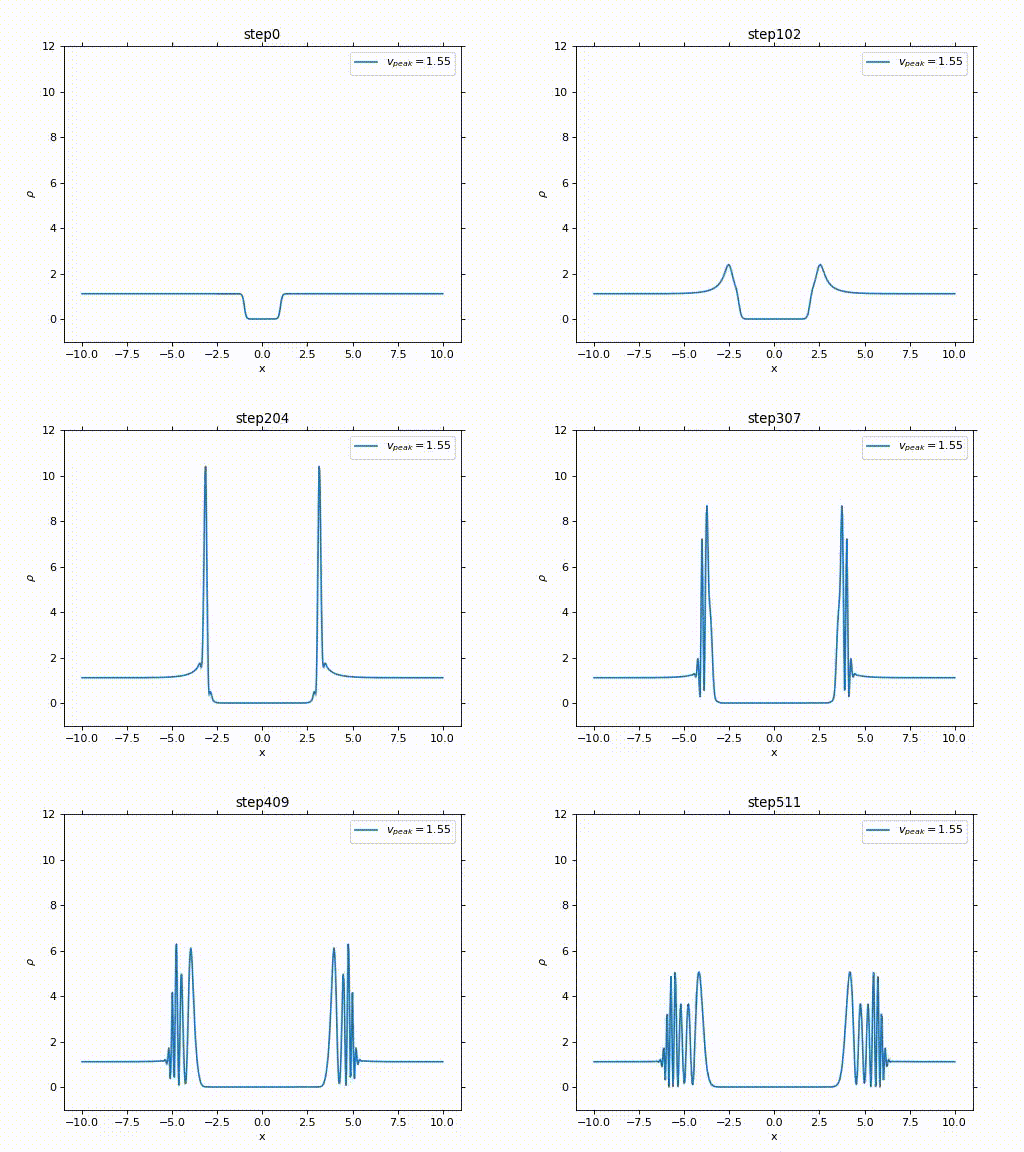
Here is a nice animated version of Figure 5 of the paper showing, for a 1D slice, the radial expansion of a spherically symmetric void (i.e. underdense region) using periodic boundary conditions:

The x-axis is in (scaled) comoving coordinates, i.e. expanding with the cosmological background, so that the global expansion is removed.  You can see that the void expands in these coordinates, so is expanding more quickly than the background, initially pushing matter into a dense ring around the rim of the empty void. That part of the evolution is just the same as for “normal” matter but in this case the wave-mechanical behaviour of the matter prevents it from being confined to a strongly-localized structure as well as affecting the subsequent expansion rate.

Of course in the real Universe, voids are not isolated like this but instead tend to push into each other, but we felt it was worth studying the single void case to understand the dynamics!

Cosmological Wave Mechanics

Posted in The Universe and Stuff with tags , , , , on June 15, 2017 by telescoper

As promised here are the slides I used for my talk yesterday at Imperial College. I stole some of them from an old presentation given by Chris Short, who was a PhD student of mine when I was at Nottingham. Chris now works for the Met Office, working on rather different application of fluid mechanics!

Reflections on Quantum Backflow

Posted in Cute Problems, The Universe and Stuff with tags , , , , on November 10, 2016 by telescoper

Yesterday afternoon I attended a very interesting physics seminar by the splendidly-named Gandalf Lechner of the School of Mathematics here at Cardiff University. The topic was one I’d never thought about before, called quantum backflow. I went to the talk because I was intrigued by the abstract which had been circulated previously by email, the first part of which reads:

Suppose you are standing at a bus stop in the hope of catching a bus, but are unsure if the bus has passed the stop already. In that situation, common sense tells you that the longer you have to wait, the more likely it is that the bus has not passed the stop already. While this common sense intuition is perfectly accurate if you are waiting for a classical bus, waiting for a quantum bus is quite different: For a quantum bus, the probability of finding it to your left on measuring its position may increase with time, although the bus is moving from left to right with certainty. This peculiar quantum effect is known as backflow.

To be a little more precise about this, imagine you are standing at the origin (x=0). In the classical version of the situation you know that the bus is moving with some constant definite (but unknown) positive velocity v. In other words you know that it is moving from left to right, but you don’t know with what speed v or at what time t0 or from what position (x0<0) it set out. A little thought, (perhaps with the aid of some toy examples where you assign a probability distribution to v, t0 and x0) will convince you that the resulting probability distribution for moves from left to right with time in such a way that the probability of the bus still being to the left of the observer, L(t), represented by the proportion of the overall distribution that lies at x<0 generally decreases with time. Note that this is not what it says in the second sentence of the abstract; no doubt a deliberate mistake was put in to test the reader!

If we then stretch our imagination and suppose that the bus is not described by classical mechanics but by quantum mechanics then things change a bit.  If we insist that it is travelling from left to right then that means that the momentum-space representation of the wave function must be cut off for p<0 (corresponding to negative velocities). Assume that the bus is  a “free particle” described by the relevant Schrödinger equation.One can then calculate the evolution of the position-space wave function. Remember that these two representations of the wave function are just related by a Fourier transform. Solving the Schrödinger equation for the time evolution of the spatial wave function (with appropriately-chosen initial conditions) allows one to calculate how the probability of finding the particle at a given value of evolves with time. In contrast to the classical case, it is possible for the corresponding L(t) does not always decrease with time.

To put all this another way, the probability current in the classical case is always directed from left to right, but in the quantum case that isn’t necessarily true. One can see how this happens by thinking about what the wave function actually looks like: an imposed cutoff in momentum can imply a spatial wave function that is rather wiggly which means the probability distribution is wiggly too, but the detailed shape changes with time. As these wiggles pass the origin the area under the probability distribution to the left of the observer can go up as well as down. The particle may be going from left to right, but the associated probability flux can behave in a more complicated fashion, sometimes going in the opposite direction.

Another other way of thinking about it is that the particle velocity corresponds to the phase velocity of the wave function but the probability flux is controlled by the group velocity

For a more technical discussion of this phenomenon see this review article. The exact nature of the effect is dependent on the precise form of the initial conditions chosen and there are some quantum systems for which no backflow happens at all. The effect has never been detected experimentally, but a recent paper has suggested that it might be measured. Here is the abstract:

Quantum backflow is a classically forbidden effect consisting in a negative flux for states with negligible negative momentum components. It has never been observed experimentally so far. We derive a general relation that connects backflow with a critical value of the particle density, paving the way for the detection of backflow by a density measurement. To this end, we propose an explicit scheme with Bose-Einstein condensates, at reach with current experimental technologies. Remarkably, the application of a positive momentum kick, via a Bragg pulse, to a condensate with a positive velocity may cause a current flow in the negative direction.

Fascinating!


Classical Fluids via Quantum Mechanics

Posted in The Universe and Stuff with tags , , , , , , on June 17, 2012 by telescoper

The subject of this post is probably a bit too technical to interest many readers, but I’ve been meaning to post something about it for a while and seem to have an hour or so to spare this morning so here goes. This is going to be a battle with the clunky WordPress latex widget too so please bear with me if it’s a little difficult to read.

The topic something I came across a while ago when thinking about the way the evolution of the matter distribution in cosmology is described in terms of fluid mechanics, but what I’m going to say is not at all specific to cosmology, and perhaps isn’t all that well known, so it might be of some interest to readers with a general physics background.

Consider a fluid with density \rho= \rho (\vec{x},t). The velocity of the fluid at any point is \vec{v}=\vec{v}(\vec{x},t). The evolution of such a fluid can be described by the continuity equation:

\frac{\partial \rho}{\partial t} + \vec{\nabla}\cdot (\rho\vec{v})= 0

and the Euler equation

\frac{\partial \vec{v}}{\partial t} + (\vec{v}\cdot\vec{\nabla})\vec{v} +\frac{1}{\rho} \vec{\nabla} P + \vec{\nabla} V = 0,

in which P is the fluid pressure (pressure gradients appear in the above equation) and V is a potential describing other forces on the fluid (in a cosmological context, this would include its self-gravity). To keep things as simple as possible, consider a pressureless fluid (as might describe cold dark matter) and restrict consideration to the case of a potential flow, i.e. one in which

\vec{v} = \vec{\nabla}\phi

where \phi=\phi(\vec{x},t) is a velocity potential; such a flow is curl-free. It is convenient to take the first integral of the Euler equation with respect to the spatial coordinates, which yields an equation for the velocity potential (cf. the Bernoulli equation):

\frac{\partial \phi}{\partial t} + \frac{1}{2} (\nabla \phi)^{2} + V=0.

The continuity equation becomes

\frac{\partial \rho}{\partial t} + \vec{\nabla}\cdot(\rho\vec{\nabla}\phi) = 0

This is all standard basic classical fluid mechanics. Now here’s the interesting thing. Introduce a new quantity \Psi defined by

\Psi(\vec{x},t) \equiv R\exp(i\phi/\nu),

in which R=R(\vec{x},t) and \nu is a constant. Using this construction, it turns out that

\rho = \Psi\Psi^{\ast}= |\Psi|^2=R^2.

After a little bit of fiddling around putting this in the previous equation you can obtain the following:

i\nu \frac{\partial \Psi}{\partial t} = -\frac{\nu^2}{2} \nabla^2{\Psi} + V\Psi + Q\Psi

which, apart from the last term Q and a slightly different notation, is identical to the Schrödinger equation of quantum mechanics; the term \nu would be  proportional to Planck’s constant h in that context, but in this context is a free parameter.

The mysterious term Q is pretty horrible:

Q = \frac{\nu^2}{2} \frac{\nabla^2 R}{R},

and it turns the Schrödinger equation into a non-linear equation, but its role can be understood by seeing what happens if you start with the normal single-particle Schrödinger equation and work backwards; this is the approach taken historically by David Bohm and others. In that case the term Q appears as a strange extra potential term in the Bernoulli equation which is sometimes called the quantum potential. In the context of fluid flow, however, the term describes  the the effect of pressure gradients that would arise if the fluid were barotropic. In the approach I’ve outlined, going in the opposite direction, this term is consequently sometimes called the “quantum pressure”. The parameter \nu controls the size of this term, which has the effect of blurring out the streamlines of the purely classical solution.

This transformation from classical fluid mechanics to quantum mechanics is not a new idea; in fact it goes back to Madelung who, in the 1920s, was trying to find a way to express quantum theory in the language of classical fluids.

What interested me about this approach, however, is more practical. It might seem strange to want transform relatively simple classical fluid-mechanical setup into a quantum-mechanical framework, which isn’t the obvious way to make progress, but there are a number of advantages of doing so. Perhaps chief among them is that the construction of \Psi means that the density \rho is guranteed positive definite; this means that a perturbation expansion of \Psi will not lead to unphysical negative densities in the same way that happens if perturbation theory is applied to \rho directly. This approach also has interesting links to other methods of studying the growth of large-scale structure in the Universe, such as the Zel’dovich approximation; the “waviness” controlled by the parameter \nu is useful in ensuring that the density does not become infinite at shell-crossing, for example.

Anyway, here are some links to references with more details:

http://adsabs.harvard.edu/abs/1993ApJ…416L..71W
http://adsabs.harvard.edu/abs/1997PhRvD..55.5997W
http://adsabs.harvard.edu/abs/2002MNRAS.330..421C
http://adsabs.harvard.edu/abs/2003MNRAS.342..176C
http://adsabs.harvard.edu/abs/2006JCAP…12..012S
http://adsabs.harvard.edu/abs/2006JCAP…12..016S
http://adsabs.harvard.edu/abs/2010MNRAS.402.2491J

I think there are many more ways this approach could be extended, so maybe this will encourage someone out there to have a look at it!