Archive for Science

Stay of Execution

Posted in Education, Finance, Politics, Science Politics with tags , , , , on June 22, 2010 by telescoper

Another beautiful summer’s day here in Cardiff just happened to be the day when the new ConDem government unleashed its much-feared budget. I suppose we were all expecting some combination of  tax rises and spending cuts but nodody I know had managed to predict the details. A big rise in VAT (to 20%) is the headline figure most of the newspapers seem to be running with, but the other side is the one that caught my eye;  average cuts of 25% in “unprotected” Whitehall departments. That means basically everything outside Health and Education, and “Education” doesn’t include Higher Education which falls within the remit of the Department of Business Innovation and Skills.  Universities (in England; Scotland, Wales and Northern Ireland run their own budgets for HE) and the Research Councils are therefore bracing themselves for cuts of 25% or even more; if some departments are cut less than this average, then some will be cut more…

For informed comment, see here and here.

However, the details of how these cuts will be implemented – and, of particular relevance to me, how much the Science and Technology Facilities Council will be chopped – will have to wait until the Comprehensive Spending Review to be announced in October 2010. No doubt the STFC Executive will be using all their political skills and powers of persuasion to argue for a positive settlement. Like they did last time. In other words, we’re doomed.

Incidentally, you can hear Lord Rees’ scathing comments about the inept management of STFC here, although to so involves shaking hands with the devil that is iTunes.

There’s also a two-year freeze on public sector salaries – again, not entirely unexpected – but obviously that will only apply to those who keep their jobs after the departmental budgets are cut by a quarter.

Anyway, no point in griping. We all knew this was coming. The big question now is whether the increases in unemployment and tax rises will stop our feeble economic recovery in its tracks, and how badly the cuts in investment will jeoparside future growth. I’m not sufficiently knowledgeable about economics to comment sensibly on this.

Coincidentally today was also the day that STFC Council met here in Cardiff. Of course they did so behind closed doors, but they also had a quick tour of the buildings and a briefing by our Head of School, Swiss Tony Walter Gear. I’m told one of the Council members asked “Excuse me, but what is Planck?”. Apparently the question was posed by one of the non-scientists on STFC Council. So that’s alright then.

Still, there’s always the elimination of France from the World Cup to gladden the heart of an Englishman. Like STFC, the England  football team will learn its fate soon eough …

Sexism, of course…

Posted in Education with tags , , on June 21, 2010 by telescoper

I’ve only just recovered from the shock  of seeing the sheer hopelessness of British science education laid bare last week. Indeed, I was so staggered to discover how poorly conceived the current GCSE science examinations are that I forgot that I’d already blogged about the lamentable tendency of the modern education system to concentrate on getting kids to swallow and regurgitate little bite-sized factoids, rather than actually learning to think for themselves.  Leaving aside the issue that quite a few of the things that are being taught seem to be wrong anyway, my point there was that teaching science isn’t about teaching facts at all, it’s about trying to develop critical thinking and problem-solving skills. At least that’s what it should be, if only the dumbers-down would stop meddling.

Well, I’d almost come to terms with my despair when I saw another article (from Friday’s Guardian) which tells a tale that’s not just idiotic, but also sinister and offensive. Here’s the full text

One of the country’s biggest exam boards is developing different GCSE courses for boys and girls, it emerged today.

The Assessment and Qualifications Alliance (AQA) said it was looking into creating a science GCSE with more coursework in it for girls, and one which gave more weighting to exam marks for boys.

Studies have shown that girls perform better in coursework than boys, while boys do better in exams.

AQA said it would not prevent boys from taking the girls’ course and vice versa.

The courses in English, maths and science could be available from September next year.

Bill Alexander, the exam board’s director of curriculum and assessment, told the Times Educational Supplement: “We could offer a route for boys that is very different to a route for girls.

John Bangs, head of education at the National Union of Teachers, said it was “extremely dangerous” to get into gender stereotyping. “There are lots of boys who like the investigative element of coursework as well,” he said.

John Dunford, general secretary of the Association of School and College Leaders, said it was a “wild generalisation” to state that boys did better in exams, while girls performed better in coursework, but that it had “more than a grain of truth” to it.

However, he suggested that as well as sitting the gender-specific exams, pupils’ work should be marked in part by professional assessors.

Experts believe that this year could end a 20-year trend for girls to outperform boys in GCSEs because many new courses have no coursework. Instead, pupils complete work over a prolonged period, but under exam conditions.

There’s also a longer piece on the same topic in the Times Education Supplement.

Different courses for boys and girls? Are they serious? This is gender stereotyping of the worst possible kind. I find it absolutely abhorrent that anyone in any position of authority in the education system could even have contemplated doing something so offensively patronising. What’s next, different courses for different racial groups?

I sincerely hope that the new government intervenes and stops the AQA from going along this road. Better still, it should scrap these worthless examination factories and sack the profiteering dunderheads in charge who are responsible for turning the education system into a national disgrace.

Science Examination Blues

Posted in Education, The Universe and Stuff with tags , , , , , on June 16, 2010 by telescoper

I woke up this morning …

.. to the 7am news on BBC Radio 3, including a story about how GCSE science examinations are not “sufficiently rigorous”. Then, on Twitter, I saw an example of an Edexcel GCSE (Multiple-choice) Physics paper.  It’s enough to make any practising physicist weep.

Most of the questions are very easy, but there’s just as many that are so sloppily put together that they  don’t make any sense at all. Take Question 1:

I suppose the answer is meant to be C, but since it doesn’t say that A is the orbit of a planet, as far as I’m concerned, it might just as well be D. Are we meant to eliminate D simply because it doesn’t have another orbit going through it?

On the other hand, the orbit of a moon around the Sun is in fact similar to the orbit of its planet around the Sun, since the orbital speed and radius of the moon around its planet are smaller than those of the planet around the Sun. At a push, therefore you could argue that A is the closest choice to a moon’s orbit around the Sun. The real thing would be something close to a circle with a 4-week wobble variation superposed.

You might say I’m being pedantic, but the whole point of exam questions is that they shouldn’t be open to ambiguities like this, at least if they’re science exams. I can imagine bright and knowledgeable students getting thoroughly confused by this question, and many of the others on the paper.

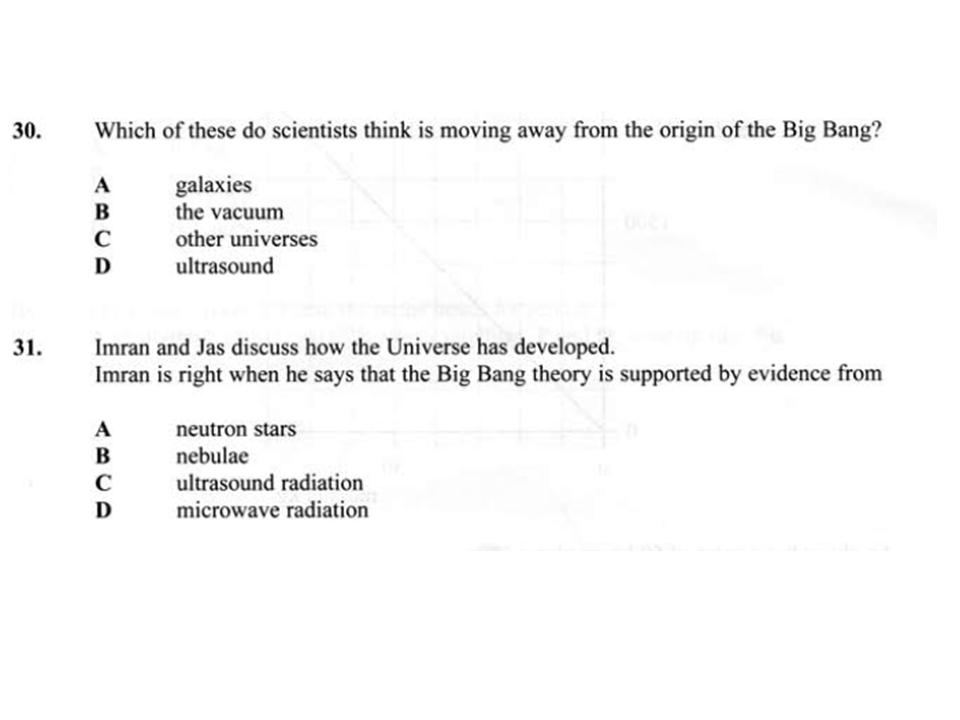
Here’s a couple more, from the “Advanced” section:

The answer to Q30 is, presumably, A. But do any scientists really think that galaxies are “moving away from the origin of the Big Bang”?  I’m worried that this implies that the Big Bang was located at a specific point. Is that what they’re teaching?

Bearing in mind that only one answer is supposed to be right, the answer to Q31 is presumably D. But is there really no evidence from “nebulae” that supports the Big Bang theory? The expansion of the Universe was discovered by observing things Hubble called “nebulae”..

I’m all in favour of school students being introduced to fundamental things such as cosmology and particle physics, but my deep worry is that this is being done at the expense of learning any real physics at all and is in any case done in a garbled and nonsensical way.

Lest I be accused of an astronomy-related bias, anyone care to try finding a correct answer to this question?

The more of this kind of stuff I see, the more admiration I have for the students coming to study physics and astronomy at University. How they managed to learn anything at all given the dire state of science education in the UK is really quite remarkable.

Pecha Kucha

Posted in Education with tags , , , , , on June 8, 2010 by telescoper

A few months ago I was invited to take part in an evening of Pecha Kucha in a hotel in Geneva. I’ll try anything once, so I agreed. I have to admit, though, that I wasn’t actually very good at it. Neither were any of the other scientists present.

No idea what a Pecha Kucha is? Well then you’re probably not an architect or an artist or a designer. Then again, you’re reading this blog so that’s pretty much a given anyway. Pecha Kucha is a style of presentation at which arty types display their portfolios in a strictly disciplined format. The standard form is twenty slides with twenty seconds allowed for each one, i.e. a total time of 6 minutes and 40 seconds. The timing is ruthlessly regulated.

Those of us scientists used to taking at least a few  minutes per slide find this format very challenging, but then that’s because we tend to have text and equations on our slides and they take some explaining. Designers and the like tend to just show pictures, and these should – if they’re any good – be pretty self-explanatory. I guess this is why the Pecha Kucha format is de rigeur in such disciplines while it has yet to catch on in physics.

I only just survived my initiation into the strange world of Pecha Kucha. Before being told what it was I thought it was a mountain in the Andes. I was reminded about it this morning by a tweet from John Butterworth (a particle physicist who, incidentally, has a nice blog of his own) confessing similar trepidation to what I experienced before I lost my Pecha Kucha virginity. The first time can be disappointing, but I hope he survived his inauguration.

Looking back on it though I think this might be an interesting idea to try in a physics context. We’re trying increasingly hard these to teach our physics and astronomy students transferable skills, but when it comes to presentations we’re fixated by the traditional presentation format. Why not get undergraduate students to do a Pecha Kucha about their project, instead of a 20-minute lecture? Why not include a Pecha Kucha in the PhD viva?

The more I think about it, the more attractive the idea seems. Has anyone out there tried a physics Pecha Kucha?

Cut and Thrust and Nip and Tuck

Posted in Finance, Science Politics with tags , , , , , , , on March 26, 2010 by telescoper

This week we received the not-altogether-unexpected news that the budgets of Welsh universities will be cut next year. The Higher Education Funding Council for Wales (HEFCW) has announced its detailed allocations for 2010-11 and all but one institution will receive a cash cut.  Cardiff University faces a cash cut of 1.74%. Lampeter is the exception, but it gets a cash increase of only 0.32%. After taking inflation into account, even they get a real terms decrease. So it’s real cuts across the board for Welsh Higher Education, with a total of about £30 million in funding taken away.

In fact, it appears that the total amount of money available to HEFCW for next year is level in cash terms compared to last year. The total amount it has distributed in recurrent grants has, however, decreased by about 2% on last year. As far as I understand it, the discrepancy between the income and expenditure is partly explained by the diversion of some funds into a new Strategic Implementation Fund(SIF) to enable HEFCW to meet the goals outlined in the Welsh Assembly Government (WAG) document stating its vision for Higher Education, entitled For our Future. Some elements of SIF are included with the current allocation, but other’s are not, hence the  cash cuts seen here.In future, a larger proportion of the budget will move from recurrent, formula-based funding towards initiatives more closely aligned with the WAGs or, more likely, wasted on window-dressing and increased bureaucracy.

We’ll have to see what the impact of the new SIF arrangements will be in the longer term. In the short-term, however, the cuts (though obviously regrettable) are by no means a shock and will probably appear entirely insignificant after the General Election and the real cuts start, probably more like 20% than 2%…

The situation in Wales contrasts with Scotland where the Higher Education has grown by 1% for 2010/11.  Some Scottish universities, such as Edinburgh with a cash increase of 2.2%, have done pretty well. A small number of others, such as Stirling have been cut by 3.3% in cash terms.

Allocations for English universities were announced by HEFCE last week. There the situation is more mixed, partly to do with HEFCE rejigging its formula for research funding to concentrate it even more than last time (something that HEFCW – wisely, in my view – decided not to do..). It seems about half the 130 institutions in HEFCE’s remit get a cash increase, although when inflation is factored in the number with a real increase is much smaller. Among the universities with big cash cuts are Reading (-7.7%) and the London School of Economics (-6.3%).

As far as I understand the situation, these figures don’t include the fines for over-recruitment recently demanded by Lord Mandelson and may not take into account cuts in capital allowances, so things may be a lot worse than they appear at first sight.

However, to complicate things  a bit more, this week’s budget announced new funding for Science Technology Engineering and Mathematics (STEM) subjects, corresponding to an increase in numbers of about 20,000.This is only for England, as Higher Education in Wales and Scotland is not part of the remit of the Westminster government. One advantage of this for those of us in Wales is that we can’t be affected by pre-election tinkering in the same way England can.

I’m sure the news of new funding is very welcome to my colleagues across the border, but it does look to me like a bit of sticking plaster that looks likely to fall off after polling day.

Anyway, it looks to me like these results are going exactly with the form book. Scotland has always valued Higher Education more strongly than England, and Wales has usually trailed along in third place.  The real struggle hasn’t yet started, however, and we have to wait anxiously to see how hard the axe will fall once the election is over.

Space without Physics…

Posted in Uncategorized with tags , , , , , on March 24, 2010 by telescoper

I’m indebted to a colleague (Annabel Cartwright) for sending me this (coincidentally topical) sample question, illustrating the quality of a modern British school science examination.

Since it’s now clear  that there is no room for science in the new era of the UK Space Agency, I suppose we should get used to the removal of science from other things too. Starting with science exams.

This question is taken from a GCSE Physics examination.

Some people think that governments spend too much money on space research.

Which ONE of the following statements is true?

  1. Science can tell us what the planets are made of, and whether they ought to be explored.
  2. Science can tell us what the planets are made of, but not whether they ought to be explored.
  3. Science cannot tell us what the planets are made of but can tell us whether they ought to be explored.
  4. Science cannot tell us what the planets are made of, nor whether they ought to be explored.

Apparently one (and only one) answer is correct. Any offers?

Science’s Dirtiest Secret?

Posted in Bad Statistics, The Universe and Stuff with tags , , , on March 19, 2010 by telescoper

My attention was drawn yesterday to an article, in a journal I never read called American Scientist, about the role of statistics in science. Since this is a theme I’ve blogged about before I had a quick look at the piece and quickly came to the conclusion that the article was excruciating drivel. However, looking at it again today, my opinion of it has changed. I still don’t think it’s very good, but it didn’t make me as cross second time around. I don’t know whether this is because I was in a particularly bad mood yesterday, or whether the piece has been edited. But although it didn’t make me want to scream, I still think it’s a poor article.

Let me start with the opening couple of paragraphs

For better or for worse, science has long been married to mathematics. Generally it has been for the better. Especially since the days of Galileo and Newton, math has nurtured science. Rigorous mathematical methods have secured science’s fidelity to fact and conferred a timeless reliability to its findings.

During the past century, though, a mutant form of math has deflected science’s heart from the modes of calculation that had long served so faithfully. Science was seduced by statistics, the math rooted in the same principles that guarantee profits for Las Vegas casinos. Supposedly, the proper use of statistics makes relying on scientific results a safe bet. But in practice, widespread misuse of statistical methods makes science more like a crapshoot.

In terms of historical accuracy, the author, Tom Siegfried, gets off to a very bad start. Science didn’t get “seduced” by statistics.  As I’ve already blogged about, scientists of the calibre of Gauss and Laplace – and even Galileo – were instrumental in inventing statistics.

And what were the “modes of calculation that had served it so faithfully” anyway? Scientists have long  recognized the need to understand the behaviour of experimental errors, and to incorporate the corresponding uncertainty in their analysis. Statistics isn’t a “mutant form of math”, it’s an integral part of the scientific method. It’s a perfectly sound discipline, provided you know what you’re doing…

And that’s where, despite the sloppiness of his argument,  I do have some sympathy with some of what  Siegfried says. What has happened, in my view, is that too many people use statistical methods “off the shelf” without thinking about what they’re doing. The result is that the bad use of statistics is widespread. This is particularly true in disciplines that don’t have a well developed mathematical culture, such as some elements of biosciences and medicine, although the physical sciences have their own share of horrors too.

I’ve had a run-in myself with the authors of a paper in neurobiology who based extravagant claims on an inappropriate statistical analysis.

What is wrong is therefore not the use of statistics per se, but the fact that too few people understand – or probably even think about – what they’re trying to do (other than publish papers).

It’s science’s dirtiest secret: The “scientific method” of testing hypotheses by statistical analysis stands on a flimsy foundation. Statistical tests are supposed to guide scientists in judging whether an experimental result reflects some real effect or is merely a random fluke, but the standard methods mix mutually inconsistent philosophies and offer no meaningful basis for making such decisions. Even when performed correctly, statistical tests are widely misunderstood and frequently misinterpreted. As a result, countless conclusions in the scientific literature are erroneous, and tests of medical dangers or treatments are often contradictory and confusing.

Quite, but what does this mean for “science’s dirtiest secret”? Not that it involves statistical reasoning, but that large numbers of scientists haven’t a clue what they’re doing when they do a statistical test. And if this is the case with practising scientists, how can we possibly expect the general public to make sense of what is being said by the experts? No wonder people distrust scientists when so many results confidently announced on the basis of totally spurious arguments, turn out to be be wrong.

The problem is that the “standard” statistical methods shouldn’t be “standard”. It’s true that there are many methods that work in a wide range of situations, but simply assuming they will work in any particular one without thinking about it very carefully is a very dangerous strategy. Siegfried discusses examples where the use of “p-values” leads to incorrect results. It doesn’t surprise me that such examples can be found, as the misinterpretation of p-values is rife even in numerate disciplines, and matters get worse for those practitioners who combine p-values from different studies using meta-analysis, a method which has no mathematical motivation whatsoever and which should be banned. So indeed should a whole host of other frequentist methods which offer limitless opportunities for to make a complete botch of the data arising from a research project.

Siegfried goes on

Nobody contends that all of science is wrong, or that it hasn’t compiled an impressive array of truths about the natural world. Still, any single scientific study alone is quite likely to be incorrect, thanks largely to the fact that the standard statistical system for drawing conclusions is, in essence, illogical.

Any single scientific study done along is quite likely to be incorrect. Really? Well, yes, if it is done incorrectly. But the point is not that they are incorrect because they use statistics, but that they are incorrect because they are done incorrectly. Many scientists don’t even understand the statistics well enough to realise that what they’re doing is wrong.

If I had my way, scientific publications – especially in disciplines that impact directly on everyday life, such as medicine – should adopt a much more rigorous policy on statistical analysis and on the way statistical significance is reported. I favour the setting up of independent panels whose responsibility is to do the statistical data analysis on behalf of those scientists who can’t be trusted to do it correctly themselves.

Having started badly, and lost its way in the middle, the article ends disappointingly too. Having led us through a wilderness of failed frequentists analyses, he finally arrives at a discussion of the superior Bayesian methodology, in irritatingly half-hearted fashion.

But Bayesian methods introduce a confusion into the actual meaning of the mathematical concept of “probability” in the real world. Standard or “frequentist” statistics treat probabilities as objective realities; Bayesians treat probabilities as “degrees of belief” based in part on a personal assessment or subjective decision about what to include in the calculation. That’s a tough placebo to swallow for scientists wedded to the “objective” ideal of standard statistics….

Conflict between frequentists and Bayesians has been ongoing for two centuries. So science’s marriage to mathematics seems to entail some irreconcilable differences. Whether the future holds a fruitful reconciliation or an ugly separation may depend on forging a shared understanding of probability.

The difficulty with this piece as a whole is that it reads as an anti-science polemic: “Some science results are based on bad statistics, therefore statistics is bad and science that uses statistics is bogus.” I don’t know whether that’s what the author intended, or whether it was just badly written.

I’d say the true state of affairs is different. A lot of bad science is published, and a lot of that science is bad because it uses statistical reasoning badly. You wouldn’t however argue that a screwdriver is no use because some idiot tries to hammer a nail in with one.

Only a bad craftsman blames his tools.

Education. Education. Education.

Posted in Science Politics with tags , , on March 2, 2010 by telescoper

I can’t believe it. It’s an outrage. My world has fallen apart. Everything I used to believe in now stands in ruins.The unthinkable has happened. The Conservative Party has had a good idea.

Actually several. 

This is from the Guardian’s coverage of the story:

A Conservative government would immediately overhaul the national curriculum in English, maths and science – and hand control of A-level exam content to universities and academic experts to end “political control” , the shadow education secretary, Michael Gove, said today.

Every child would get the chance to study all three science subjects – physics, chemistry and biology – separately at GCSE and there would be a return to disciplines such as geometry and algebra in tests for 11-year-olds.

The Tories would abolish the Qualifications and Curriculum Development Agency (QCDA), the quango in charge of curriculum design, and benchmark the exams sat by children in England against those taken by young people across the world.

Outlining his plan in a speech to the annual conference of the Advisory Committee for Mathematics Education (Acme), Gove suggested that calculus be restored to A-level physics, and statistical concepts such as randomness and prediction – which have been key to understanding the financial crisis – be part of the GCSE curriculum for the brightest students.

“We will make a radical change to the way in which A-levels are designed,” Gove said. “We must ensure that A-levels are protected from devaluation at the hands of politicians. The institutions with the greatest interest in maintaining standards at A-level are those which receive A-level students – our universities.

“The individuals with the keenest interest in ensuring A-levels require the depth of knowledge necessary to flourish at university are our teaching academics. So we will take control of the A-level syllabus and question-setting process out of the hands of bureaucrats and instead empower universities, exam boards, learned societies and bodies like Acme.”

The national curriculum would be reformed to specify core knowledge “based on global evidence for what children can and should learn at different ages”, with changes to be introduced from September 2011.

Science would be divided into the disciplines of physics, chemistry and biology, rather than the hybrid headings currently used, which include “chemical and material behaviour” and “the environment, earth and universe”.

“When we reconstruct the national curriculum, we will ensure that it is built around a basic entitlement to study each of these scientific disciplines in a proper, rigorous fashion,” Gove said.

“We will ensure that each of the three basic sciences takes its place within the curriculum, in significantly greater depth and greater detail than now. Studying what has now become known as triple science should not be an elite activity but a basic curriculum entitlement.”

There isn’t much  in this that I would disagree with. The only thing that makes me nervous is that  abolishing the QCDA and handing over curriculum control to Universities may simply be a cost-cutting measure. I can see a strong possibility that we might have to take on this duty for free at a time when we’re threatened with big cuts in our research and teaching funds.

I’d also say that I think we’d be better off scrapping A-levels entirely – they’re damaged beyond repair, in my view. “Benchmarking” could be achieved quite easily by making British students take the International Baccalaureate.

These things aside, I would strongly endorse the statement that a proper science education should be an entitlement not a privilege. People might sneer at the reintroduction of geometry into the syllabus but I think it’s an excellent idea. Too much education these days consists of the rote-learning of snack thoughts in bit-sized factoid pieces. Too little involves nurturing brains to exploit their full potential to do things other than act as memory devices.  Education is there to help people learn to apply rigorous logical thinking as well as exercising its creative problem-solving powers. Doing classical Euclidean geometry is a wonderful way to develop the idea of a mathematical proof and, in my view, cutting it out of the school syllabus was a very retrograde step and one that should be reversed as soon as possible.

We’ve been going backwards in science education for far too long. Educationalists have convinced our schools that today’s students are not sufficiently intelligent to do science or mathematics and must instead be content to reproduce it. That’s an insult to the intelligence of the younger generation and it means Universities have to do a great deal of remedial teaching before they can get on and do things properly.

I’m no Conservative, but there’s no doubt in my mind that New Labour lost the plot a long time ago so I think the Tory plans are to be applauded.

Not that I’m going to vote for them.

Eidolons

Posted in Poetry, The Universe and Stuff with tags , , on February 17, 2010 by telescoper

Off early this morning, as I have to travel to the frozen North to give a seminar in a foreign land. Time, therefore, to pad this blog thing out with another poem. I haven’t posted much by Walt Whitman so now seems like a good time to correct the omission. This is called Eidolons, and it’s taken from Whitman’s famous and, at the time of its publication, controversial, collection of poems Leaves of Grass.

The word itself is from the Greek ειδωλον, meaning an image, spectre or phantom and, according to the Oxford English Dictionary (which Whitman would of course not have been using), it can have the additional meanings in English of a “mental image” or an “insubstantial appearance”, a “false image or fallacy”. It  also has the meaning of “an image of an idealised person or thing”, and is thus the origin of the word Idol.

Eidolons is written in Whitman’s characteristic free verse style, with a broad sweep and strong cadences which really should be read out loud rather than silently on the page.

I’ve heard it said that this poem is anti-scientific. I suppose it is, in some respects, but only if you think that science is capable of telling us everything there is to know about the Universe. I don’t think of science like that, so I don’t see this poem as anti-scientific. It celebrates world beyond that which we perceive directly and that which our minds comprehend. Our representations of true reality are eidolons because they are incomplete and imperfect and not, I think, because they are mere fallacies. Whitman is not saying science is wrong, just that it only gives us part of the picture.

Anyway, that’s why I think. Read for yourself and see what you think. But whether or not it is anti-science it is definitely about science. The references to professors, stars, spectroscopes and the like are all clear. He even seems to be having a pre-emptive dig at the multiverse theory!

I met a seer,
Passing the hues and objects of the world,
The fields of art and learning, pleasure, sense,
To glean eidolons.

Put in thy chants said he,
No more the puzzling hour nor day, nor segments, parts, put in,
Put first before the rest as light for all and entrance-song of all,
That of eidolons.

Ever the dim beginning,
Ever the growth, the rounding of the circle,
Ever the summit and the merge at last, (to surely start again,)
Eidolons! eidolons!

Ever the mutable,
Ever materials, changing, crumbling, re-cohering,
Ever the ateliers, the factories divine,
Issuing eidolons.

Lo, I or you,
Or woman, man, or state, known or unknown,
We seeming solid wealth, strength, beauty build,
But really build eidolons.

The ostent evanescent,
The substance of an artist’s mood or savan’s studies long,
Or warrior’s, martyr’s, hero’s toils,
To fashion his eidolon.

Of every human life,
(The units gather’d, posted, not a thought, emotion, deed, left out,)
The whole or large or small summ’d, added up,
In its eidolon.

The old, old urge,
Based on the ancient pinnacles, lo, newer, higher pinnacles,
From science and the modern still impell’d,
The old, old urge, eidolons.

The present now and here,
America’s busy, teeming, intricate whirl,
Of aggregate and segregate for only thence releasing,
To-day’s eidolons.

These with the past,
Of vanish’d lands, of all the reigns of kings across the sea,
Old conquerors, old campaigns, old sailors’ voyages,
Joining eidolons.

Densities, growth, facades,
Strata of mountains, soils, rocks, giant trees,
Far-born, far-dying, living long, to leave,
Eidolons everlasting.

Exalte, rapt, ecstatic,
The visible but their womb of birth,
Of orbic tendencies to shape and shape and shape,
The mighty earth-eidolon.

All space, all time,
(The stars, the terrible perturbations of the suns,
Swelling, collapsing, ending, serving their longer, shorter use,)
Fill’d with eidolons only.

The noiseless myriads,
The infinite oceans where the rivers empty,
The separate countless free identities, like eyesight,
The true realities, eidolons.

Not this the world,
Nor these the universes, they the universes,
Purport and end, ever the permanent life of life,
Eidolons, eidolons.

Beyond thy lectures learn’d professor,
Beyond thy telescope or spectroscope observer keen, beyond all mathematics,
Beyond the doctor’s surgery, anatomy, beyond the chemist with his chemistry,
The entities of entities, eidolons.

Unfix’d yet fix’d,
Ever shall be, ever have been and are,
Sweeping the present to the infinite future,
Eidolons, eidolons, eidolons.

The prophet and the bard,
Shall yet maintain themselves, in higher stages yet,
Shall mediate to the Modern, to Democracy, interpret yet to them,
God and eidolons.

And thee my soul,
Joys, ceaseless exercises, exaltations,
Thy yearning amply fed at last, prepared to meet,
Thy mates, eidolons.

Thy body permanent,
The body lurking there within thy body,
The only purport of the form thou art, the real I myself,
An image, an eidolon.

Thy very songs not in thy songs,
No special strains to sing, none for itself,
But from the whole resulting, rising at last and floating,
A round full-orb’d eidolon.

Science and Poetry

Posted in Poetry, The Universe and Stuff with tags , , , on December 6, 2009 by telescoper

In amongst all the doom and gloom about job cuts and the oncoming onslaught that goes by the name of impact, I found in this week’s Times Higher a thought-provoking article about the demise of poetry. The author, Neil McBride, is principal lecturer in Informatics at De Montfort University and the piece is made all the more interesting by the fact that it includes some of his own verse. In fact, with his permission, I’ve included one of the poems below.

I agree with some of what McBride says in his article and disagree with some too. I don’t intend to dissect the piece here, and suggest instead that you read it yourself and form your own opinion. Since I wanted to include one of the poems here, however, I thought I should at least address its context in the article. The opening paragraph states

Dame Jocelyn Bell Burnell, the renowned astrophysicist, hid her love for poetry from the world until she retired, out of fear for what people would think.

In fact, I posted an item about an anthology of astronomy-inspired poems edited by Jocelyn on this blog many moons ago. McBride goes on to describe an anthology of poetry written by scientists that was published in 2001 wherein all the writers remained anonymous, the reason being

Good intelligent men and women, clothed in cold rationality, considered it professional suicide to admit to any literary emotions.

The following poem, McBride’s own, develops this image to the point of caricature:

Science and Poetry

In his lab he’s hid “Whitsun Weddings” behind the sink,
The latest volume of Fuller sandwiched between reagent catalogues.
Shakespeare’s sonnets encoded in the lab book
Rossetti pasted to the wall behind the periodic table.

Amongst the chaotic dishes and tubes, there cannot be anything poetic at all
Rhythm and language must be neutralised, the third person
Is the wash of objectivity, the veneer of scientific discipline:
Verse is hidden at the back of a draw covered with Millipore.

The poets of science have no names, clothed in the shame
Of irrationality, the atrocity of the literary mind is unspoken
Words must be disguised, sanitised. Any evidence of life
Outside the rational, the objective, must be denied.

The observatory is cold, dark, starless. Pulsars blip
The steady drip, drip of numbers stripped of spirit
The poetry of the stars must be denied
Planets are mathematical objects swimming in an emotional vacuum.

Do not suggest that patterns, laws, and the aesthetics of structure
Hold anything of the spirit. Don’t speak poetry to me:
We silence our critics, mute emotions, declare ourselves ‘observers’.
There is no soul, nothing but a rotting body of clockwork chemicals.

It’s certainly a finely crafted piece of satire, but as a scientist myself I have to stand up for my brothers and sisters and say that it is very far from my experience of their view of literature. Perhaps astronomy attracts more romantic types more likely to wear their hearts (and literary sensibilities) on their sleeves than computer scientists or chemists. The many scientists I know who do read and write poetry do not hide- and, as far as I know, never have hid – this from their peers or anyone else. And I doubt if it ever occurred to any of them that confession to a love of poetry would damage their careers. I don’t think there ever was a reason for Dame Jocelyn to have hidden it away for all those years, or perhaps she was just using poetic license?

McBride goes on to discuss a number of possible reasons for poetry’s falling popularity. Modern poetry is too difficult , too obscure, too “academic” , for the reader-in-the-street to understand. That’s not helped by the fact that, in this digital age people, the immediate availability of easier visual forms of entertainment is making people less receptive to literature that requires prolonged reflection. I think there’s truth in both of these arguments, but I think there’s another possibility: that the internet revolution may just be changing the way literature is conceived and delivered, just as technological and sociological change has done many times in the past.

In the course of his very interesting piece, McBride also touches on another theme I’ve posted about a number of times. To quote:

Perhaps the power of poetry is its downfall. It addresses uncertainty. It questions, it leaves frayed edges and loose wires. We reject poetry because we shun its emotional engagement.

This reminds me of the stereotypical image of a scientist as an arrogant god of certainty, one that I don’t recognize at all. Scientists are constantly addressing uncertainty. That’s their job. I’m sure we’re all too aware of frayed edges and loose wires too. The conflict and indeterminacy we face in our work is not the same as people find in their emotional lives, of course, but the need to engage with it causes similar levels of stress!

Most people don’t care much for either science or poetry. Both are considered too hard, but probably in different ways. The digital age hasn’t turned everyone into unthinking zombies, but I think it has probably led to more people opting out of difficult ways of earning a living and finding easier ways of spending their leisure time. But there are still some who find pleasure in what’s difficult. Perhaps the reason why so many scientists love poetry is that they know how hard it is.

You can find more of Neil McBride’s poetical work here.